

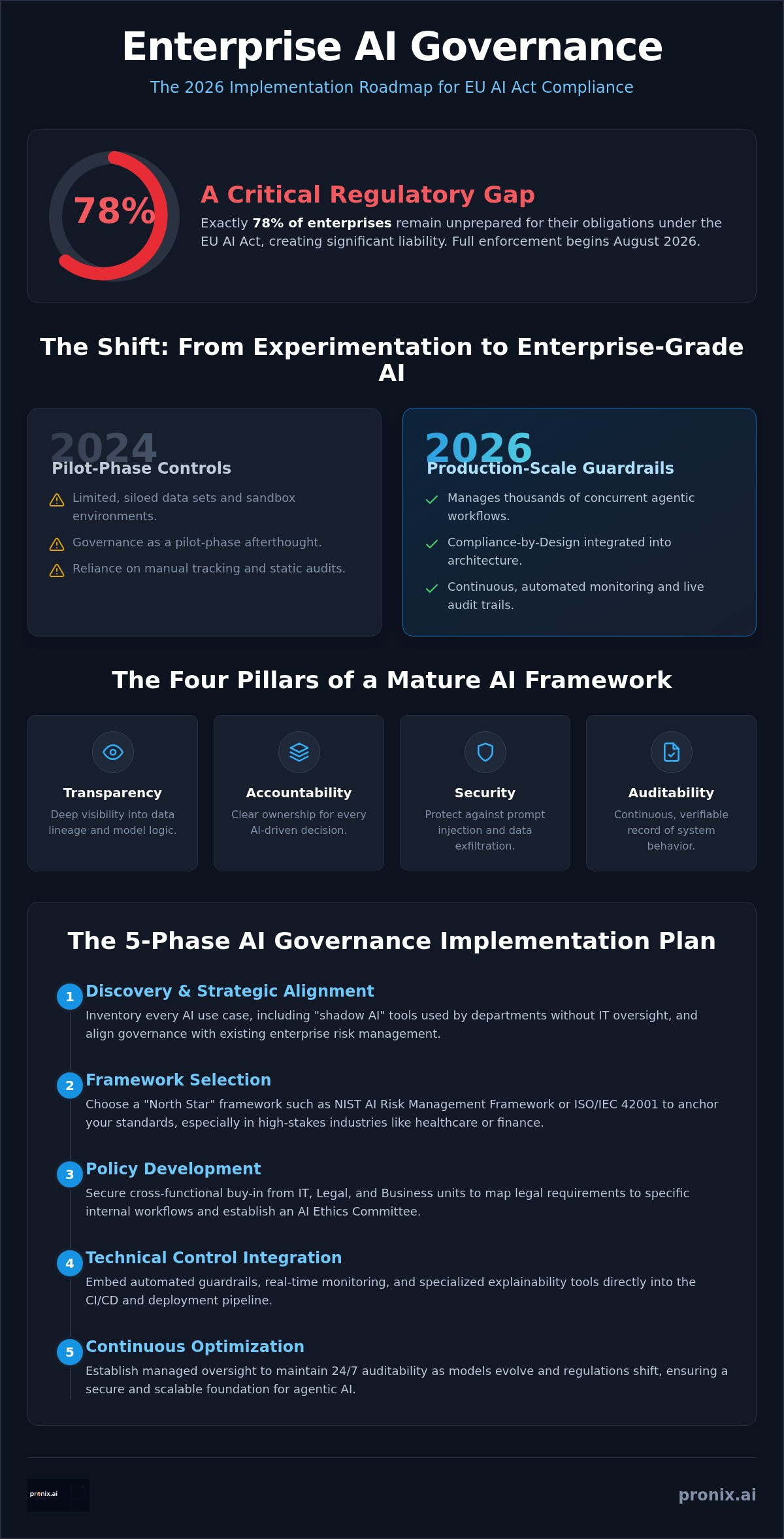
Exactly 78% of enterprises remain unprepared for their obligations under the EU AI Act, despite full enforcement beginning in August 2026. This regulatory gap creates a significant liability for leadership teams trying to scale innovation. To mitigate risk, your organization needs a high-performance AI governance implementation plan that transforms compliance from a bottleneck into a competitive advantage. The era of unregulated experimentation is over; stability and auditability are now the primary drivers of ROI.
You've likely seen high-potential pilots stall because of security concerns or witnessed shadow AI usage creeping into department workflows. It's a common friction point that prevents moving from a sandbox to a global production environment. This guide provides a practical, executive-level roadmap to solve these challenges. We detail a repeatable framework for aligning IT, Legal, and Business units while establishing the technical evidence required for modern audits. You'll learn how to secure the integration layer for agentic AI and build a transparent foundation for long-term scalability.
Key Takeaways
- Contrast the shift from 2024 pilot-phase controls to the rigorous technical guardrails required for 2026 production-scale AI deployments.
- Execute a 5-phase AI governance implementation plan that moves your organization from strategic discovery to full-scale operational maturity.
- Transform compliance into a competitive advantage by establishing clear audit trails tailored for highly regulated healthcare and finance markets.
- Master the transition from governing static models to managing autonomous agents through advanced prompt injection protection and data masking.
- Leverage enterprise managed services to ensure 24/7 auditability and maintain a secure, scalable foundation for agentic AI orchestration.
Defining the Enterprise AI Governance Framework in 2026
AI governance isn't just a policy manual. It's the technical and operational engine that ensures every autonomous action aligns with corporate ethics and legal mandates. In 2024, governance was often a pilot-phase afterthought focused on limited, siloed data sets. By 2026, production-scale requirements demand a comprehensive AI governance implementation plan that manages thousands of concurrent agentic workflows. Executive leadership must view this framework as a performance multiplier rather than a bureaucratic hurdle. It provides the high-performance suspension that allows your enterprise to scale AI at speed without losing control.
A mature framework rests on four non-negotiable pillars. Transparency ensures deep visibility into data lineage and model logic. Accountability establishes clear ownership for every AI-driven decision. Security protects against emerging threats like prompt injection and data exfiltration. Finally, Auditability provides a continuous, verifiable record of system behavior. These pillars transform AI from a "black box" experiment into a stable, enterprise-grade asset.
The 2026 Regulatory Landscape: EU AI Act and Beyond
The global AI regulatory landscape has shifted from voluntary guidelines to binding legal requirements. As of August 2, 2026, the EU AI Act is fully enforceable, imposing heavy penalties for non-compliance. Enterprises now look to international standards like ISO/IEC 42001 to anchor their strategy. This shift mandates rigorous AI impact assessments for any system deemed high-risk, particularly in finance and healthcare. Compliance-by-Design is now the mandatory enterprise standard for every AI deployment. Organizations that fail to integrate these standards into their initial architecture face costly retrofitting or complete project shutdowns.
Why Traditional IT Governance Falls Short for AI
Traditional IT governance relies on deterministic logic where specific inputs yield predictable outputs. AI is fundamentally different because it's probabilistic and non-deterministic. A model's behavior can drift over time, making static annual audits obsolete. You can't just "patch" a model like you patch a legacy software application. The "Black Box" problem requires specialized explainability tools that interpret why an agent took a specific action in real-time. Effective governance in 2026 requires continuous, automated monitoring of model telemetry. If you're still relying on manual spreadsheets to track AI risk, you're already behind the curve. Modern systems demand live dashboards that trigger immediate alerts when a model exceeds its defined guardrails.
The 5-Phase AI Governance Implementation Plan
Execution is where most AI initiatives fail. Without a structured AI governance implementation plan, organizations risk fragmented deployments that increase liability and stall innovation. A phased approach ensures every model or autonomous agent is validated against corporate risk thresholds before reaching production. This lifecycle moves your organization from reactive damage control to proactive, evidence-based management.
- Phase 1: Discovery and Strategic Alignment. Inventory every AI use case, including "shadow AI" tools used by departments without IT oversight.
- Phase 2: Framework Selection. Choose a "North Star" framework such as the NIST AI Risk Management Framework or ISO/IEC 42001 to anchor your standards.
- Phase 3: Policy Development. Secure cross-functional buy-in to map legal requirements to specific internal workflows.
- Phase 4: Technical Control Integration. Embed automated guardrails and real-time monitoring into the deployment pipeline.
- Phase 5: Continuous Optimization. Establish managed oversight to maintain auditability as models evolve and regulations shift.
Phase 1 & 2: Setting the Strategic Foundation
Aligning AI governance with existing enterprise risk management is critical. It shouldn't exist in a vacuum. High-stakes industries like healthcare or finance must select a framework that addresses their specific regulatory burdens. Establishing a cross-functional AI Ethics Committee ensures that IT, Legal, and Business units remain synchronized. This group acts as the final arbiter for high-risk deployments, ensuring that strategic goals don't bypass safety protocols. It's about building a foundation that supports speed through stability.
Phase 3: Data Foundations and Policy Mapping
Governance fails without a robust enterprise data strategy for AI. You can't govern what you can't trace. For RAG-based systems, establishing clear data lineage and quality standards is mandatory to prevent hallucinations and PII leaks. Your AI governance implementation plan must also distinguish between internal productivity tools and external, customer-facing agents. Defining these "Acceptable Use" boundaries early prevents costly compliance breaches later. This is where you translate high-level ethics into concrete data permissions and access controls.
Implementing these phases requires deep technical expertise and strategic foresight. For organizations looking to accelerate this journey, engaging with the Agentic AI Strategy & Consulting team at pronix.ai can streamline the transition from pilot to production while ensuring full regulatory alignment.
Risk Mitigation and Auditability in Regulated Markets
Governance is often mischaracterized as a bottleneck. In reality, it serves as a speed-to-market advantage. In highly regulated sectors, the inability to prove compliance is the primary reason AI initiatives fail to reach production. A robust AI governance implementation plan provides the legal and technical clearance required to deploy at scale. Without it, your enterprise remains paralyzed by potential liability. With it, you possess the "brakes" that allow your organization to drive faster and more confidently than the competition.
Regulated markets demand specific, non-negotiable guardrails. In finance, SEC and FINRA guidelines require absolute transparency in algorithmic decision-making to prevent market manipulation or biased lending. Healthcare organizations must navigate HIPAA requirements while ensuring that AI-driven diagnostics or administrative agents don't leak protected health information (PHI). Distinguishing between model-level risk, such as inherent bias in a base LLM, and application-level risk, such as how an agent interacts with a specific database, is essential for accurate risk adjudication. Automated audit trails mitigate litigation risk by providing a timestamped, immutable record of every AI action.
Implementing Enterprise-Grade AI Auditability
Technical auditability requires more than simple text logs. You need comprehensive telemetry that captures the prompt, the retrieved data context, the model's reasoning steps, and the final output. This metadata is vital for "Hallucination Reporting," where systems automatically flag and categorize instances of factual inaccuracy for human review. Establishing these feedback loops allows for iterative model tuning without taking systems offline. Auditability-as-a-Service is the automated, real-time provision of verifiable technical evidence required for regulatory compliance in 2026 enterprise environments. It transforms the annual audit into a continuous, low-friction process.
Mitigating Bias and Ensuring Fairness
Fairness isn't a static achievement; it's a continuous monitoring requirement. Models can drift over time as they encounter new data, potentially introducing discriminatory patterns that weren't present at launch. Practical mitigation involves real-time bias detection tools that alert administrators when outputs deviate from established fairness benchmarks. For high-stakes decisions like credit approvals or medical triage, Human-in-the-loop (HITL) workflows remain mandatory. These workflows ensure that an accountable professional reviews AI recommendations before they're executed. Using synthetic data for bias testing is another critical strategy. It allows your teams to stress-test agents against diverse scenarios without compromising actual PII or PHI.
Operationalizing Governance: From Policy to Production
Moving from policy to production requires a fundamental shift in technical architecture. Your AI governance implementation plan must transition from governing static models to governing autonomous agents. Model governance focuses on training data and weights. Agent governance focuses on actions, tool-calling, and external integrations. This is the integration layer where risk is most acute in 2026. Effective orchestration ensures that every autonomous step remains within the bounds of corporate safety.
Enforcement happens at the orchestration layer. API gateways act as the primary control point, inspecting every outbound call for PII or unauthorized data access. Technical guardrails like prompt injection protection prevent users from bypassing safety protocols through jailbreaking techniques. Every agent must pass a Production-Ready checklist before deployment. This list verifies that the agent operates within predefined latency, accuracy, and security thresholds. It's the final gate between a successful pilot and a secure production outcome.
Governing Agentic AI and Autonomous Workflows
Specialized Agentic AI implementation services prioritize the definition of Agency Boundaries. You must explicitly define what an agent can decide independently versus what requires human approval. Without these boundaries, multi-agent systems can fall into recursive loops or exhibit emergent behaviors that bypass traditional controls. Monitoring these interactions in real-time is the only way to ensure stability in autonomous workflows. It transforms unpredictable AI behavior into a managed enterprise asset.
CX Modernization: Governed Customer Interactions
Maintaining AI-driven CX modernization standards requires automated compliance checking for every voice and chat interaction. In 2026, governed prompt libraries ensure that customer-facing agents maintain brand voice consistency while adhering to legal disclosures. By integrating these controls directly into the communication stack, you eliminate the variance associated with manual quality assurance. This results in a customer experience that is both innovative and rigorously protected. It's a scalable way to build trust through every digital touchpoint.
To bridge the gap between high-level strategy and technical execution, enterprises should partner with experts in Agentic AI Implementation to build secure, production-ready systems.
Managed Governance: Scaling Responsibly with pronix.ai
Governance isn't a destination. It's a continuous operational state. Most organizations treat an AI governance implementation plan as a one-time compliance checkbox. This mindset leads to technical debt and regulatory exposure as models evolve and autonomous agents take on more complex tasks. Pronix.ai provides a different path. We deliver an end-to-end lifecycle that combines high-level strategic consulting with "boots-on-the-ground" technical execution. This ensures your AI environment remains secure, compliant, and performant every hour of the day.
Our approach bridges the critical talent gap facing modern enterprises. While 76% of organizations now have a Chief AI Officer in 2026, many lack the deep technical staff required to manage complex agentic ecosystems. We provide that expertise. We transform governance from a friction-filled project into a seamless corporate culture. This shift allows your business units to innovate with confidence, knowing the guardrails are already in place and functioning. It's about moving from a state of uncertainty to one of operational maturity.
The Managed Services Advantage for AI Stability
Internal teams often struggle to maintain the technical evidence required for modern audits. Our enterprise AI automation managed services solve this by providing automated, real-time risk monitoring. We act as an independent layer of oversight, which is vital for maintaining transparency in regulated markets like finance and healthcare. This managed model enables you to deploy new AI capabilities across global regions without ballooning your internal head count. We ensure that your data foundations and model telemetry are always audit-ready, even as global regulations shift.
Next Steps: Your 90-Day Governance Roadmap
Securing your environment starts with identifying hidden risks. Only 25% of organizations currently report full visibility into employee AI use, leaving 75% vulnerable to shadow AI threats. Your 90-day roadmap begins with an immediate AI Readiness and Governance Audit to map these gaps. Within the first month, we prioritize "Quick Wins" like securing unauthorized API access and establishing acceptable use policies for existing tools. This provides immediate stability while we build the long-term framework.
By the second month, we integrate automated guardrails into your existing DevOps pipelines. By day 90, your organization moves from experimentation to a fully governed production environment. This methodical progression builds trust with stakeholders and regulators alike. Stop reactive firefighting and start proactive scaling. Partner with pronix.ai to secure your AI future and build a foundation that lasts.
Accelerating Production Readiness for 2026
The shift from experimental AI to production-scale operations is no longer optional. With the full enforcement of the EU AI Act in 2026, the cost of inaction has become a global liability. A comprehensive AI governance implementation plan serves as the essential architecture for this transition. It moves your organization beyond static policy documents into a state of continuous, automated auditability. By defining clear agency boundaries and securing the integration layer, you ensure that innovation never outpaces your ability to manage risk.
Pronix.ai brings decades of excellence in CX modernization and enterprise automation to the table. Our team specializes in the complex regulatory requirements of healthcare and finance, providing the technical evidence needed for absolute transparency. We offer end-to-end managed services that guide your journey from the initial pilot to a globally scaled, secure production environment. Your path to a governed, scalable future starts with a partner who prioritizes stability as much as speed. Secure your AI production outcomes with a managed governance strategy from pronix.ai. The future of your enterprise depends on the foundations you build today.
Frequently Asked Questions
What are the core components of an enterprise AI governance framework?
An effective framework consists of three primary pillars: policy, technical guardrails, and continuous auditability. It requires a cross-functional committee representing IT, Legal, and Business units to oversee risk adjudication. Key technical components include data lineage tracking, model telemetry, and explainability tools. These elements ensure that every AI decision is traceable, secure, and aligned with corporate ethics while maintaining the stability required for production-scale operations.
How does the EU AI Act affect US-based enterprises in 2026?
US-based enterprises are subject to the EU AI Act if they deploy or provide AI systems within the European Union market. As of August 2, 2026, the Act is fully enforceable, carrying penalties of up to €35 million or 7% of global annual turnover. Many multinational firms now adopt these standards as a global baseline to ensure operational consistency and avoid fragmented compliance workflows across different jurisdictions.
Can we implement AI governance without slowing down our AI pilots?
Yes, you can maintain velocity by integrating a modular AI governance implementation plan that applies controls based on the specific risk profile of each project. Sandbox environments allow for rapid experimentation with minimal oversight. As a pilot moves toward production, the framework triggers more rigorous technical guardrails. This tiered approach prevents governance from becoming a bottleneck while ensuring that every deployment is secure and audit-ready.
What is the difference between AI governance and AI ethics?
AI ethics defines the moral principles, such as fairness and transparency, that guide how a company intends to use technology. AI governance is the operational engine that enforces those principles through specific policies and technical controls. While ethics provides the "why," governance provides the "how." It transforms abstract values into verifiable workflows, ensuring that ethical standards are consistently met through automated monitoring and rigorous documentation.
How do we govern autonomous AI agents differently than standard LLMs?
Governing autonomous agents requires a focus on "Agency Boundaries" and the orchestration layer rather than just the model's output. Unlike standard LLMs, agents can initiate actions, call APIs, and access external databases independently. Governance must control which tools an agent can use and define when human approval is mandatory. This necessitates real-time monitoring of agentic loops to prevent emergent behaviors that could lead to unauthorized data access or transactions.
What are the most common risks of failing to implement an AI governance plan?
The primary risks include shadow AI usage, regulatory non-compliance, and data exfiltration. Without a structured AI governance implementation plan, organizations often lack visibility into how employees use unapproved tools. This creates significant security vulnerabilities and litigation risks, especially in regulated markets. Only 25% of organizations currently report comprehensive visibility into employee AI use, leaving the majority exposed to potential reputational damage and heavy financial penalties from biased or inaccurate outputs.
How do managed services help with AI compliance in regulated industries?
Managed services provide the specialized expertise and 24/7 technical oversight required to maintain auditability in healthcare and finance. They handle the complex task of generating technical evidence for regulators, such as model cards and data lineage reports. By partnering with a managed service provider, enterprises can scale their AI initiatives globally without ballooning their internal head count. These services ensure that your AI foundations remain compliant as global regulations evolve.
Which AI governance framework is best: NIST, ISO, or a custom build?
The optimal choice depends on your industry and geographic footprint. The NIST AI Risk Management Framework is a preferred choice for US enterprises seeking a flexible, risk-based approach. ISO/IEC 42001 provides a globally recognized standard for management systems, making it ideal for multinational organizations. Most mature enterprises use these established frameworks as a "North Star" to build a custom solution that aligns with their unique technical architecture and business goals.