

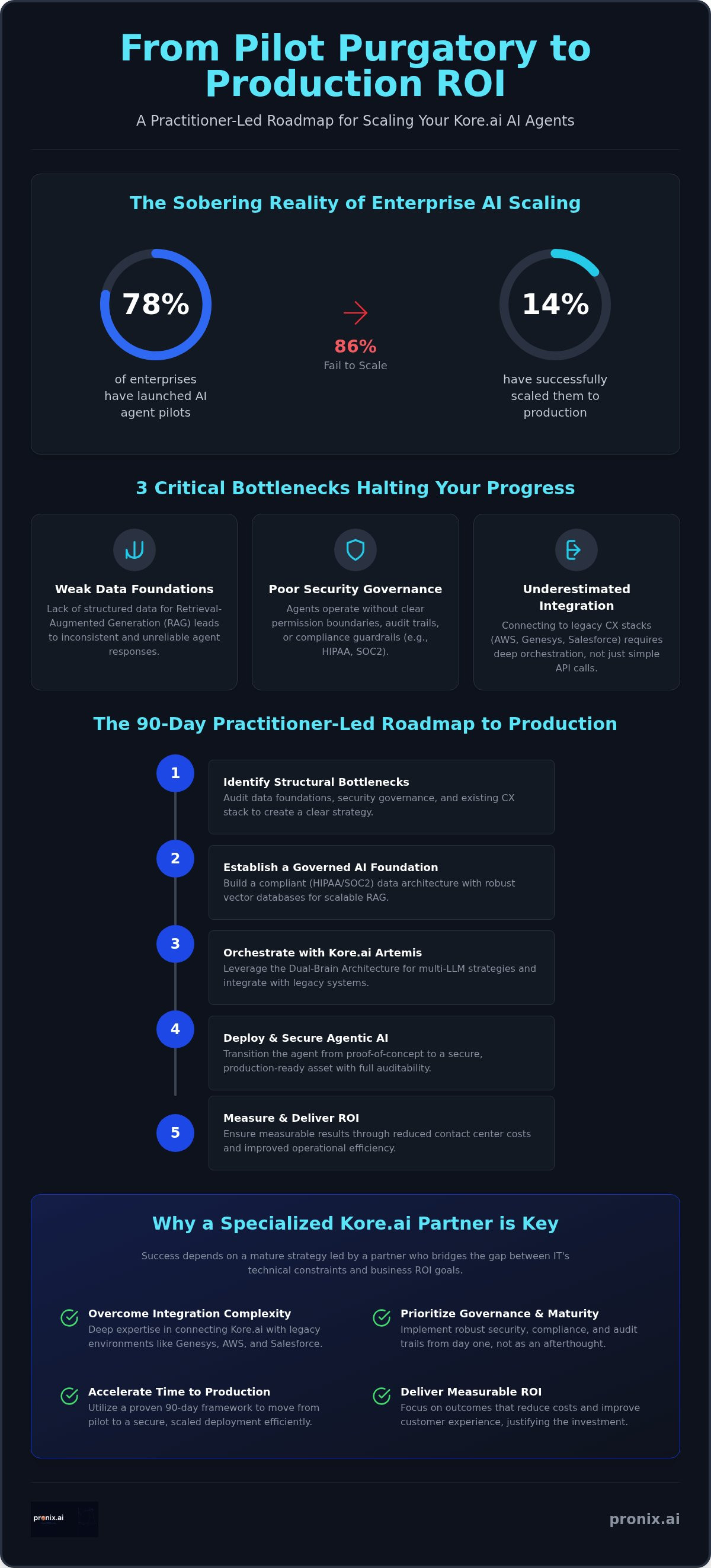
Recent data confirms a sobering reality for digital leaders: while 78% of enterprises have launched AI agent pilots, only 14% have successfully scaled them to production as of September 2026. Most organizations find themselves trapped in pilot purgatory, where agentic AI works in a controlled sandbox but fails when faced with the complexity of a legacy CX stack. You've likely seen the potential of the Kore.ai Artemis platform, but bridging the gap between a proof-of-concept and enterprise-wide ROI requires more than just software. It demands a specialized Kore.ai implementation partner who prioritizes governance and operational maturity over experimental hype.
We understand the frustration of being stuck at 1% of total interaction volume while internal talent gaps stall your progress. This guide provides a practitioner-led roadmap to break that ceiling. You'll learn how to execute a 90-day production deployment that integrates seamlessly with existing AWS or Genesys environments. We'll preview the essential steps for building a secure, governed AI architecture that reduces contact center costs without compromising stability. It's time to move beyond the experimental phase and deliver the measurable results your stakeholders expect.
Key Takeaways
- Identify the specific structural bottlenecks, including data foundations and security governance, that prevent 86% of AI pilots from reaching production-grade scale.
- Leverage the Kore.ai Artemis architecture to orchestrate autonomous workflows and multi-LLM strategies across your existing enterprise CX stack.
- Learn why selecting a specialized Kore.ai implementation partner is the key to overcoming integration complexity within legacy environments.
- Follow a 90-day practitioner-led roadmap to transition your agentic AI from a proof-of-concept to a secure, production-ready asset.
- Establish a governed AI foundation that ensures measurable ROI through reduced contact center costs and improved operational auditability.
The Pilot Purgatory Challenge: Why Kore.ai Rollouts Stall
Many enterprises celebrate a successful proof-of-concept only to hit a wall during full-scale deployment. This is the pilot purgatory challenge. It represents the massive gap between a controlled, small-scale demo and the high-stakes reality of a production-grade rollout. Scaling Kore.ai requires moving past the "sandbox" phase toward a governed, enterprise-wide architecture that can handle millions of interactions without degradation. Stalling occurs when organizations treat AI as a plug-and-play tool rather than a core infrastructure component.
Scaling typically stalls due to three primary bottlenecks. First, data foundations often lack the structure needed for effective Retrieval-Augmented Generation (RAG). Second, security governance remains an afterthought, leaving agents without clear permission boundaries or compliance guardrails. Third, integration depth is frequently underestimated. Connecting an AI agent to a legacy CX stack involves more than simple API calls; it requires deep orchestration across multiple systems. A license-first approach fails because it ignores these organizational friction points. Success depends on a mature strategy led by a specialized Kore.ai implementation partner who can bridge the gap between IT's technical constraints and the business unit's ROI goals.
The Reality of Scaling Agentic AI
Transitioning from simple intent-matching to complex autonomous agent orchestration is a significant leap in maturity. In a pilot, a bot that fails is a minor annoyance. In production, an unmanaged AI agent can hallucinate or leak sensitive data, causing irreversible damage to your brand reputation. Most enterprises don't have the internal talent to manage these complexities or optimize the Kore.ai Artemis engine for high-volume traffic. You need practitioners who treat AI agents as governed digital employees, not just scripts.
Identifying Scaling Red Flags Early
You can spot a failing rollout by monitoring specific operational red flags. A lack of a clear data strategy for RAG is the most common indicator of future failure. Without structured data, your agent's responses will be inconsistent and unreliable. Inadequate audit trails are another warning sign, especially for those in regulated industries like finance or healthcare. Finally, persistent friction between legacy contact center workflows and modern AI agents indicates that your implementation hasn't accounted for the human-in-the-loop reality of modern customer experience.
Orchestrating the Kore.ai Artemis Environment for Production
The Artemis edition, released in mid-2026, transforms Kore.ai from a conversational tool into a sophisticated orchestration layer. Its Dual-Brain Architecture enables multi-LLM orchestration, allowing enterprises to route tasks to the most efficient model based on complexity and cost. Moving beyond simple intent matching requires an enterprise-wide strategy that prioritizes stability. This architectural shift is where a seasoned Kore.ai implementation partner provides the most value, ensuring that autonomous agents follow strict operational guardrails. We focus on deploying the Agent Blueprint Language (ABL) to define precise agent behaviors that remain consistent across every interaction.
Data Engineering for Kore.ai Success
Clean, structured data is the prerequisite for high-fidelity agent responses. Scalable Retrieval-Augmented Generation (RAG) workflows depend on robust vector databases that can surface relevant information in milliseconds. We focus on building data foundations that prioritize privacy and auditability. This includes ensuring full HIPAA and SOC2 compliance within the AI stack. Every interaction must be auditable, providing a transparent record of how the AI reached a specific conclusion. Choosing the right Kore.ai implementation partner ensures your data architecture supports these high-stakes production requirements while preventing hallucinations through verified enterprise knowledge.
Integrating Agentic AI with Legacy CX
Production agents must thrive within your existing ecosystem. This means deep integration with Salesforce, Genesys Cloud, or Amazon Connect. The goal is a unified customer journey where context is never lost. If a Kore.ai agent determines a human operator is needed, the hand-off must be instantaneous and include the full conversation transcript and intent analysis. We utilize specialized application accelerators to bypass common integration hurdles. These pre-built frameworks reduce time-to-market while allowing for the deep customization required by large organizations. Orchestrating these workflows across platforms like Salesforce Agentforce requires a practitioner who understands the friction of legacy systems. If you're looking to bridge these technical gaps, pronix.ai provides the boots-on-the-ground expertise needed for a successful rollout.
Selecting Your Kore.ai Implementation Partner: A Selection Framework
Selecting a Kore.ai implementation partner is a high-stakes decision that determines whether your AI agents become productive assets or operational liabilities. While many firms claim expertise in conversational AI, few possess the technical depth to navigate the biggest AI adoption challenges, such as data readiness and complex workflow orchestration. You need a partner who views AI agents as governed enterprise employees, not just experimental scripts. This requires evaluating a firm's "production readiness"—their proven track record of moving beyond the 1% pilot phase into secure, global production environments.
GSI vs. Specialist Partners: The Trade-offs
Global Systems Integrators (GSIs) offer massive scale and broad strategic reach, which is often necessary for multi-national conglomerates. However, these large firms frequently lack the "boots-on-the-ground" pragmatism required for specific platform optimization. Specialist AI implementation firms operate with greater agility and deeper technical focus. They employ seasoned practitioners who have navigated the friction points of modernizing legacy systems directly. Choosing a specialist means you're working with experts who prioritize stability and risk mitigation over high-level, speculative vision. They bridge the gap between IT constraints and business goals through evidence-based success.
Key Questions for Your Potential Partner
A capable partner should provide transparent, direct answers to technical hurdles. Use these questions to assess their readiness for a production-grade rollout:
- How do you handle agent orchestration across multiple LLMs? Look for a partner who understands the Artemis Dual-Brain Architecture and can optimize for both cost and performance.
- What is your framework for AI auditability in regulated environments? In industries like finance or healthcare, every AI decision must be traceable and compliant with SOC2 or HIPAA standards.
- Can you demonstrate a 90-day path to production for a complex workflow? Avoid partners who offer open-ended timelines. A disciplined Kore.ai implementation partner uses a structured blueprint to deliver measurable ROI quickly.
Industry-specific expertise is non-negotiable. A partner who understands the nuances of healthcare data privacy or manufacturing supply chain logic will anticipate bottlenecks before they stall your rollout. They don't just install software; they implement a governed architecture that scales alongside your business needs.
The 5-Step Roadmap to Scaling Your Kore.ai Pilot
Moving from a controlled demo to an enterprise-wide rollout requires a disciplined, phase-gate approach. This 5-step roadmap ensures that your agentic AI transition is stable, secure, and ready for high-volume production. Scaling isn't a linear software installation; it's a strategic migration of your customer experience infrastructure. Success depends on partnering with a Kore.ai implementation partner who understands that scaling is an orchestration challenge, not just a configuration task. We focus on moving beyond experimental scripts toward a governed architecture that delivers measurable ROI.
Step 1 & 2: Building the Foundation
The first priority is validating your data quality for production-grade Retrieval-Augmented Generation (RAG). If your source data is fragmented or outdated, your agents will hallucinate, regardless of the underlying LLM. You must audit and structure your enterprise knowledge base to ensure high-fidelity responses. Simultaneously, you need to define a strict governance and security framework. This involves:
- Establishing guardrails to prevent unauthorized data access and ensure HIPAA or SOC2 compliance.
- Creating an auditable trail for every AI-driven decision to satisfy regulatory requirements.
- Securing executive buy-in for the full-scale production budget by demonstrating these safety protocols early.
Leadership needs confidence that the AI won't become a liability. By prioritizing governance in the first 30 days, you remove the primary friction points that stall most enterprise rollouts.
Step 3, 4 & 5: Executing the Rollout
Once the foundation is secure, the focus shifts to engineering the production integration. This involves building a robust technical bridge between Kore.ai and your enterprise CRM, such as Salesforce or Genesys Cloud. It's not just about passing data; it's about maintaining shared context across the entire customer journey. Before going live, your agents must undergo rigorous load testing. Stress-testing against high-volume customer queries ensures the system won't buckle during peak traffic periods. We simulate diverse scenarios to identify latency bottlenecks and integration friction before they impact your brand reputation.
The final step is the transition to enterprise AI managed services. Scaling doesn't end at deployment; it requires continuous monitoring and performance optimization to handle evolving user intents. A dedicated Kore.ai implementation partner manages these complexities, allowing your internal teams to focus on strategy rather than troubleshooting. This lifecycle approach ensures that your agentic AI remains an asset that grows with your business. If you're ready to break out of pilot purgatory, explore our 90-day blueprint for production-ready outcomes to accelerate your deployment timeline.
Why pronix.ai is the Preferred Partner for Production-Ready Kore.ai Outcomes
Pronix Inc., founded in 2010, has spent over a decade navigating the complexities of large-scale digital transformation. As a specialized Kore.ai implementation partner, we focus exclusively on delivering production-ready outcomes rather than speculative demos. We understand that enterprise AI is an orchestration challenge. It requires deep technical knowledge of both the Kore.ai Artemis platform and the legacy CX stacks it must inhabit. Our team functions as a practitioner-led alternative to large, generalist GSIs. We prioritize speed where possible but always place stability, risk mitigation, and operational maturity first.
Our 90-day blueprint is designed to break the cycle of pilot purgatory. We move through strategy, data foundation audits, and production integration with disciplined precision. This approach ensures your agentic AI is secure, scalable, and fully auditable from day one. We specialize in high-stakes sectors like healthcare, finance, and manufacturing, where data privacy and compliance aren't optional. Whether you're integrating with Amazon Connect or leveraging Salesforce Agentforce, we build the technical bridge that maintains customer context across every touchpoint.
The Pronix.ai Difference: Practitioner-Led Implementation
We move beyond theory by solving real-world integration friction. Our practitioners don't just configure software; they engineer governed AI foundations. We leverage our deep partnerships with AWS, Microsoft, and Salesforce to create a unified CX environment. This ensures your Kore.ai agents have the data they need to provide high-fidelity responses without hallucinations. We focus on the boots-on-the-ground pragmatism required to modernize legacy systems. Every implementation includes a clear path to long-term auditability and performance optimization.
Unlike many integrators, we provide end-to-end Enterprise AI Managed Services. We don't exit the project once the agent goes live. We stay to manage AI governance and ensure the system evolves with your business. This long-term commitment allows your internal talent to focus on high-level strategy while we handle the technical complexities of agentic AI operations. It's a partnership built on transparency, evidence, and a relentless focus on ROI.
Your Next Steps Toward Production
Transitioning from a successful pilot to a global rollout requires a partner who understands the high stakes of enterprise transformation. We're ready to help you secure your AI future through a structured, evidence-based engagement model.
- Schedule an AI maturity assessment with our technical leadership to identify specific scaling bottlenecks.
- Review our case studies on CX modernization to see how we've scaled agentic AI for similar organizations.
- Request a custom Kore.ai scaling roadmap tailored to your specific data architecture and business goals.
Mastering the Transition to Scalable Agentic AI
Moving beyond pilot purgatory is a strategic necessity for enterprises aiming to capture the full value of agentic AI. Success requires more than just a functional demo. It demands a rigorous focus on data foundations, security governance, and seamless integration with your existing CX stack. By following a practitioner-led roadmap, you can transform experimental agents into secure, auditable, and production-grade assets that drive measurable ROI.
Pronix Inc., established in 2010, brings specialized expertise across the AWS, Salesforce, and Kore.ai ecosystems to solve these complex orchestration challenges. As your Kore.ai implementation partner, we prioritize operational maturity and risk mitigation to ensure your AI rollout remains stable under high-volume pressure. We bridge the technical gap between legacy systems and modern autonomous agents through a disciplined, 90-day blueprint for success.
Don't let your transformation stall at the pilot stage. Take the next step toward a fully governed AI architecture today. Schedule your Kore.ai production readiness assessment with pronix.ai to accelerate your path to enterprise-wide production. Your journey to scalable, intelligent automation begins with a proven strategy.
Frequently Asked Questions
What should I look for in a Kore.ai implementation partner?
Look for technical depth and a proven track record of moving beyond simple demos. A qualified Kore.ai implementation partner should demonstrate expertise in the Artemis platform and its Dual-Brain Architecture. They must prioritize security governance and integration depth over simple bot configuration. Ensure the partner has specific experience in your industry, such as healthcare or finance, to navigate regulatory requirements and complex legacy workflows effectively.
How long does it take to move a Kore.ai pilot to production?
Our practitioner-led approach utilizes a 90-day blueprint to move from proof-of-concept to production outcomes. While simple bots can be configured quickly, enterprise-grade agentic AI requires time for data foundation audits and rigorous load testing. This timeline accounts for building secure technical bridges to your CRM and establishing governance guardrails. Most organizations can achieve measurable ROI within three months by following a structured, phase-gate implementation strategy.
Can a Kore.ai partner help with HIPAA or SOC2 compliance?
Yes, a specialized partner is critical for ensuring HIPAA or SOC2 compliance within your AI stack. We focus on building secure, auditable AI agents that maintain strict data privacy boundaries. This includes implementing vector databases that support scalable RAG workflows while protecting sensitive information. Every interaction must be traceable to satisfy regulatory requirements in high-stakes industries. Proper governance ensures your AI remains an asset rather than a liability.
Does Kore.ai integrate with Amazon Connect or Genesys Cloud?
Kore.ai integrates deeply with major CX ecosystems, including Amazon Connect and Genesys Cloud. We specialize in orchestrating these workflows to ensure a unified customer journey across multiple touchpoints. This involves building technical bridges that maintain shared context between AI agents and human operators. Whether you're using AWS or Salesforce Agentforce, we ensure your agentic AI functions as a seamless extension of your existing communication infrastructure.
What is the difference between a GSI and a specialist AI partner?
Global Systems Integrators provide massive scale and broad strategy, but often lack the practitioner-led agility of a specialist firm. Specialist partners focus on technical depth and platform-specific optimization, moving faster to solve real-world integration challenges. We provide boots-on-the-ground pragmatism that avoids the high-level speculative language typical of larger firms. Specialists prioritize stability and evidence-based success, ensuring your implementation is production-ready rather than just a theoretical framework.
How much does a Kore.ai implementation project typically cost?
Implementation costs vary significantly based on the complexity of your workflows and the scale of your data architecture. Factors such as the number of integrated systems, the depth of RAG requirements, and the level of managed services required will influence the total investment. Instead of looking for fixed pricing, enterprises should evaluate the potential for measurable ROI through reduced contact center costs and increased operational efficiency. We recommend a technical assessment to define a custom roadmap.
Why do AI pilot programs often fail to scale in large enterprises?
Most AI pilots fail to scale because they don't account for the organizational friction of moving from a sandbox to production. Common bottlenecks include poor data foundations, a lack of internal talent, and inadequate security governance. Organizations often treat AI as a standalone tool rather than a core infrastructure component. Success requires a Kore.ai implementation partner who can bridge the gap between IT constraints and business goals through a disciplined architecture.
What are the benefits of managed services for AI agents?
Managed services provide the specialized talent needed to maintain AI governance and performance optimization over the long term. AI agents are not static; they require continuous monitoring to handle evolving user intents and maintain high-fidelity responses. These services ensure your architecture remains secure, scalable, and auditable as your business grows. By offloading technical management to experts, your internal teams can focus on high-level strategy and driving enterprise-wide innovation.