

What makes the right Agentic AI consulting firm? It isn’t just a bold strategy. It’s a clear, governed path from an idea to production. For enterprise leaders, that distinction matters. Agentic AI systems can plan and execute multi-step tasks with limited human intervention, but a promising pilot can still stall if it doesn’t fit existing systems, workflows, or controls.
Look beyond strategic advice. A partner should connect use-case selection to implementation, integration, governance, and ongoing operations, with clear accountability at each stage. Without that path, it’s difficult to assess security and auditability or determine whether the work is delivering measurable business value.
This guide offers a practical framework for evaluating an agentic AI partner. You’ll learn what to ask about enterprise architecture, human oversight, risk management, production readiness, and success measures. It also explains how to distinguish firms that advise from those that implement and manage solutions over time. pronix.ai brings strategy, implementation, and managed services together across enterprise AI, working with platforms including AWS, Microsoft, Salesforce, Kore.ai, and Genesys. The goal is to move business priorities into production without losing control or accountability.
Key Takeaways
- Assess whether an Agentic AI consulting firm can move beyond recommendations and define accountable deliverables from initial assessment through ongoing operations.
- Distinguish AI agents from fixed automation by examining how they make bounded decisions and use tools to complete tasks.
- Compare partners based on evidence of strategic fit, technical delivery, integration, governance, measurement, and operational support.
- Define scope, ownership, acceptance criteria, and review points before work begins so progress and risk are easier to evaluate.
- Use a sequence of decisions, tests, approvals, and operational checks to establish control before expanding an agentic AI system.
What an Agentic AI Consulting Firm Does for an Enterprise
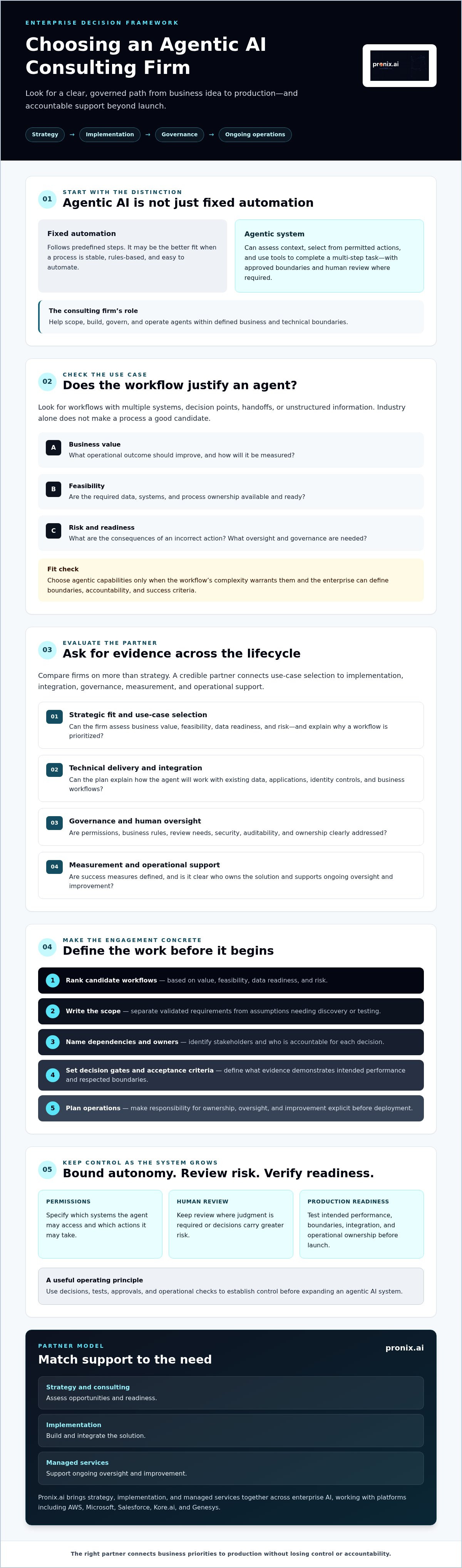
An Agentic AI consulting firm helps an enterprise scope, build, govern, and operate AI agents within defined business and technical boundaries.
Unlike fixed automation, which follows predefined steps, an agentic system can assess context, select from permitted actions, and use tools to complete a multi-step task. A useful starting point is the foundational concept of an intelligent agent, a system that perceives its environment and acts toward goals. In an enterprise, those actions must remain within approved permissions and business rules, with human review where required.
How enterprise agentic AI consulting differs from general AI advice
Strategy advice can identify opportunities. Enterprise consulting must also explain how a selected workflow will operate in practice: who uses it, what data it can access, which systems it can interact with, how its output will be evaluated, and who owns it after launch. That requires workflow design, architecture decisions, technical integration, testing, and operational planning.
The engagement should match the organization’s needs. Strategy and consulting can help assess opportunities and readiness. Implementation is needed to build and integrate a solution. Managed services can support ongoing oversight and improvement. Some enterprises need only one of these; others need a coordinated partner across the lifecycle. Limit autonomy to actions the agent is authorized to take, with human review for decisions that require judgment or carry greater risk.
Which enterprise problems justify a consulting engagement?
Look at workflows with multiple systems, decision points, handoffs, or unstructured information. These can arise in healthcare, finance, and manufacturing, but the industry alone doesn’t make a process a good candidate. The key question is whether an agent can address a meaningful operational need without adding unacceptable risk or complexity.
- Business value: Identify the operational outcome the workflow should improve and how you’ll measure it.
- Feasibility: Check whether the required data, systems, and process ownership are available and ready.
- Risk and readiness: Assess the consequences of an incorrect action, the human oversight needed, and the organization’s ability to govern the system.
If a process is stable, rules-based, and easy to automate, fixed automation may be the better fit. A consulting engagement is most useful when the workflow’s complexity warrants agentic capabilities and the enterprise can define clear boundaries, accountability, and success criteria before implementation.
What an Agentic AI Consulting Engagement Should Deliver
A credible engagement turns an opportunity into a controlled delivery plan, then tests whether the system is ready for production and ongoing operation. The work should connect business objectives to architecture, implementation, evaluation, and operational ownership. For a leadership overview of the technology and its implementation considerations, see Agentic AI, explained from MIT Sloan.
From use-case discovery to an implementation roadmap
Start with a ranked set of candidate workflows, not a technology demonstration. Ask the Agentic AI consulting firm to assess each opportunity against business value, feasibility, data readiness, and risk. The roadmap should explain why each use case is prioritized and what must be true before it advances.
Request a written scope that separates validated requirements from assumptions that still need discovery or testing. It should name dependencies, stakeholders, decision gates, measurable objectives, and the person accountable for each decision. Define acceptance criteria before development, including what evidence will show that the solution performs as intended and respects its boundaries.
From technical integration to ongoing operations
Architecture and implementation plans should explain how the agent will work with existing data, applications, identity controls, and business workflows. Ask which systems it may access, what actions it may take, and how access will be limited to approved tasks. Integration should fit enterprise controls and process ownership, not create an isolated pilot that teams cannot sustain.
Make operational responsibilities explicit before deployment. The delivery plan should identify who owns testing, release approval, monitoring, incident response, and change management. It should also define how performance and business outcomes will be reviewed, what triggers an investigation, and how updates are assessed before affecting live workflows.
Managed services may suit organizations that need continuing support for oversight and improvement after implementation. Clarify the boundaries: which activities the partner will manage, which remain with the enterprise, how issues are escalated, and how changes are approved. These details help prevent an unclear handoff when a project moves into operations.
- Discovery: Prioritized use cases, documented assumptions, and readiness findings.
- Design: Architecture, integration requirements, access boundaries, and ownership.
- Delivery: Test evidence, deployment criteria, and agreed acceptance measures.
- Operations: Monitoring responsibilities, incident processes, and improvement reviews.
For more implementation considerations, review this enterprise agentic AI production guide. Enterprises evaluating connected strategy, implementation, and managed support can also explore pronix.ai’s enterprise AI services.
How to Compare Agentic AI Consulting Firms: An Enterprise Scorecard
Compare firms against the systems, controls, and operating model your enterprise actually needs. An impressive partner list or broad promise of “production-ready AI” is not proof of delivery. Ask for evidence, then score each firm against your requirements.
Use a simple scale: 1 means the firm offers little relevant evidence; 3 means it meets requirements with some gaps; 5 means it provides clear, relevant evidence and an accountable approach. Treat scores as a discussion tool, not a substitute for due diligence.
| Criterion | What to examine | Evidence-based question |
|---|---|---|
| Strategic fit | Alignment with priorities and workflows | How do you rank use cases by value, feasibility, readiness, and risk? |
| Technical delivery | Architecture, evaluation, and deployment capability | Can you show a relevant architecture and explain how the solution was tested? |
| Governance | Permissions, oversight, auditability, and risk controls | How are actions bounded, reviewed, and recorded? |
| Integration | Fit with existing data, applications, and workflows | How will your approach work with our architecture and identity controls? |
| Measurement | Quality, reliability, and business impact | Which measures define success, and how are failures detected and handled? |
| Operational support | Ownership after launch and continuous improvement | Who monitors the system, manages changes, and receives escalations? |
What evidence proves a firm can deliver beyond a pilot?
Request references for relevant production work, then clarify the firm’s specific role. Did it lead strategy, implement the system, support operations, or contribute a narrower component? Ask to review sample architecture, evaluation methods, governance artifacts, and transition plans. A strong answer explains how quality and reliability are assessed, how business impact is tracked, and what happens when the system produces an unsafe or incorrect result.
How to assess platform fit and team accountability
Check experience with platforms already used across your enterprise, but don’t assume a familiar technology stack guarantees fit. Ask who will work with business owners, architects, data teams, security, and operations. Compare how each firm documents decisions, escalates issues, transfers knowledge, and manages dependencies. A high score should reflect alignment with your actual requirements, not the breadth of a technology list.
Score each firm independently, note the evidence behind every rating, and investigate gaps before selecting a partner. To discuss enterprise AI priorities with pronix.ai, connect with the team.
How to Reduce Risk Before and During an Agentic AI Engagement
Agentic AI doesn’t require unbounded autonomy. It requires measurable controls that define what a system can access, decide, and do, and when a person must intervene. An Agentic AI consulting firm should help establish those controls before implementation, then test and review them throughout delivery.
Reduce risk through a sequence of decisions and checks, rather than relying on a final approval at launch:
- Set boundaries: Define the agent’s purpose, permitted data, tools, actions, and limits. Give it only the access needed for its assigned tasks.
- Define escalation: Specify which conditions require human review, such as uncertainty, an exception, or an action outside approved rules. Identify who receives the escalation and who can stop the workflow.
- Test behavior: Evaluate expected tasks and failure scenarios before production. Check whether the agent follows permissions, handles exceptions, and stays within its defined scope.
- Review evidence: Record relevant inputs, outputs, actions, decisions, and exceptions so authorized teams can investigate behavior and assess performance.
- Monitor and control change: Establish ongoing checks, incident procedures, and approval steps for changes to tools, data access, prompts, or workflows.
Which governance and safety controls should buyers evaluate?
Ask how permissions are assigned, how tool access is restricted, and what thresholds trigger escalation or human approval. Confirm which events are logged, who can review them, and how exceptions are handled. Logging should support investigation without unnecessarily expanding access to sensitive information. Regulatory obligations depend on the organization, jurisdiction, and use case, so verify applicable requirements with qualified internal or external advisers.
A governance approach should make accountability clear: who owns the business rules, who approves access, and who decides whether an issue requires suspension or reassessment. For additional guidance, review the enterprise AI governance framework.
How to set production gates and measure results
Before launch, agree on acceptance criteria for quality, reliability, security, and business performance. Set a baseline and name the measures, owners, and reporting cadence. Define what counts as a failure, who handles incidents, and how the system can be rolled back or paused if it behaves outside expectations.
Production approval should depend on evidence against those criteria, not on a successful demonstration alone. After launch, schedule reviews to assess results, examine exceptions, and reassess controls when the workflow or system changes. To discuss governed agentic AI strategy, implementation, or managed services, contact Pronix.ai.
When Pronix.ai Is the Right Agentic AI Consulting Firm
Pronix.ai may suit enterprises seeking connected support across agentic AI strategy, implementation, governance, and managed services, rather than advice that stops at recommendations. Its focus is helping organizations move toward secure, scalable, auditable production outcomes while keeping business value and operational oversight in view.
The company works with AWS, Microsoft, Salesforce, Kore.ai, and Genesys platforms. These are platforms it works with, not a one-size-fits-all technology prescription. The right choice depends on your current architecture, workflow requirements, data readiness, and governance needs.
A partner for strategy, implementation, and managed services
Pronix.ai’s services span enterprise AI consulting and implementation, with managed services available for organizations seeking ongoing support. That combination can help when a pilot needs a practical path into existing systems and workflows, followed by continued oversight. Pronix.ai provides services, not direct software licensing, so assess the fit based on delivery capabilities and your environment’s requirements.
Its enterprise focus is relevant to organizations in healthcare, finance, and manufacturing, where integration, security, auditability, and governance can shape AI adoption. This is not a claim of specific results in those industries. It’s a reason to discuss your operating context and verify how a proposed approach would address it. For help assessing ongoing operations, review the enterprise AI managed-service provider selection framework.
Prepare for a focused first conversation
Bring one priority workflow, a high-level view of the systems and data involved, and the business measures you want to improve. Identify where decisions, handoffs, or exceptions occur. You don’t need a complete solution design before starting, but be ready to explain the problem and its constraints.
Include stakeholders from business operations, IT, data, security, and compliance as appropriate. Their perspectives can clarify process ownership, architecture fit, access boundaries, and review requirements. A discovery conversation can help determine what needs further assessment; it shouldn’t be treated as a promise of a particular timeline, scope, or outcome.
If your organization is assessing an enterprise agentic AI initiative, talk with Pronix.ai about enterprise agentic AI.
Move Your Enterprise AI Priorities Toward Production
Choosing an Agentic AI consulting firm takes more than a compelling strategy. Look for a partner that connects use-case selection to implementation and ongoing operations, defines clear ownership and acceptance criteria, and treats governance as part of delivery from the start.
Use the scorecard to test each firm against your architecture, workflows, and risk requirements. Ask for evidence of production capability, clear measures of business value, and practical controls for access, review, monitoring, and change. These are the foundations for moving forward with confidence, not simply advancing a pilot.
Pronix.ai supports enterprise AI strategy, implementation, and managed services, with experience across AWS, Microsoft, Salesforce, Kore.ai, and Genesys. Its focus is on secure, scalable, auditable production outcomes. If that connected approach fits your priorities, discuss your enterprise agentic AI priorities with Pronix.ai.
Start with one meaningful workflow and a clear view of the outcome you need. With the right partner and an accountable plan, your organization can take its next step toward responsible, measurable AI in production.
Frequently Asked Questions
What does an agentic AI consulting firm do?
An Agentic AI consulting firm helps an organization determine where AI agents may be useful and what it takes to deploy them responsibly. Its work can span use-case assessment, workflow and architecture design, system integration, governance, evaluation, and ongoing management. Before engaging a firm, clarify which tasks its team will perform, what deliverables you’ll receive, how progress will be assessed, and which responsibilities your internal teams retain.
How do I choose an agentic AI consulting firm?
Choose an Agentic AI consulting firm by checking how its capabilities match your architecture, operating requirements, and risk profile. Ask for references relevant to your environment and clarify the firm’s role in each engagement. Request sample deliverables, evaluation methods, and clear ownership and escalation plans. A structured scorecard can help compare evidence across firms and distinguish demonstrated delivery practices from broad marketing claims or technology partner lists.
Can an agentic AI consulting firm move a pilot into production?
A consulting firm can support a pilot’s transition when the engagement covers production requirements, not just prototype development. Confirm that the proposed scope addresses architecture, data and system integration, access permissions, evaluation, monitoring, incident handling, and operational ownership. Ask what evidence must be met before launch and how performance will be reviewed afterward. Your organization must also assign internal owners who can make decisions and manage the workflow.
What should an enterprise AI consulting engagement include?
An enterprise engagement should define the business problem, prioritized use cases, architecture needs, integration scope, governance roles, evaluation approach, and criteria for production readiness. It should also document assumptions, dependencies, decision points, deliverables, and accountable owners. Implementation or ongoing management may be included if they fit the organization’s needs. The scope should reflect the actual systems, workflows, risks, and operating model, rather than relying on a generic service package.
How do consulting firms govern enterprise AI agents?
Effective governance sets clear boundaries for what an agent can access and do, when human approval is required, and how activity is reviewed. Ask how the firm handles exceptions, records agent actions, evaluates quality, monitors deployed systems, and responds to incidents. Governance should also identify accountable business and technical owners. Applicable legal and regulatory requirements depend on the organization and use case, so verify them with qualified advisers.
Is agentic AI consulting different from AI implementation services?
The labels can overlap, so compare the actual scope rather than relying on a service name. Consulting often covers opportunity assessment, strategy, architecture, and operating models. Implementation focuses on building and integrating a solution. A complete enterprise effort may require both, followed by evaluation and ongoing management. Ask the provider to specify deliverables, team responsibilities, and how work moves between phases, including what your organization must own.
How can we measure the value of an agentic AI consulting firm?
Measure value by setting a baseline before implementation and connecting agreed measures to business objectives. Depending on the workflow, these might include process performance, service quality, productivity, or operational reliability. Identify the data sources, measurement owner, reporting cadence, and review period. Account for changes in workflow or demand, and distinguish observed results from projections. Ask the firm to explain its measurement method without treating unverified outcomes as guaranteed.