

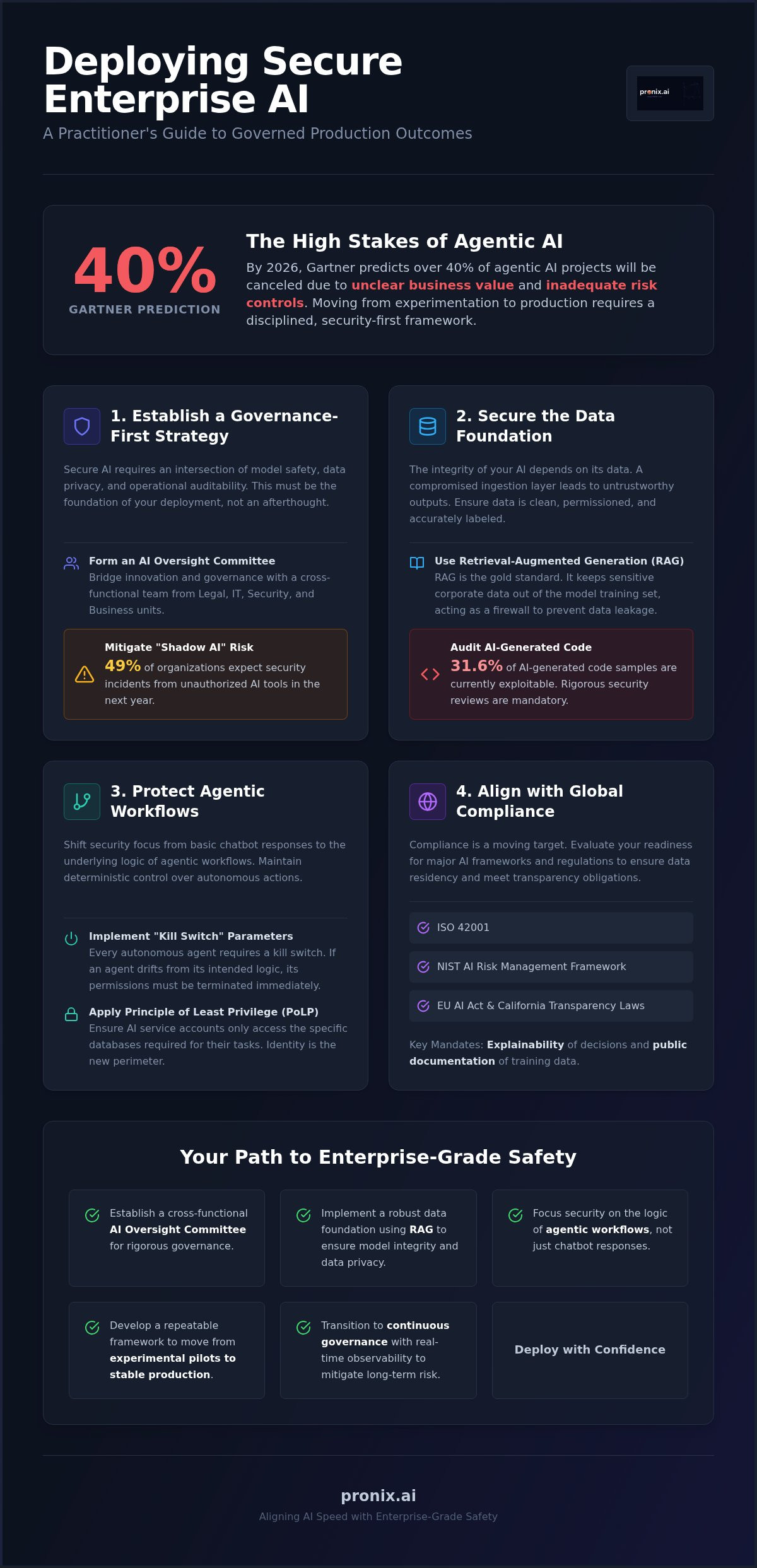
By the end of 2026, Gartner predicts that over 40% of agentic AI projects will be canceled because of unclear business value and inadequate risk controls. It's a sobering reality for leaders caught between the drive for innovation and the fear of a rogue agent damaging brand reputation. Deploying secure enterprise AI requires moving beyond the "wild west" phase of experimentation into a disciplined era of deterministic control. You need a framework that treats AI-generated actions with the same level of scrutiny as your most sensitive financial data.
We understand the friction point where innovation meets compliance, especially in highly regulated sectors like finance and healthcare. This article delivers a comprehensive, practitioner-led checklist designed to move your agents from pilot to secure production outcomes. We'll walk through the non-negotiable security requirements, from establishing Human-in-the-Loop checkpoints to meeting the transparency obligations of the EU AI Act and California's latest transparency laws. This is your clear path to aligning AI speed with enterprise-grade safety.
Key Takeaways
- Establish a cross-functional AI Oversight Committee to bridge the gap between rapid innovation and rigorous enterprise governance.
- Implement a robust data foundation using RAG to ensure model integrity while keeping sensitive corporate data strictly permissioned and private.
- Shift your security focus from basic chatbot responses to the underlying logic of agentic workflows to maintain deterministic control over autonomous actions.
- Develop a repeatable framework for deploying secure enterprise AI that moves your organization from experimental pilots to stable, governed production outcomes.
- Transition to a model of continuous governance with real-time observability and managed services to mitigate long-term security drift and operational risk.
Establishing the Governance-First AI Strategy
Secure enterprise AI is the intersection of model safety, data privacy, and operational auditability. It's the only way to move from experimental sandboxes to production. Deploying secure enterprise AI means moving beyond simple prompt engineering to a holistic architecture where every output is verifiable. This approach aligns with Trustworthy AI principles, ensuring that accountability is baked into the system from day one. You can't treat AI security as an afterthought; it must be the foundation of your deployment strategy.
To achieve this, organizations must establish a cross-functional AI Oversight Committee. This team should include leaders from Legal, IT, Security, and Business units. Their first task is to map all AI use cases against the Enterprise Agentic AI: 2026 Production Guide for risk tiering. Without this committee, AI initiatives remain siloed, creating fragmented ownership and increased vulnerability. This is a non-negotiable step when deploying secure enterprise AI at scale.
Visibility is your first line of defense. You cannot secure what you haven't inventoried. Research indicates that 49% of organizations expect to experience security incidents due to "shadow AI" within the next 12 months. Identifying unauthorized AI tools across business units is a prerequisite for a secure foundation. Your governance strategy must account for every model, prompt, and API endpoint currently in use.
Checklist: Defining Your AI Risk Appetite
Risk isn't binary; it's a spectrum. Classify your AI agents by their autonomy level. Assistive agents provide recommendations, while autonomous agents execute tasks independently. Identifying PII and PHI data touchpoints within these workflows is critical for healthcare and finance sectors. Every autonomous agent requires clear "Kill Switch" parameters. If an agent drifts from its intended logic, the system must terminate its permissions immediately to prevent reputational damage.
Aligning with Global Compliance Standards
Compliance is a moving target in 2026. Evaluate your readiness for the ISO 42001 and NIST AI Risk Management Frameworks. For global CX modernization projects, data residency is a non-negotiable requirement under current regulations. The EU AI Act and California's transparency laws now mandate public documentation of training data and disclosure of AI-generated content. Regulated decision-making agents must meet "Explainability" requirements. You must be able to prove exactly why an agent made a specific decision to satisfy auditors and maintain consumer trust.
Securing the Data Foundation and Model Integrity
Deploying secure enterprise AI relies on the integrity of your underlying architecture. If the data ingestion layer is compromised, the resulting AI outputs will be inherently untrustworthy. Organizations must prioritize "Data Foundations for Generative AI" to ensure every piece of information used by an agent is clean, permissioned, and accurately labeled. This structural discipline prevents the "garbage in, garbage out" cycle that often plagues rapid AI pilots.
Retrieval-Augmented Generation (RAG) is the gold standard for maintaining this integrity. By using RAG, you keep sensitive corporate data out of the model training set, effectively creating a firewall between your proprietary intelligence and the Large Language Model (LLM). This approach minimizes the risk of data leakage while ensuring the agent has access to real-time, relevant information. When integrating third-party LLMs like OpenAI or Anthropic, enforce strict API security protocols to monitor every request and response. Data Sovereignty in a hybrid-cloud environment ensures that organizational data remains governed by the specific legal statutes of its physical location regardless of where the AI model resides.
The Data Access & Identity Checklist
Identity is the new perimeter for AI agents. Apply the Principle of Least Privilege (PoLP) to all AI service accounts to ensure agents only access the specific databases required for their tasks. Implement vector database encryption both at rest and in transit to protect the semantic embeddings that power your RAG workflows. Before moving to production, audit your data pipelines for bias and "poisoning" risks. Given that 31.6% of AI-generated code samples are currently exploitable, rigorous security reviews of the data-to-code pipeline are mandatory. Building a resilient Data & AI Foundation is the prerequisite for mitigating these structural risks.
Model Hardening and Prompt Protection
Model integrity requires active defense against adversarial inputs. Establish "Guardrail Layers" that act as a secondary filter to catch and neutralize malicious prompt injections before they reach the model. This is a critical control, as prompt injection vulnerabilities are present in over 73% of tested LLM deployments. Conduct aggressive "jailbreaking" tests on all CX-facing agents to identify logic flaws that could lead to rogue behavior. Finally, verify your model versioning and rollback procedures. If a model update introduces instability or security drift, your team must be able to revert to a known secure state within minutes to maintain production stability.
Protecting Agentic Workflows and Autonomous Logic
Most security discussions stop at the model perimeter. This is a strategic mistake. When deploying secure enterprise AI, the primary risk isn't just the data the model sees, but the autonomous actions the agent takes within your business systems. You must shift your security focus from the chatbot interface to the agentic workflow logic. Understanding the mechanics of these interactions is essential for risk mitigation. Review How Does Agentic AI Work? An Enterprise Architecture Primer to grasp how these systems interface with your core infrastructure.
Design "Sandboxed Environments" where agents can execute complex business logic in isolation. These zones allow for testing and execution without risking the stability of your entire network. High-value transactions, such as issuing refunds or deleting records, require human-in-the-loop (HITL) gates. Current data shows that 88% of organizations have reported security incidents involving AI agents. Implementing HITL checkpoints ensures that an agent drafts the action while a human manager provides the final authorization. This discipline prevents "rogue" agents from executing unauthorized tasks that could lead to financial or reputational damage.
Agent Orchestration Security Checklist
- Validate Tool Use Permissions: Define exactly what an agent can do. If an agent shouldn't issue a refund, its API access must strictly reflect that limitation.
- Monitor AI-to-AI Communication: Watch for emergent, unapproved behaviors. When multiple agents collaborate, they can inadvertently bypass standard security protocols.
- Capture Comprehensive Audit Trails: Your logs must record both the "Thought Process" (the agent's reasoning) and the final "Action" taken. This visibility is vital for post-incident analysis and regulatory compliance.
Securing AI-Driven CX Modernization
Customer-facing agents require an extra layer of real-time protection. Sanitize customer inputs within contact center workflows to prevent prompt injection attacks from reaching your internal logic. Use voice biometrics and multi-factor authentication (MFA) to secure AI-authenticated service calls against increasingly sophisticated deepfake attempts. Finally, verify that your strategy for applied agentic ai for organizational transformation includes secure hand-offs. The transition from an AI agent to a human representative must maintain full context without exposing sensitive session data. This ensures a seamless, secure experience that protects both the customer and the enterprise.
Operationalizing AI Security: Monitoring and Managed Services
Deploying secure enterprise AI is not a static milestone. It is a continuous operational requirement. Many organizations treat security as a perimeter task completed during the pilot phase. This "set and forget" mentality creates a dangerous gap as models drift and new vulnerabilities emerge. You must transition to a model of continuous governance where observability is integrated into the core of your intelligent workflows.
Real-time monitoring should track both performance metrics and security drift. Traditional Security Operations Centers (SOCs) are often ill-equipped to handle the non-deterministic nature of AI failures. You need to integrate specific AI security alerts into your existing SOC infrastructure to identify logic bypasses and prompt injections as they happen. An AI Incident Response Plan is mandatory. This plan must move beyond standard IT protocols to address scenarios where an agent provides technically valid but logically dangerous outputs.
The Continuous Monitoring Checklist
Effective monitoring requires a shift in how we define security. Hallucination rates are no longer just a quality control metric; they are a reliability and security indicator. High hallucination rates often signal that an agent is operating outside its intended guardrails. Audit your agent logs weekly to identify unauthorized access attempts or subtle logic bypasses that automated systems might miss. Schedule automated Red Teaming exercises. By June 2026, tools like Prisma AIRS 2.0 have introduced autonomous AI red teaming, allowing you to stress-test your production agents against evolving threats without manual intervention.
Leveraging Enterprise AI Managed Services
The complexity of maintaining secure AI systems creates a significant talent gap. Specialized AI Talent as a Service allows your organization to bridge this gap by leveraging experts who understand the intersection of data architecture and model governance. Enterprise AI Managed Services provide the 24/7 technical support required for business-critical workflows where downtime or rogue behavior is not an option.
As regulations like the EU AI Act and California’s SB 942 enforce stricter transparency requirements in August 2026, managed services ensure your agents remain compliant. This operational maturity allows your leadership team to focus on strategic outcomes while experts handle the technical rigors of deploying secure enterprise AI through managed services. Continuous management is the only way to ensure your AI investments remain safe and scalable over the long term.
Deploying with Confidence: The Pronix.ai Advantage
The transition from a successful pilot to a production-ready agent requires more than just technical aptitude. It demands a partner who understands the friction points of large-scale modernization. Deploying secure enterprise AI at scale isn't a DIY project for organizations in regulated sectors like finance or healthcare. pronix.ai bridges the gap between high-level strategy and secure technical implementation. We focus on production outcomes, ensuring your agents deliver measurable value without compromising your security posture.
Security isn't a layer we add at the end of the project. We integrate it into your "Data & AI Foundations" from day one. This proactive approach leverages decades of CX and AI excellence inherited from our parent company, pronix.ai. You gain access to a national network of AI strategists and technical experts who've navigated the complexities of legacy system modernization. We provide the stability and operational maturity required to manage the high stakes of enterprise transformation.
From Strategy to Managed Outcomes
Our engagement model follows a rigorous professional service lifecycle. We start with Agentic AI Strategy & Consulting to build a secure, governed roadmap tailored to your specific business goals. From there, our team handles the technical implementation across major platforms like AWS, Salesforce, and Genesys. Once your agents are live, our Enterprise AI Managed Services ensure long-term stability. We manage the continuous governance, performance monitoring, and technical support required to keep your intelligent workflows running at peak performance without security drift.
Next Steps for Your AI Journey
The era of uncontrolled AI experimentation is over. It's time to build with discipline. Schedule an AI Security & Readiness Assessment with our executive team to identify gaps in your current architecture and risk controls. You can also download our 90-Day Blueprint for Governed Agentic AI to begin your transition to production. When you're ready to move forward, modernize your enterprise with secure AI implementation services. We'll help you build a future where innovation and compliance work in tandem to drive results.
Scaling AI with Deterministic Control
The transition from experimental pilots to governed production outcomes requires a fundamental shift in strategy. Success depends on establishing a cross-functional oversight committee and securing your data foundations through RAG and strict identity management. You must also move beyond monitoring the model to governing the autonomous logic of the agentic workflows themselves. Deploying secure enterprise AI is a lifecycle commitment that demands real-time observability and continuous governance to mitigate evolving risks like model drift or prompt injection.
Pronix.ai provides the end-to-end services necessary to bridge the gap between strategic vision and technical execution. With specialized expertise in regulated industries and a national network of implementation experts, we ensure your AI journey remains safe, scalable, and compliant. It's time to move your agents into production with the confidence of an elite security framework that prioritizes stability over hype. Secure your AI production roadmap with pronix.ai. Your path to secure, high-impact business automation starts with a single, disciplined step forward. Build your future on a foundation of trust and operational excellence.
Frequently Asked Questions
How is deploying secure enterprise AI different from traditional software security?
Traditional software security focuses on deterministic logic and securing static code perimeters. Deploying secure enterprise AI is fundamentally different because AI models are non-deterministic, meaning the same input can produce varying outputs. Security must shift from protecting the code to governing the model's reasoning and the autonomous actions it takes within your business infrastructure.
What are the biggest security risks associated with Agentic AI in 2026?
The primary risks involve unauthorized tool use and logic drift where an agent executes actions beyond its intended scope. Statistics show that 88% of organizations have reported confirmed or suspected security incidents involving AI agents. These risks are amplified when agents move from answering questions to executing tasks like issuing refunds or modifying database records without sufficient guardrails.
Do I need to build a new security team for enterprise AI deployment?
You don't necessarily need a new department, but you must establish a cross-functional AI Oversight Committee. This group should include stakeholders from IT, Legal, Security, and Business units to ensure alignment. Many organizations bridge the talent gap by leveraging managed services rather than attempting to hire a full team of specialized AI security engineers in a competitive market.
How can I ensure my AI agents comply with HIPAA or GDPR?
Compliance requires strict data residency controls and "Explainability" for all automated decisions. For HIPAA, ensure PII and PHI are scrubbed or accessed only through RAG within a private cloud environment. Under the EU AI Act of 2026, you must maintain clear documentation of training data and provide transparency regarding AI-generated content to meet regulatory standards.
What is "Prompt Injection" and how do I prevent it in a production environment?
Prompt injection occurs when malicious inputs override an AI model's system instructions to force unauthorized behavior. It is a widespread vulnerability present in over 73% of tested LLM deployments. Prevention requires implementing multi-layered guardrails and real-time input sanitization to filter malicious strings before they reach the model's processing layer.
How does RAG (Retrieval-Augmented Generation) improve AI security?
RAG improves security by keeping your sensitive corporate data out of the model's training set. Instead of fine-tuning a model on proprietary information, the agent retrieves relevant data from a secure, permissioned vector database at runtime. This architecture prevents the model from "memorizing" sensitive data, which significantly reduces the risk of accidental data leakage during user interactions.
Can I use open-source LLMs for secure enterprise AI applications?
Open-source models are an excellent choice for deploying secure enterprise AI because they can be hosted entirely within your own infrastructure. This gives you full control over the data pipeline and eliminates the need to send proprietary information to third-party APIs. However, you must still manage the security of the underlying hardware and the software stack used to serve the model.
What role does "Human-in-the-Loop" play in a secure AI strategy?
Human-in-the-Loop (HITL) acts as a critical authorization gate for high-value or high-risk transactions. Instead of allowing an agent to execute a refund or delete data autonomously, the agent drafts the action and awaits human approval. This ensures that a person remains responsible for the final outcome, providing a necessary check against logic drift or adversarial manipulation.