

Most enterprises are currently stuck in a cycle of "chatting" with their data, but the real value isn't in conversation; it's in execution. While generative AI produces content, agentic AI produces outcomes. You've likely seen the flashy demos, yet moving a Large Language Model from a simple RAG pilot into a reliable, autonomous system often feels like navigating a black box. The noise of industry buzzwords makes it difficult to identify the actual infrastructure needed for scale.
We understand the frustration of seeing potential that remains locked behind experimental barriers. This primer clarifies exactly how does agentic ai work by pulling back the curtain on reasoning loops, tool-use protocols, and the governance frameworks required for production. You'll gain a clear mental model of how these systems function within a modern enterprise architecture. We'll explore the structural shift from static prompts to multi-agent orchestration, ensuring your autonomous systems remain both productive and fully auditable.
Key Takeaways
- Move beyond passive LLM responses to active systems that execute complex goals through autonomous reasoning.
- Discover exactly how does agentic ai work by examining goal decomposition and dynamic tool selection within reasoning loops.
- Scale operational complexity by transitioning from generalist bots to specialized multi-agent systems managed by a central orchestrator.
- Bridge the pilot-to-production gap with enterprise-grade governance and role-based access controls to ensure system auditability.
- Modernize your customer experience and core business workflows using a strategic implementation framework designed for secure deployment.
The Shift from Generative to Agentic AI: Understanding the Core Difference
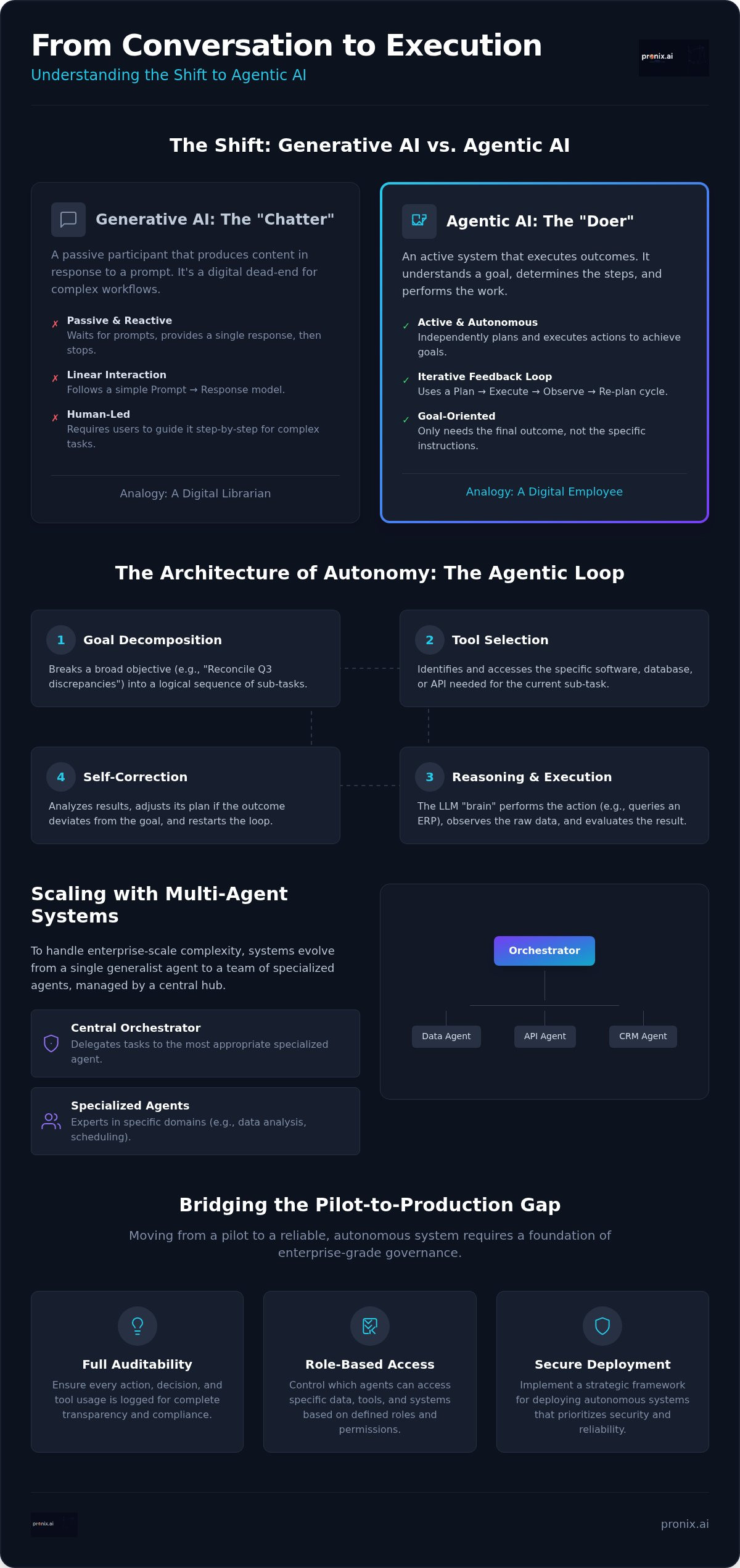
Generative AI is a passive participant. It waits for a prompt. It provides a response. Then it stops. This model is a digital dead-end for complex enterprise workflows. Agentic AI is an active system. You give it a goal. It determines the steps to reach it. It executes. This is the structural shift from predicting the next word to predicting the next action. Enterprises are making this move because static chatbots cannot handle multi-stage business processes. They need systems that don't just talk about work, but actually perform it. To understand this evolution, one must first define What is an AI Agent? in a technical context.
Passive Chatbots vs. Autonomous Agents
Traditional chatbots require human-led "chain of thought" prompting. If the task is complex, the user must guide the AI through every step, essentially acting as the project manager for the machine. This creates a bottleneck. Autonomous agents operate differently. They use internal reasoning loops to break down high-level objectives into manageable sub-tasks. They don't need you to tell them how to do the job; they only need to know what the final outcome should be.
Interaction models highlight this divide. Chatbots use a linear model where a prompt leads to a single response. Agents use an iterative feedback loop. They plan an action, execute it, observe the result, and then re-plan based on what they learned. This loop allows the system to correct its own errors without human intervention. It transforms the AI from a digital librarian into a digital employee that can navigate uncertainty.
The Concept of 'Agentic' Behavior
Agency requires more than just processing text. It demands perception, memory, and the ability to affect an environment. Understanding how does agentic ai work starts with these three pillars. Agents use "memory" to maintain context over long, multi-step projects. This prevents the "forgetting" issue common in simple LLM sessions where the AI loses the thread of the conversation. They perceive their environment by checking API statuses, reading database entries, or scanning real-time web data.
By predicting actions rather than just words, these systems can autonomously navigate enterprise software to complete workflows. They don't just tell you that an invoice is overdue. They cross-reference the payment history, draft a follow-up, and schedule it in the CRM. Agentic AI is a goal-oriented system capable of independent tool-use.
The Architecture of Autonomy: How the Agentic Loop Functions
Understanding how does agentic ai work requires moving beyond the idea of a single text prompt. In an enterprise environment, autonomy isn't a single event; it's a continuous, iterative cycle known as the agentic loop. This architecture allows the system to interact with its environment, evaluate its progress, and pivot when necessary. According to Stanford University's exploration of What is Agentic AI, this goal-directed behavior is what separates modern agents from the static models of the past. The process follows a four-stage logic workflow.
- Goal Decomposition: The agent receives a broad objective, such as "reconcile Q3 vendor discrepancies." It breaks this down into a logical sequence of sub-tasks.
- Tool Selection: The agent identifies which specific software, database, or API it needs to access. It doesn't just guess; it selects the tool based on the requirements of the current sub-task.
- Reasoning and Execution: The agent performs the action. It might query an ERP system or pull a PDF from a cloud drive. It then observes the raw data returned.
- Self-Correction: This is the most critical phase. The agent analyzes the results. If the outcome deviates from the goal, it adjusts its plan and restarts the loop until the objective is met.
The Reasoning Engine (LLM as the Brain)
Large Language Models (LLMs) serve as the central controller for this entire process. They don't just generate text; they act as the logic engine that handles planning and decision-making. Through "Chain of Thought" (CoT) processing, the agent "thinks" through the steps internally before taking an external action. This internal reasoning allows the agent to anticipate potential blockers. When building these systems, model size and latency are vital. A larger model provides more robust reasoning but may introduce delays that stall high-speed business automations. Finding the right balance is a core part of an effective Agentic AI strategy.
Tool-Use and API Integration
Agents interact with the real world through pre-defined toolsets, a process often called function calling. Unlike a chatbot that simply talks about a CRM, an agentic system is connected to the CRM via secure APIs. It uses structured output, typically in JSON format, to ensure that its instructions are readable by other enterprise software. This structured communication is what allows an agent to move data between an ERP, a knowledge base, and a communication platform like Slack without human help. It's the difference between a system that describes a solution and one that implements it directly into your existing infrastructure.
Orchestration and Multi-Agent Systems: Scaling Complexity
Single-agent systems often hit a ceiling. They struggle with context windows and task fatigue when faced with enterprise-grade complexity. To solve this, the architecture shifts toward multi-agent systems. This is a fundamental layer of how does agentic ai work in a production environment. By distributing a large goal across a network of specialized agents, you ensure that no single model is overwhelmed. Accuracy increases. Latency decreases. The system becomes a team rather than a solo operator.
The Orchestrator agent serves as the central command. It doesn't perform every task itself; it manages the sub-agents. It decomposes the primary objective and delegates sub-tasks to the most qualified specialist. This structure mirrors a professional service lifecycle. A project manager coordinates subject matter experts to deliver a final result. Frameworks like LangGraph, AutoGen, and CrewAI have emerged as the industry standards in 2026 for building these coordinated workflows. They provide the necessary scaffolding for complex, multi-step logic and ensure that the system stays on track.
Specialized Agents in Action
Specialization is the most effective defense against AI hallucinations. When an agent has a narrow domain, it operates with higher precision. For example, a "Researcher" agent might be tasked only with gathering real-time market data, while a "Writer" agent focuses on drafting the executive summary based on that data. Designing agent personas for specific business functions, such as CX or Supply Chain management, allows for deeper integration with relevant tools. A "Logistics" agent doesn't need to know how to write marketing copy; it only needs to master your shipping APIs and inventory databases. This focus ensures that the outputs are grounded in facts rather than creative predictions.
Communication and Conflict Resolution
Successful multi-agent systems rely on a shared state. This workspace allows agents to pass data and context back and forth without losing the original goal's intent. It functions as a digital whiteboard where every agent can see the progress of the project. However, autonomy requires a plan for when outputs conflict. Enterprises implement voting mechanisms where multiple agents verify a single result, or they trigger human-in-the-loop (HITL) checkpoints for high-stakes decisions. Agent orchestration is the management of inter-agent dependencies. This ensures that the workflow remains stable even as the number of agents increases and the tasks become more intricate.
Enterprise Governance: Moving Agentic AI from Pilot to Production
The transition from a successful pilot to a production-grade system is where most enterprise AI initiatives stall. While a demo might look impressive in a sandbox, the lack of oversight often prevents full-scale deployment. Industry reports suggest that a vast majority of AI agents fail to reach production because they lack the necessary control layers. Understanding how does agentic ai work in a corporate setting requires looking beyond the reasoning engine and focusing on the governance framework that surrounds it. Governance isn't a hurdle; it's the prerequisite for trust.
Effective governance starts with Role-Based Access Control (RBAC). You wouldn't give a junior intern unrestricted access to your financial core; you shouldn't give it to an AI agent either. By restricting agent actions based on pre-defined roles, you minimize the risk of unauthorized data access or accidental system changes. This is critical for maintaining security and data privacy. During the reasoning phase, agents must be prevented from leaking sensitive Personally Identifiable Information (PII) into their internal logs or external communications. Without these constraints, an autonomous agent becomes a liability.
Auditability provides the transparency needed for executive buy-in. Every "thought" and "action" within the agentic loop must be recorded in real-time. This creates a forensic trail that allows compliance teams to review why an agent made a specific decision or chose a particular tool. It turns the "black box" into a transparent process, ensuring that autonomous systems remain accountable to human supervisors at every stage of the lifecycle.
The Safety Net: Guardrails and Human-in-the-Loop
Guardrails define the operational boundaries of an agent. Hard guardrails prevent an action entirely, such as moving funds above a certain threshold or accessing restricted servers. Soft guardrails trigger a notification or a request for clarification when the agent's confidence score drops. Strategic placement of Human-in-the-Loop (HITL) checkpoints at high-stakes decision points ensures that the machine remains a tool, not an unguided force. Automated monitoring then detects "loop failures" or performance drift, allowing for immediate intervention before a minor error scales into a systemic issue.
Scalable Infrastructure and Managed Services
A robust data foundation is the prerequisite for any agentic deployment. If your data is siloed or inconsistent, your agents will produce unreliable outcomes. Managed services provide the ongoing oversight required to maintain agent performance after the initial launch, handling the complexities of model updates and tool integrations. This is where Agentic AI Implementation services become essential. They bridge the gap between technical execution and long-term business value, ensuring your autonomous systems remain secure, compliant, and ready for global scale.
Implementing Agentic AI with Pronix.ai: A Strategic Framework
Understanding how does agentic ai work is the first step toward actual transformation. The second step is execution. Pronix.ai provides a results-oriented approach that bridges the gap between technical potential and business outcomes. We focus on Agentic AI Strategy & Consulting to ensure every deployment aligns with your long-term goals. By modernizing Customer Experience (CX) through intelligent workflows, we transform static service models into dynamic, action-oriented systems. We leverage industry-leading platforms like AWS, Microsoft, and Salesforce to provide the scalable orchestration needed for global enterprise operations.
Our commitment is to production-ready outcomes. We don't just build prototypes; we build secure, auditable systems that can handle the rigors of a live environment. This involves deep integration with your existing Data & AI Foundations to ensure that every agent has access to the right context without compromising security. By focusing on enterprise-grade governance from day one, we help you avoid the common pitfalls that stall 80% of AI initiatives before they reach scale.
Our 90-Day Blueprint for Governed AI
Our 90-day blueprint is designed for stability and speed. Step one involves identifying high-impact, low-risk use cases. We target specific bottlenecks where autonomous agents can provide immediate ROI, such as automating complex data reconciliation or enhancing CX response times. Step two focuses on building the data and governance foundation. We ensure your data architecture is robust and compliant with emerging standards. Finally, step three involves deploying and scaling the agentic workforce. We provide Enterprise AI Managed Services to monitor performance and maintain auditability long after the initial launch.
Why Partner with Pronix.ai?
We understand the friction points of modernizing legacy systems in regulated sectors. Our expertise in Finance, Healthcare, and Manufacturing ensures that your AI implementation meets the highest standards of safety and compliance. We don't just build agents; we build the "safety net" that makes autonomous systems viable for the enterprise. We focus on measurable business value, prioritizing cost reduction and productivity acceleration at every stage of the lifecycle. If you're ready to stop experimenting and start delivering outcomes, it's time to move your Agentic AI from pilot to production with Pronix.ai.
Scaling the Autonomous Enterprise
Transitioning from generative experiments to agentic execution is no longer optional for organizations seeking operational maturity. Understanding how does agentic ai work provides the mental model needed to move beyond simple chatbots. The real challenge lies in building the architecture that supports reasoning loops and multi-agent coordination. Success requires a shift from prompt-based interactions to governed, tool-enabled systems that navigate complex enterprise logic without constant human oversight. You need a framework that prioritizes stability, auditability, and safety at every turn.
Reliability in these autonomous systems depends on a foundation of rigorous oversight. Pronix.ai specializes in transitioning high-potential pilots into secure production outcomes. We provide the enterprise-grade governance frameworks and managed services necessary for long-term stability in regulated industries. Don't let your AI strategy stall in the experimental phase. Scale your Enterprise AI with Pronix.ai implementation services to turn autonomous potential into measurable business value. The era of the agentic workforce is here; it's time to build yours with confidence and precision.
Frequently Asked Questions
Is Agentic AI the same as an AI Assistant?
No. An AI assistant is a passive tool that requires human-led prompts to provide information or generate content. Agentic AI is an active system that receives a high-level goal and autonomously determines the sequence of actions needed to achieve it. Assistants are designed for conversation; agents are designed for execution. This fundamental shift from "chatting" to "doing" is the core of how does agentic ai work in a modern business environment.
Can Agentic AI work with our existing legacy software and APIs?
Yes. Agents are architected to interface with legacy systems through secure function calling and API integrations. They act as a sophisticated orchestration layer that can bridge silos between your CRM, ERP, and internal databases. By using structured communication protocols, agents can read data from older systems and execute actions within them without requiring a complete overhaul of your current IT infrastructure.
What are the biggest security risks of autonomous AI agents?
The primary risks involve unauthorized system actions, sensitive data leakage, and prompt injection. Because agents have the power to execute tasks, they require a robust safety net to prevent them from accessing restricted information or making incorrect financial decisions. Enterprises mitigate these risks by implementing strict role-based access control (RBAC) and maintaining comprehensive audit trails that record every reasoning step and tool-use event.
How do you prevent an AI agent from looping infinitely or hallucinating?
Prevention relies on internal reasoning loops and narrow domain specialization. When you restrict an agent to a specific business function, the risk of hallucinations drops significantly. Developers also implement self-correction protocols where the agent evaluates its own progress against the stated goal. For high-stakes workflows, human-in-the-loop (HITL) checkpoints ensure that a person verifies the agent's logic before it takes a final, irreversible action.
Do we need to build our own LLM to use Agentic AI?
Building a proprietary LLM is rarely necessary for enterprise-grade agency. Most organizations leverage frontier models from major platforms like AWS, Microsoft, or Salesforce to serve as the underlying reasoning engine. The real competitive advantage comes from the custom orchestration layer, the quality of your internal data foundations, and the governance frameworks you build around those existing models.
What industries benefit most from Agentic AI implementation?
Regulated industries like Finance, Healthcare, and Manufacturing see the most immediate ROI. These sectors rely on complex, multi-step processes that demand high precision and full auditability. Beyond these, any organization managing high-volume customer experience (CX) workflows or intricate supply chain logistics can use agentic systems to accelerate productivity and reduce operational friction.
How does human oversight work in a fully autonomous system?
Human oversight functions as a "supervised autonomy" model. You don't just set the system and forget it; you define the operational guardrails and set mandatory checkpoints for sensitive decisions. Automated monitoring tools track the agent's performance and confidence scores in real-time. If the agent encounters an edge case it can't resolve, it automatically escalates the task to a human supervisor for clarification.
What is the typical timeline for deploying an enterprise-grade AI agent?
A production-ready deployment typically follows a 90-day strategic blueprint. The first month is dedicated to identifying high-impact use cases and establishing the governance foundation. The second month focuses on technical implementation, tool integration, and reasoning loop development. The final 30 days involve rigorous testing and monitoring as the agentic workforce scales from a pilot environment into full production.