

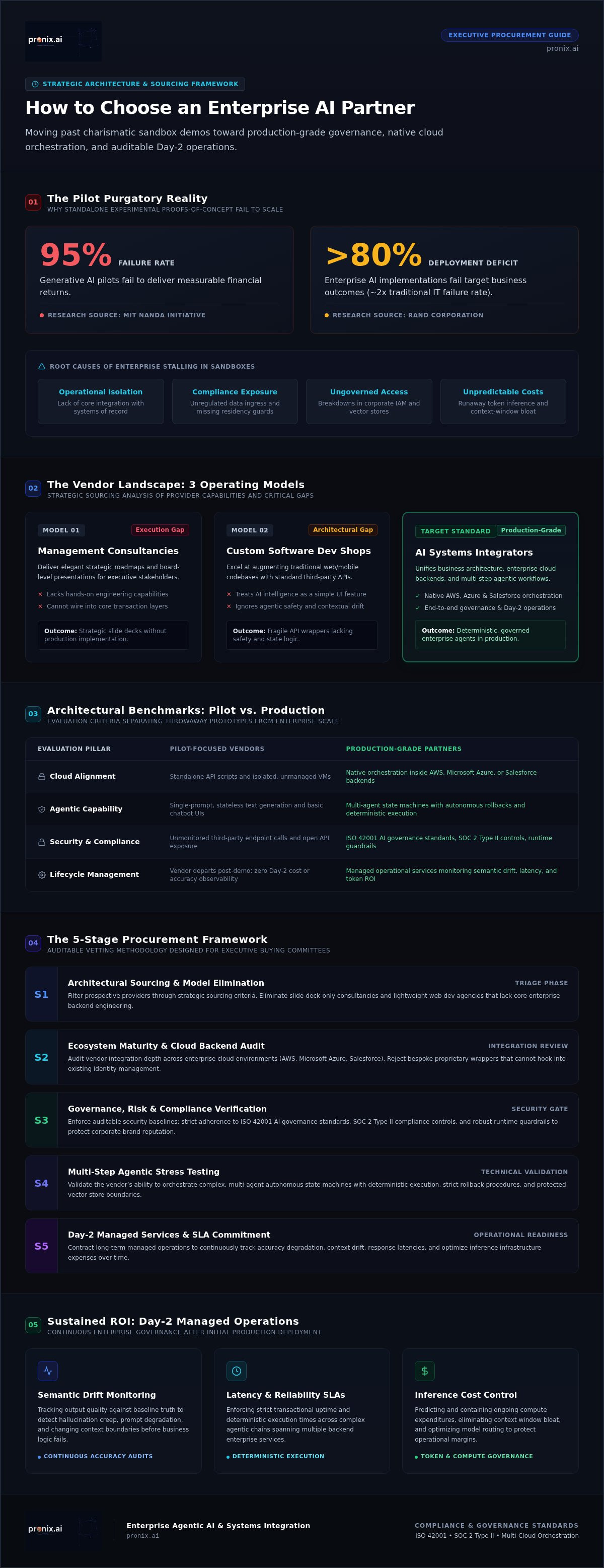
Nearly 95% of enterprise generative AI pilots fail to deliver measurable financial returns, according to research from the MIT NANDA Initiative. Enterprise leaders don't suffer from a lack of ambitious experimentation; they're trapped in endless sandbox proofs-of-concept that stall before reaching production. Knowing how to choose an enterprise AI partner in 2026 means looking past charismatic model demos and focusing squarely on production governance, platform orchestration, and auditable Day-2 operations.
You already know that spinning up an experimental agent is easy, but integrating reliable multi-step workflows into legacy environments across AWS, Microsoft, and Salesforce introduces severe friction. Mounting compliance exposure, ungoverned data access, and unpredictable inference costs quickly derail enterprise momentum. This guide delivers the strategic framework executive buyers need to vet prospective implementation firms, establish rigorous evaluation criteria, and secure production-grade business value. We'll break down the architectural benchmarks, ISO 42001 governance standards, and operational metrics that separate true transformation partners from software vendors and pilot experimenters.
Key Takeaways
- Shift procurement focus away from isolated model demos toward enterprise integrators capable of deploying governed, multi-step agentic workflows.
- Learn how to choose an enterprise AI partner using an auditable, five-stage evaluation framework tailored for executive buying committees.
- Prioritize platform integration maturity across AWS, Microsoft Azure, and Salesforce over unmaintainable, bespoke proprietary architectures.
- Protect brand reputation and data integrity by auditing vendor adherence to ISO 42001 standards, SOC 2 Type II controls, and runtime guardrails.
- Secure long-term operational ROI by establishing comprehensive Day-2 managed services to monitor semantic drift, latency, and inference expenses.
The Enterprise AI Partnership Landscape: Moving Beyond Pilot Hype to Production
Enterprise AI adoption has hit an operational inflection point. A true enterprise AI partner isn't a vendor selling boxed software licenses or an agency running isolated laboratory experiments. They act as an end-to-end systems integrator, strategist, and Day-2 operator. RAND Corporation research shows that over 80% of enterprise AI implementations fail to achieve their target business outcomes, roughly double the failure rate of traditional IT deployments. The root cause isn't model intellect; it's operational isolation. Understanding how to choose an enterprise AI partner demands shifting your procurement lens away from standalone algorithms toward robust enterprise integration.
The Pilot Purgatory Trap: Why Standalone AI Demos Fail
Prototype velocity rarely translates to production viability. Boutique shops can wire together a quick demonstration using basic API wrappers in days, yet those sandboxes crumble when subjected to corporate identity access management, vector store partitioning, or strict data residency mandates. Enterprises require transactional reliability, deterministic execution, and auditable governance. Transitioning beyond toy prototypes to scalable architectures demands dedicated Agentic AI implementation services that connect frontier reasoning directly to backend systems of record.
The Spectrum of AI Providers: Consultancies vs. Integrators vs. Boutiques
Navigating the vendor market reveals three distinct operating models, each bringing significant structural trade-offs:
- Management Consultancies: Deliver elegant strategic roadmaps and board-level presentations, yet lack the hands-on engineering capability to integrate models into core transaction layers.
- Custom Software Dev Shops: Excel at augmenting traditional codebases, but treat intelligence as a simple UI feature while ignoring agentic safety, contextual drift, and model orchestration.
- Dedicated AI Systems Integrators: Unify enterprise business architecture, legacy platforms, and automated workflow execution into a governed production ecosystem.
Applying rigorous strategic sourcing methodologies allows executive evaluation committees to eliminate pure slide-deck advisors and unvetted development boutiques early. When evaluating how to choose an enterprise AI partner, your focus must center on engineering maturity: proven ability to orchestrate multi-step agent actions safely inside AWS, Microsoft Azure, and Salesforce backends while protecting data boundaries.
Essential Evaluation Pillars: How to Assess Technical Architecture and Ecosystem Maturity
Assessing an implementation firm requires examining how their architecture operates inside real enterprise constraints. When determining how to choose an enterprise AI partner, your evaluation committee must determine whether a vendor writes disposable scripts or integrates directly with your existing core systems. Production viability lives in the connective tissue between models and enterprise workflows.
| Evaluation Pillar | Pilot-Focused Vendors | Production-Grade Partners |
|---|---|---|
| Cloud Alignment | Standalone API scripts and isolated VMs | Native orchestration inside AWS, Azure, or Salesforce |
| Agentic Capability | Single-prompt, stateless text generation | Multi-agent state machines with autonomous error rollbacks |
| Data Security | Ad-hoc vector dumps without permission layers | Partitioned retrieval, metadata filters, and strict RBAC |
Evaluating Hyperscaler and Enterprise Platform Alignment
Enterprise scale relies on deep platform maturity across AWS, Microsoft Azure, and Salesforce rather than unmaintainable proprietary silos. For contact centers, this alignment extends to modern orchestration engines like Amazon Connect and Genesys Cloud. Architectures built through AI-driven CX modernization unify front-office conversational layers with back-office transactional records. Certified platform competency protects organizations against architectural dead ends and ensures seamless updates.
Scrutinizing Agentic AI Orchestration Capabilities
Single-prompt completions cannot automate complex operations. True architectural maturity requires multi-agent orchestration that supports task decomposition, deterministic tool-calling, and state rollbacks if an execution step fails. Grounding agent behaviors in the NIST AI Risk Management Framework (AI RMF) ensures teams systematically map, measure, and manage operational risks like excessive agency and semantic drift before agents touch production systems of record.
Data Engineering and Underlying Architecture Foundations
An agent's reasoning capability is bounded by the quality of enterprise data feeding it. Production readiness demands clean APIs, sub-second vector queries, and role-based access control. Establishing a resilient enterprise data strategy for AI eliminates hallucination loops and guarantees continuous auditability. Vetting these underlying engineering disciplines reveals whether an agency can sustain scale. For organizations planning mission-critical rollouts, partnering with proven enterprise AI systems integrators provides the technical discipline required to launch safely.
Governance, Security, and Compliance: Auditing Your Partner’s Risk Mitigation Framework
The primary barrier to scaling enterprise artificial intelligence isn't technical capability. It's executive risk aversion surrounding brand damage, regulatory non-compliance, and intellectual property leakage. As the EU AI Act enforces strict penalties reaching up to €35 million or 7% of global turnover, governance can no longer remain a retrospective checklist. Auditing an implementation firm's defensive posture is central to understanding how to choose an enterprise AI partner equipped for regulated environments.
Every prospective partner must validate baseline credentials, including SOC 2 Type II, ISO 27001, and HIPAA compliance where relevant. However, static credentials only cover standard IT hosting. Leading firms demonstrate continuous alignment with modern AI governance frameworks like ISO/IEC 42001:2023 and the OECD AI Principles, verifying that risk mitigation runs throughout the entire system lifecycle.
Data Sovereignty, Privacy, and Zero-Retention Frameworks
Protecting confidential enterprise data requires contractual and technical isolation. A qualified partner enforces private tenant configurations and signs binding zero-data-retention agreements with foundation model providers to prevent customer inputs from entering training corpuses. Before onboarding, audit their operational data security stack:
- Dynamic Field Masking: Automated stripping of PII, PHI, and sensitive financial entities before prompts reach inference endpoints.
- Format-Preserving Encryption: End-to-end cryptographic protection for data in transit, at rest, and across intermediate vector indexes.
- Granular Tenant Segregation: Isolated retrieval partitions that enforce enterprise access control policies down to the individual user level.
Operationalizing Guardrails and Model Hallucination Defenses
Governance fails when treated as passive policy documentation. It must operate as compiled code. Production-grade partners deploy programmatic firewall layers that evaluate inputs and outputs in sub-100 millisecond runtimes. These systems intercept prompt injection attacks, block system prompt leakage, and prevent excessive autonomous agency as classified by the OWASP Top 10 for LLMs.
Contracts must specify enforceable operational SLAs. These include hard ceilings on hallucination rates, strict latency thresholds under peak token load, and deterministic failover protocols that automatically route compromised interactions to human agents. Learning how to choose an enterprise AI partner means ensuring your systems integrator can deliver real-time audit logs across financial services, healthcare, and manufacturing, proving every automated decision remains transparent and defensible.
The 5-Stage Procurement Framework: How to Vet, Shortlist, and Select Your Partner
Buying enterprise AI requires structured commercial and technical discipline. Relying on standard IT procurement models falls short because generative workflows involve non-deterministic outputs, API rate-limiting, and complex inference economics. Decision-makers evaluating how to choose an enterprise AI partner must implement a structured vetting blueprint that systematically eliminates pilot experimenters before committing capital.
- Strategic Scoping: Align stakeholder expectations around hard business metrics rather than model capability demos.
- Production Audit: Demand verified customer case studies with live deployment data instead of lab benchmarks.
- Architecture Review: Interrogate API resiliency, vector search latency, and role-based data isolation.
- Paid Proof-of-Value (PoV): Commission a 60-to-90 day bounded engagement targeting a high-friction operational bottleneck.
- Red-Teaming and Governance Stress-Testing: Subject the candidate system to adversarial inputs and regulatory audits.
Stages 1 to 3: Strategic Scoping, Capability Audits, and Architectural Vetting
Begin by defining measurable business value: operational cost takeout, average handle time reduction, or pipeline acceleration. In executive pitch meetings, cut through sales jargon with direct scrutiny. Demand answers to three direct questions:
- "What percentage of your delivered client implementations currently run in active production versus sandbox environments?"
- "How does your architecture handle vector database drift when underlying enterprise schemas change?"
- "What mechanisms prevent prompt injection from exposing corporate systems of record?"
Before committing internal engineering resources to an RFP cycle, schedule a discovery session with pronix.ai strategy experts to pressure-test your architectural readiness and procurement scorecards.
Stages 4 and 5: Paid Proof-of-Value and Governance Stress-Testing
Never sign an enterprise-wide Master Services Agreement based on slide decks. Execute a paid, time-boxed 60-to-90 day Proof-of-Value addressing a bounded, high-value process. Subject this system to adversarial red-teaming, intentionally triggering prompt injections, data extraction attempts, and boundary edge cases. Ensure your legal team preserves complete corporate ownership of all custom middleware, system prompts, retrieval pipelines, and fine-tuning metadata. Mastering how to choose an enterprise AI partner means paying only for verifiable production stability, not experimental learning curves.
Day-2 Operations and Managed Services: Ensuring Sustained ROI Across the AI Lifecycle
Initial deployment represents roughly 20% of the enterprise AI lifecycle. The remaining 80% determines whether that technology delivers compounding value or becomes unmaintainable technical debt. Unlike traditional software, AI systems don't remain static; they interact with dynamic datasets, evolving user inputs, and shifting model behaviors. Evaluating how to choose an enterprise AI partner requires inspecting their ongoing Day-2 operational capabilities just as closely as their initial engineering velocity.
Combating Drift, Degradation, and Evolving API Dependencies
Foundation model providers frequently update underlying weights and API parameters. These unannounced adjustments can silently alter reasoning outputs and break deterministic multi-agent tool-calling. Contracting dedicated managed services for agentic AI establishes automated evaluation pipelines. These continuous monitors track output latency, semantic drift, and hallucination rates against historical baselines, executing instant rollbacks whenever anomalous behavior occurs.
FinOps and Compute Cost Governance
Autonomous agent loops and recursive retrieval queries create severe financial exposure if left unmonitored. Without rigorous controls, token consumption can quickly overrun departmental budgets. Production-grade partners implement active LLM FinOps governance, enforcing:
- Semantic Caching: Storing and serving identical query embeddings locally to slash external inference calls.
- Dynamic Model Routing: Triage logic that sends high-frequency tasks to low-cost small language models while reserving frontier models for edge-case reasoning.
- Execution Circuit Breakers: Programmatic token ceilings that terminate runaway agent loops before compute costs spike.
Partnering for Long-Term Maturity: The pronix.ai Advantage
Sustainable enterprise transformation demands an implementation partner that bridges strategic vision, systems engineering, and Day-2 operational reliability. Backed by Pronix Inc.'s proven integration heritage, pronix.ai delivers end-to-end Agentic AI Implementation, AI Business Automation, and Enterprise AI Managed Services across healthcare, financial services, and manufacturing.
Our engineered 90-day delivery blueprints unify workflows natively across AWS, Microsoft Azure, Salesforce Agentforce, and Genesys Cloud, eliminating the enterprise AI talent gap while safeguarding compliance. When deciding how to choose an enterprise AI partner, prioritize long-term accountability over transactional delivery. Schedule an Enterprise AI Assessment with pronix.ai to benchmark your operational architecture and accelerate production ROI.
Securing Your Operational Advantage: The Path to Production AI
Enterprise AI success in 2026 hinges on execution discipline rather than model novelty. Moving past experimental sandboxes requires prioritizing platform integration, auditable data boundaries, and continuous Day-2 management. When deciding how to choose an enterprise AI partner, look beyond persuasive slide decks. Align with an integrator that guarantees operational guardrails, cross-system orchestration, and measurable business value.
Backed by the proven enterprise integration heritage of Pronix Inc., pronix.ai bridges strategic architecture and technical execution. Through deep ecosystem partnerships across AWS, Microsoft Azure, Salesforce, and Genesys, we deploy engineered 90-day production blueprints designed to protect corporate governance while scaling intelligent automation. Sustainable transformation doesn't happen in an isolated sandbox; it demands a partner committed to production resilience and long-term operational maturity.
Partner with pronix.ai to deploy secure, production-grade enterprise AI and establish an enduring competitive advantage today.
Frequently Asked Questions
How does an enterprise AI implementation partner differ from traditional IT consultancies?
Traditional IT consultancies focus primarily on high-level advisory slide decks and generic technology migrations. In contrast, an enterprise AI implementation partner combines strategic consulting with hands-on systems engineering, deploying autonomous agentic workflows and active runtime guardrails. They don't just deliver recommendations; they integrate deterministic tool-calling into systems of record and take operational accountability for model performance, safety, and compliance across your enterprise platforms.
What is the typical timeline for an enterprise AI partner to deploy a production-ready solution?
A production-ready deployment typically follows an engineered 90-day delivery blueprint. The initial 30 days focus on strategic scoping, data foundation auditing, and architecture design. Days 31 through 60 involve orchestrating multi-agent workflows and connecting enterprise APIs across platforms like AWS or Salesforce. The final 30 days center on red-teaming, compliance stress-testing, and operational handover. This time-boxed schedule prevents endless pilot purgatory and demonstrates rapid, auditable ROI.
How do enterprise AI partners ensure proprietary company data remains secure and private?
Enterprise partners enforce dedicated tenant isolation, format-preserving encryption, and binding zero-data-retention agreements with foundation model providers. Before any data reaches an inference engine, automated middleware tokenizes sensitive corporate records, strips PII, and applies strict role-based access controls. This ensures private business intelligence never mixes with public training datasets or breaches regulatory frameworks like HIPAA, GDPR, or the EU AI Act.
What questions should an enterprise buying committee ask during vendor pitch evaluations?
When learning how to choose an enterprise AI partner, buying committees should look past generic software demos. Ask vendors to reveal the exact percentage of their deployments operating in live production rather than sandboxes. Demand proof of how their architecture handles API version changes and model drift. Finally, require them to detail their specific security controls for mitigating prompt injection and unbounded compute consumption.
Why do most enterprise AI pilots fail to transition into scalable production environments?
Most enterprise pilots fail because they operate as isolated experiments built on lightweight wrappers rather than deep backend integrations. Sandboxes ignore messy enterprise realities, including legacy API latency, rigid access governance, and dynamic data schemas. When organizations attempt to scale these prototypes without robust data foundations, agentic orchestration layers, and deterministic error handling, systems break down under real-world transactional volumes and security audits.
How should enterprise leaders evaluate an AI partner’s ecosystem integration capabilities?
Evaluating an AI partner's ecosystem maturity requires reviewing certified alliances across major hyperscalers and platforms like AWS, Microsoft Azure, Salesforce Agentforce, and Genesys Cloud. A competent partner avoids proprietary, locked-in software architectures. Instead, they engineer modular, API-first solutions directly within your existing cloud infrastructure and CRM layers. This strategy ensures seamless interoperability, simplifies compliance audits, and lowers long-term architectural maintenance costs across your business units.
What are Day-2 AI managed services and why are they necessary for long-term ROI?
Day-2 managed services provide continuous post-deployment monitoring, prompt optimization, and FinOps governance across an AI system's lifecycle. Understanding how to choose an enterprise AI partner includes verifying their capacity to handle model drift, semantic changes, and API updates from model providers. Without continuous operational oversight, production systems suffer from accuracy degradation, token cost spikes, and silent workflow failures that erode multi-million dollar technology investments.