

The greatest threat to your 2026 AI roadmap isn't a lack of innovation, it's the governance paralysis that keeps the majority of enterprise pilots trapped in a permanent state of experimentation. You've seen the potential of agentic systems, yet the fear of inconsistent security protocols across multi-cloud deployments often halts progress. Adopting a comprehensive Enterprise AI governance framework is no longer a luxury for the risk-averse; it's the primary operational engine for any organization that intends to scale. You likely agree that moving fast is essential, but doing so without a clear audit trail for autonomous decisions is a liability your brand can't afford.
This article provides the strategic blueprint required to move your AI initiatives from fragmented pilots to secure, production-ready environments. We'll master the repeatable safety protocols that align AI outputs with your corporate policy, ensuring faster time-to-market without compromising stability. You'll learn how to establish the data and AI foundations necessary for full visibility into every autonomous agent decision. By the end of this guide, you'll have a clear path to operational maturity that turns compliance from a gatekeeper into a competitive advantage.
Key Takeaways
- Learn how to transition from static policy documents to active governance using automated technical guardrails that protect your production environment in real-time.
- Master the four pillars of a scalable Enterprise AI governance framework to ensure data sovereignty and full model explainability for every autonomous decision.
- Discover how to balance automation speed with human accountability by defining oversight levels based on task risk and impact.
- Access a five-step implementation roadmap designed to move your AI strategy from high-risk pilots to stable, compliant business outcomes.
- Understand how enterprise AI managed services bridge the 2026 expertise gap, ensuring your governance remains resilient as technology evolves.
What is an Enterprise AI Governance Framework in 2026?
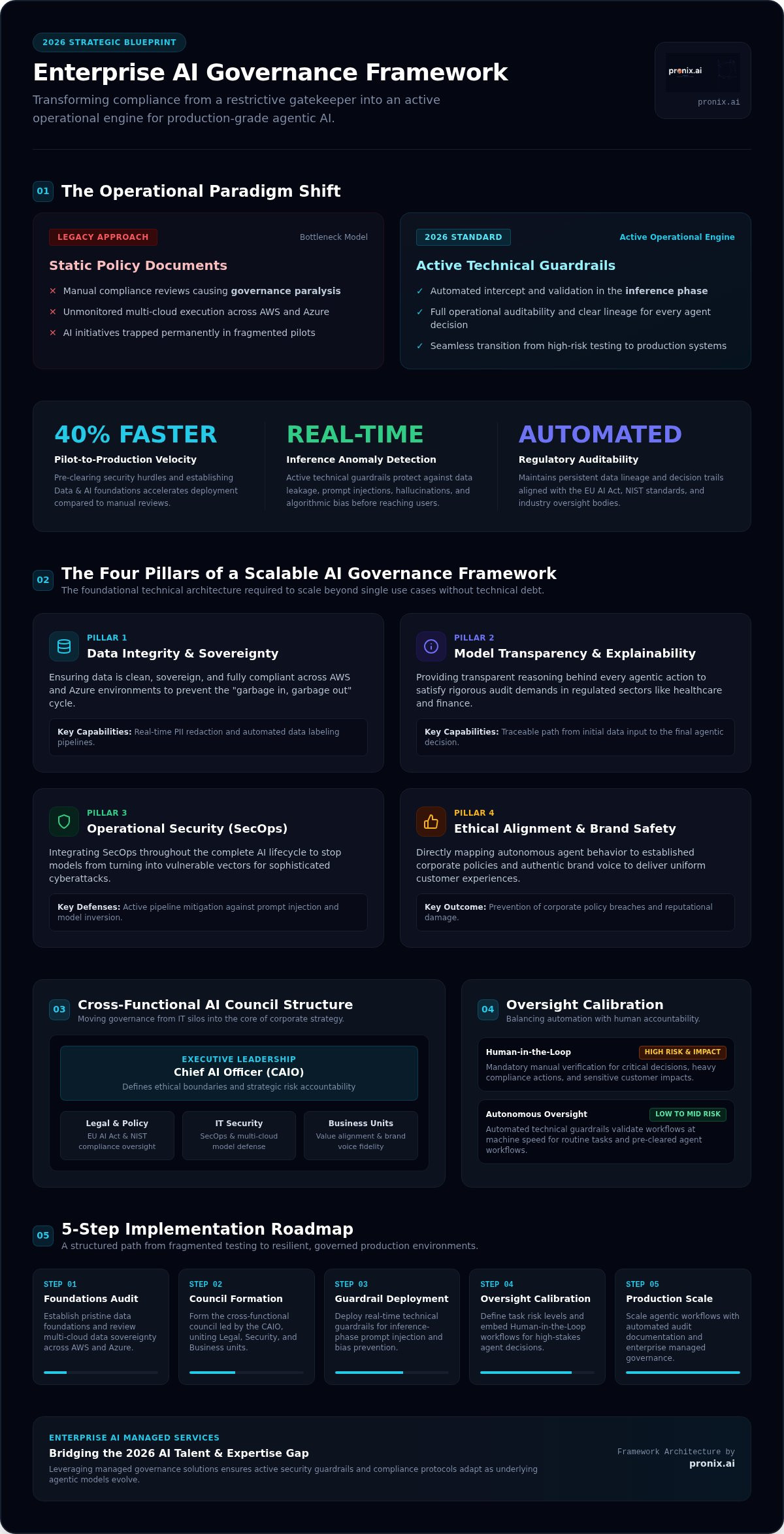
An Enterprise AI governance framework is no longer a collection of static policy documents sitting on a corporate server. In 2026, it's a dynamic, technical system of rules and automated controls that ensures every model, agent, and data stream remains ethical, transparent, and secure. The transition from "Static Governance" to "Active Governance" defines this era. While legacy frameworks focused on manual approvals, modern systems utilize technical guardrails that intercept and validate AI outputs in real-time before they reach a customer or a business system.
The explosion of Agentic AI makes this shift mandatory. When autonomous agents execute workflows across multi-cloud environments, the risk of "governance paralysis" is high. Organizations need a framework that provides clear data lineage and model transparency. It's about creating a traceable path from the initial data source to the final agentic decision. This level of operational auditability is the only way to satisfy the increasing demands of global AI governance and regulation while maintaining the speed required for production-ready outcomes.
The Core Objectives of Modern AI Oversight
- Risk Mitigation: You must protect the brand against data leakage, algorithmic bias, and hallucinations. Active frameworks detect these anomalies during the inference phase, preventing costly production failures.
- Compliance: Organizations must align with evolving standards like the EU AI Act and NIST. A robust framework automates the documentation required to prove compliance during external audits.
- Value Acceleration: Governance shouldn't be a bottleneck. By pre-clearing security hurdles and establishing clear "Data & AI Foundations," you can move from a pilot to a production environment 40% faster than teams relying on manual reviews.
Who Owns Governance? The Cross-Functional AI Council
Ownership has shifted. The Chief AI Officer (CAIO) now leads a cross-functional council that integrates Legal, IT Security, and Business Unit leaders. This group doesn't just manage risk; they define the ethical boundaries for autonomous agents. Accountability is the priority. When an AI agent makes a high-stakes decision, the council ensures there's a clear "Human-in-the-Loop" protocol for oversight. This structure moves governance out of the IT silo and into the heart of corporate strategy, ensuring that AI outcomes directly support business objectives without introducing unmanaged liability.
The Four Pillars of a Scalable AI Governance Framework
A scalable Enterprise AI governance framework rests on four distinct pillars that transform abstract policy into technical reality. These foundations ensure your systems remain within the guardrails of safety and corporate compliance. Without these pillars, scaling beyond a single use case creates unmanageable technical debt and legal risk. By focusing on these core areas, you move from "governance paralysis" to a state of operational maturity where innovation and safety coexist.
- Data Integrity & Sovereignty: High-quality outputs depend on pristine "Data Foundations for Generative AI." You must ensure data is clean, compliant, and sovereign across AWS and Azure environments. This prevents the "garbage in, garbage out" cycle that stalls most pilots.
- Model Transparency & Explainability: You need to understand why an AI agent took a specific action. This isn't just for debugging; it's a legal requirement for auditability in regulated industries like healthcare and finance.
- Operational Security (SecOps): Protecting pipelines from prompt injection and model inversion is critical. SecOps must be baked into the AI lifecycle, ensuring that your models don't become vectors for cyberattacks.
- Ethical Alignment: Mapping AI behavior to your brand voice ensures consistent customer experiences. It prevents the reputational damage caused by agents that deviate from corporate values or policy.
Data Foundations: The Bedrock of Governed AI
Transitioning to production requires a robust enterprise data strategy for AI. This strategy prioritizes automated data labeling and real-time PII (Personally Identifiable Information) redaction. In multi-cloud architectures, managing data sovereignty is a primary friction point. You need automated workflows that ensure data stays in its designated jurisdiction while still feeding the models that drive your business. This level of control is essential for maintaining privacy standards without sacrificing the performance of your agentic systems.
Model and Agent Oversight
Effective oversight requires rigorous version control for both LLMs and custom agents. You must monitor for "model drift," where performance degrades as real-world data evolves. Establishing "Agentic Guardrails" limits the scope of autonomous actions, preventing agents from making unauthorized commitments or accessing restricted datasets. This approach aligns with the NIST AI Risk Management Framework, which emphasizes the need to map, measure, and manage risks throughout the AI lifecycle. To accelerate this transition, many leaders choose to partner with specialized AI consultants to build these foundations properly from day one.
Human-in-the-Loop vs. Autonomous Oversight
The "Governance Paradox" defines the 2026 landscape. You need the speed of autonomous agents to remain competitive, but you cannot sacrifice the human accountability that protects your license to operate. A robust Enterprise AI governance framework must distinguish between tasks that require split-second automation and those that demand human judgment. This isn't just about safety; it's about operational efficiency. Forcing a human into every low-stakes loop creates a bottleneck that negates the value of AI. Conversely, removing the human from high-stakes decisions introduces existential risk to the brand.
Consider the difference in risk profiles. In healthcare diagnostics, the framework mandates high-human oversight because the cost of error is life-altering. However, in CX ticket routing, the risk is low. An autonomous agent can categorize thousands of requests per minute without human intervention. This tiered approach aligns with the OECD AI Principles for trustworthy AI, which emphasize that oversight should be proportional to the impact. Human-in-the-loop serves as the ultimate fail-safe for enterprise-grade AI auditability.
When to Mandate Human Intervention
Certain triggers must automatically pause autonomous workflows. Financial transactions that exceed specific enterprise thresholds require a human signature to proceed. In the context of AI-driven CX modernization, sensitive customer interactions, such as formal complaints or high-value contract negotiations, should be escalated to a human expert. Any AI-generated legal or medical documentation must undergo a manual review before it's finalized or distributed. These checkpoints ensure that technology serves as an assistant, not a replacement for professional liability.
Automating Governance with AI Agents
To solve the scale problem, enterprises are now using "Governance Agents" to monitor "Production Agents" 24/7. These specialized agents act as a real-time audit layer. They enforce policy via automated API gateways, blocking any agentic action that violates pre-defined safety parameters. This setup reduces the "Compliance Tax" by automating the generation of audit logs and performance reports. By using AI to govern AI, you maintain the momentum of production while ensuring every decision is recorded and validated against corporate policy. This dual-layered approach allows for rapid scaling while maintaining a rigorous, evidence-based oversight system.
How to Implement Your Governance Framework: A 5-Step Roadmap
Implementing a robust Enterprise AI governance framework requires a structured, phase-based approach. You cannot simply flip a switch on compliance. It's a journey from initial risk assessment to fully automated oversight. This roadmap ensures your production outcomes are stable, secure, and aligned with corporate mandates. By following these five steps, you transform governance from a theoretical hurdle into an operational engine.
- Step 1: Conduct an AI Readiness and Risk Assessment to identify high-impact vulnerabilities.
- Step 2: Define Policy and Ethical Guardrails that reflect your brand's core values.
- Step 3: Build the Technical Governance Layer to automate data security and model validation.
- Step 4: Deploy Pilot Projects under the new framework to test guardrail efficacy.
- Step 5: Scale and Iterate via continuous monitoring and real-time performance feedback.
Phase 1: Strategy and Policy Alignment
Success starts with a thorough audit of your legacy systems and existing data silos. You must understand where your data lives before you can govern how AI interacts with it. Developing a responsible AI adoption strategy is essential for securing leadership buy-in and establishing a clear vision for the AI council. This phase involves mapping internal policies directly to external regulatory requirements, including HIPAA, GDPR, and CCPA. It's about ensuring your framework isn't just compliant today, but resilient enough to handle the regulatory shifts of 2026.
Phase 2: Technical Execution and Scaling
Once the policy is set, you must integrate governance tools directly into your multi-cloud architecture. Whether you're utilizing AWS, Azure, or Salesforce Agentforce, the technical layer must be invisible but absolute. Setting up automated dashboards for "Enterprise AI Risk Mitigation" allows for real-time visibility into model drift and agent behavior. Training is the final piece of the puzzle. You must equip your employees with the best practices for governed AI usage. If your internal team lacks the bandwidth to manage this transition, consider engaging with Agentic AI Strategy & Consulting to accelerate your roadmap. This phase moves you beyond the pilot stage, enabling you to scale production-ready agents with confidence.
Managed Governance: Solving the AI Talent Gap
The reality of 2026 is a severe talent deficit. The demand for AI governance experts has far outpaced the supply. Building a robust Enterprise AI governance framework requires specialized knowledge in data architecture, legal compliance, and model security. Most organizations find that hiring a full in-house team is slow and prohibitively expensive. This is where enterprise AI automation managed services bridge the expertise gap. These services provide "Governance as a Service," offering continuous auditing, expert model tuning, and 24/7 monitoring.
Continuous auditing ensures that every agentic interaction is logged and analyzed for policy violations. Expert tuning allows your models to adapt to new data without losing their ethical alignment. This 24/7 monitoring layer acts as a digital safety net, catching hallucinations or security breaches before they impact your customers. A systems integrator like Pronix Inc is the logical choice for long-term stability. They provide the operational maturity needed to maintain high-stakes AI pipelines across complex environments. This model ensures that your governance protocols evolve as fast as the underlying technology.
Managed Services vs. In-House Governance
Building an internal AI SecOps team involves significant hidden costs. Recruitment, retention, and ongoing training for elite roles create a heavy financial burden. You aren't just paying for salaries; you're investing in the constant upskilling required to stay ahead of emerging threats. Accessing enterprise AI talent as a service allows you to bypass these hurdles while strengthening your Enterprise AI governance framework. You gain immediate access to practitioners who understand the friction points of modernizing legacy systems. This partnership ensures your "Production-Ready Outcomes" remain consistent as technology evolves, providing a more predictable cost structure than an internal build.
Next Steps: Moving Beyond the Pilot
It's time to move beyond the pilot. The first step is requesting an AI Governance Audit from pronix.ai. This assessment identifies the gaps between your current operations and a fully "Governed Enterprise" state. Transitioning from fragmented pilots to a unified, governed environment is the only way to achieve national-scale results. You need a partner who prioritizes transparency and evidence over hype. Stop letting governance paralysis stall your innovation. It's time to implement a repeatable blueprint for safety. Scale your AI with confidence—Contact pronix.ai today.
Scaling with Confidence in the Age of Agentic AI
The shift toward autonomous agents requires an evolution in how we view compliance. Moving from static policy documents to a technical Enterprise AI governance framework is what separates high-performing organizations from those stalled in pilot purgatory. You've seen how the four pillars of data integrity, model transparency, security, and ethics create the stability needed for production. By implementing a tiered oversight model, you protect your brand while maintaining the momentum of your AI initiatives.
Success in 2026 depends on operational maturity. As an AWS and Microsoft Certified Partner, Pronix specializes in regulated industry compliance and building the data foundations that drive real business value. We focus on production-ready outcomes so you can deploy with certainty. Secure Your AI Future: Download the 2026 Governance Blueprint. Your path to a fully governed enterprise starts with a single strategic step.
Frequently Asked Questions
What are the core components of an enterprise AI governance framework?
The core components include data integrity, model transparency, operational security, and ethical alignment. An Enterprise AI governance framework requires technical guardrails that monitor agentic behavior in real-time to prevent hallucinations. It also includes an organizational structure, such as an AI Council led by a Chief AI Officer. These elements ensure every autonomous decision is traceable and aligns with corporate policy, moving systems from risky pilots to production-ready outcomes.
How does AI governance differ for regulated industries like finance and healthcare?
Governance in finance and healthcare requires higher human oversight and stricter data sovereignty protocols. These sectors must adhere to specific mandates like HIPAA or financial audit requirements that demand absolute data lineage. While a standard framework might automate most routing, regulated environments mandate manual reviews for high-stakes decisions. This ensures that AI outputs don't violate legal standards or compromise sensitive patient and financial data during multi-cloud deployments.
Can an AI governance framework help reduce operational costs?
Yes, it reduces costs by streamlining the path from pilot to production and lowering "compliance taxes" through automation. A well-implemented framework prevents expensive security breaches and reputational damage caused by unmanaged model drift. By using automated dashboards for risk mitigation, enterprises scale their AI agents without hiring massive internal oversight teams. This efficiency accelerates time-to-market and lowers the long-term total cost of ownership for AI-driven business automation.
What is the role of 'explainability' in AI governance?
Explainability provides the technical evidence for why an AI agent took a specific action. It's the bridge between a "black box" model and an auditable enterprise system. Without it, you cannot verify if a decision was biased or based on incorrect data. High-quality explainability allows your legal and security teams to validate autonomous workflows, ensuring every outcome is transparent and defensible during internal reviews or external regulatory audits.
How do I ensure my AI agents comply with the EU AI Act?
Compliance requires categorizing your AI applications by risk level and implementing the corresponding technical controls. You must maintain detailed documentation of your model training, data sources, and human oversight protocols. Using an Enterprise AI governance framework that automates audit logging is the most efficient way to meet these international standards. It ensures your agents operate within the legal boundaries of the EU while maintaining the speed of your domestic enterprise operations.
Is it possible to automate the AI audit process?
Automation is essential for managing the scale of 2026 agentic systems. You can deploy specialized "Governance Agents" that monitor production agents 24/7, logging every interaction and flagging policy deviations in real-time. This reduces the manual burden on your IT security teams and provides a continuous, evidence-based audit trail. Automated API gateways can also block unauthorized actions instantly, ensuring your systems remain compliant without requiring constant human intervention for low-stakes tasks.
What is the difference between AI security and AI governance?
AI security focuses on protecting the technical pipeline from external threats like prompt injection or data poisoning. AI governance is a broader strategic system that includes security but also covers ethics, compliance, and business alignment. While security keeps the system running, governance ensures the system is doing the right thing according to corporate values and legal mandates. Both are necessary to move AI from experimental pilots to secure, scalable production environments.
How often should an enterprise AI governance framework be updated?
Your framework should be a living system that updates alongside technological shifts and new regulatory releases. Most leaders review their core policies quarterly while maintaining "Active Governance" tools that adapt to model drift in real-time. As you implement new agentic capabilities or enter new regulated markets, you must recalibrate your risk thresholds. Continuous iteration ensures your governance remains a competitive advantage rather than a static bottleneck to innovation.