

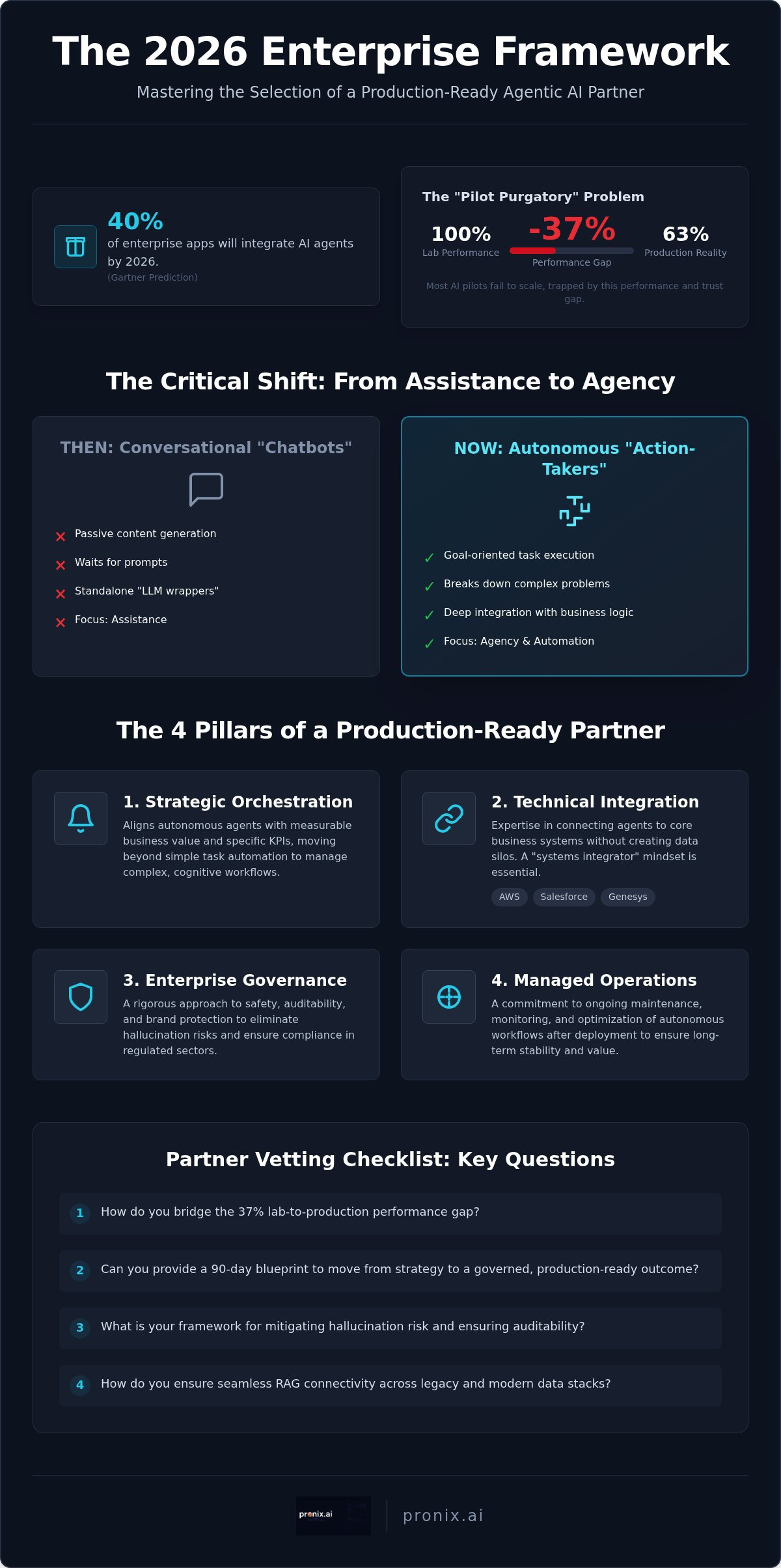
Gartner predicts that 40% of enterprise applications will be integrated with task-specific AI agents by the end of 2026. Despite this rapid adoption, there is a documented 37% gap between lab performance and production reality. Most executives agree that while pilots are easy, scaling autonomous agents without damaging brand reputation is exceptionally difficult. You're likely facing high operational friction when trying to integrate these agents with legacy systems. Choosing an agentic AI implementation partner today requires a shift in focus from model capabilities to orchestration and governance.
This article provides the 2026 Enterprise Selection Framework to help you master the criteria for selecting a partner that moves autonomous agents from experimental pilots to secure, high-scale production outcomes. We will preview the technical vetting process, strategic alignment requirements, and the risk mitigation steps necessary for a zero-risk transition to autonomous customer and employee experiences. By the end of this guide, you'll have a clear roadmap to reduce time-to-value and ensure your agentic workflows are stable, auditable, and ready for the 2026 regulatory environment.
Key Takeaways
- Shift your selection strategy from conversational "chatbots" to autonomous "action-takers" capable of executing complex workflows in live production environments.
- Master a 2026 framework for choosing an agentic AI implementation partner that prioritizes strategic orchestration and deep technical integration over model-only experimentation.
- Identify the critical data foundation requirements needed to support Retrieval-Augmented Generation (RAG) and seamless connectivity across AWS, Salesforce Agentforce, and Genesys stacks.
- Bridge the "Trust Gap" by vetting partners for rigorous governance frameworks that mitigate hallucination risks and ensure compliance in regulated sectors like finance and healthcare.
- Utilize a practitioner-led checklist to verify a partner's ability to navigate the 37% performance gap between laboratory pilots and high-scale enterprise outcomes.
Beyond the Pilot: Why 2026 Demands a New Breed of AI Partner
The era of the experimental chatbot ended in 2025. In 2026, enterprise leaders are pivoting toward agentic AI, shifting from passive content generation to autonomous, goal-oriented systems. These agents don't just summarize data; they execute complex tasks across your business stack. However, moving from a sandbox to a live environment is where most initiatives stall. Industry data reveals a 37% gap between lab performance and production reality, leaving many organizations trapped in "pilot purgatory."
Success requires more than a prompt engineer. It demands a partner capable of wiring intelligence into the core logic of your organization. When choosing an agentic AI implementation partner, your selection criteria must prioritize operational maturity over speculative hype. The complexity of autonomous workflows means traditional digital transformation partners often lack the specific orchestration skills needed to manage agents that can independently update CRM records or resolve multi-step customer service tickets.
The Shift from Generative to Agentic AI
Generative AI was about assistance; agentic AI is about agency. Traditional LLM applications wait for a prompt to generate text or code. In contrast, an autonomous agent pursues a defined goal by breaking it into sub-tasks, selecting the right tools, and executing actions. This transition requires deeper integration into core business logic and APIs. For example, a production-ready agent in 2026 must navigate multi-agent orchestration, where different agents collaborate to solve a single request. If your partner treats AI as a standalone layer, your project will remain a curiosity rather than a competitive advantage.
Why Generalist Consultants Fail at Scale
Many firms offer high-level strategy but lack the "boots-on-the-ground" pragmatism required for technical execution. They often build "LLM wrappers" that look impressive in a demo but fail when integrated with legacy data silos. Choosing an agentic AI implementation partner with a systems integrator mindset is essential for 2026. Generalist consultants frequently overlook the friction points of modernizing legacy systems, leading to high operational costs and brand-damaging hallucinations. You need a partner who understands the specific architectures of platforms like AWS, Salesforce Agentforce, and Genesys Cloud AI. Results-oriented deployment requires a disciplined framework, such as a 90-Day Blueprint, to move from strategy to a governed, production-ready outcome without the typical integration delays.
The Four Pillars of a Production-Ready Agentic AI Partner
Moving from a successful pilot to a production-ready outcome requires a framework that balances speed with stability. Choosing an agentic AI implementation partner is a high-stakes decision that dictates your long-term operational agility. To avoid the traps of "pilot purgatory," you must evaluate potential partners based on four foundational pillars designed for enterprise scale.
- Strategic Orchestration: The ability to align autonomous agents with measurable business value and specific KPIs.
- Technical Integration: Expertise in connecting agents to core AWS, Salesforce, and Genesys stacks without creating data silos.
- Enterprise Governance: A rigorous approach to safety, auditability, and brand protection to eliminate hallucination risks.
- Managed Operations: A commitment to the ongoing maintenance and optimization of autonomous workflows post-deployment.
A partner must demonstrate maturity in each area to ensure your investment translates into a competitive advantage. When evaluating AI consulting partners, look for evidence of practitioner-led success rather than theoretical frameworks. This discipline ensures that your agents remain secure, compliant, and integrated with the systems your employees and customers use every day.
Strategic Orchestration vs. Simple Automation
Simple automation handles repetitive, linear tasks. Orchestration manages cognitive workflows that require autonomous decision-making. Your partner should prioritize high-impact, low-risk business processes to prove value quickly. They should guide you using a structured Enterprise Agentic AI: 2026 Production Guide to ensure every agent workflow maps to a clear financial outcome, such as cost reduction or increased resolution speed. This strategic alignment prevents the deployment of "technology for technology's sake."
The Managed Services Advantage
The "set it and forget it" mindset is a recipe for failure in 2026. Agents are dynamic systems. They can experience "agent drift" or develop new hallucination patterns as the underlying models evolve. Managed services provide the specialized talent needed to monitor these autonomous workflows long-term. This proactive oversight ensures your customer and employee experiences remain reliable and effective over time. For organizations ready to bridge the gap between strategy and production, exploring Agentic AI Strategy & Consulting can provide the necessary stability for a high-scale rollout.
Evaluating the Technical Stack: Platforms and Integration Expertise
Integration is the primary failure point for enterprise AI. A partner's technical depth determines whether your agents become operational assets or expensive liabilities. Choosing an agentic AI implementation partner requires a rigorous audit of their ability to orchestrate intelligence across your existing stack. It's not enough to build a standalone agent; the solution must communicate seamlessly with AWS, Microsoft, Salesforce, and Genesys environments. This requires a systems integrator mindset that prioritizes backend connectivity over front-end aesthetics.
Cross-platform orchestration is the next frontier. Agents must navigate siloed applications to retrieve data and execute tasks. For organizations modernizing their customer experience, this means integrating with platforms like Amazon Connect or NICE. These tools provide the infrastructure, but the partner provides the logic. They must ensure that an agent can trigger a workflow in your CRM based on a voice interaction in your contact center. This level of synchronization is what separates a production-ready system from a high-cost experiment.
Platform-Agnostic vs. Platform-Deep Expertise
True proficiency requires more than a general understanding of cloud services. Your partner must understand the specific nuances of Salesforce Agentforce implementation to leverage its native action-taking capabilities. They should also possess deep technical depth in AWS Bedrock and the Microsoft Agent Framework v1.0, which reached general availability in April 2026. Choosing an agentic AI implementation partner with this specialized knowledge allows you to bridge the gap between best-of-breed tools. This ensures your architecture remains flexible enough to adopt new models without rebuilding your entire orchestration layer.
Engineering Data for Agentic Success
Data is the fuel for agentic reasoning. Without a robust data foundation, agents will hallucinate or fail to complete tasks. Vetting a partner's data engineering capabilities is non-negotiable. They must be able to architect the Retrieval-Augmented Generation (RAG) pipelines that provide agents with real-time, context-aware information. This process requires a disciplined Enterprise AI Data Strategy: 2026 Production Foundation to ensure every piece of data is clean, accessible, and auditable. Auditability is especially critical; you must be able to trace an agent's decision back to its specific data source to maintain compliance and brand trust.
Risk Mitigation: Vetting for Governance, Security, and Compliance
Autonomous agents move beyond conversation to execution. This shift creates a significant "Trust Gap" where a single hallucination can lead to unauthorized financial transactions or leaked patient data. When choosing an agentic AI implementation partner, governance isn't a secondary feature. It's the primary architecture. You need a partner who ensures every autonomous action is traceable, explainable, and compliant with the evolving 2026 regulatory landscape. Trust is built through rigorous risk-mitigation protocols, not speculative promises.
Auditability is the cornerstone of responsible AI adoption. In a production environment, you must be able to explain why an agent took a specific action during a regulatory review. Following the NIST AI Risk Management Framework has become a de facto standard for US enterprises. Your partner should provide a technical "harness" that monitors agent behavior in real-time. This prevents sensitive data leaks and ensures that autonomous workflows remain within predefined ethical and operational boundaries.
The 90-Day Blueprint for Governed Deployment
Safety shouldn't slow you down. Vetting for a partner with a structured, time-bound approach is essential. A "90-Day Blueprint" moves your project from experimental status to production-ready by integrating governance at the design phase. Early-stage guardrails prevent late-stage production failures. This disciplined methodology allows you to deploy agents without risking your brand reputation. It transforms speculative technology into a stable, auditable business asset that delivers immediate value.
Compliance in Regulated Markets
Regulated industries like Healthcare and Finance face unique pressures. As of August 2026, the EU AI Act and the California AI Transparency Act impose strict disclosure and risk management duties. Non-compliance is expensive. You must ask potential partners about data residency, model transparency, and their history in high-stakes environments. Vetting for experience in HIPAA or SEC/FINRA environments is non-negotiable for long-term stability.
The role of managed services for agentic AI is critical here. It provides the continuous monitoring required to maintain compliance as regulations evolve. A partner with a history in complex organizations will prioritize these protocols over speed alone. If you're ready to secure your autonomous workflows, consider a partner specialized in Agentic AI Implementation to bridge the gap between innovation and safety.
The Selection Framework: Final Checklist for Decision Makers
Choosing an agentic AI implementation partner is the final hurdle in moving from experimental theory to production-ready reality. By 2026, the market is saturated with "AI consultants" who lack the technical depth to manage autonomous workflows at scale. Decision makers must apply a rigorous framework to separate high-level strategists from the practitioners who can actually deliver outcomes. This checklist ensures your selection aligns with the operational maturity required for enterprise-grade deployment.
- Step 1: Verify practitioner-led experience. Demand to see production case studies rather than pilot decks. A partner must prove they've navigated the 37% performance gap between laboratory testing and live environments.
- Step 2: Audit technical depth in your specific stack. Ensure the partner has deep, certified expertise in AWS, Salesforce Agentforce, or Genesys Cloud. Generalist knowledge is no longer sufficient for complex API orchestration.
- Step 3: Evaluate the managed services model. Autonomous agents require continuous monitoring for drift and hallucinations. A partner without a long-term operational support model is a liability.
- Step 4: Confirm a "Governance-First" methodology. Risk mitigation and auditability must be integrated into the architecture from the first day of development.
- Step 5: Test for strategic vision. Your partner should be able to map current agentic workflows to your three-year business roadmap, ensuring the technology evolves with your organization.
Red Flags to Watch For in AI Proposals
Proposals that prioritize "cool tech" over "business outcomes" are a primary red flag. Avoid "Black Box" solutions that offer no clear path to auditability or explainability. If a partner cannot explain why an agent took a specific action, they cannot meet 2026 regulatory requirements. Be wary of firms that lack a specialized AI-first business unit. Generalist digital transformation firms often lack the "boots-on-the-ground" pragmatism needed to modernize legacy systems without causing operational friction.
Why pronix.ai is the Practitioner’s Choice
Pronix.ai stands as the preferred partner for enterprises that value stability and results. As a division of Pronix Inc., we leverage over 15 years of stability in systems integration to bridge the gap between strategy and production. We don't just build agents; we manage them through their entire lifecycle. Our approach to AI-driven CX modernization and business automation is grounded in reality, utilizing "90-Day Blueprints" to ensure governed, secure, and scalable outcomes. We provide the elite technical depth required to turn autonomous agents into high-performing enterprise assets.
Securing Your Path to Autonomous Production
The transition from experimental AI to autonomous execution is the defining challenge of 2026. Success rests on your ability to integrate intelligence into core business logic while maintaining rigorous governance. By prioritizing technical depth and long-term operational support, you bridge the gap between speculative pilots and scalable enterprise outcomes. This framework ensures your agents deliver measurable value without compromising brand reputation or security.
Choosing an agentic AI implementation partner is a strategic decision that determines your organizational agility for years to come. You need a practitioner who understands the friction points of legacy modernization and the nuances of platforms like AWS, Salesforce Agentforce, and Genesys Cloud. With over 15 years of enterprise technology expertise, Pronix.ai provides the practitioner-led approach and dedicated managed services required for sustained success in a complex regulatory environment.
Don't let your transformation stall in the sandbox. Move your AI agents from pilot to production with pronix.ai. The future of autonomous CX and business automation is ready for deployment. Your journey toward a results-oriented, production-ready enterprise starts with the right partner.
Frequently Asked Questions
What is the difference between an AI consultant and an Agentic AI implementation partner?
An AI consultant typically focuses on high-level strategy and feasibility studies. In contrast, an agentic AI implementation partner specializes in the technical orchestration and backend integration required for autonomous action. Choosing an agentic AI implementation partner ensures your organization moves beyond conversational chat to systems that execute tasks. These partners possess the specialized engineering talent to connect AI intelligence with core enterprise APIs, legacy data foundations, and complex business workflows for production-ready results.
How long does it typically take to move an AI agent from pilot to production?
Most enterprise-grade agents can transition from a pilot to a production environment within 90 days. This timeline is achieved through a structured approach like our "90-Day Blueprint," which prioritizes high-impact, low-risk workflows. Moving faster often compromises governance, while slower timelines lead to "pilot purgatory." A disciplined framework allows for the rapid engineering of data architectures and the establishment of risk-mitigation guardrails necessary for a secure, high-scale rollout across the organization.
Why is managed services essential for Agentic AI in 2026?
Managed services are essential because autonomous agents are dynamic systems that require continuous oversight. Unlike traditional software, AI agents can experience "agent drift" or develop new hallucination patterns as underlying models and data environments evolve. In 2026, a dedicated managed services model provides the proactive monitoring and optimization needed to maintain brand reputation. This ongoing support ensures that your autonomous workflows remain secure, compliant, and effective long after the initial implementation phase is complete.
How do we ensure our AI agents remain compliant with industry regulations?
Compliance is maintained through a "governance-first" architecture and adherence to frameworks like the NIST AI Risk Management Framework. Your partner must integrate real-time monitoring and technical "harnesses" that track every autonomous action. This ensures transparency and auditability for regulatory reviews under the EU AI Act or California’s AI Transparency Act. By engineering data foundations with strict residency and privacy protocols, you can safely deploy agents in highly regulated sectors like healthcare and finance.
What platforms are best for enterprise-scale Agentic AI orchestration?
Enterprise-scale orchestration is best handled through robust cloud ecosystems and specialized CX platforms. AWS Bedrock and the Microsoft Agent Framework provide the foundational infrastructure for complex reasoning. For customer-facing roles, Salesforce Agentforce and Genesys Cloud AI offer native action-taking capabilities that integrate directly with your CRM and contact center data. A skilled partner bridges the gap between these best-of-breed tools to create a unified, platform-agnostic orchestration layer that avoids vendor lock-in.
Can Agentic AI integrate with our existing legacy contact center software?
Yes, agentic AI is designed to bridge the gap between modern intelligence and legacy contact center software. A practitioner-led partner uses custom APIs and middleware to connect autonomous agents with older systems like NICE or traditional on-premise infrastructure. This modernization allows you to automate multi-step workflows without a complete rip-and-replace of your existing technology. Integration experts focus on creating a seamless data flow that empowers agents to retrieve information and execute tasks across siloed environments.
How do we measure the ROI of an Agentic AI implementation partner?
Measuring ROI involves tracking specific operational KPIs such as reduced time-to-value, increased resolution speed, and significant cost reductions in service workflows. You should also evaluate the reduction in operational friction and the acceleration of employee productivity. A successful partnership moves agents into production quickly, avoiding the sunk costs associated with failed pilots. By mapping AI outcomes to your three-year business roadmap, you can quantify the financial impact of improved customer and employee experiences.
What are the biggest risks of choosing the wrong AI partner in 2026?
The biggest risks include brand-damaging hallucinations, sensitive data leaks, and being trapped in "pilot purgatory." Choosing an agentic AI implementation partner without deep technical depth often leads to high integration costs and systems that fail to scale. If a partner lacks a rigorous governance framework, your organization faces legal and financial liabilities under new AI regulations. Ultimately, a poor choice results in a 37% performance gap between laboratory testing and the actual production outcomes your business requires.