

An AI proposal earns approval when it solves a business problem, not when it promises a more impressive technology stack. That’s the difference between getting executive buy-in for AI and adding another pilot to the roadmap.
Executives are right to ask hard questions. What measurable outcome will change? What baseline supports the projected value? Who owns the system, and how will the organization manage security, compliance, reliability, and reputational risk? Without clear answers, even a promising use case can stall before it reaches production.
This article shows you how to connect AI to a strategic priority, build a defensible business case, and address leadership concerns with practical safeguards. You’ll learn what to include in a decision-ready proposal, from measures and governance to investment and operational ownership. You’ll also see how to request a bounded next step, such as a governed pilot, with success criteria and a decision point for whether to scale, revise, or stop.
Key Takeaways
- Make getting executive buy-in for AI easier by tying a defined business problem to strategic priorities, not model features.
- Build a case leaders can evaluate: establish a baseline, distinguish measured benefits from assumptions, and explain how assumptions will be tested.
- Address risk alongside potential value by naming failure modes, safeguards, accountable owners, and where human oversight remains necessary.
- Shape the proposal around the decision required, its scope, the expected outcome, and the controls, while aligning stakeholders on their roles.
- Treat approval as the start of governed execution, with clear decision criteria guiding the path from strategy through implementation and ongoing operations.
Why AI Proposals Lose Executive Support Before the Business Case Is Clear
Interest in AI may be visible across an organization. Teams test new tools, leaders ask about automation, and competitors’ announcements create pressure to respond. But visible interest is not the same as an approvable decision. Proposals lose support when they lead with model capabilities, feature counts, or impressive demonstrations instead of explaining what business constraint needs to change and how leaders will judge success.
That distinction matters for getting executive buy-in for AI. A model’s ability to summarize, classify, or generate content is not, by itself, a strategic rationale. Executives need to understand who benefits, what work or customer experience changes, and what trade-offs the organization accepts. A foundational view of understanding artificial intelligence can clarify the range of applications, but the proposal still needs to show why a particular application belongs in this business.
Executive buy-in is funded, accountable commitment to a defined business outcome, with an owner responsible for delivering and measuring it. A general mandate to “do more with AI” does not meet that standard. It signals interest but leaves the problem, investment decision, and accountability unresolved.
Start with the business constraint, not the AI technology
Describe the bottleneck before naming a solution. Identify who experiences it, where it occurs, and how the current process handles the work. For example, a customer service team may spend time searching across knowledge sources to answer routine questions. That describes an operational friction point. “Deploy a generative AI assistant” describes a possible capability, not the business change itself.
Keep the desired outcome separate from the proposed technology. It might be faster access to approved information, fewer manual handoffs, or a more consistent customer experience. AI may help achieve that outcome, but the proposal should explain what would improve before settling on a specific capability.
- Problem: What task, delay, or customer friction needs attention?
- People: Which employees, customers, or teams experience it?
- Current process: What steps, tools, and human judgments are involved today?
- Desired change: What observable difference would make the effort worthwhile?
Recognize the concerns behind executive hesitation
Leaders may be weighing uncertain value, delivery effort, data readiness, operating ownership, and whether teams can absorb a new workflow. These questions are connected. A proposal can identify a promising use case yet remain difficult to approve if nobody owns implementation, oversight, or the transition into day-to-day operations.
Unsupported benefit claims erode trust. If a proposal predicts large gains without explaining how they will be measured, executives cannot distinguish evidence from aspiration. State what is known, what remains an assumption, and what evidence would resolve the uncertainty. Responsible scrutiny is part of the decision, not automatic opposition.
That scrutiny can sharpen the proposal. It prompts the team to expose dependencies, define limits, and clarify accountability before funding is committed. The goal is not to eliminate every uncertainty upfront. It is to make open questions visible and show how the organization will manage them.
Turn an AI Use Case into a Business Case Executives Can Evaluate
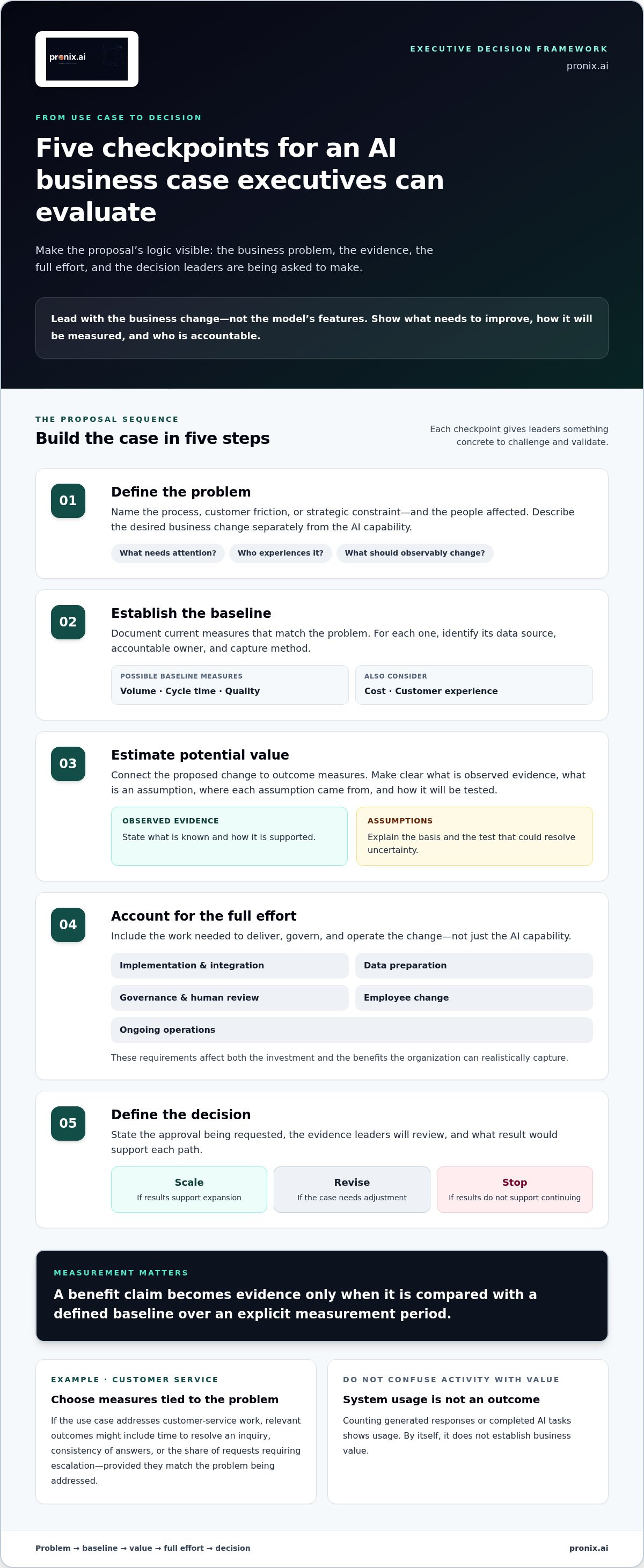
A credible business case makes its logic visible: which business problem matters, what it costs today, how an AI-enabled change could improve it, and what evidence will support the decision. Give leaders a sequence they can challenge and validate, rather than presenting a headline return as if it were guaranteed.
- Define the problem. Specify the process, customer friction, or strategic constraint and the people affected. Describe the desired business change separately from the AI capability being considered.
- Establish the baseline. Document current volume, cycle time, quality, cost, or experience measures. Identify the data source, accountable owner, and method used to capture each measure.
- Estimate potential value. Connect the proposed change to one or more outcome measures. Separate observed evidence from assumptions, explain where each assumption came from, and state how it will be tested.
- Account for the full effort. Include implementation, integration, data preparation, governance, human review, employee change, and ongoing operations. These requirements affect both the investment and the benefits the organization can realistically capture.
- Define the decision. State what approval is being requested, what evidence will be reviewed, and what result would support scaling, revising, or stopping the initiative.
Benefits are meaningful only against a defined baseline and an explicit measurement period. Without both, improvement is a claim, not evidence.
Set a baseline and choose outcome measures
Choose measures that reflect the business objective, not model activity. A count of generated responses or completed AI tasks shows system usage, but doesn’t establish business value. For a customer-service use case, relevant measures might include time to resolve an inquiry, consistency of answers, or the share of requests requiring escalation, provided they match the problem being addressed.
Record how each measure is calculated, where the data comes from, who owns it, and the period it represents. Check that the baseline reflects normal process variation. Also confirm that the measurement approach can distinguish a real change from seasonal shifts or other operational changes. If the outcome is faster resolution, for example, define when the clock starts and stops and how reopened inquiries are counted.
Build a transparent value and investment case
Use conservative scenarios rather than a single optimistic forecast. Label assumptions about adoption, task eligibility, review effort, and expected process change. For each assumption, name the evidence available and how a bounded test could validate or revise the estimate. This makes uncertainty assessable instead of hiding it inside a projected return.
Include the work required to make the use case reliable in operation: integration with enterprise systems, governance and security controls, human oversight, staff training, and ongoing monitoring and maintenance. MIT’s discussion of addressing AI risks for executive approval reinforces why risk ownership belongs in the decision alongside expected value. For implementation context, the enterprise AI production guide connects the business case to the practical demands of production. Organizations planning that path can also explore pronix.ai’s enterprise AI strategy and implementation.
Address AI Risk, Governance, and the Objection That Can Stop Approval
Uncertain returns are difficult to defend. Unmanaged risk is harder. Executives may hesitate when a proposal describes potential gains but leaves unanswered what happens if an AI system produces an inaccurate answer, exposes sensitive information, or performs inconsistently. A credible case treats those concerns as design requirements, not footnotes. It balances expected benefits against known limitations, plausible failure modes, and the human oversight needed to keep decisions accountable.
For getting executive buy-in for AI, make each control tangible: name its owner, the evidence that will show it is working, the path for escalating an issue, and when it will be reviewed. The NIST AI Risk Management Framework (AI RMF 1.0) offers a voluntary reference for organizing risk management. It can inform a company’s approach, but it doesn’t replace organization-specific governance, accountability, or approval authority.
Make risk ownership and controls concrete
Assign responsibilities across business, technology, security, and governance teams. The business owner defines acceptable outcomes and operating limits. Technology teams manage system reliability and integration. Security and governance roles establish access rules, review risks, and retain evidence. Responsibilities may be shared, but accountability for each control should be explicit.
For a system that drafts responses using internal knowledge, specify which information it can access, when an employee must review an answer, and how questionable outputs are reported. Define what gets monitored, how incidents are escalated, and what records support an audit. If data quality, lineage, permissions, or availability shape these safeguards, the enterprise AI data strategy can help frame readiness as part of the control plan.
Be equally clear about limitations. Identify tasks the system should not handle, conditions that require human review, and the fallback process if the system is unavailable or its output is unreliable. That makes oversight operational rather than aspirational.
Use decision gates to contain uncertainty
Approval does not have to mean unrestricted deployment. Define a bounded next step and decide in advance what evidence is required before expanding scope or moving toward production. Relevant evidence could include output quality against agreed criteria, successful human escalation, access controls functioning as intended, and operational owners able to respond to issues.
Write down three outcomes before work begins:
- Proceed: Required performance, control, and readiness evidence meets the agreed criteria.
- Revise: A gap appears manageable through changes to scope, workflow, safeguards, or training, followed by another review.
- Stop: A material risk, unmet requirement, or unsupported business assumption makes continued investment unjustified.
Use each review to update the decision record. Document findings, unresolved risks, revised assumptions, and the rationale for proceeding, revising, or stopping. This gives leaders traceable evidence that safeguards were assessed and keeps difficult results from disappearing into a final report.
Align Stakeholders and Present a Decision-Ready AI Proposal
An AI proposal can make sense to its sponsor and still fail in the approval room. Finance may question the assumptions, technology leaders may see integration and support gaps, and operational teams may wonder who will change the workflow. Getting executive buy-in for AI means aligning those perspectives around one decision and making clear who approves, who delivers, and who remains accountable after launch.
Tailor the case to executive priorities
Map stakeholders before drafting the proposal. Separate decision-makers from implementers, then identify what each group needs to assess. A focused conversation with each can uncover constraints early, such as a data access dependency, a service-quality target, or an operational owner who has not yet been assigned.
- Financial leaders: Show the assumptions behind projected value, the full operating effort, and how results will be measured.
- Technology and security leaders: Describe integration needs, data access boundaries, controls, support ownership, and dependencies on existing systems.
- Business sponsors: Explain the workflow change, adoption responsibilities, intended service or process improvement, and who is accountable for the outcome.
- Implementers and frontline teams: Clarify how work may change, where human judgment remains necessary, and how issues will be raised and resolved.
These are not separate pitches. They are different views of the same proposal. Surface disagreements directly, then identify which ones require executive direction and which teams can resolve during validation.
Make the approval request specific
Keep the decision brief and explicit. State the sponsor, bounded scope, resources requested, outcome under review, and evidence leaders should expect at the next review. Name material assumptions and dependencies, such as data access or process-owner availability, instead of burying them in technical detail.
Frame approval as a sequence, not a commitment to scale. A first phase can validate feasibility and controls within a defined scope. A later decision can consider whether the evidence supports expansion, revision, or stopping. Don’t promise results in advance. Specify what evidence would justify each path and when leaders will review it.
- Decision requested: What exactly are leaders being asked to authorize?
- Scope and ownership: Which use case, teams, and accountable sponsor are included?
- Evidence and review: What findings will be presented, by whom, and at which review point?
- Decision gates: What conditions support proceeding, revising the scope, or stopping?
A one-page decision summary can lead, with supporting detail available for deeper review. Include a simple responsibility map so approval doesn’t leave ownership ambiguous. If leaders approve validation, record the decision, open dependencies, and the person responsible for closing each one.
For a practical view of how an approved initiative can progress toward production, the enterprise AI implementation production guide provides relevant context. To connect a business case with enterprise strategy and delivery, pronix.ai’s enterprise AI capabilities bring these considerations together.
Move from Executive Approval to Governed Enterprise AI Execution
Executive approval authorizes the next decision. It doesn’t prove that the initiative is ready for production. Delivery still depends on usable data, technical integration, accountable owners, governance controls, and teams prepared to work differently. If those requirements are not carried forward from the business case, an approved initiative can lose its purpose as it moves into implementation.
Keep the original decision visible. Approved outcomes, scope, assumptions, and controls should guide delivery planning and remain reference points as new evidence emerges. That continuity turns approval into accountable execution, rather than treating the funding decision as the finish line.
Translate the approved case into delivery ownership
Assign business and technical owners before work begins. The business owner tracks whether the initiative is addressing the agreed need; technical teams manage integration, reliability, and implementation dependencies. Establish how they’ll review progress, document decisions, raise issues, and escalate when scope, risk, or assumptions change.
- Carry forward: The approved outcome, scope, assumptions, measures, and controls.
- Assign ownership: Name the people responsible for business results, technical delivery, and governance.
- Set review points: Agree when progress and evidence will be assessed, and who can approve a change in direction.
For a customer-experience initiative, connect delivery measures to the intended service improvement, not just system activity. The AI-driven CX modernization guide provides context for translating a CX use case into production-oriented outcomes.
Choose support that spans strategy and operations
Enterprise execution needs a connected path from business strategy to technical implementation. Strategy keeps the use case aligned with priorities; implementation connects AI capabilities to workflows, data, and enterprise systems. Governance must carry through both, with clear responsibilities for controls, oversight, and evidence.
Ongoing managed services can support operational continuity after implementation through continued governance, monitoring, and improvement. Operating requirements don’t end when a system is deployed. Teams still need to review performance, address issues, manage changes, and determine whether the solution remains aligned with its approved purpose.
pronix.ai helps enterprises move AI initiatives from pilots toward secure, scalable production through strategy, implementation, and managed services. Its work includes AI business automation, AI-driven CX modernization, and agentic AI implementation, with governance and operational ownership considered as part of the delivery path.
If your organization has an approved use case or is defining its next decision, pronix.ai’s enterprise AI strategy, implementation, and managed services connect planning with delivery and ongoing operations.
Turn Approval into a Disciplined Next Move
The strongest next step after approval is not automatically a larger rollout. It’s a deliberate choice about what to validate, who will own the work, and what evidence should shape the next investment decision. That discipline keeps momentum without treating approval as proof that every assumption has been resolved.
Getting executive buy-in for AI is most useful when it creates a clear path from a business priority to accountable action. pronix.ai connects strategy, implementation, and managed services across enterprise initiatives such as agentic AI, business automation, and CX modernization, with attention to measurable value and responsible operations.
If your team is defining that next move, discuss your enterprise AI initiative with pronix.ai. Bring the business outcome you want to advance and the decisions still ahead. A well-governed first step can give leaders and delivery teams a stronger basis for deciding what to do next.
Frequently Asked Questions
Is executive buy-in for AI the same as approval for a pilot?
No. Buy-in means accountable leaders support the business objective, ownership, risk approach, and decision process. A pilot is one possible approved step, not automatic permission to expand. For example, a limited test might check whether staff can use an AI tool to find approved internal guidance. Before it starts, define what it will test, who owns the work, what evidence will be reviewed, and which leaders decide the next phase.
Who should sponsor an enterprise AI initiative?
A business leader accountable for the underlying problem is usually the strongest sponsor, rather than a technology leader alone. For a customer-service use case, that could be the executive responsible for service operations. Technology, security, data, legal, and frontline operations should have defined roles based on the risks and workflow involved. The sponsor needs enough authority to resolve cross-functional barriers, support process changes, and remain accountable for decisions about value and risk.
How much detail should an AI business case include?
Include enough detail for reviewers to test the proposal’s logic without burying the decision in technical documentation. State the problem, baseline, target measures, scope, investment categories, dependencies, controls, owners, and decision gates. A concise executive summary can point to supporting analysis for finance, technology, security, and business teams. Label estimates clearly. For example, if adoption is uncertain, explain what information or user feedback will help validate the assumption.
Can an AI proposal receive executive approval without a finished ROI estimate?
Yes. Leaders can approve a bounded discovery or validation phase when the available evidence isn’t sufficient for a reliable return estimate. Be explicit about what remains unknown, what the team will investigate, and what decision will follow. For example, validation might determine whether usable data can be accessed under the proposed controls. Keep approval to learn separate from approval to scale, so further investment requires a new evidence-based decision.
What should executives review before an AI initiative moves beyond a pilot?
Executives should check whether the agreed measures were met and whether results hold under the conditions expected in routine use. Review whether operating effort, human escalation, and support responsibilities are understood, not just whether a demonstration worked. They should also assess security, data readiness, reliability, and employee adoption. Apply the decision criteria established before the pilot: proceed if requirements are met, revise if gaps are addressable, or stop if they are not.
How do you explain AI risk to nontechnical executives?
Explain risk in terms of possible business consequences and the controls that address them. For instance, describe which information a system can access, when a person reviews its output, how staff report an error, and who responds to an incident. Identify what evidence is retained and when controls are reviewed. This approach makes accountability clear without relying on model terminology or suggesting that safeguards eliminate every source of uncertainty.