

Only 29% of organizations report seeing significant returns from their AI investments in 2026, while 79% admit their projects have gone over budget. For most enterprises, the journey to AI-driven operational efficiency has stalled in a cycle of expensive, fragmented pilots that fail to reach production. You've likely felt this friction firsthand. Your teams are experimenting with models, yet data silos and compliance anxieties regarding autonomous agents keep these innovations sidelined. It's frustrating to watch spending climb while operational overhead remains stagnant.
This article provides the roadmap you need to bridge the gap between experimental "Shadow AI" and a governed, agentic operational model. We'll explore how to dismantle silos, implement auditable workflows, and finally secure the enterprise-scale ROI that has remained elusive for so many. By moving from isolated tasks to governed agentic orchestration, you can transform AI from a line-item expense into a core driver of business value.
Key Takeaways
- Move beyond simple chatbots to achieve true AI-driven operational efficiency by implementing autonomous orchestration across your enterprise.
- Explore the architecture of agentic workflows that use perception and reasoning to execute complex actions within your existing legacy systems.
- Identify the specific pitfalls of "Pilot Purgatory" and learn why model selection alone cannot solve deeper operational integration challenges.
- Establish a production-grade data foundation combined with a rigorous governance framework to ensure security and auditability at scale.
- Shift from a "set and forget" mentality to a managed services model that secures long-term stability and measurable financial returns.
Redefining AI-Driven Operational Efficiency for the 2026 Enterprise
The enterprise landscape has moved beyond the era of isolated digital experiments. In 2026, AI-driven operational efficiency is defined by the transition from manual oversight to autonomous orchestration. Traditional models relied on human intervention to bridge the gaps between software tools. Today, the "Agentic Enterprise" integrates perception and action directly into the core workflow. This isn't just about faster tasks; it's about a fundamental shift in how work is structured and executed.
Many organizations began their journey with Business process automation to handle repetitive data entry. While effective for stable environments, these legacy systems lack the flexibility required for modern, volatile markets. Simple chatbots and basic RPA scripts act as rigid digital band-aids. They break when data formats change or when edge cases arise. True operational maturity requires end-to-end intelligent workflows that don't just follow instructions but achieve objectives.
The Evolution of Automation: From RPA to Agentic AI
Rule-based systems are inherently brittle. They require a human to define every "if-then" scenario, which creates a maintenance nightmare in complex enterprise environments. Static workflows cannot adapt to real-time variables or learn from past failures. In contrast, dynamic AI agents are self-correcting. They evaluate the context of a problem and select the best path forward without needing a pre-written script for every possible outcome. Agentic AI is a system capable of autonomous reasoning and execution.
Why 2026 is the Year of Production-Ready AI
The infrastructure supporting enterprise AI has finally matured. We've moved past the "hype cycle" where large language models were treated as standalone miracles. COOs now face intense pressure to translate AI spending into tangible bottom-line impact. With worldwide AI spending projected to reach $2.59 trillion this year, the focus has shifted from "what is possible" to "what is profitable."
Scaling requires more than just a model; it requires a governed framework for deployment. For leaders moving beyond the pilot phase, the Enterprise Agentic AI: 2026 Production Guide provides the necessary foundational context. Achieving AI-driven operational efficiency in this climate means prioritizing stability, auditability, and measurable ROI over speculative innovation.
The Architecture of Autonomy: How Agentic AI Transforms Workflows
The shift toward autonomy requires a structural rethink of how systems process information. Agentic workflows rely on three core pillars: Perception, Reasoning, and Action. Perception allows the system to ingest unstructured data from emails, logs, or voice transcripts. Reasoning applies logic to determine the next best step based on enterprise guidelines. Action involves executing that decision through API layers that connect to legacy systems. This loop creates a competitive advantage of using AI by removing the latency inherent in manual hand-offs.
For high-stakes decision points, "Human-in-the-Loop" (HITL) remains a critical safety valve. It ensures that while the AI handles the bulk of the processing, a human expert validates outcomes that fall outside of pre-defined confidence scores. Scaling AI-driven operational efficiency involves moving from single-purpose bots to multi-agent orchestration. In this model, specialized agents collaborate on complex business logic, each handling a specific domain like inventory management or billing. This collaborative approach ensures that the system handles edge cases with the same precision as routine tasks.
Orchestrating Complex Business Logic
Designing workflows that handle exceptions autonomously is the hallmark of a mature AI strategy. Integration with platforms like Kore.ai and Genesys allows for seamless CX orchestration across the enterprise. By moving from siloed bots to integrated agent ecosystems, organizations reduce the friction of fragmented data. This transition ensures that a customer's journey remains consistent across multiple touchpoints without requiring manual intervention to sync records. If you're ready to design these systems, Agentic AI Strategy & Consulting can help define your roadmap.
Modernizing the Contact Center Layer
The contact center is often the first place where inefficiencies become visible. Implementing AI-driven CX modernization reduces operational costs by automating routine inquiries and surfacing data for complex ones. Real-time agent assistance tools boost employee productivity by delivering relevant documentation instantly during live calls. This moves the organization from reactive support to proactive engagement, where AI predicts needs before the customer even reaches out. It's a fundamental change that turns a cost center into a driver of AI-driven operational efficiency.
Myth vs. Reality: Why Most AI Efficiency Initiatives Stall at the Pilot Phase
The reality of 2026 is sobering. While 88% of organizations use AI in some capacity, 79% report that their initiatives have exceeded their budgets. This gap exists because many leaders still believe the myth that "better LLMs" will naturally solve operational friction. It's a fundamental misunderstanding. An LLM is merely an engine; without a robust chassis and steering, it cannot drive AI-driven operational efficiency at scale. Better models don't fix broken processes.
Most initiatives stall in "Pilot Purgatory" because they're built as isolated experiments. It's easy to create a compelling demo in a sandbox. It's significantly harder to transition that demo into a governed environment where it must interact with live customer data and legacy backends. Security and brand reputation risks are the primary objections from the C-suite. If an autonomous agent makes a mistake, the cost isn't just a failed task; it's a potential legal liability or a public relations crisis.
Generic, "out-of-the-box" solutions often fail at enterprise scale because they lack the necessary context of your specific business logic. These tools are designed for broad utility, not the nuanced requirements of a complex supply chain or a highly regulated financial service. Operational maturity means moving away from these generic wrappers toward custom-orchestrated environments that respect your unique constraints and security protocols.
The "Data Foundation" Trap
AI is only as effective as the architecture supporting it. Fragmented data silos are the leading cause of "hallucination risks" in operational agents. When an agent cannot access a single source of truth, it begins to fill the gaps with probabilistic guesses. This is why a comprehensive enterprise data strategy for AI is non-negotiable. You cannot automate what you haven't unified. Without clean, accessible data, your agents will remain experimental toys rather than production-grade assets that deliver AI-driven operational efficiency.
Overcoming the Governance Hurdle
Scaling AI requires moving from experimental safety to operational auditability. Stakeholders need to see the logic behind every decision an agent makes. This is the core of "Responsible AI" in a production setting. By implementing transparent workflows, you build the trust necessary to move past the pilot phase. AI is revolutionizing business operations, but only for those who prioritize governance. Trust isn't built on promises; it's built on a framework that allows every autonomous action to be audited and verified in real time.
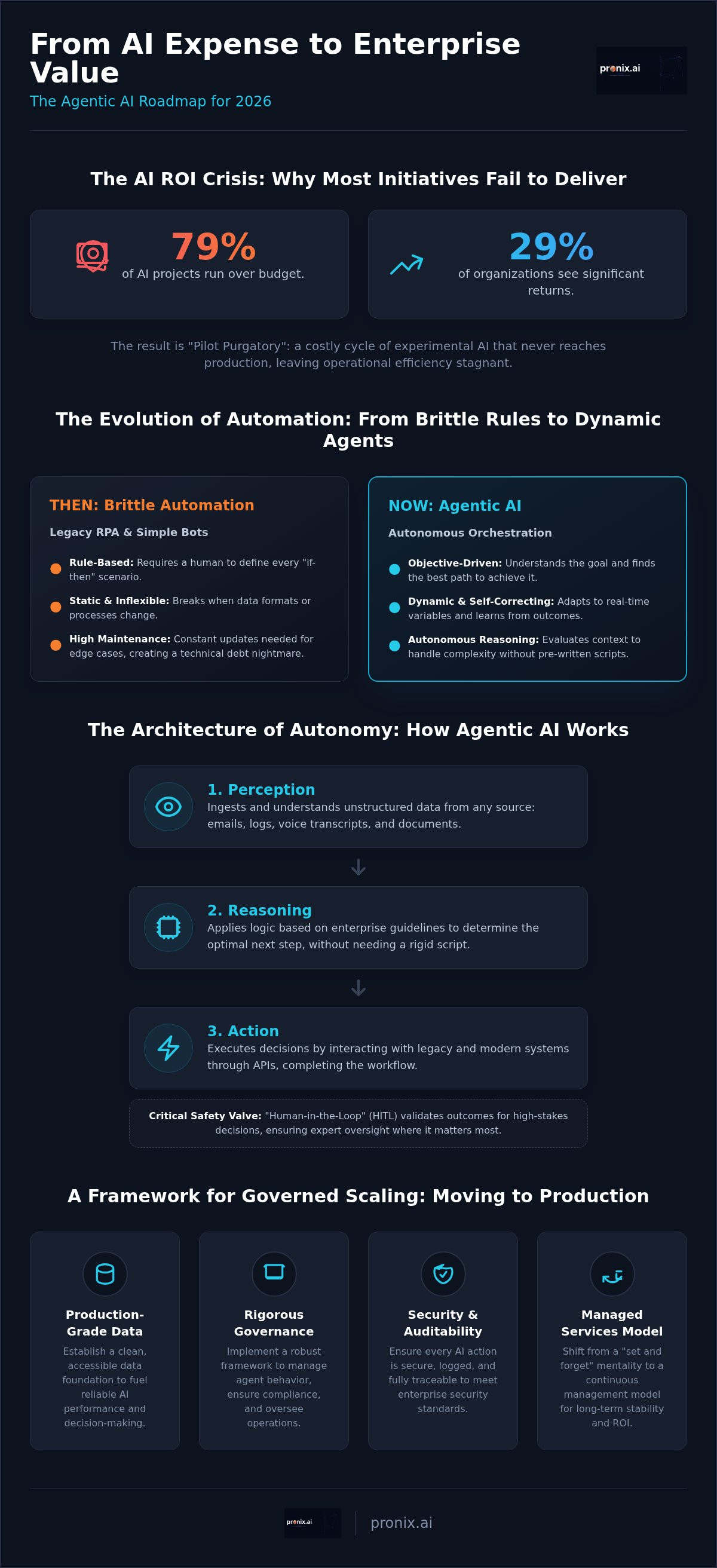
A Framework for Governed Scaling: Security, Data, and Auditability
Transitioning from a successful pilot to an enterprise-scale reality requires a disciplined, multi-step framework. You can't simply "turn on" autonomous agents and expect immediate results. AI-driven operational efficiency is the product of a structured lifecycle that prioritizes safety and stability at every phase. This five-step approach ensures that your scaling efforts remain grounded in measurable business value.
- Step 1: Establish a Production-Grade Data Foundation. Unify siloed telemetry and business records into a retrieval-augmented generation (RAG) architecture that agents can query with high precision.
- Step 2: Define the Governance and Risk Mitigation Framework. Set explicit guardrails for what an agent can and cannot do, ensuring compliance with the EU AI Act and other relevant 2026 regulations.
- Step 3: Implement Agentic Orchestration Layers. Deploy the reasoning engines that allow multiple agents to collaborate on complex workflows without manual hand-offs.
- Step 4: Establish Continuous Monitoring and Managed Services. AI isn't a static asset; it requires ongoing tuning and performance oversight to prevent drift.
- Step 5: Scale via Iterative Value Realization. Expand the footprint from one department to the next only after proving ROI in the initial production environment.
Building for Production-Ready Outcomes
Scalability must be baked into the design from day one. When building enterprise AI agents, you must ensure they are compatible with your existing cloud and CRM environments. Technical requirements for secure, multi-platform integration with AWS, Azure, and Salesforce are essential for maintaining a unified operational view. Every autonomous decision must be backed by a comprehensive, immutable audit trail to ensure full transparency and accountability. This level of rigor is what separates a toy from a tool.
Measuring What Matters: AI-Driven KPI Transformation
Traditional metrics like "time saved" are no longer sufficient for the C-suite. In 2026, you must report on "cost per outcome" and "process velocity" to show the true impact of your investments. These metrics provide a clearer picture of how AI-driven operational efficiency affects the bottom line. Real-time dashboards allow operational managers to spot bottlenecks instantly, moving the organization from monthly reports to minute-by-minute optimization. Reporting this data to the board with confidence requires a direct link between AI activity and financial performance.
To begin your own transition from pilot to production, explore our Agentic AI Implementation services.
Transitioning to an AI-First Operational Model with Managed Services
Deploying an agentic model is only the beginning of the journey. Unlike traditional software, AI systems are dynamic; they require a continuous cadence of tuning, monitoring, and refinement to maintain peak performance. Treating AI as a "set and forget" installation is the quickest path to model drift and diminished returns. To sustain AI-driven operational efficiency, enterprises must shift toward a managed services mindset that prioritizes long-term stability over initial deployment speed.
Specialized talent is the backbone of this transition. Maintaining high-performing agents requires deep expertise in prompt engineering, data orchestration, and platform-specific integrations like AWS, Salesforce, and Genesys. Most internal IT teams are already overextended with legacy maintenance. Partnering with experts allows your organization to offload the technical burden while ensuring your AI workflows remain aligned with evolving business objectives. This is how enterprise AI automation managed services secure the ROI that fragmented pilots often lose.
The Managed Services Advantage
A managed approach provides a rigorous safety net for your autonomous systems. As regulatory environments shift, such as the enforcement of the EU AI Act in August 2026 and new California AI legislation, your systems must adapt in real time to remain compliant. Managed services provide several critical advantages:
- Continuous Optimization: Regular analysis of agent reasoning and accuracy ensures that workflows don't degrade as data sets evolve.
- Proactive Security: Constant monitoring for prompt injections and vulnerabilities keeps your enterprise data secure against emerging threats.
- Compliance Updates: Automated adjustments to audit trails and disclosure requirements ensure your agents meet the latest legal standards without manual intervention.
Next Steps: From Strategy to Execution
Moving to an AI-first model requires a methodical approach. It starts with an AI Maturity Assessment to identify where your data foundation stands and which workflows are ready for autonomous orchestration. By focusing on high-impact use cases first, you can demonstrate immediate gains in AI-driven operational efficiency before scaling across the entire organization. This iterative process reduces risk and builds the internal buy-in necessary for a total digital transformation.
Pronix.ai serves as the strategic partner that bridges the gap between high-level vision and "boots-on-the-ground" technical execution. We don't just build agents; we manage the entire lifecycle of your AI evolution to ensure every workflow is governed, auditable, and results-oriented. Consult with pronix.ai to modernize your enterprise operations and move your AI initiatives from the pilot phase to production-scale reality.
Securing the Future of Enterprise Orchestration
Achieving true AI-driven operational efficiency requires a fundamental shift from isolated pilots to a governed, agentic model. This transition demands more than just better models; it requires a production-grade data foundation and a disciplined approach to risk management. By moving away from "set and forget" deployments toward a managed services framework, you ensure your autonomous workflows remain secure, compliant, and results-oriented. The era of experimental AI is over. The era of the agentic enterprise has begun.
Pronix.ai provides the expertise and the proven framework necessary to bridge the gap between vision and production. With deep proficiency across AWS, Microsoft, and Salesforce, we deliver dedicated enterprise AI managed services that prioritize stability and long-term ROI. Don't let your initiatives stall in the pilot phase. It's time to build an operational model that scales with confidence and transparency.
Move your AI from pilot to production with pronix.ai and start transforming your enterprise workflows today. Your path to a more efficient, autonomous future starts with a single, strategic step.
Frequently Asked Questions
How do we calculate the ROI of AI-driven operational efficiency?
ROI calculation must move beyond individual productivity gains to enterprise-level financial impact. Focus on cost per outcome, reduction in manual error rates, and increased process velocity. By comparing the operational spend before and after agentic orchestration, leaders can quantify the net savings. It's essential to factor in the total cost of ownership, including ongoing managed services, to ensure the resulting ROI reflects true bottom-line growth.
What is the difference between RPA and Agentic AI for business processes?
Traditional RPA follows rigid, pre-defined scripts to handle repetitive tasks. If a data format changes, the process breaks. Agentic AI utilizes reasoning and perception to handle ambiguity and adapt to real-time variables. These autonomous agents don't just mimic human clicks; they understand intent and execute complex workflows independently. This capability allows for the automation of non-linear processes that were previously considered too complex for standard rule-based systems.
How can we ensure AI agents remain compliant with industry regulations?
Compliance is maintained through a combination of hard-coded guardrails and immutable audit trails. Every decision an agent makes must be logged and searchable for regulatory review. Implementing a "Human-in-the-Loop" model for high-stakes decisions ensures that autonomous actions stay within legal and ethical boundaries. Regular audits by a managed service provider help organizations stay ahead of evolving standards, such as the EU AI Act or new state-level privacy legislation.
What are the biggest risks when scaling AI from pilot to production?
The most significant risks include data fragmentation leading to model hallucinations and the potential for brand reputation damage from ungoverned autonomous actions. Without a production-grade data foundation, agents may provide inaccurate information to customers or partners. Scaling also introduces the risk of "Shadow AI," where teams deploy unsanctioned tools that bypass corporate security protocols. Establishing a centralized governance framework is the only way to mitigate these operational and security vulnerabilities effectively.
Do we need to replace our existing systems to achieve AI-driven efficiency?
You don't need to rip and replace your legacy infrastructure. Achieving AI-driven operational efficiency involves building orchestration layers that sit on top of your current systems. Modern AI agents interact with existing databases and CRMs via API layers, acting as an intelligent connective tissue. This approach allows you to modernize your workflows and contact centers without the high cost and disruption of a complete platform overhaul.
How does pronix.ai handle data privacy in enterprise AI implementations?
Pronix.ai prioritizes data privacy by establishing secure, production-grade data foundations that adhere to enterprise-level governance standards. We implement strict access controls and data masking to ensure sensitive information is never exposed to unauthorized models or external environments. Our approach focuses on responsible AI adoption, ensuring that all agentic workflows are fully auditable and compliant with national privacy regulations. We build the "chassis" that keeps your proprietary data isolated and protected.
What is the role of a managed service provider in AI operations?
A managed service provider ensures your AI systems don't degrade over time. AI models require continuous performance monitoring, security patching, and prompt tuning to account for data drift. We provide the specialized talent needed to manage these complex environments, reducing the burden on your internal IT teams. This ongoing partnership ensures that your agentic workflows remain accurate, secure, and aligned with your shifting business objectives long after the initial deployment.