

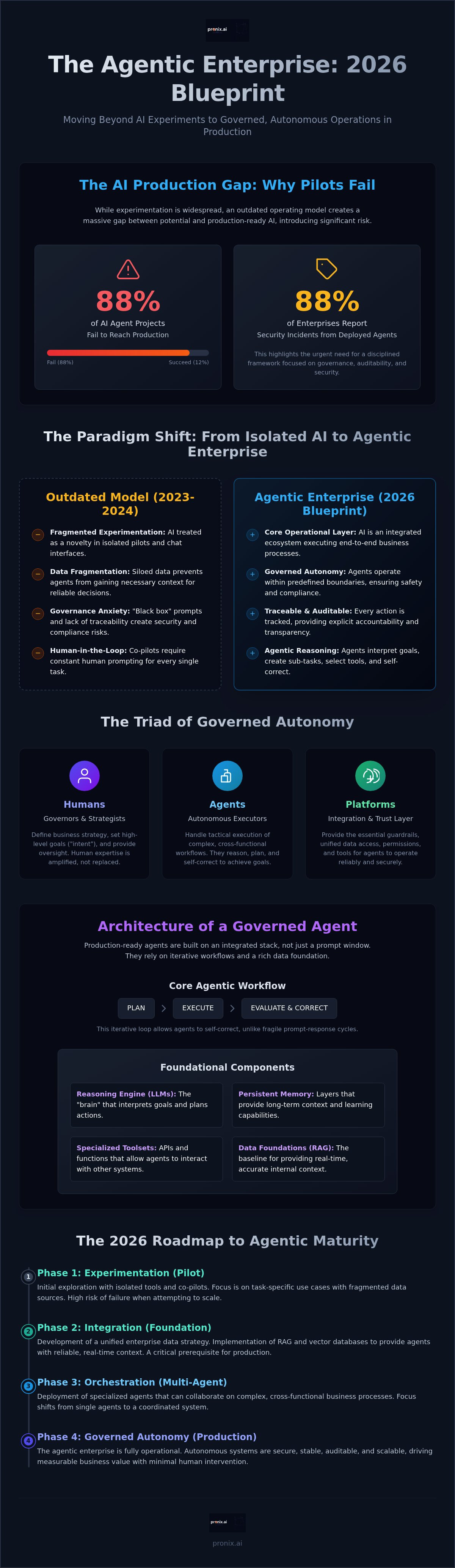
While 79% of organizations have experimented with AI agents, a staggering 88% of these projects fail to reach production. This production gap isn't a failure of the technology itself. It's a symptom of an outdated operating model that's ill-equipped for the speed and complexity of a true agentic enterprise. You've likely seen the potential of AI in isolated pilots, yet you're facing the friction of data fragmentation and governance anxiety that keeps these tools from scaling. With 88% of enterprises reporting security incidents linked to deployed agents, the need for a disciplined framework is urgent.
Transitioning to a model of governed autonomy requires more than just better models; it demands a fundamental architectural shift. This article provides the 2026 blueprint for building that enterprise, moving beyond simple experimentation to a results-oriented production environment. We'll define the core pillars of autonomous operations, provide a step-by-step framework to move your projects into production, and explain how rigorous governance ensures your systems remain stable, auditable, and secure. This framework ensures you can orchestrate specialized agents that collaborate to handle complex, cross-functional business processes with minimal intervention and maximum reliability.
Key Takeaways
- Define the structural shift from isolated AI experimentation to a core operational layer where autonomous agents drive end-to-end business value.
- Identify the architectural components required for a governed agentic enterprise, including memory layers, toolsets, and multi-agent workflow orchestration.
- Compare deterministic legacy automation with probabilistic AI reasoning to understand how to manage workflows that require high levels of context and adaptability.
- Apply a 2026 maturity framework that moves projects from fragile pilots to secure, production-ready outcomes through data readiness and responsible AI strategy.
- Bridge the production gap by integrating managed services and specialized talent to ensure long-term stability, auditability, and scalability of autonomous systems.
What is the Agentic Enterprise? Beyond the AI Pilot
The 2023-2024 era was defined by fragmented experimentation. Enterprises treated AI as a novelty, often isolated in chat interfaces or basic summarization tools. By 2026, the paradigm has shifted. The agentic enterprise represents a structural evolution where AI moves from being a peripheral feature to a core operational layer. It's a coordinated ecosystem where autonomous agents don't just assist humans; they execute complex workflows alongside them within a governed framework.
This shift requires a move away from "black box" prompts toward systems built on shared context and explicit accountability. In this model, every action taken by an agent is traceable, auditable, and aligned with business objectives. It's no longer about whether AI can do a task. It's about how a multi-agent system can orchestrate entire business processes autonomously. This creates a resilient operation where the agentic enterprise can scale without the traditional linear increase in headcount or manual oversight.
From Co-pilots to Autonomous Agents
The transition from passive assistants to active agents is the hallmark of the current landscape. Early co-pilots required constant human prompting to produce a single result. Modern autonomous agents possess agentic reasoning. This means they can interpret a high-level goal, break it into sub-tasks, select the appropriate tools, and self-correct when they encounter errors or data inconsistencies.
In a high-stakes production environment, suggestions aren't enough. The enterprise requires agents that execute. Whether it's managing a supply chain disruption or resolving a complex customer service escalation, these agents act with a level of independence that was impossible two years ago. They operate within predefined boundaries, ensuring that speed never comes at the expense of safety or compliance.
The Triad: Humans, Agents, and Platforms
Success in this new era depends on the synergy between three pillars. Humans have transitioned into the roles of governors and creative directors. They define the strategy and the "intent," while agents handle the tactical execution. This doesn't replace human expertise; it amplifies it by removing the friction of manual, repetitive workflows.
Platforms provide the essential integration layer and trust guardrails. They ensure that agents have the necessary permissions and access to real-time information across the stack. A robust enterprise AI data strategy for AI is the absolute prerequisite here. Without a unified data foundation, agents lack the context needed to make accurate, reliable decisions. When human oversight, agentic execution, and platform stability work in concert, the organization achieves true operational maturity.
The Architecture of Autonomy: Orchestrating Governed AI
Building an agentic enterprise requires moving beyond the limited "chat" interface. It's about an integrated stack where LLMs act as the reasoning engine, connected to persistent memory layers and specialized toolsets. Unlike early experiments, these systems don't operate in a vacuum. They require a production-ready foundation to handle complex business logic across legacy silos. For a deeper look at the industry definition, IBM provides an excellent overview in their guide on What Is an Agentic Enterprise?.
Traditional prompt-response cycles are too fragile for production. They lack the iterative loops needed to verify facts or correct errors. Success depends on "Agentic Workflows" where the system can plan, execute, and evaluate its own output before finalizing a task. This shift is critical when building enterprise AI agents that must deliver reliable, repeatable results. When agents can navigate these loops autonomously, they move from being simple tools to becoming active participants in the value chain.
Data Foundations: Providing Agentic Context
Context is the currency of autonomy. Retrieval-Augmented Generation (RAG) has evolved from a luxury to the baseline requirement for enterprise agents. By leveraging vector databases and real-time data pipelines, agents can access the most current internal documents and transactional data without constant retraining. Grounding is the process of connecting AI to trusted business facts. This ensures that every decision is backed by verifiable enterprise data rather than statistical hallucinations. Implementing these foundations is a core part of our Agentic AI Strategy & Consulting services.
Multi-Agent Systems (MAS) and Orchestration
No single agent can master every enterprise function. The future lies in specialized collaboration. In a multi-agent system, specific agents are assigned roles, such as data retrieval, logic validation, or external API execution. An orchestration layer manages the hand-offs between these agents, ensuring the workflow remains cohesive and governed. This architecture often integrates with robust platforms like AWS enterprise AI services to maintain high availability and security. By decoupling tasks into specialized units, the organization can navigate complex business logic across fragmented silos without losing oversight.
Agentic Operations vs. Legacy Automation: Why RPA Isn’t Enough
Legacy automation is hitting a functional ceiling. Robotic Process Automation (RPA) served its purpose by handling high-volume, repetitive tasks with "if-this-then-that" logic. However, RPA is fundamentally brittle. It breaks the moment a user interface changes, a data field moves, or an unexpected variable enters the workflow. This rigidity creates a maintenance nightmare that prevents true scalability. The agentic enterprise solves this by replacing deterministic scripts with probabilistic reasoning.
Unlike traditional bots, agents don't just follow instructions; they understand goals. They can navigate ambiguity and adjust their path in real-time. This adaptability is what allows an organization to move from basic task automation to full operational autonomy. As these systems gain more independence, security becomes paramount. Organizations must implement foundational identity standards for agentic AI to ensure every autonomous action is verified and governed. This shift reduces the technical debt of maintaining thousands of fragile RPA scripts.
Deterministic Logic vs. Adaptive Reasoning
RPA operates on a fixed path. If the path is blocked, the process stops. Agentic AI uses feedback loops to learn and improve. It evaluates the current state, compares it against the desired outcome, and selects the best tool for the job. In AI-driven CX modernization, the difference is clear. While a traditional bot might fail if a customer uses slang or non-standard phrasing, an agentic system interprets the intent. It retrieves the correct data, reasons through the context, and provides a resolution without human intervention. This goal-oriented approach ensures that workflows remain functional even as business environments change.
Breaking the Human-in-the-Loop Bottleneck
Traditional systems require a human to fix every error. This creates a massive operational bottleneck. In the modern agentic enterprise, we utilize governed autonomy. Agents operate within pre-set boundaries, but they possess the reasoning to handle exceptions themselves. If a data source is temporarily unavailable, the agent can retry, find an alternative source, or log the specific reason for the delay. This exception handling happens at the agent level rather than the human level. By delegating tactical problem-solving to agents, human leaders can focus on high-level strategy. This structural change dramatically reduces operational costs while increasing the speed of execution.
The Roadmap to Agentic Maturity: A 2026 Framework
The transition to a mature agentic enterprise is a phased evolution, not a single deployment. Successful organizations move from isolated pilots to integrated production environments by following a disciplined sequence. This progression ensures that speed never compromises stability. The roadmap begins with a rigorous data audit to establish a secure foundation, followed by a clear Responsible AI adoption strategy for governed autonomy. Once the strategy is set, the implementation follows a logical flow:
- Step 1: Audit data readiness and establish a secure, unified foundation.
- Step 2: Define governance frameworks to manage autonomous agent behavior.
- Step 3: Deploy specialized agents for high-friction, high-volume workflows.
- Step 4: Implement orchestration for cross-functional multi-agent collaboration.
- Step 5: Transition to managed services for continuous optimization and auditing.
Following these steps prevents the common "pilot stall" where projects fail to scale due to missing infrastructure or unclear accountability. Secure your path to production with our Agentic AI Implementation experts.
Establishing Enterprise-Grade Governance
Governance in the agentic enterprise isn't about restriction; it's about brand protection. We utilize a "Guardrail" approach that defines the boundaries within which an agent can operate. Every decision an agent makes must be traceable and auditable. If an agent resolves a customer dispute or adjusts a supply chain order, the logic behind that action must be transparent. Human oversight remains critical for high-stakes decision-making, acting as a final check on autonomous workflows. This ensures that even as agents gain independence, they remain aligned with corporate policy and ethical standards.
Identifying High-Impact Use Cases
Focus on areas where context and variables change frequently. CX modernization, supply chain orchestration, and financial reporting are prime candidates for agentic deployment. In these sectors, agents can handle exceptions autonomously, reducing the need for constant human intervention. Calculating ROI in this landscape goes beyond simple headcount reduction. It measures the value of speed, accuracy, and the ability to process data at a scale impossible for manual teams. This creates an "Augmented Enterprise" where AI accelerates productivity and allows your human workforce to focus on high-level strategy and creative problem-solving.
Scaling the Agentic Enterprise: Partnering for Production
The 88% failure rate of AI agents in 2026 reveals a fundamental flaw in how organizations approach scaling. Most companies view deployment as a static milestone. In reality, the agentic enterprise demands a dynamic, lifecycle-based approach. Moving from a controlled pilot to a high-stakes production environment introduces complexities in data orchestration and cross-functional integration that traditional IT models can't handle. This production gap is where strategic vision often stalls, leaving high-potential projects stuck in the experimental phase. Success requires a transition from "can we build it" to "how do we maintain it at scale."
Moving to AI Managed Services
Scaling requires a shift toward long-term operational maturity. This is why managed services for agentic AI are becoming the industry standard. With a global shortage of 4.2 million qualified practitioners, internal hiring is a significant bottleneck. Managed services provide immediate access to "Talent as a Service," ensuring your systems are built and maintained by experts. These partners manage critical tasks like performance monitoring, model drift detection, and automated security patching. Given that 1 in 8 corporate data breaches is now linked to AI agent activity, a proactive, managed approach to security is the only way to protect your brand while pursuing autonomous growth.
The pronix.ai Advantage: Governed, Production-Ready Outcomes
pronix.ai provides the technical rigor and strategic discipline needed to bridge the gap between vision and execution. Our methodology for AI-first business transformation focuses on delivering measurable value through governed, production-ready outcomes. We don't just build agents; we architect the entire ecosystem required for them to thrive. By utilizing our deep expertise in AWS, Microsoft, and Salesforce platforms, we help you navigate the friction points of legacy modernization. Our focus remains on risk mitigation and evidence-based success, ensuring that your transition to autonomous operations is both fast and secure.
The shift to an autonomous operating model is a journey of continuous refinement. It's not a "set and forget" installation but a fundamental change in how your business creates value. Partnering with a seasoned practitioner ensures that every innovation is backed by a rigorous framework and a clear path to production. Stop experimenting and start executing. Schedule an Agentic Strategy Consultation with pronix.ai to secure your 2026 blueprint for autonomous operations.
Executing the Autonomous Future: From Vision to Operational Reality
The evolution toward an agentic enterprise is no longer a speculative goal; it's a competitive necessity for 2026. Success depends on moving beyond passive assistants to a coordinated system of autonomous agents that execute complex workflows within rigorous governance frameworks. By replacing brittle legacy automation with adaptive reasoning and specialized multi-agent orchestration, organizations can finally solve the production gap that has stalled previous AI initiatives.
Realizing this blueprint requires a partner who understands the friction points of large-scale modernization. We specialize in delivering production-ready outcomes for global enterprises by leveraging our deep expertise across AWS, Salesforce, and Microsoft AI stacks. With enterprise-grade governance frameworks and a focus on long-term operational maturity, we ensure your transition is both secure and scalable. Move your AI agents from pilot to production with pronix.ai. It's time to stop experimenting and start leading the next era of enterprise operations.
Frequently Asked Questions
What is the main difference between an AI agent and an agentic enterprise?
An AI agent is a single software entity designed to perform a specific task autonomously. In contrast, an agentic enterprise is a comprehensive operating model where multiple specialized agents are orchestrated across the entire organization. While an agent is a tool, the enterprise model is the structural framework that ensures these tools work in concert, share context, and adhere to centralized governance standards to drive measurable business value.
How does an agentic enterprise ensure security and compliance in regulated industries?
Security is maintained through a combination of identity management and rigorous auditability. Every decision made by an agent is traceable and logged to meet regulatory requirements in sectors like finance and healthcare. By implementing foundational identity standards and enterprise-grade governance, organizations ensure that autonomous workflows remain compliant. This approach mitigates risk by keeping agent actions within predefined legal and ethical boundaries, preventing unauthorized data access or transactional errors.
Can an agentic enterprise operate without human oversight?
Complete autonomy without oversight is not the goal of a mature agentic enterprise. We utilize a model of governed autonomy where humans act as creative directors and strategic governors. While agents handle tactical execution and exception handling, humans remain in the loop for high-stakes decisions and brand-critical outcomes. This synergy ensures that the speed of AI never bypasses the necessary checks and balances required for stable, long-term operations.
What technical infrastructure is required to support an agentic enterprise?
Supporting this model requires a robust data foundation and an orchestration layer. Key components include vector databases for real-time Retrieval-Augmented Generation (RAG), persistent memory layers, and integration with platforms like AWS or Microsoft. These systems must be built on production-ready foundations that allow agents to access trusted enterprise facts. Without this unified architecture, agents lack the context needed to navigate complex business logic across fragmented data silos.
Is an agentic enterprise just another name for hyper-automation?
No, these concepts are fundamentally different. Hyper-automation typically relies on Robotic Process Automation (RPA), which uses deterministic logic. The agentic enterprise model uses probabilistic reasoning, allowing systems to adapt when variables change or context shifts. While RPA is brittle and breaks under pressure, an agentic system can plan, use tools, and self-correct. This move from rigid scripts to goal-oriented reasoning is the defining shift in modern operations.
How long does it typically take to transition from an AI pilot to an agentic production environment?
The timeline varies based on your existing data maturity and infrastructure. Most organizations can move a specific workflow from a pilot phase to a production-ready environment within 90 to 180 days. This transition involves auditing data readiness, establishing governance guardrails, and deploying specialized agents. A phased approach is essential to ensure that each autonomous workflow is fully auditable and secure before it scales across the broader enterprise.
What are the biggest risks of moving toward an agentic enterprise model?
The primary risks include data breaches, model drift, and the failure of projects to reach production. Research shows that 1 in 8 corporate data breaches is now linked to AI agent activity, making security a top priority. Additionally, without managed services to monitor performance, agents can lose accuracy over time. Organizations must also address the skills gap, as the global shortage of qualified practitioners can lead to poorly governed or fragile implementations.
How do agents in an agentic enterprise handle complex, multi-step business processes?
Complex processes are managed through Multi-Agent Systems (MAS). In this architecture, specialized agents are assigned distinct roles, such as data retrieval, logic validation, or API execution. An orchestration layer manages the hand-offs between these agents, ensuring the workflow remains cohesive. This collaborative approach allows the system to solve problems that are too complex for a single agent, mirroring the way cross-functional human teams operate within a traditional business.