

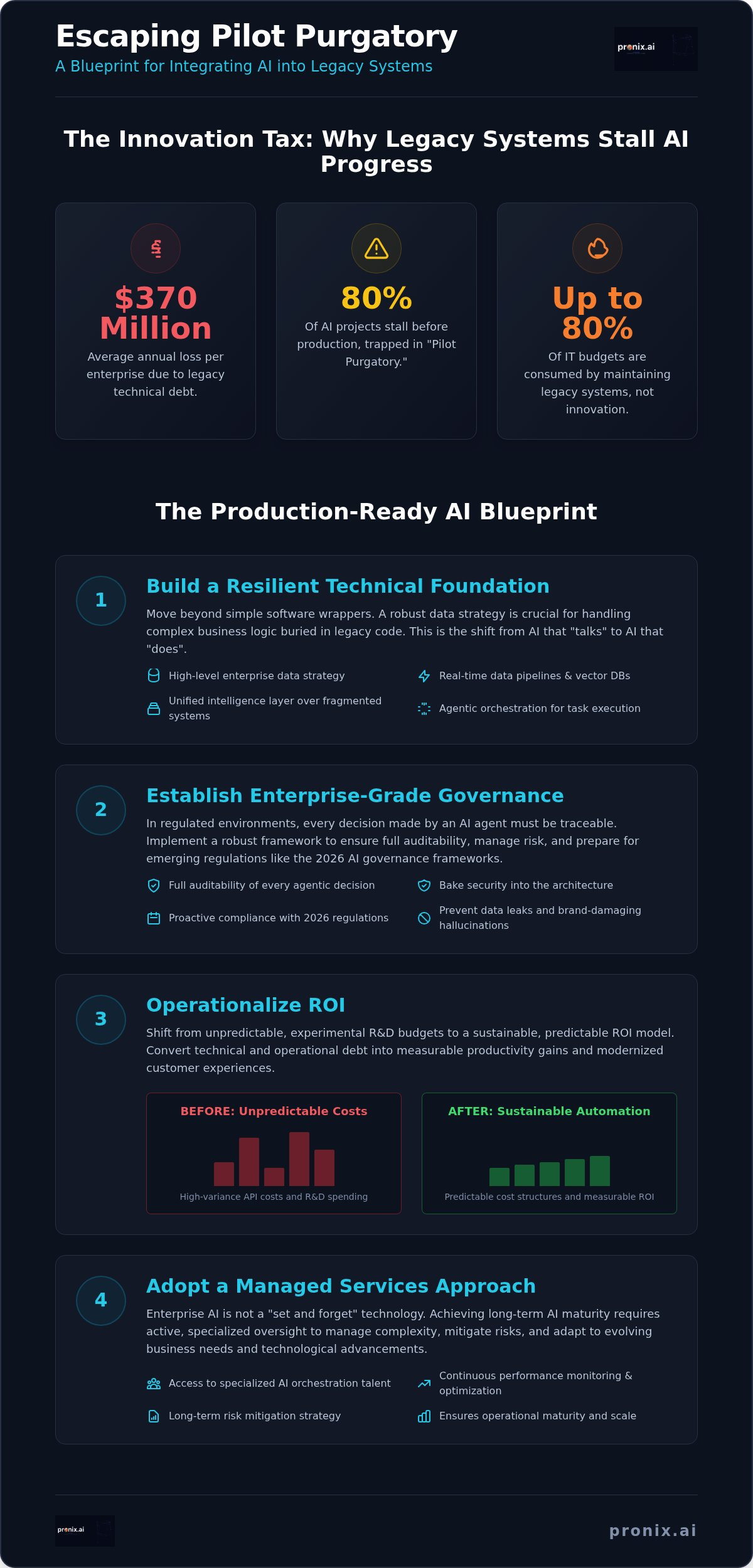
US enterprises lose an average of $370 million per year to legacy technical debt. This isn't just a line item; it's a massive innovation tax that prevents the deployment of autonomous workflows. You likely feel the friction of managing systems that consume up to 80% of your IT budget while trying to launch next-generation capabilities. Integrating AI agents into legacy systems is no longer a luxury for those seeking to escape pilot purgatory and achieve real operational scale.
You're right to be concerned about unpredictable API costs and the governance risks introduced by the latest 2026 AI governance frameworks and emerging regulations. It's difficult to find specialized talent capable of orchestrating these transitions without disrupting core business operations. This blueprint bridges the gap between your existing technical debt and production-ready AI orchestration. We provide a clear roadmap for scaling safely, ensuring predictable cost structures and an enterprise-grade governance framework. You'll learn how to transition from fragmented experiments to a disciplined, managed architecture that drives measurable results and secure outcomes at scale.
Key Takeaways
- Break the cycle of pilot purgatory. Identify exactly where enterprise-wide data inputs stall autonomous workflows and prevent production-ready results.
- Build a resilient technical foundation for integrating AI agents into legacy systems. Prioritize high-level data strategy over simple software wrappers to handle complex business logic.
- Establish full auditability. Implement a governance framework that tracks every decision made by your agentic workforce, especially in highly regulated environments.
- Convert operational debt into productivity. Use CX modernization to move from unpredictable scaling costs to a sustainable ROI model.
- Adopt a managed services approach. It's not a "set and forget" technology; AI maturity requires active, managed oversight to mitigate long-term risk.
The Pilot-to-Production Gap: Why Integrating AI into Legacy Systems Fails
Legacy systems are the backbone of the enterprise, yet they're also the primary anchor dragging down modern AI initiatives. While initial pilots often show promise, 80% of AI projects stall before reaching full production. This is Pilot Purgatory. It happens when the controlled logic of a sandbox meets the messy reality of decades-old architecture. Integrating AI agents into legacy systems requires more than a simple API connection. It demands a total shift from experimental R&D to governed, production-ready workflows that can survive the rigors of a live environment.
The gap between a successful demo and a scalable solution is wider than most executives realize. A functional AI can generate a response, but a production-ready agent must execute complex transactions and respect strict security protocols. This level of system integration is notoriously difficult. Without a disciplined framework, autonomous agents become liabilities that can't maintain state across disconnected databases. Operational maturity isn't just a goal; it's the essential prerequisite for scaling AI in legacy environments.
Identifying the 2026 Scaling Bottlenecks
Nearly 60% of AI leaders identify legacy integration as their primary barrier to deployment. One major bottleneck is the rise of department-level shadow AI. These unmanaged experiments create fragmented data silos and increase technical debt. Additionally, there's a critical lack of specialized talent capable of managing complex AI agent orchestration. When inconsistent data foundations cause Retrieval-Augmented Generation (RAG) systems to break at scale, many organizations find they lack the internal expertise to fix the underlying architecture.
The Cost of Inaction: Brand Reputation and Market Share
Delaying the transition to a managed AI architecture carries heavy risks. Ungoverned scaling often leads to high-profile hallucinations that damage brand reputation or trigger compliance failures under the 2026 California AI legislation. Slow deployment cycles also hand a competitive advantage to AI-first challengers who aren't weighed down by technical debt. Moving from experimental R&D budgets to predictable operational ROI models is the only way to secure long-term market share. Enterprises that struggle with integrating AI agents into legacy systems will see their innovation budgets consumed by maintenance rather than growth.
Technical Architecture: Data Foundations and Agentic Orchestration
Standard LLM wrappers often fail in the enterprise because they can't interpret the nuanced business logic buried in legacy code. They lack the "memory" and context required to navigate thirty years of undocumented operational rules. Successful implementation requires a robust enterprise data strategy for AI that treats your historical data as a live, queryable asset. We're moving beyond simple prompt engineering. We're now designing autonomous workflows that bridge Salesforce, AWS, and Microsoft environments into a unified intelligence layer.
The shift to agentic design represents a move from "talking" to "doing." While a chatbot provides information, an agent executes a task. Accomplishing this across fragmented platforms requires an orchestration layer that sits above your cloud providers. Designing these architectures is complex, which is why many leaders start with agentic AI strategy and consulting to map their legacy dependencies before any code is written.
Building Scalable Data Foundations
Production environments demand more than static datasets. You need real-time pipelines and vector databases to feed agents the most current context. Without high-quality data lineage, your models will inevitably drift, leading to inaccurate or unsafe outcomes. When building enterprise AI agents, security must be baked into the architecture from day one. It's about creating a secure perimeter where data flows to the agent for processing but never leaks outside the corporate boundary. This ensures that integrating AI agents into legacy systems doesn't create new vulnerabilities in your data architecture.
Orchestrating Complex Agentic Workflows
Single-turn interactions are insufficient for modern business processes. Enterprise agents must collaborate. This requires multi-agent frameworks where one specialized agent handles data retrieval while another executes a transaction in a legacy ERP. Managing state and memory across these long-running, multi-departmental processes is the most significant hurdle. You need a system that maintains a "source of truth" for a customer's journey, even as it moves through legacy CX environments like Genesys or Amazon Connect. Success is measured by the agent's ability to complete a workflow without human intervention, regardless of how many legacy databases it must touch to get the job done.
Governance and Security: Managing Risk in Regulated Environments
Transitioning from a sandbox to a regulated production environment is where most AI initiatives face their greatest test. It's the difference between a chatbot that summarizes meeting notes and an autonomous agent that processes healthcare claims. The latter requires absolute auditability. You must be able to verify exactly who made a decision, why they made it, and which specific data points influenced the outcome. In high-stakes sectors like finance and healthcare, "black box" logic is a non-starter. It's a liability that no board should accept.
Scaling in these environments necessitates a Human-in-the-Loop (HITL) model. While agents handle the heavy lifting of data retrieval and initial processing, a qualified professional must validate high-risk outputs. This isn't just a safety measure; it's a requirement for regulatory survival. Maintaining this level of oversight is complex, which is why many organizations pivot toward enterprise AI automation managed services to ensure continuous risk mitigation and operational stability.
Compliance Frameworks for Healthcare and Finance
Deploying autonomous agents under HIPAA or SOC2 requires a surgical approach to data handling. Personally Identifiable Information (PII) must be scrubbed or masked before it ever enters a Retrieval-Augmented Generation (RAG) pipeline. When integrating AI agents into legacy systems, you're often dealing with databases that weren't built with modern privacy standards in mind. Explainability is mandatory. If a federal auditor asks why an agent denied a credit application, "the model said so" isn't an acceptable answer. You need a transparent logic trail that links every autonomous action back to a specific business rule.
Risk Mitigation and Brand Safety
Risk mitigation involves multi-layered guardrail systems that monitor agent behavior in real-time. These systems are designed to prevent inappropriate autonomous actions and protect against adversarial threats like prompt injection or data poisoning. Brand safety is paramount; one rogue action can erase years of hard-earned consumer trust. According to IBM's 2025 data, organizations using security AI and automation saved $1.9 million during data breaches compared to those that didn't. In 2026, as California's CCPA Automated Decision-Making Regulations take full effect, a responsible AI adoption strategy is no longer optional. It's the only way to protect your market share while pursuing innovation.
Operationalizing ROI: From High Costs to Sustainable Automation
Integrating AI agents into legacy systems is often viewed through the lens of technical feasibility, but the real hurdle is economic sustainability. Many organizations treat AI as an experimental budget line. At scale, this becomes a liability. Token usage and compute overhead are silent killers of ROI. If you aren't careful, the API bills alone can exceed the efficiency gains. You need a transition from fragmented experiments to a disciplined, managed architecture that drives measurable results.
One of the most effective ways to stabilize these costs is through AI-driven CX modernization. This approach converts high operational costs into productivity by automating high-volume, repetitive interactions. To optimize further, enterprises are adopting a tiered model strategy. Small models handle high-volume, low-complexity tasks with low latency and minimal cost. Large models are reserved for complex reasoning and multi-step orchestration. It's a balanced approach that ensures you aren't overpaying for simple logic.
The Economics of Enterprise AI
While pay-per-token models work for pilots, they create unpredictable volatility as you scale across global departments. Maturity involves switching to sustainable, dedicated infrastructure models. You must calculate the Total Cost of Ownership (TCO) for a production-grade agent, including the long-term maintenance of the data pipelines feeding it. Focus on "high-gravity" use cases where the investment is justified by significant process improvements.
- Identify workflows where manual intervention currently creates the longest delays.
- Evaluate the cost difference between dedicated GPU instances and variable API pricing.
- Prioritize integrations that solve the most expensive friction points in your legacy stack.
Measuring Success Beyond Accuracy
Accuracy is a baseline, not a success metric. In a production environment, you need to track KPIs that reflect business value. Latency, cost-per-resolution, and Employee Net Promoter Score (eNPS) provide a clearer picture of operational health. McKinsey research indicates that generative AI agents can accelerate technology modernization timelines by 40 to 50 percent. This acceleration is a critical metric for reporting value to the board of directors. Use transparent, audit-ready data to show how AI is shortening business process cycles and reducing the innovation tax imposed by technical debt.
To begin stabilizing your cost structures and building a resilient automation strategy, consider a consultation on AI business automation.
The Managed Services Model: Ensuring Long-Term AI Maturity
AI is not a static installation. It's a living system that requires constant recalibration. Many enterprises treat AI as a project with a defined end date, but the real challenge begins during Day 2 operations. Project-based engineering often ignores the long-term friction of model drift and API volatility. Integrating AI agents into legacy systems creates a delicate web of dependencies that can break with a single cloud update. Achieving maturity requires a shift from "set and forget" thinking to a managed services model that prioritizes stability, security, and continuous improvement.
Why Managed Services are Essential for Scaling
Model updates occur frequently; even a minor change in a base LLM can disrupt the business logic governing your legacy ERP or CRM. Managed services provide the necessary buffer. They offer 24/7 monitoring for agent performance and behavioral drift, ensuring that autonomous actions remain within defined guardrails. This model also solves the talent cliff. Instead of competing for scarce AI orchestrators, you gain immediate access to specialized engineers through a "Talent as a Service" approach. Use the managed services for agentic AI selection framework to evaluate partners based on their ability to handle these operational complexities.
The Path to the Agentic Enterprise
The ultimate objective is to move beyond isolated agents. You're building a unified, governed "Agentic Ecosystem" where intelligence flows seamlessly between HR, Finance, and Sales. This requires a partner who understands the deep technical architecture of legacy systems as well as the nuances of autonomous orchestration. Integrating AI agents into legacy systems at this scale demands a disciplined framework that balances speed with risk mitigation. As an experienced systems integrator, pronix inc focuses on driving production-ready outcomes that survive the transition from pilot to global scale. We ensure your AI investment doesn't just work today; it evolves to meet the regulatory and operational demands of tomorrow.
Scaling Your Enterprise AI Strategy with Governance
The path to 2026 enterprise maturity requires a fundamental shift from experimental R&D to disciplined execution. Successfully integrating AI agents into legacy systems depends on your ability to bridge technical debt with a governed, agentic architecture. You've seen that standard wrappers aren't enough. You need a production-ready foundation that respects strict compliance and delivers predictable ROI. By prioritizing auditability and adopting a managed services model, you ensure that your autonomous workflows remain stable even as models evolve.
Pronix Inc brings decades of systems integration excellence to this transition. Our strategic partnerships with AWS, Microsoft, and Salesforce allow us to deliver production-ready outcomes for global enterprises. We help you navigate the complexities of regulated industries while accelerating your modernization timeline. Don't let your AI initiatives stall in pilot purgatory. Take the next step toward a unified, intelligent ecosystem that scales safely and effectively.
Move your AI agents from pilot to production with pronix.ai. Your legacy infrastructure is no longer a barrier; it's the foundation for your next phase of growth.
Frequently Asked Questions
What is the biggest challenge in scaling AI projects for enterprises?
The primary barrier is the friction between modern AI and legacy technical debt. Nearly 60% of AI leaders report that legacy systems prevent them from moving beyond the initial testing phase. Scaling requires a shift from isolated experimentation to a unified architectural strategy. Without a disciplined framework for integrating AI agents into legacy systems, projects often collapse under the weight of unmanaged data silos.
How do we manage the costs of scaling generative AI agents?
Cost management requires a tiered model strategy and a shift from pay-per-token to dedicated infrastructure. Using small models for high-volume, low-complexity tasks significantly reduces compute overhead. Large models should be reserved for complex reasoning and multi-step orchestration. This balanced approach ensures predictable ROI while preventing the innovation tax often associated with unmanaged API calls at a global scale.
Can AI agents be safely used in regulated industries like healthcare?
Yes, provided you implement multi-layered guardrails and a Human-in-the-Loop (HITL) model. Security AI and automation can save organizations an average of $1.9 million during data breaches. In regulated sectors like healthcare and finance, you must prioritize explainability and PII masking. This ensures that every autonomous decision is auditable and compliant with 2026 regulatory standards like the CCPA Automated Decision-Making provisions.
What is the difference between an AI pilot and a production-ready AI outcome?
An AI pilot is a controlled experiment in a sandbox environment, while a production-ready outcome is a governed, scalable workflow. Pilots often ignore the complexities of real-world data inputs and legacy system dependencies. A production-ready solution is fully integrated into your core business logic. It handles live traffic, respects security protocols, and maintains operational stability across your entire enterprise infrastructure.
How do we ensure our data is ready for enterprise-scale AI?
Data readiness involves building real-time pipelines and robust vector databases. You need to establish clear data lineage to prevent model drift and ensure that your agents have access to the most current context. Integrating AI agents into legacy systems requires cleaning historical data and masking PII. This creates a secure foundation where data flows to the agent for processing without leaking outside your corporate perimeter.
Why do most AI projects fail to move past the pilot stage?
Most projects fail because they lack the operational maturity to handle enterprise-scale data chaos. While a demo might work with a clean dataset, production environments are unpredictable. Projects often stall when the underlying legacy infrastructure can't support real-time, API-first operations. Without a clear roadmap for governance and specialized talent for orchestration, these initiatives become trapped in pilot purgatory and never deliver measurable value.
What role does a managed service provider play in scaling AI?
A managed service provider handles the complexities of Day 2 operations, including monitoring for model drift and security vulnerabilities. They bridge the talent gap by providing immediate access to specialized AI engineers. This Talent as a Service model ensures your AI ecosystem remains stable despite frequent API changes or model updates. It allows your internal teams to focus on strategy while experts manage the technical execution.
How do we measure the ROI of large-scale AI automation?
Measure ROI by tracking KPIs such as latency, cost-per-resolution, and the acceleration of business process cycles. Research indicates that generative AI agents can speed up modernization timelines by 40% to 50%. You should also monitor Employee Net Promoter Scores (eNPS) to gauge the impact on internal productivity. Reporting these metrics to the board with transparent, audit-ready data provides a clear picture of how AI converts debt into growth.