

AI for call center quality assurance can evaluate 100% of customer interactions, rather than relying only on a small manual sample. It uses speech analytics, machine learning, and natural language processing to score calls and analyze conversations across channels. The result is broader visibility, not a reason to remove human judgment.
Manual reviews provide context and support coaching, but they can leave gaps in coverage and make consistent scoring difficult. AI can flag potential compliance risks, customer dissatisfaction, and agent behaviors for closer review, while human oversight helps assess complex or sensitive interactions.
This guide explains how AI scoring works alongside manual QA, what to consider when comparing call center quality monitoring software, and how automated monitoring can support compliance and coaching. You’ll learn which capabilities matter, how to assess scoring quality, and where human review remains essential. The focus is practical: matching the technology to your evaluation standards, workflows, and operational needs.
Key Takeaways
- Define clear, observable scoring criteria so automated evaluations align with the behaviors your team wants to reinforce.
- Compare automated scores with human reviews before using the results to guide coaching or performance decisions.
- Build compliance monitoring around the interaction risks, data handling, and review workflows that matter to your operation.
- Compare software by how well it fits your scoring model, existing systems, and quality-management processes, not just by feature count.
What is AI quality assurance for call centers?
AI quality assurance uses machine learning, natural language processing, and speech analytics to evaluate customer interactions. AI for call center quality assurance can assess calls and text conversations across channels, giving teams broader visibility than manual QA alone.
Automated Interaction Evaluation
Automated interaction evaluation uses transcripts, audio, and defined criteria to assess customer-agent exchanges. AI tools can evaluate 100% of interactions and analyze voice and text across phone, chat, email, and social media. They can process thousands of conversations simultaneously, flagging issues such as customer dissatisfaction or missed steps in a service process. A scorecard then turns those findings into evidence for review.
A mature AI for call center quality assurance program can also assess AI-agent interactions. For example, a QA process can check whether an AI agent answered a billing question clearly, followed the intended workflow, and escalated an unresolved issue. Align evaluation criteria with the task: a successful automated exchange may require different measures from a human-led conversation.
Agent Coaching and Performance Tracking
Coaching turns QA findings into specific behaviors agents can strengthen. Rather than treating a score as a verdict, a supervisor can use an example interaction to show where an agent missed a step or handled a concern effectively. This makes feedback actionable and ties development to the standards used to evaluate interactions.
AI-generated dashboards can track agent performance alongside measures such as first-call resolution and customer satisfaction. Managers can identify patterns across calls, spot recurring coaching needs, and monitor whether focused feedback changes performance. For example, repeated transfers may prompt a review of call-handling guidance, followed by targeted coaching.
Risks and Limitations of AI QA
Risks include inaccurate interpretation, missing context, and overreliance on automated scores. Sentiment analysis may misread sarcasm or distress, while speech recognition can miss meaning in unclear audio. A score may also reflect weak evaluation criteria rather than an agent’s actual performance, so human review remains important for complex issues and interactions requiring empathy.
Post-deployment monitoring can reveal reliability problems, unexpected outputs, and drift. The National Institute of Standards and Technology (NIST) emphasizes monitoring AI systems after deployment. Teams can compare selected evaluations with recordings, inspect disputed scores, and adjust criteria when results differ from human judgment. This keeps QA accountable as customer language and service workflows change.
Automated and manual call quality scoring
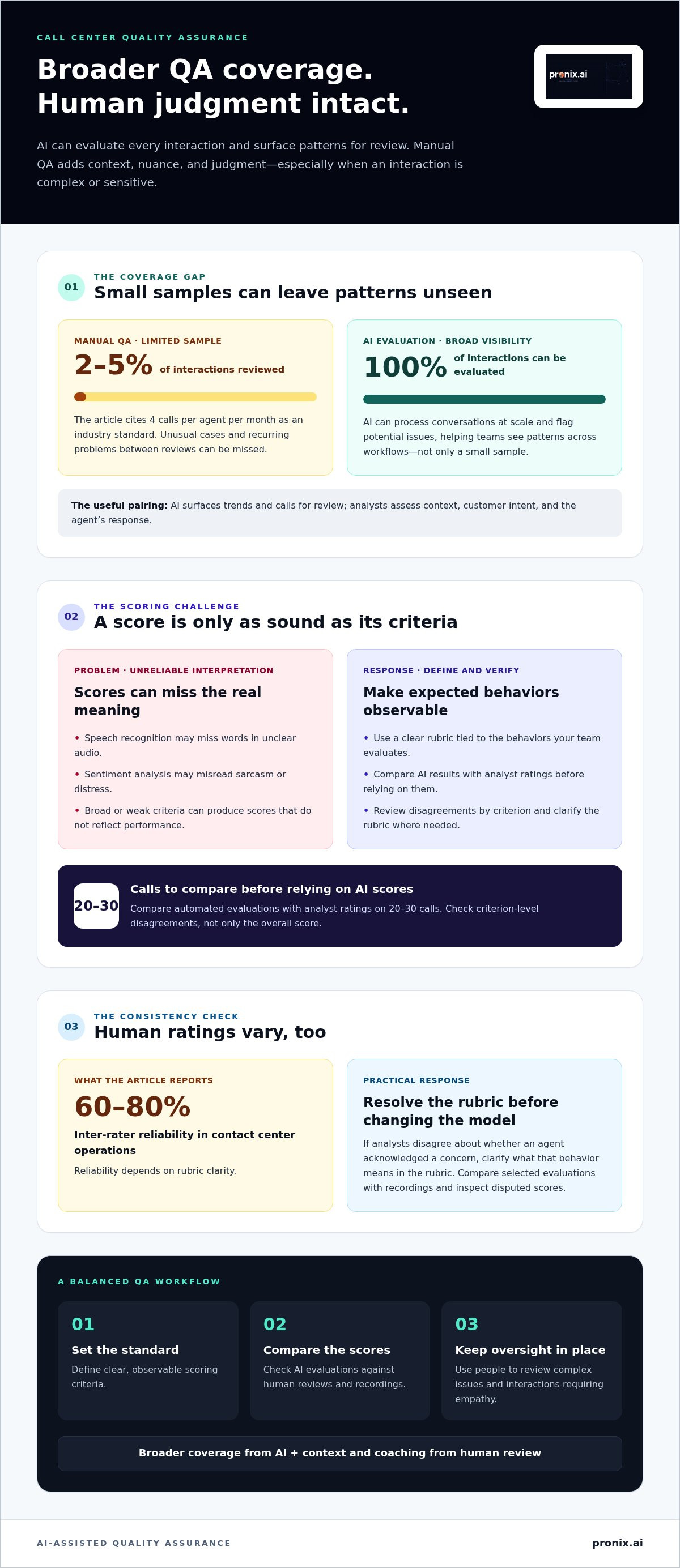
Accuracy depends on clear criteria, reliable transcripts, and consistent interpretation. AI scores should be compared with analyst ratings on 20-30 calls before teams rely on them.
AI-Powered and Manual Review
AI-powered scoring applies a shared rubric across interactions, while manual review lets analysts interpret context and nuance. This distinction matters when teams need broad coverage without losing human judgment. A platform can surface trends and flag calls for review; analysts can then assess whether each score reflects the customer’s intent and the agent’s response.
Manual QA has a sampling limit: reviewers often assess only 2 to 5 percent of customer interactions. The 4-calls-per-agent-per-month industry standard can miss unusual cases and recurring problems between reviews. AI can evaluate calls at scale, helping managers see patterns across workflows instead of drawing conclusions from a small sample.
Accuracy of Automated Scoring
Automated scoring accuracy is how closely a system’s scores match the intended criteria and human assessments. It matters because inaccurate scores can misdirect coaching or distort performance insights. Speech recognition can affect scoring when transcripts miss words, while broad criteria can make correct interpretation difficult. Define observable behaviors, then compare AI results with analyst scores on 20-30 calls.
Human scoring also varies: inter-rater reliability in contact center operations is 60-80%, depending on rubric clarity. Compare disagreements by criterion, not only by overall score. For example, if analysts disagree about whether an agent acknowledged a concern, clarify the rubric before adjusting the AI model. Review the scoring workflow again when call language or processes change.
Compliance monitoring
AI compliance monitoring applies defined checks to recorded conversations, transcripts, and scoring results. It can flag a missed disclosure, an unapproved statement, or a required escalation for review. For example, a quality manager can route a flagged conversation to a specialist, document the finding, and refine evaluation criteria. This links quality management with risk detection and resolution.
Protect customer data by limiting access to recordings and transcripts to roles that need it, and by defining retention and deletion workflows. Map each data source, its purpose, and the teams authorized to use it. For example, document whether a transcript supports scoring, coaching, or both. Align access permissions with those purposes, and review them when teams or workflows change.
Disclosure monitoring can check whether required call-recording language appears in a conversation. A required call-recording disclosure may need to appear in the first 30 seconds of every call. Configure the scoring criteria to detect the disclosure, then review flagged calls against the recording. This creates a traceable path from the conversation to the evaluation and any follow-up action.
Coverage matters because sampling can miss isolated compliance failures. Automated monitoring can surface patterns across interactions, while human reviewers assess flagged cases and decide whether context changes the interpretation. A system may identify a missing phrase, for example, while a reviewer checks whether the customer received the information elsewhere in the exchange.
Integration also shapes the control environment. When QA connects with a contact center platform or customer record system, define which conversation data enters scoring and who can view the findings. Assign owners for alert review, escalation, and correction. Monitor these workflows after deployment so script or process changes do not leave compliance checks outdated.
Call center quality monitoring software comparisons
Compare software by how it turns customer interactions into useful decisions, not by feature count alone. Start with your QA goals: compliance checks, agent performance, customer satisfaction, or coaching. Then assess whether each platform supports your scoring criteria, reporting needs, and existing workflows. A team focused on resolution quality, for example, needs to see how evaluations connect to unresolved customer issues.
Evaluate the scoring model next. A scorecard with 8-12 mostly binary questions can make criteria easier to apply consistently. Check whether supervisors can adjust questions, inspect the evidence behind a score, and distinguish missed steps from judgment-based behaviors. A platform that highlights why an interaction received a score gives reviewers more useful feedback than a number without context.
Assess coverage and reporting across the conversations your team handles. Compare which channels the software analyzes, how it groups recurring issues, and whether managers can filter results by agent, team, or evaluation criterion. For example, a rise in low satisfaction scores for one call type can guide focused coaching instead of broad, untargeted feedback.
Plan for adoption and validation. Observe AI scoring across the full team for 30 days before using its data for formal coaching. During that period, review disputed evaluations, test reporting workflows, and note where manual review remains necessary. Compare how easily supervisors find examples, assign coaching, and track improvement from one evaluation to the next.
Software pricing depends on the case and is provided after a quote request; cost factors include agent seats, interaction volume, integrations, and scoring requirements. Compare the full operational fit, including implementation effort and ongoing review workflows, rather than judging a platform by its initial price alone.
Use your QA priorities and system requirements to narrow the comparison. Assess your AI implementation needs to align quality monitoring with your contact center workflows.
Pronix.ai: Agentic AI Implementation
pronix.ai helps enterprises move AI initiatives from pilots into secure, scalable production through Agentic AI Implementation. This work fits when quality monitoring needs to connect with broader contact center workflows, data, and customer experience priorities. Effective implementation aligns the technology with operating processes, evaluation criteria, and governance requirements.
AI-Driven CX Modernization and Data & AI Foundations can support the wider architecture behind this work. The focus is on putting AI into its operational context, not treating automated scoring as a standalone fix. For organizations looking to streamline repeatable workflows, AI Business Automation may also be relevant.
To discuss how these capabilities fit your contact center priorities, contact pronix.ai.
Make quality assurance part of the operating model
The next step is deciding how quality findings will shape daily operations. Set clear ownership for scorecard changes, disputed evaluations, coaching actions, and escalation decisions. Then connect those responsibilities to the systems and workflows agents already use. This makes AI for call center quality assurance a governed part of service delivery, not just a monitoring layer.
This work may also reveal broader opportunities. If customer experience modernization, repeatable workflow automation, or AI implementation is part of your roadmap, align those initiatives with the same operating priorities. pronix.ai offers Agentic AI Implementation, AI-Driven CX Modernization, and AI Business Automation to support that work.
Contact pronix.ai to discuss your needs and identify a practical next step for your contact center. A disciplined approach can help your team move forward with greater clarity and control.
Frequently Asked Questions
What is the implementation sequence for AI QA in a call center?
Start by defining the interactions and decisions the system should support. Map where recordings, transcripts, scorecards, and coaching actions currently sit. Then configure evaluation criteria, connect the required data sources, and compare automated results with analyst reviews before using scores operationally. Technical setup may take 1-2 days, while meaningful implementation, including validation and calibration, takes 2-4 weeks.
Can AI replace humans in quality assurance?
No. AI can process interactions and surface patterns, but people remain essential for interpreting context, reviewing sensitive conversations, and making judgment calls. An automated score may flag a missed response, for example, while a supervisor determines whether the customer’s request was resolved another way. Keep human reviewers involved in disputed evaluations, coaching decisions, and changes to quality standards.
Does AI QA replace manual call monitoring?
No. AI can extend monitoring coverage, while manual review remains valuable for targeted investigation and nuanced evaluation. A practical model uses automated findings to identify unusual interactions, then assigns analysts to examine complaints, escalations, or cases with unclear context. This directs reviewer time toward conversations that need interpretation rather than listening without a specific review purpose.
How can AI enhance the QA process in customer service?
AI can connect quality findings to operational action. If conversations about a particular process repeatedly show confusion, for example, a manager can review the related guidance, update agent resources, and monitor subsequent feedback. Linking evaluations to workflows helps teams address recurring customer friction instead of treating each low score as an isolated event. It also gives supervisors a clearer basis for focused follow-up.
How can AI help quality management?
AI can help quality leaders identify where standards, training, or service processes need attention. Group findings by interaction type, customer issue, and coaching theme to distinguish an individual performance concern from a process-wide gap. Similar errors across several teams, for example, may point to unclear instructions. Managers can assign an owner, document corrective action, and review later evaluations for evidence of change.
How do you build a QA scorecard that AI can score reliably?
Write each criterion as an observable action, not a subjective impression. Specify what evidence counts, such as whether an agent confirmed the customer’s requested change before ending the interaction. Separate required process steps from qualities that need human judgment, and avoid combining several behaviors in one item. Test the wording against real conversations, revise ambiguous criteria, and document how reviewers should handle exceptions.