

A model can appear accurate overall while making more errors for minority groups. AI bias arises when data, measurement choices, or model design lead to systematically unfair outcomes. Ensuring AI model fairness and bias detection means looking beyond aggregate performance to assess who benefits and who may be harmed.
Fairness isn’t a single score or a one-time model check. A disciplined approach to ensuring AI model fairness and bias detection considers who is affected, what decision the system makes, and how it operates in practice.
Learn how bias can become discrimination, how to assess fairness, and how teams can detect and mitigate risks throughout development and deployment. The article also explores practical ways of ensuring AI model fairness and bias detection while protecting minority groups through representative data, subgroup testing, human review, and ongoing monitoring.
Key Takeaways
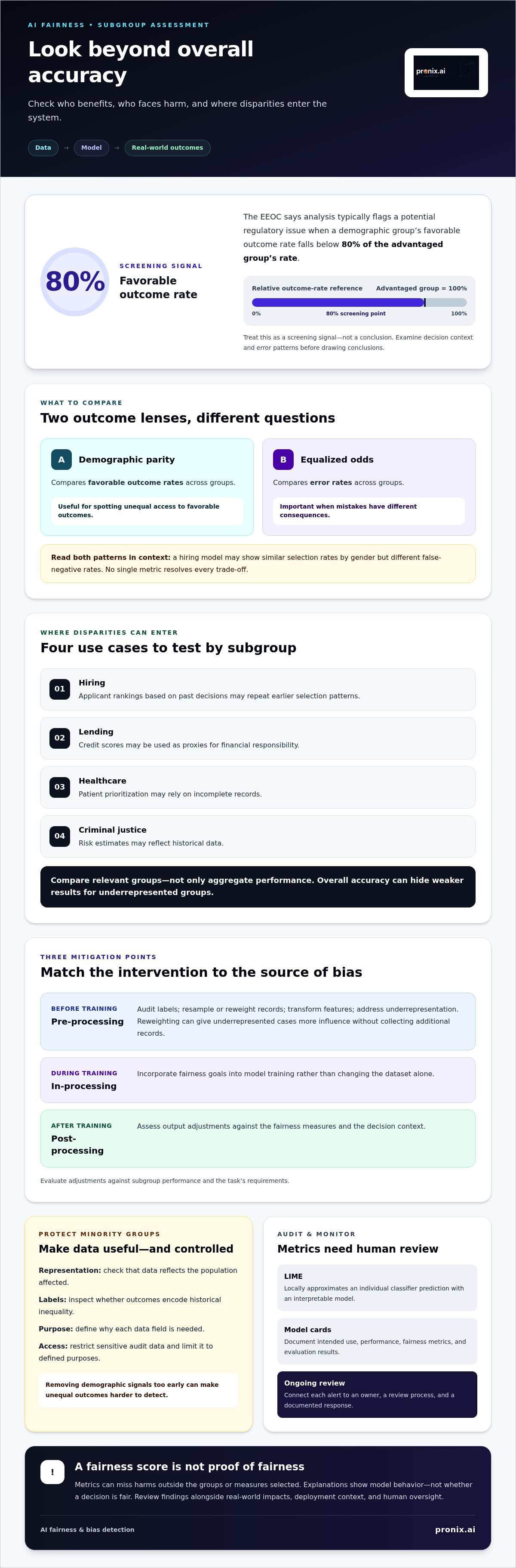
- Use subgroup outcome comparisons to surface potential disparate impact. The U.S. Equal Employment Opportunity Commission says analysis typically flags a potential regulatory issue when a demographic group’s favorable outcome rate falls below 80% of the advantaged group’s rate.
- Protect minority groups by checking whether data represents the people affected, while limiting sensitive data to what the assessment requires.
- Match mitigation to the source of bias: adjust data before training, incorporate fairness goals during training, or assess output adjustments after training.
- Monitor for changes in performance and deployment context, and include diverse stakeholders in human review to catch risks that model metrics may miss.
Balancing data minimisation with protection of minorities
Data minimization limits personal information, while fairness testing requires enough evidence to reveal who benefits and who faces harm. Define the purpose of each data field before model development, then restrict access to sensitive audit data.
Representation, Labels, and Historical Bias
Bias can arise when a model’s training data does not reflect the population it is intended to serve or reflects past inequalities. Hiring records, for example, may reflect previous selection patterns rather than job-relevant performance. Labels based on those outcomes can teach a model to repeat them. Inspect sampling, label definitions, and data collection context, then address gaps before evaluation. Minority groups need adequate representation for subgroup results to be meaningful.
Subgroup Performance Across Use Cases
Subgroup performance shows whether errors or favorable outcomes differ across population groups. Examples include hiring tools ranking applicants based on past decisions, lending models using credit scores as proxies for financial responsibility, healthcare systems prioritizing patients based on incomplete records, and criminal justice tools estimating risk from historical data. These cases matter because a classifier optimized for overall accuracy may perform worse for an underrepresented group. Compare results across relevant groups, not just in aggregate.
In legal environments, disparate impact analysis typically flags a potential regulatory issue when a demographic group receives favorable outcomes at a rate below 80% of the advantaged group's rate, according to the U.S. Equal Employment Opportunity Commission. Treat this comparison as a screening signal, then examine decision context and error patterns before drawing conclusions.
Balance data minimization with minority protection by controlling access to audit data and limiting its use to defined purposes. Document why each field is needed, who can access it, and how findings inform model development. Removing demographic signals too early can make unequal outcomes harder to detect.
How do bias and discrimination relate to fairness?
Bias describes systematic patterns in AI systems; discrimination occurs when those patterns contribute to unfair treatment. Fairness assessment tests outcomes in context and tracks risks throughout the system’s lifecycle.
Fairness Metrics and Their Uses
Fairness metrics compare outcomes or errors across groups, and the right measure depends on the decision. Demographic parity compares favorable outcome rates; equalized odds compares error rates across groups. Compare outcomes to spot unequal access, then examine error rates when mistakes have different consequences. No single metric resolves every trade-off.
For example, a hiring model might show similar selection rates by gender but different false-negative rates. Ensuring AI model fairness and bias detection means assessing both patterns across training, validation, and live decisions. Document the chosen metric, affected groups, decision context, and rationale. This helps teams interpret changes rather than treating a score as proof of fairness.
Auditing Tools and Detection Limitations
Bias audits use fairness testing tools to measure group outcomes, while explainable AI helps teams examine how a model reaches decisions. LIME locally approximates an individual classifier prediction with an interpretable model. Model cards can document intended use, performance, fairness metrics, and evaluation results. Together, these methods make review more structured and traceable.
Automated monitoring can flag shifts in sensitive attributes, input patterns, or outcome rates. Human reviewers must determine whether an alert reflects discrimination or a legitimate change in context. A metric may miss harms outside its chosen groups or measures, and explanations show model behavior, not that a decision is fair. Ensuring AI model fairness and bias detection requires reviewing findings alongside real-world impacts.
Continuous monitoring should connect each alert to an owner, review process, and documented response. Compare current results with the model’s approved evaluation, investigate meaningful changes, and escalate high-impact decisions for human oversight. This lifecycle approach can catch risks a one-time audit misses, including patterns that emerge after deployment or changes in how people use the system.
Pre-processing, in-processing, and post-processing mitigation
Bias mitigation can target the dataset, training algorithm, or model predictions. The right intervention point depends on where the risk enters and which fairness metrics the team needs to improve.
Pre-processing Training Data
Pre-processing changes training data before model development to reduce bias carried into the algorithm. Teams can audit labels, resample or reweight records, transform features, or address underrepresentation. For example, reweighting can give underrepresented cases more influence without collecting additional records. Evaluate each adjustment against subgroup performance and the task’s requirements.
In the UK, special category data may be processed for research assessing AI discrimination under Article 9(2)(j), read with Schedule 1 paragraph 4 of the Data Protection Act 2018, if relevant conditions are met. This can support bias testing, but teams must assess the applicable requirements before using sensitive data.
In-processing Mitigation
In-processing builds fairness objectives into model training rather than changing the dataset alone. Teams can add fairness constraints or regularization to the optimization process, use adversarial debiasing, or learn representations designed to reduce the influence of sensitive attributes. These techniques can address patterns that remain after data preparation.
Compare the revised model with its baseline using consistent evaluation data and group-level metrics. A fairness constraint may affect prediction quality across groups, so document the chosen trade-off and intended use. Check that the model still meets operational needs, not just whether one metric improves.
Post-processing Model Outputs
Post-processing adjusts predictions after training without retraining the classifier. Techniques include threshold adjustments, outcome correction, and fairness calibration. Equalized Odds Postprocessing can adjust classifier outputs to balance error rates across groups. This approach may help when retraining is impractical, but evaluate changes against the same outcomes and metrics.
Group-specific thresholds may raise legal concerns in some use cases. Assess the decision context and applicable requirements before deployment. Record the adjustment, its rationale, and its effect on predictions for each evaluated group. Then monitor outcomes to see whether the intervention reduces one disparity while creating another.
Continuous bias detection across the AI lifecycle
Bias detection should span data preparation, model evaluation, and live operation. This lifecycle view connects demographic outcomes with accuracy, context, and compliance risks.
Bias Detection in Models and Training Data
Lifecycle testing checks whether training data, model outputs, and deployment conditions produce unequal patterns. Before training, review dataset coverage, label quality, and missing demographic groups. During development, compare subgroup error rates and favorable outcomes against the model’s intended use. This helps organizations detect bias in both data and predictions, rather than relying on overall accuracy alone.
Keep a consistent evaluation set and record its scope, sensitive attributes, metrics, and known limitations. Rerun tests after data changes, feature updates, or model adjustments. If a hiring model’s false-negative rate shifts for a demographic group, trace the change through inputs, labels, and decision thresholds before approving release.
Post-deployment Bias Monitoring
Post-deployment monitoring compares live outcomes with the model’s approved evaluation and identifies meaningful changes. Track input distributions, subgroup outcomes, error patterns, and user feedback. For example, a change in customer behavior may alter model outputs even when the algorithm remains unchanged. Monitor the context as well as performance.
Assign an owner to review each alert, document the finding, and determine whether it requires investigation, escalation, or a model adjustment. Human oversight matters because an outcome shift may reflect a data-quality issue, a new usage pattern, or an emerging discrimination risk. Preserve audit records so teams can connect alerts to decisions and compliance reviews.
Make monitoring operational: define which metrics trigger review, who assesses them, and how findings feed back into development. A dashboard without an accountable response process cannot close the loop. Strengthen AI lifecycle monitoring with a governed implementation approach.
Pronix.ai: Agentic AI Implementation
pronix.ai helps enterprises move AI initiatives toward secure, scalable production through Agentic AI Implementation. This work is relevant when fairness checks need to become part of operational workflows, supported by clear governance and ongoing oversight rather than isolated model tests.
Effective implementation depends on reliable data foundations, defined decision boundaries, and monitoring that connects model outputs to business processes. For customer-facing systems, AI-Driven CX Modernization can help align intelligent workflows with customer experience needs. AI Business Automation applies similar discipline to enterprise processes.
To discuss how these capabilities could support your AI deployment, contact pronix.ai.
Make Fairness Part of Every AI Decision
Fairness becomes durable when it shapes how an organization approves, owns, and evolves AI use. Treat ensuring AI model fairness and bias detection as an operating commitment, not a technical checkpoint. Set clear decision rights, document why a system is used, and give affected teams a defined way to raise concerns. These choices help leaders connect responsible AI principles with everyday accountability.
The next step is to turn that commitment into a practical governance approach. Decide who reviews material changes, how teams escalate concerns, and what evidence supports continued use. Keep responsibilities visible as AI moves into new workflows. This clarity helps organizations make deliberate choices as capabilities and business needs change.
For support shaping an enterprise AI approach, contact pronix.ai to discuss AI fairness. Build the conditions for responsible progress, and move forward with confidence.
Frequently Asked Questions
What Is Bias in AI?
Bias in AI is a systematic pattern that can lead a model to treat cases differently and produce unfair outcomes. For example, a recommendation system trained mainly on frequent users may repeatedly overlook people with less common needs. Bias can stem from data, design choices, or how people use the system, so examine the full decision process.
What Is Fairness in AI?
Fairness in AI means evaluating whether a system’s decisions are appropriate and equitable for the people affected. There is no universal threshold: a fair outcome depends on the decision, its consequences, and the groups involved. For example, a service-routing model may need to provide comparable access, while a fraud detector requires careful attention to false accusations and missed cases.
How Do You Mitigate Bias and Improve Fairness in AI?
Start by defining the decision, potential harms, and affected groups before choosing a model or evaluation approach. Then test realistic cases, including unusual situations routine datasets may miss. For a customer-support assistant, review whether different phrasing leads to different service options. Assign an owner to investigate concerns, record changes, and ensure users have a clear way to challenge consequential decisions.
Can bias be completely eliminated from AI models?
No. AI bias cannot be completely eliminated because data and decisions reflect changing human behavior, institutional practices, and real-world conditions. A model can also create new disparities when its use shifts beyond its original context. The practical objective is to identify harmful patterns, reduce their effects, and keep reviewing whether the system remains appropriate as users, workflows, and available data change.
How can non-technical stakeholders contribute to bias detection?
Non-technical stakeholders can identify assumptions and harms that technical tests may overlook. Frontline staff can flag confusing recommendations; affected users can describe barriers or inconsistent treatment; and business teams can explain how decisions work in practice. Give these groups a structured way to submit examples, review edge cases, and track whether reported concerns lead to investigation or change.
What are the most common types of bias in AI models?
Common types include selection, measurement, algorithmic, and contextual bias. Selection bias occurs when included data differs from the population of interest. Measurement bias arises when a recorded feature fails to represent the concept it is meant to capture. Algorithmic bias can emerge from model design, while contextual bias appears when a system is used in circumstances different from those for which it was designed.