

A prompt can become a privacy decision before it becomes an AI answer. Generative AI creates new content, such as text, images, or code, by learning patterns from data and responding to prompts. Generative AI data privacy concerns arise when prompts, training data, or outputs contain personal or confidential information that is collected, retained, or exposed.
The risk goes beyond data breaches. Excessive data collection, unclear retention practices, and broad access can all expose personal information, making privacy a governance issue as well as a technical one. With appropriate safeguards, organizations can assess these risks without treating AI adoption and data protection as competing goals.
This article explains how generative AI works, where privacy risks arise, and how encryption, access management, data minimization, and responsible governance can help reduce them. It also outlines how to identify exposure and build privacy controls into AI workflows from the outset.
Key Takeaways
- Understand how generative AI uses prompts, training data, and outputs, and why each can create privacy exposure.
- Identify how excessive collection, retention, or access can increase risk when personal information enters AI workflows.
- See how anonymization, encryption, and role-based access controls can help protect sensitive data.
- Explore how privacy-by-design and responsible governance can make safeguards part of AI systems from the outset.
What is generative AI and why it matters for data privacy?
Generative AI models produce text, images, audio, and code based on patterns learned from data and instructions supplied in prompts. Generative AI data privacy concerns arise when inputs or outputs expose personal information beyond its intended purpose.
Consent, transparency, and data minimization shape whether that use is responsible. The European Union implemented the General Data Protection Regulation (GDPR) on May 25, 2018.
Consent and transparency
Consent and transparency mean explaining what personal data an AI service collects, why it uses it, and how people can make choices about that use. Clear information helps users decide whether to share sensitive details such as health information or customer records. Practices vary by service, so review its data-use notice and settings before entering private content. Some services may use conversations to improve models. Check whether a training opt-out is available and enable it where offered.
Deepfakes and personal content
A deepfake is synthetic audio, video, or imagery that makes a person appear to say or do something they did not. For example, someone could upload a colleague’s photograph or voice recording and generate a misleading clip without permission. Personal content can be repurposed, shared, or presented as authentic, so consent matters. Treat identifiable images, voices, and private messages as sensitive data. Do not submit them for generation without an authorized purpose.
Data minimization
Data minimization means collecting and using only the personal information needed for a defined purpose. Consent does not make unnecessary collection sound practice: a prompt can often work without names, account numbers, or identifiable customer details. Replace these with role labels or fictional examples before using a model. This limits the personal information exposed if prompts are retained, reviewed, or reused.
State privacy law regulation
State privacy laws can affect how organizations collect and use personal data in generative AI, with requirements varying by law and activity. California’s CCPA and CPRA are relevant to personal and sensitive personal data; the CPRA provides a right to opt out of automated decision-making. Before deployment, global organizations should map data sources, the purpose of each AI use, and the state laws that apply.
Privacy risks from AI data collection and surveillance
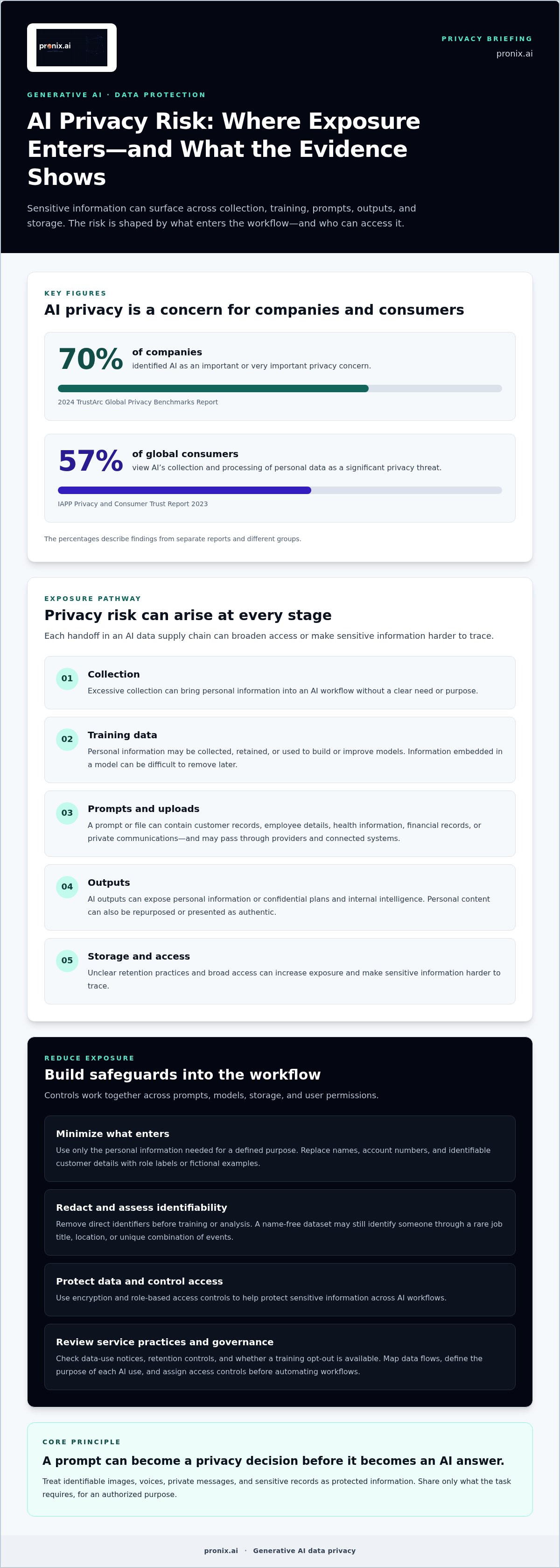
Privacy exposure can arise at every stage of an AI system’s data supply chain, from collection and training to prompts, outputs, and storage. Each handoff can broaden access or make sensitive information harder to trace.
Training data privacy risks
Training data privacy risks arise when personal information is collected, retained, or used to build or improve models. A user’s prompt or uploaded file may pass through the AI provider and connected systems, where handling depends on the service’s data practices and settings. A conversation could include customer records or employee details. Before sharing, remove identifiers and examine the service’s stated use and retention controls.
The risk can extend beyond the original user: information embedded in a model may be difficult to remove later. That is why the purpose and provenance of training data matter, not just the final output.
Anonymization and re-identification
Anonymization removes direct identifiers, while re-identification happens when other details make someone recognizable again. A dataset without names may still identify a person through a rare job title, location, or combination of events. AI systems can connect details across inputs and produce identifying outputs. Remove personal identifiers before training or analysis, then assess whether the remaining information could point back to an individual.
Removing a name alone is not enough if the surrounding context is unique.
Sensitive data risks
Sensitive data, such as health details, financial records, or private communications, can harm people if collected or disclosed beyond its intended purpose. For example, a prompt asking for a case-file summary could include client identifiers alongside medical history. Limit inputs to what the task requires, and use synthetic or redacted examples where possible.
In the 2024 TrustArc Global Privacy Benchmarks Report, 70% of companies identified AI as an important or very important privacy concern. The IAPP Privacy and Consumer Trust Report 2023 found that 57% of global consumers view AI’s collection and processing of personal data as a significant privacy threat.
Organizational and legal risks
For businesses, employee prompts can expose confidential plans, customer information, or internal intelligence in AI outputs. The CCPA and CPRA in California, as well as other state privacy laws, may apply to personal data collection and processing; obligations depend on the law and activity. A California legislator proposed requiring browser makers to respect third-party opt-out signals, a regulatory action concerning privacy choices.
That proposal is not a reported generative AI incident. The practical incident pattern to control is unauthorized exposure through prompts, uploaded files, or outputs. Map data flows and assign access controls before automating workflows. AI business automation can help organizations structure workflows with data handling in view.
Anonymization, encryption, and access controls
Privacy safeguards are most effective when they work together across prompts, AI models, storage, and user permissions. Apply controls before sensitive information enters an AI workflow.
Anonymization safeguards
Anonymization removes identifying details so data can be used with less direct exposure. Replace names, account numbers, and contact details with neutral labels before submitting a prompt. A data privacy vault can store personal information separately and provide a de-identified token with no mathematical connection to the original data, making it impossible to reverse engineer. This keeps useful context separate from direct identifiers.
Removing names may leave details that identify someone when combined. Before sharing a dataset, review locations, job titles, dates, and unusual events. Keep only fields needed for the task, and document the purpose and consent associated with their use. These steps reduce unnecessary exposure while preserving relevant information.
Encryption and access controls
Encryption protects data at rest and in transit by making it unreadable without the appropriate key. Use it for stored files and data exchanged with third-party AI APIs or cloud services. Combine encryption with role-based access controls: give employees access only to the models, training data, and outputs they need for their responsibilities, and remove permissions when those responsibilities change.
For ChatGPT, Gemini, Claude, and Copilot, retention and deletion depend on each service’s policies and available account settings. Before sharing sensitive information, review the service’s privacy controls for conversation history, data use, retention, and deletion. Do not assume that deleting a visible chat also removes every associated record.
Access controls should also support privacy requests. Under the GDPR and other laws, people in the European Union and California can request access to personal data through Data Subject Access Requests. The GDPR gives individuals rights to access, rectify, and erase their personal data. Maintain a process for locating associated records and responding through the applicable workflow.
Privacy by design and responsible governance
Privacy by design builds data protection into an AI system before deployment, rather than after an incident. For a generative AI workflow, decide what personal information it needs, who can access it, and how long it will be stored. These decisions help determine whether individuals retain meaningful control as the system moves from testing into daily operations.
Start by defining the purpose of each use case. Map the dataset, its source, the people affected, and every system that receives or stores personal information. Assess whether the task can use less data, then document retention, access, and deletion rules. For example, a customer-support assistant may need an order status but not a full customer profile. Clear ownership makes controls easier to apply and audit.
Assess impact before high-risk applications go live. Data Protection Impact Assessments are required for high-risk AI applications under regulations named in this article, including the GDPR, CCPA, and emerging EU AI Act. Use an assessment to identify potential harms, assign mitigations, and record decisions. The NIST AI Risk Management Framework offers a structure for aligning AI risk assessments with governance and operational controls.
Governance must continue after launch. Assign a business owner to review data sources, system changes, user access, and incidents. Track whether outputs expose personal information, and provide a way for individuals to raise concerns or exercise applicable rights. Federated learning and differential privacy can also help train models while limiting direct data exposure. Choose measures based on the system’s purpose, data, and risk profile.
Make privacy operational, not just a policy statement. Build privacy controls into AI workflows through a documented governance approach, from use-case assessment to ongoing oversight.
Pronix.ai: Agentic AI Implementation
pronix.ai helps enterprises turn AI plans into operational workflows through Agentic AI Implementation. This service is suited to organizations with a defined use case that need to integrate AI with operational processes, data, and privacy controls.
For broader readiness, Data & AI Foundations can address underlying data and architecture needs. AI Business Automation and AI-Driven CX Modernization connect AI capabilities with business workflows and customer interactions. Choose a starting point based on the use case, existing systems, and governance requirements.
If you’re planning an AI initiative and want to discuss implementation, contact pronix.ai.
Make privacy readiness part of AI execution
Managing generative AI data privacy concerns is an ongoing operating discipline, not a one-time review. Assign each use case a clear owner, make data handling visible, and revisit safeguards as workflows and business needs change. This keeps privacy decisions grounded in how teams use AI.
Turn these principles into an implementation plan by defining the business outcome, identifying the data involved, and establishing how the workflow will be governed. For enterprise initiatives, pronix.ai offers Agentic AI Implementation, AI-Driven CX Modernization, and AI Business Automation to connect AI use cases with operational goals.
Bring your priorities and current challenges into a practical discussion. Contact pronix.ai to discuss your needs and identify a clear path forward. With deliberate ownership and execution, organizations can advance AI adoption while keeping privacy in view.
Frequently Asked Questions
What is Generative AI?
Generative AI produces new content, including text, images, audio, or code, in response to instructions. Unlike a system designed only to classify a message or predict a value, it generates outputs, such as a drafted customer reply or an image based on a description. Its results depend on learned patterns and the prompt, so they can be useful but may also be inaccurate.
Can generative AI models memorize and reveal sensitive training data?
Yes. A model can sometimes reproduce information from its training data, particularly when that information is repeated or distinctive. An answer that exposes a private record can create a disclosure risk even if the user cannot access the original dataset. Organizations should test models with realistic prompts, review outputs for sensitive details, and avoid using confidential records in training without a defined privacy review.
How can organizations assess and govern generative AI privacy risks?
Before deployment, assess each proposed use case by identifying its users, data sources, outputs, and potential impact on individuals. For example, test whether a customer-support assistant reveals account details when prompted by someone without authorization. Assign an owner to approve the use case, record mitigation decisions, and review system changes and reported issues. This makes governance specific to how the AI is used, not just to the model.
What privacy incidents or regulatory actions involving generative AI have occurred in the United States?
California’s CCPA and CPRA may apply to personal data collection and processing, and the CPRA provides a right to opt out of automated decision-making. A California legislator proposed requiring browser makers to respect third-party opt-out signals, but this was not a reported generative AI incident.