

What if the biggest risk in adopting AI isn’t moving too slowly, but automating a process that should have been redesigned first? Business process re-engineering with AI starts by tracing how work moves across teams, systems, decisions, and handoffs, then reshaping the process around what people and AI can do well. The goal isn’t to add another tool. It’s to improve how the whole operation performs.
That distinction matters when AI pilots show promise but fail to produce sustained results. Existing workflows can include dependencies, unclear decision rights, and exceptions that a model alone can’t resolve. Redesign can also create uncertainty for employees if responsibilities and oversight aren’t clear. A disciplined approach connects process change with technology, governance, and adoption from the start.
This article explains how to identify processes where AI-enabled redesign is justified, assess value, risk, and readiness, and compare practical implementation approaches. You’ll also learn how to build a governed roadmap from current-state analysis to production, define human oversight, and measure outcomes across the end-to-end process rather than isolated tasks. The focus is a repeatable path from opportunity to measurable operational impact.
Key Takeaways
- Redesign the end-to-end workflow around outcomes, roles, and decisions instead of simply adding AI to an existing process.
- Map handoffs and bottlenecks to identify where AI, rules, or human judgment can improve the work, and where AI isn’t needed.
- Compare targeted automation, incremental improvement, and business process re-engineering with AI to choose an approach suited to the process and its risks.
- Build a governed roadmap with clear owners, baseline measures, controlled validation, and ongoing review.
- Connect process design with enterprise integration and operational support to move from pilot activity toward secure, scalable production.
What Business Process Re-Engineering With AI Changes, and What It Does Not
AI can make a task faster without making the process work better. A document may be summarized in seconds, for example, while employees still wait for approvals, re-enter information in another system, or resolve the same exceptions manually. Re-engineering starts with the intended service or business outcome, then examines the complete path of work needed to achieve it.
Business process re-engineering with AI is the redesign of an end-to-end workflow around its intended outcomes, the people and systems involved, decision rights, and the capabilities AI can responsibly support.
This approach extends established Business Process Re-engineering (BPR) principles by considering AI as one possible part of the future-state design. It does not mean applying AI to every activity or replacing human judgment by default. The right design may combine automation, AI, clear rules, and human decisions, depending on the work and the consequences of error.
Process automation versus process re-engineering
Task automation changes how one activity is completed. Re-engineering can change the sequence of activities, who has authority to decide, how teams hand work to one another, and which service outcome the process is accountable for. A copilot added to an unchanged workflow may help an employee, but it won’t resolve unnecessary approvals, duplicate data entry, or unclear ownership elsewhere in the process.
Consider a claims workflow. AI might extract details from submitted documents, but if staff still copy them into separate systems and send incomplete cases through the same approval queue, friction remains. A redesigned process examines intake, validation, exception routing, decision authority, and communication as connected steps. AI may support some of them; others may be better handled through simpler rules or a change in responsibility.
Why end-to-end workflow design matters
Start by tracing how a case, request, or transaction moves from initiation to completion. Include teams, systems, handoffs, exceptions, and customer or employee touchpoints. Note where information is created, checked, repeated, delayed, or lost. This view helps distinguish a process constraint from a local inconvenience and reveals dependencies a task-level change could miss.
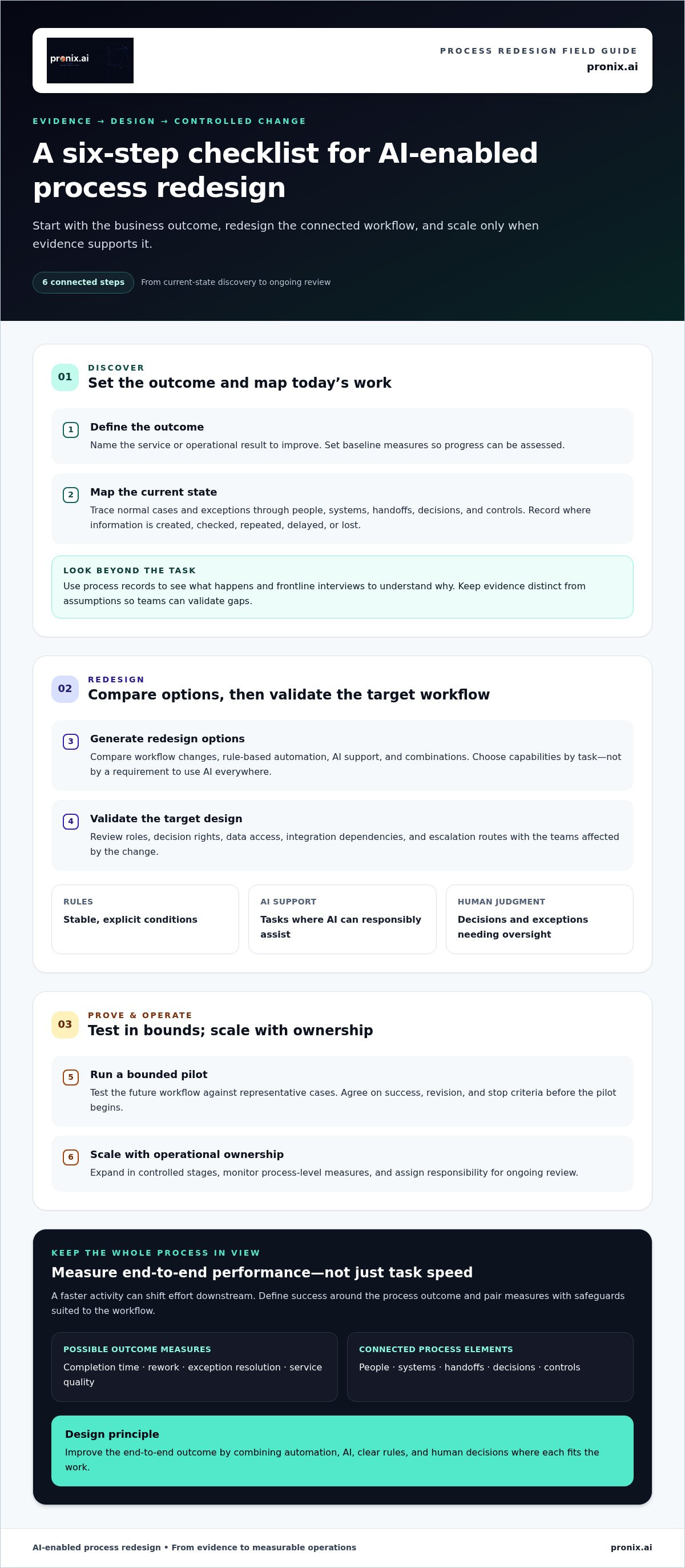
Local efficiency can shift effort rather than remove it. Faster intake may send more cases to a review team that lacks the capacity or information to act. One team’s productivity may improve even as the overall service takes longer. Define measures around the process outcome, such as completion time, rework, exception resolution, or service quality, and pair them with safeguards suited to the workflow.
The unit of change is the connected process: its people, systems, handoffs, decisions, and controls. Before selecting a technology, establish what a successful end-to-end outcome looks like and where human oversight remains necessary. That scope helps teams decide whether to automate a task, adjust the workflow, or undertake broader redesign. AI is a design capability, not a mandate to make every process an AI project.
How AI-Enabled Process Re-Engineering Redesigns Work From End to End
A reliable redesign moves from evidence to controlled change. Begin with the business outcome, establish how the process works today, compare future-state options, then validate, pilot, and scale only when the evidence supports it. This sequence ties technology choices to operational needs and makes integration, data access, exceptions, and human escalation part of the design rather than late-stage fixes.
Discover the process and define target outcomes
Set a measurable outcome before choosing a model or platform. Document who performs each activity, what information they use, where decisions occur, which systems are involved, and how exceptions and existing controls are handled. Process records can show what happens; interviews with frontline staff and process owners help explain why. Label evidence separately from assumptions so stakeholders can validate gaps before they shape the future workflow.
Use the findings to work through a deliberate sequence:
- Define the outcome. Specify the service or operational result to improve, along with baseline measures that make progress assessable.
- Map the current state. Trace normal cases and exceptions across people, systems, handoffs, decisions, and controls.
- Generate redesign options. Compare workflow changes, rule-based automation, AI support, and combinations of these approaches.
- Validate the target design. Review roles, decision rights, data access, integration dependencies, and escalation routes with affected teams.
- Run a bounded pilot. Test the future workflow against representative cases and agreed success, revision, and stop criteria.
- Scale with operational ownership. Expand in controlled stages, monitor process-level measures, and assign responsibility for ongoing review.
Design, validate, and transition the future workflow
Choose capabilities by task. Rules can handle stable, explicit conditions. Generative AI may assist with interpreting or drafting information, while an AI agent may coordinate actions across defined steps when permissions and controls support that role. People should retain decision authority when a task requires judgment, accountability, or exception handling. Specify which data each capability can access and what happens when information is missing or confidence is insufficient.
Before rollout, test routine cases, edge cases, incomplete inputs, system failures, and escalation paths. Confirm that information moves correctly between connected systems and that employees know when to intervene. A pilot needs a defined scope, an accountable owner, and evidence thresholds for proceeding, revising, or stopping. Track end-to-end outcomes alongside quality and exception measures; activity volume alone can hide delays or rework shifted elsewhere.
For a deeper view of moving agentic workflows into production, see the enterprise agentic AI production guide. Organizations shaping enterprise AI implementation can use the same discipline to connect process design, technology, and governance before expanding a pilot.
Choose Between AI Automation, Incremental Improvement, and Full Re-Engineering
The right scope depends on the process problem, not on how ambitious the AI opportunity sounds. A stable task may need targeted automation. A localized bottleneck may call for incremental improvement. If delays, duplicated work, or unclear decisions span teams, broader redesign may be justified. Business process re-engineering with AI is not automatically superior; match the intervention to evidence, risk, integration needs, and the organization’s capacity for change.
| Process conditions | Disruption and integration | Risk and likely outcome | |
|---|---|---|---|
| Targeted automation | A bounded task has clear inputs, outputs, and manageable exceptions. | Usually focused on one activity, with limited workflow change. | Can reduce manual effort at that step; upstream and downstream friction may remain. |
| Incremental improvement | The wider workflow is sound, but a specific, evidenced friction point needs attention. | Adjusts part of the process while preserving most roles, systems, and controls. | Limits the scope of change; benefits depend on whether the targeted issue is the true constraint. |
| Full re-engineering | Handoffs, duplicated work, fragmented decisions, or poor visibility affect the end-to-end outcome. | May require cross-functional redesign, broader integration, and role changes. | Can address connected causes, but introduces more dependencies and change risk to govern. |
When targeted automation or incremental change is enough
Choose a narrow intervention when the task is repeatable and its boundaries are clear. For example, automating the routing of complete requests may be appropriate if the broader approval path works as intended. If the issue is a specific delay within an otherwise effective process, improve that step first. Keep existing controls in place, define what the change can and cannot do, and monitor exceptions so a local fix doesn’t create hidden work elsewhere.
When an end-to-end redesign is justified
Consider broader redesign when evidence points to a connected problem: teams repeatedly pass work back and forth, enter the same information in different systems, or make decisions without a shared view of the case. These symptoms suggest that optimizing one task may simply move the queue. Examine decision ownership, integration dependencies, and how the proposed future state affects customers and employees.
Cross-functional ownership matters. A redesign spanning departments needs accountable process leaders and agreement on how systems and teams will exchange work. The scope must also fit the organization’s risk tolerance and capacity to adopt change. If those conditions aren’t in place, staged improvements can build evidence and readiness before a wider shift.
Use a simple decision test: identify the root cause, locate where it occurs, and determine whether it crosses team or system boundaries. Then compare the expected process outcome with implementation complexity and operational risk. Select the smallest scope that addresses the cause, not merely the visible symptom. This keeps redesign proportionate while leaving room to expand if evidence shows the wider workflow needs to change.
Build a Governed Roadmap for Business Process Re-Engineering With AI
A governed roadmap turns process redesign into a sequence of decisions, each with an owner and evidence required to proceed. For business process re-engineering with AI, governance should cover business outcomes, technical delivery, risk decisions, and operational support, not just model approval. Assign responsibilities early so teams know who can approve a change, resolve a control issue, or pause a rollout.
- Select the process. Prioritize a process with a clear business need, an accountable owner, and a scope the organization can manage.
- Set a baseline. Record current process outcomes, service quality, exception patterns, adoption conditions, and relevant control performance.
- Design the future state. Document proposed roles, decision rights, system connections, data needs, and human intervention points.
- Validate under control. Test expected and unusual scenarios, review risks and access, and define the evidence required for a production decision.
- Roll out in stages. Confirm readiness, support arrangements, employee guidance, and ownership before extending the redesigned workflow.
- Review continuously. Monitor results and incidents, reassess controls, and adjust the design as process conditions change.
Include data readiness in the roadmap from the outset. Establish what data the workflow needs, where it resides, who can access it, and whether its quality and availability support the intended decisions. Assign owners to integration dependencies, especially when a redesigned process crosses platforms or teams. A practical enterprise AI data strategy connects these process requirements to the data foundations needed for production.
Set decision gates, governance, and human oversight
Make approval paths explicit. Identify who authorizes process changes, model behavior, data access, escalation rules, and production release. Define when a person must review an output, how they can override or correct it, and where uncertain or consequential cases go. Maintain operating procedures for recording incidents, exceptions, and material changes so accountability continues after launch.
Measure the redesigned process and manage adoption
Compare post-change performance with the baseline using measures tied to the whole process: business outcomes, service quality, exception handling, employee adoption, and control effectiveness. A faster individual task isn’t enough if rework rises or service quality falls. Review the evidence at every decision gate and revise, expand, or pause the scope as conditions warrant.
Employees provide essential insight into how work actually gets done. Involve affected teams in discovery, workflow testing, training, and feedback. Explain how responsibilities and escalation paths will change, then use their observations to identify friction the design may have missed. This makes the transition more informed and gives operational owners a clear role in ongoing review.
To structure a governed roadmap around your enterprise process and production needs, explore pronix.ai implementation and managed services.
Move From AI Process Redesign to Secure, Scalable Enterprise Operations
A redesigned workflow creates value only when it can operate reliably within the enterprise environment. That takes more than deploying a model. Strategy defines the business objective and scope; process design clarifies roles and decisions; technical integration connects the workflow to enterprise systems; governance establishes controls; and operational management sustains the work after release. These disciplines need to move together from pilot planning through production.
Pronix.ai brings strategy, implementation, and managed services together to help enterprises move from AI pilots toward secure, scalable production operations. Its work spans business owners, technical teams, data stakeholders, risk leads, platform specialists, and operational support, aligning implementation with the intended process outcome and accounting for integration, access, escalation, and accountability.
Connect business redesign to enterprise platforms
Design integration as part of the target workflow, not as a task to defer until after a pilot. Determine which systems need to exchange information, where decisions are recorded, and how exceptions move between people and applications. Platform selection should follow process requirements, existing architecture, security considerations, and operating constraints. AWS or Microsoft may be relevant to an enterprise’s cloud and AI environment; Salesforce may support customer workflows; Kore.ai or Genesys may fit contact-center processes. The choice depends on the workflow, not the platform name.
That alignment also requires attention to data foundations and controls. Teams need to understand which information the workflow uses, how access is governed, and how system connections support traceable operations. When process owners and platform teams work together, they can assess integration decisions against business needs as well as technical dependencies.
Sustain outcomes after implementation
Production marks a transition in responsibility, not the end of the work. Define who monitors process performance, handles incidents, reviews exceptions, maintains controls, and approves changes to the workflow or AI behavior. Operational teams need clear procedures for escalating issues and recording what changed, why, and who approved it. This preserves accountability as systems, data, and business needs evolve.
Feedback from employees and process owners can reveal new friction, recurring exceptions, or changing service requirements. Use it to inform controlled improvements, validate changes before release, and continue measuring process outcomes, quality, and control effectiveness. Pronix.ai provides enterprise AI managed services to support this ongoing operational discipline. The enterprise AI managed services guide explores how ongoing support connects to production outcomes.
For enterprises ready to connect process redesign with implementation and sustained operations, discuss enterprise AI process transformation with Pronix.
Turn Process Opportunity Into Your Next Enterprise Step
The next move doesn’t need to be a sweeping transformation. Choose a process where the outcome matters, the current friction is visible, and the organization can learn from a controlled change. Then use what you learn to make the next decision: refine the workflow, expand its scope, or apply the approach elsewhere. That steady progression helps business process re-engineering with AI become an operational capability, not a one-off initiative.
Strong execution depends on aligning business priorities with technical delivery and accountable operations. Pronix.ai connects those workstreams and helps enterprises move AI initiatives toward production, with attention to secure, scalable, measurable outcomes.
Discuss how to move AI-enabled process redesign into enterprise operations and identify a practical next step for your organization. With a clear process objective and the right governance in place, your team can move forward with confidence.
Frequently Asked Questions
Is business process re-engineering with AI only relevant to companies that already use automation?
No. A manual process can be a starting point for business process re-engineering with AI if the organization can observe and document how work gets done. For example, a team could examine manually reviewed service requests to identify decision points and recurring exceptions. That evidence helps determine whether to simplify the process, use rules, introduce AI support, or keep the work human-led.
Can an enterprise re-engineer a process without replacing its core systems?
Often, yes. Redesign may fit around existing systems if their integration options, data access, and security controls support the target workflow. Map which application remains the authoritative record for each key data element, then define how updates move between systems and what happens if an exchange fails. This can reveal whether a connection, configuration change, or broader technology adjustment is needed before production planning.
How should employees be involved in AI process redesign?
Involve employees who perform, supervise, and receive the work, starting with people closest to daily exceptions. Ask them to walk through recent cases, including one that followed the usual path and one that required judgment or rework. Their input can inform workflow prototypes and scenario tests. Explain changes to responsibilities early, provide role-specific practice, and create a way to report issues after the new process goes live.
What information should leaders gather before assessing a process for AI re-engineering?
Gather process documentation, role descriptions, decision rules, handoff points, system records, existing controls, and available performance measures. Include examples of routine and unusual cases, not just the ideal path. Useful measures might include completion time, rework, error patterns, or unresolved requests, depending on the process. Record who supplied each piece of information and which assumptions still need validation so gaps aren’t mistaken for established facts.
How long does business process re-engineering with AI take?
There’s no universal timeline. A contained workflow with accessible data and few system dependencies has different planning needs from a redesign spanning several teams and platforms. Estimate the work in stages, including discovery, design, integration, validation, employee preparation, and rollout. Set delivery expectations only after scope, dependencies, decision owners, and testing needs are understood. Revisit the schedule at decision gates if evidence changes the plan.
How is AI-enabled process re-engineering different from robotic process automation?
Robotic process automation generally follows defined instructions for repetitive, structured interactions. AI-enabled redesign can also reconsider how work is routed, how variable information is handled, and when a person should decide. For example, RPA may transfer set fields between applications, while AI could help interpret varied text before a reviewer acts. They can be combined, but the choice depends on input variability, control needs, and system context.