
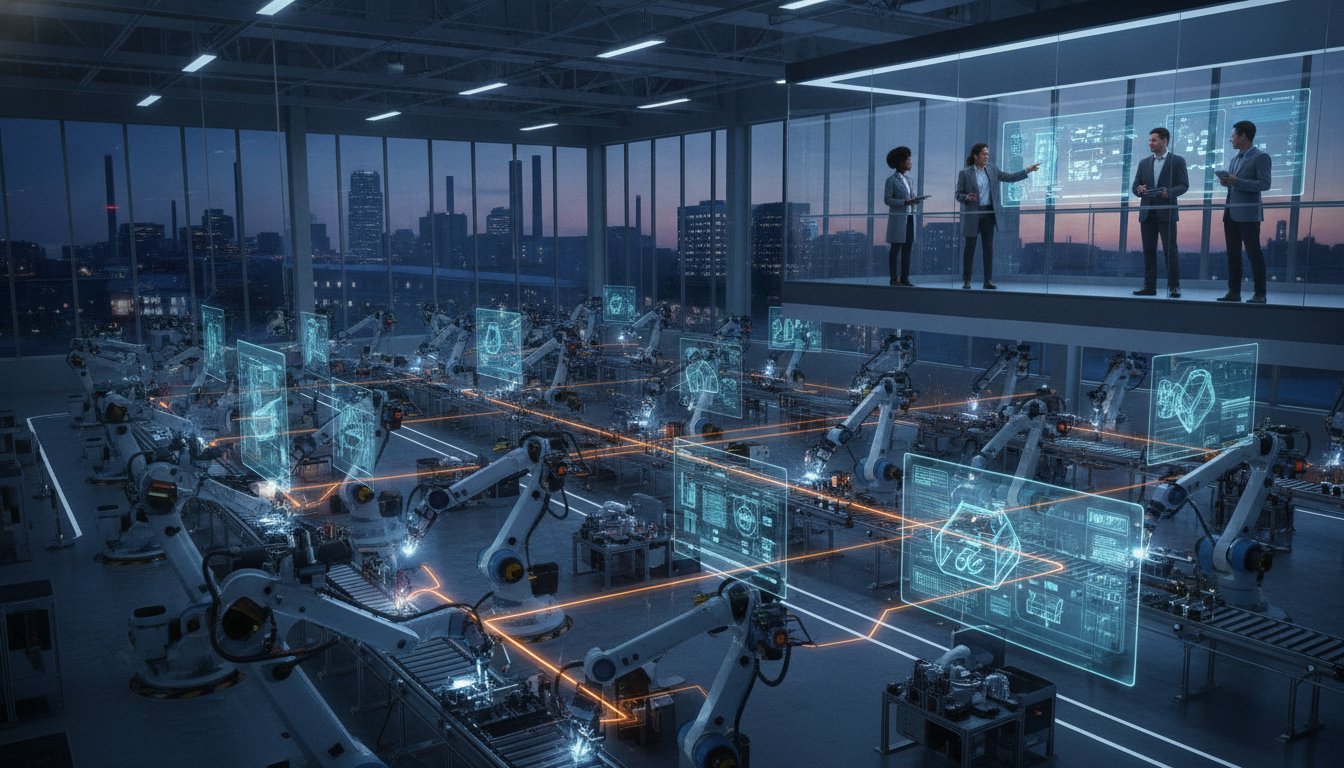
Predictive maintenance was the gold standard for a decade, but knowing a machine will fail is useless if your system lacks the autonomy to fix the problem without human intervention. Most industrial leaders have invested heavily in dashboards that highlight bottlenecks, yet they still find their AI pilots trapped in a permanent state of experimentation. You've likely seen the reports; data is abundant, but the "action" still requires a series of manual approvals and internal talent that is increasingly difficult to source. This gap between insight and action is the primary hurdle to achieving genuine manufacturing AI process efficiency in a high-stakes production environment.
You need more than just better forecasts. You need systems that can resolve supply chain disruptions and optimize floor operations autonomously. This guide outlines the transition from static AI pilots to scalable, agentic workflows that drive measurable outcomes. We will examine how to overcome talent shortages and data security concerns through a disciplined, governed implementation roadmap. By shifting from predictive insights to agentic execution, your organization can eliminate operational friction and secure a competitive advantage as we approach 2026.
Key Takeaways
- Transition from static predictive dashboards to autonomous software agents that perceive, reason, and act independently within your production environment.
- Drive measurable manufacturing AI process efficiency by deploying agentic workflows for real-time supply chain orchestration and dynamic production scheduling.
- Identify the core reasons why 70% of AI initiatives fail to scale and learn how to bypass the "Pilot Trap" through rigorous legacy system integration.
- Establish a governed AI foundation using a 90-day blueprint designed to maintain enterprise-grade stability and auditability on major cloud platforms.
- Bridge the gap between strategic vision and factory floor execution by leveraging specialized managed services to handle technical debt and security.
The Evolution of Manufacturing AI: From Predictive Insights to Agentic Execution
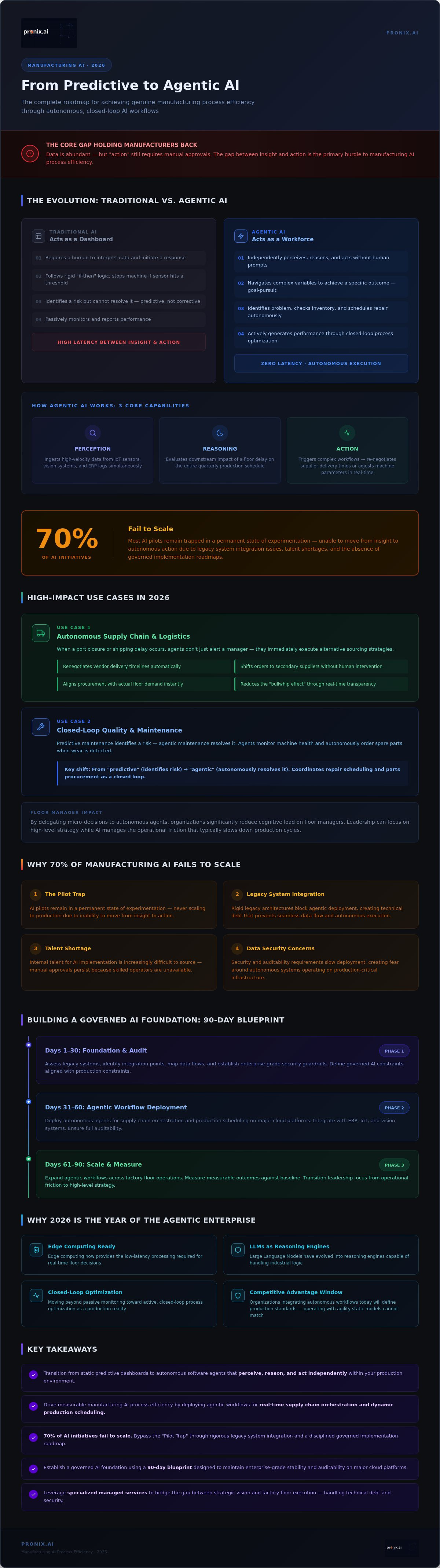
Predictive maintenance was a breakthrough that saved millions by identifying machine failure before it occurred. However, in 2026, knowing a part will fail is no longer enough to maintain a competitive edge. The global market demands immediate, autonomous resolution. Traditional AI acts as a dashboard; it requires a human to interpret data and initiate a response. Agentic AI acts as a workforce. It identifies the problem, checks inventory, and schedules the repair without human prompts. This shift is fundamental to maximizing manufacturing AI process efficiency because it eliminates the latency between insight and action.
What is Agentic AI in a Production Context?
There is a sharp distinction between simple automation and autonomous agents. Traditional automation follows rigid "if-then" logic. If a sensor hits a certain temperature, the machine stops. Agentic AI is a system capable of independent goal-pursuit within manufacturing constraints. It does not just follow a script; it navigates variables to achieve a specific outcome.
- Perception: Agents ingest high-velocity data from IoT sensors, vision systems, and ERP logs simultaneously.
- Reasoning: They evaluate the downstream impact of a floor delay on the entire quarterly production schedule.
- Action: They trigger complex workflows, such as re-negotiating supplier delivery times or adjusting machine cycle parameters in real-time.
By delegating these micro-decisions to autonomous agents, organizations significantly reduce the cognitive load on floor managers. Leadership can focus on high-level strategy while the AI manages the operational friction that typically slows down production cycles.
Why 2026 is the Year of the Agentic Enterprise
The hardware and software architectures have finally converged. Edge computing now provides the low-latency processing required for real-time floor decisions, while Large Language Models (LLMs) have evolved into reasoning engines capable of handling industrial logic. We are moving beyond passive monitoring toward active, closed-loop process optimization. This is where manufacturing AI process efficiency moves from a theoretical goal to a production reality.
This transition represents a fundamental change in factory operations. Systems no longer just report on performance; they actively generate it. For a detailed breakdown of the technical requirements for this shift, refer to our Enterprise Agentic AI: 2026 Production Guide. The organizations that integrate these autonomous workflows today will define the production standards of tomorrow. They will operate with a level of agility that static, predictive models simply cannot match.
High-Impact Use Cases: Where Agentic AI Drives 2026 Process Efficiency
Operational excellence in 2026 isn't about better reports; it's about faster execution. Agentic AI removes the human bottleneck from critical workflows. This is the cornerstone of modern manufacturing AI process efficiency. By moving beyond passive alerts, these systems transform from tools into active participants in the production cycle. They don't just highlight a problem; they execute the solution within the guardrails of your specific operational constraints.
Autonomous Supply Chain and Logistics
Logistics delays often trigger a cascade of manual emails and phone calls. Autonomous agents monitor global disruptions in real-time. When a port closure or shipping delay occurs, these agents don't just alert a manager. They execute alternative sourcing strategies immediately. By integrating with platforms like Salesforce Agentforce, agents can renegotiate delivery timelines with vendors or shift orders to secondary suppliers without human intervention. This transparency reduces the "bullwhip effect" by aligning procurement with actual floor demand instantly. Managers no longer spend hours on recovery plans because the agent has already secured the necessary inventory.
Closed-Loop Quality and Maintenance
Predictive maintenance identifies a risk; agentic maintenance resolves it. Agents now monitor machine health and autonomously order spare parts when wear is detected. They coordinate with production scheduling agents to find the optimal window for downtime, ensuring repairs happen with minimal impact on output. Industry data suggests this level of autonomy can reduce unplanned downtime by up to 50% in mature environments. Agentic AI drastically reduces the latency between defect detection and process correction by triggering root-cause analysis and line adjustments the moment a vision system identifies a variance. For example, if a computer vision agent detects a recurring defect, it can pause the specific line segment and initiate a diagnostic scan of the upstream assembly robot without waiting for a supervisor's approval.
Beyond maintenance, agents re-optimize production schedules every hour based on shifting energy costs or part shortages. If electricity prices spike, agents shift energy-intensive tasks to off-peak hours. Simultaneously, these agents serve as "digital twins" for senior engineers. They capture the heuristic knowledge of veteran staff and use it to guide junior technicians through complex repairs. This ensures that institutional knowledge remains scalable and accessible across the enterprise. Implementing these workflows requires a robust Agentic AI Strategy & Consulting partner to ensure governance and security.
Why 70% of Manufacturing AI Fails to Scale
The transition from a successful pilot to a factory-wide rollout is where most initiatives collapse. Industry data indicates that 70% of manufacturing AI projects never reach full production. This "Pilot Trap" occurs because experiments conducted in controlled sandboxes often ignore the chaotic variables of a live factory floor. Achieving manufacturing AI process efficiency at scale requires more than a successful proof of concept; it demands a system that survives real-world noise, from sensor drift to fluctuating network latency and unexpected machine downtime.
Legacy infrastructure remains a massive hurdle to operational maturity. Most facilities rely on a patchwork of aging PLCs and siloed ERP systems that weren't designed for high-velocity data exchange. Integrating autonomous agents into this technical debt creates friction that stalls scaling efforts. Without a unified architecture, the AI cannot perceive the environment accurately, leading to logic errors that threaten production stability. This lack of integration is why many leaders hesitate to move beyond passive dashboards.
Talent scarcity compounds these technical issues. Scaling agentic workflows requires a rare hybrid of data science expertise and deep industrial domain knowledge. Most organizations don't have the internal headcount to manage and govern complex AI agents, leading to valid concerns about security and brand reputation. The fear of an autonomous system making an unvetted, costly error is the primary objection at the executive level.
Infrastructure and Data Foundations
Success starts with a robust data strategy. You cannot build agentic workflows on top of fragmented, low-quality data. Overcoming the siloed data problem involves creating a centralized, high-fidelity pipeline that feeds agents the context they need to make reliable decisions. For a deeper look at preparing your architecture, see our Enterprise AI Data Strategy: 2026 Production Foundation. Stabilizing the data layer is the first step toward moving from experimental pilots to production-ready automation.
Governance and Risk Mitigation
Autonomous execution does not mean zero oversight. In regulated sectors, "black box" AI is a liability. Implementing Human-in-the-loop (HITL) frameworks ensures that agents handle routine optimizations while escalating high-stakes decisions to human experts. As we move into 2026, auditability is non-negotiable. Every autonomous action must be logged and explainable to comply with emerging safety regulations and internal risk management standards. This disciplined approach protects the brand while allowing manufacturing AI process efficiency to scale safely across multiple sites.
Building a Governed AI Foundation for Scalable Factory Operations
Establishing a scalable architecture requires a disciplined approach that balances innovation with risk mitigation. A 90-day blueprint allows organizations to deploy governed agentic AI without compromising production stability. This phased rollout starts with high-impact, low-risk use cases to validate the logic before expanding to critical floor operations. By mapping these intelligent workflows to existing Plan-Do-Check-Act (PDCA) cycles, leadership ensures that AI becomes a natural extension of the factory's continuous improvement culture. This alignment is essential for long-term manufacturing AI process efficiency and organizational buy-in.
Selecting Your AI Orchestration Layer
The choice of platform determines the speed of integration and the ease of governance. AWS and Microsoft Azure provide robust infrastructure for data-heavy operations, while Salesforce Agentforce offers a streamlined path for integrating AI with manufacturing ERPs. For internal operational communication, tools like Amazon Connect or Genesys can be repurposed to facilitate agent-to-human escalations. A platform-agnostic strategy is often the most resilient choice. It prevents vendor lock-in and allows for a multi-cloud environment where the best tools are selected for specific factory needs. Proprietary manufacturing processes must be protected through enterprise-grade security and localized data privacy protocols to maintain a competitive advantage and maximize manufacturing AI process efficiency.
Operationalizing the AI Lifecycle
Moving from a conceptual design to technical integration requires a clear roadmap. The lifecycle must account for ongoing maintenance through managed services to ensure that agents remain accurate as factory conditions shift. For a comprehensive look at this process, read our guide on Building Enterprise AI Agents: The 2026 Guide to Production-Ready Outcomes. Designing for scale is the final hurdle. The system must be capable of handling 100x the data volume of a pilot without latency issues. This technical maturity ensures that the AI foundation supports global operations rather than just a single site. It's about building a system that grows with the enterprise.
Execution at this level requires a partner who understands the friction points of modernizing legacy systems. Explore our Agentic AI Implementation services to bridge the gap between executive vision and factory floor reality.
Partnering for Production: How pronix.ai Accelerates Manufacturing Automation
Pronix.ai serves as the critical link between high-level strategic vision and the "boots-on-the-ground" technical execution required for the 2026 industrial landscape. While many consultants offer speculative advice, we focus on the pragmatic reality of scaling agentic workflows across complex organizations. We handle the technical debt and governance hurdles that typically stall manufacturing AI process efficiency. This allows your leadership to focus on production output while we ensure the underlying autonomous systems remain stable and auditability-compliant. Our approach is designed for the high-stakes nature of enterprise transformation where safety is as important as speed.
Managed Services for the Agentic Enterprise
Deployment is only the beginning of the lifecycle. Autonomous software agents require constant oversight to prevent model drift and ensure long-term reliability in fluctuating factory environments. Our Enterprise AI Managed Services provide the specialized talent needed to maintain these complex data foundations. We act as an extension of your team, filling the AI skills gap that often prevents manufacturers from moving beyond initial experiments. By providing talent-as-a-service, we ensure your automation remains secure and aligned with emerging global standards. For a detailed guide on evaluating partners, see our Choosing an Enterprise AI Managed Service Provider: The 2026 Selection Framework.
Your Path to Production-Ready AI
The Pronix Inc. heritage is built on decades of excellence in systems integration and complex business automation. We understand the friction of legacy systems because we've spent years navigating them for global enterprises. This experience allows us to drive manufacturing AI process efficiency by creating seamless bridges between modern AI agents and existing ERP and IoT assets. We don't just build experimental tools; we deliver production-ready outcomes backed by rigorous frameworks. Our methodology focuses on driving productivity acceleration by automating the resolution of supply chain disruptions and floor bottlenecks before they impact your bottom line.
Responsible AI adoption requires a partner who prioritizes stability and compliance alongside innovation. We provide the disciplined roadmap needed to move from experimental sandboxes to fully autonomous execution. Transition your AI strategy from pilot to production today by leveraging our proven methodology and specialized expertise. Discover how we support your journey as Pronix Inc: The Enterprise Systems Integrator Driving Production-Ready AI Outcomes.
Securing the Future of Autonomous Production
The transition from predictive dashboards to agentic execution is the defining operational shift for industrial leaders as we approach 2026. You've seen how autonomous workflows resolve supply chain disruptions and optimize floor assets in real-time. By establishing a governed foundation and overcoming the pilot trap, your organization can finally realize true manufacturing AI process efficiency. This evolution isn't just about adopting new technology; it's about achieving operational maturity through stability and rigorous risk mitigation.
Pronix.ai bridges the gap between executive vision and factory floor reality. As an AWS, Microsoft, and Salesforce Certified Partner, we provide the enterprise-grade governance frameworks and specialized manufacturing AI talent-as-a-service required for long-term success. We handle the complex technical debt and data architecture so your team can focus on output and scale. It's time to move beyond experimentation and secure a competitive advantage that is both scalable and auditable.
Ready to move your manufacturing AI from pilot to production? Contact pronix.ai for a strategic consultation. Your path to a fully autonomous, production-ready enterprise is within reach.
Frequently Asked Questions
How does Agentic AI differ from traditional manufacturing automation?
Agentic AI differs from traditional automation by its ability to reason and execute independent goal-pursuit within operational constraints. Traditional systems follow rigid, pre-defined scripts that fail when variables change. In contrast, autonomous agents perceive real-time data from floor sensors and adjust workflows to reach a target outcome. This adaptability is the core driver of manufacturing AI process efficiency, as it allows systems to navigate complex disruptions without manual reprogramming or human intervention.
What are the biggest risks of implementing AI in a production environment?
The primary risks include production instability, data security breaches, and brand reputation damage from unvetted autonomous decisions. Many manufacturers fear "black box" AI models that lack transparency. To mitigate these risks, organizations must implement enterprise-grade governance frameworks and human-in-the-loop (HITL) triggers. These protocols ensure that while agents handle routine optimizations, high-stakes decisions remain auditable and compliant with safety standards, preventing costly operational errors on the factory floor.
How much efficiency can a manufacturer realistically expect from Agentic AI in 2026?
Manufacturers can expect a measurable acceleration in productivity by eliminating the latency between problem detection and resolution. While results vary by facility maturity, early adopters are targeting a 50% reduction in unplanned downtime through autonomous maintenance scheduling. By 2026, the convergence of edge computing and mature models will allow for real-time re-optimization of energy usage and supply chain logistics. These improvements directly enhance manufacturing AI process efficiency by reducing manual friction.
Can Agentic AI integrate with our existing legacy ERP and MES systems?
Integration with legacy ERP and MES systems is possible through modern orchestration layers provided by partners like AWS, Microsoft, and Salesforce. These platforms act as a bridge, allowing autonomous agents to ingest data from aging PLCs and siloed databases. Successful integration requires a robust data foundation and an API-first strategy. This approach transforms static legacy records into actionable intelligence, enabling agents to trigger work orders or inventory updates across the entire enterprise architecture.
What is the typical timeline for moving an AI agent from pilot to production?
A standard timeline for moving from a pilot to a production-ready outcome is approximately 90 days. The first 30 days focus on strategy and data foundation alignment. The subsequent 60 days involve technical integration, governance testing, and phased deployment. This disciplined blueprint ensures that the system is validated against real-world factory variables before full-scale rollout. Following a structured roadmap prevents the "pilot trap" where experiments fail to transition into measurable business value.
How do you ensure AI agents comply with manufacturing safety standards?
Safety compliance is managed through rigorous governance frameworks and hard-coded operational guardrails. Agents are programmed to operate within specific safety parameters, escalating any edge cases to human supervisors immediately. Every decision made by the AI is logged to provide a full audit trail, ensuring transparency for regulatory bodies. This methodical approach prioritizes factory floor safety and ensures that autonomous execution never bypasses critical industry standards or internal risk management protocols during high-velocity production cycles.
What is the role of managed services in an AI-driven manufacturing strategy?
Managed services provide the specialized talent and ongoing oversight required to maintain AI reliability. They solve the talent gap by offering specialized talent-as-a-service to monitor agents for model drift and security vulnerabilities. As factory conditions evolve, managed service providers ensure that the underlying data foundations remain accurate and secure. This continuous management is vital for maintaining the auditability and performance of agentic workflows in high-stakes environments where internal resources may be limited.
Is Agentic AI suitable for small-to-medium manufacturing enterprises (SMEs)?
Agentic AI is increasingly accessible to SMEs through scalable cloud platforms like AWS and Salesforce. While large enterprises often lead with complex supply chain orchestration, smaller manufacturers can drive significant value by automating specific bottlenecks such as quality control or production scheduling. The key is focusing on high-ROI use cases that reduce operational costs without requiring a massive internal data science team. Managed services allow SMEs to leverage elite AI expertise without the overhead of permanent headcount.