

The era of the "helpful" chatbot is over; enterprise leaders now face a stark choice between scaling autonomous intelligence or remaining trapped in pilot purgatory. Despite massive initial investments, many contact centers still struggle with fragmented legacy systems and rising operational costs that refuse to budge. You've likely seen the promise of automation stall at the first sign of technical complexity. It's frustrating to watch AI projects fail to reach production while overhead continues to climb. Achieving true agentic ai for contact center efficiency requires moving beyond simple scripted responses toward agents that can reason and execute independently.
This guide provides the definitive 2026 framework for deploying autonomous agents to solve these persistent bottlenecks. We'll move past the hype to explore how agentic systems transition from simple triage to full, unassisted task completion. You'll discover a clear roadmap for scaling from an initial pilot to a full-scale production reality. We'll also detail how to secure measurable ROI through autonomous execution while maintaining the enterprise-grade governance and auditability your brand demands. The transition to a mature, AI-driven operating layer starts with a shift from reactive tools to autonomous agents.
Key Takeaways
- Understand how autonomous reasoning layers drive agentic ai for contact center efficiency by executing complex workflows instead of merely predicting text.
- Evaluate the 2026 platform landscape across AWS, Genesys, and Salesforce to identify the optimal integration architecture for your operational scale.
- Learn a rigorous implementation framework designed to move AI initiatives out of pilot purgatory and into secure, high-volume production.
- Establish enterprise-grade governance that mitigates hallucination risks and ensures data privacy within autonomous, tool-using AI workflows.
- Identify the specific milestones required to achieve measurable ROI through autonomous task completion and long-term operational maturity.
Beyond Chatbots: Why 2026 Demands Agentic AI for Contact Center Efficiency
The enterprise contact center has reached a critical inflection point. Legacy IVR systems and first-generation chatbots often fail because they lack the ability to understand intent or execute multi-step resolutions. By contrast, Agentic AI represents a shift toward intelligent agents that don't just predict the next word in a sentence; they reason through problems. These systems use tools, access real-time data, and execute complex workflows without constant human oversight. For leaders focused on agentic ai for contact center efficiency, this is the transition from "talking about problems" to "solving them" autonomously.
By 2026, the mandate for operational maturity has changed. Simple automation is no longer a competitive advantage; it's a baseline requirement. True differentiation now lies in AI-driven CX modernization, where agents act as autonomous extensions of your workforce. This technology enables a move away from the high-cost, high-friction models of the past toward a more agile, reasoning-led architecture.
The Shift from Reactive to Proactive Service
Shifting focus from reaction to anticipation allows brands to transform their engagement strategies. Instead of waiting for a customer to call with a billing dispute, these agents analyze historical data and cross-reference system logs to identify errors before they trigger an inquiry. This proactive approach reduces inbound volume by resolving issues at the source. By deploying autonomous outbound resolution, enterprises can handle complex issues like shipping delays or subscription renewals before the customer even notices a friction point. The goal is a "zero-touch" resolution model for Tier 1 inquiries, freeing human talent for high-value interactions.
The Economic Impact of Autonomous Reasoning
The financial argument for agentic ai for contact center efficiency is rooted in direct cost-per-interaction (CPI) reduction. Traditional scaling requires a linear increase in headcount, which is unsustainable in high-churn environments. Autonomous reasoning layers allow organizations to scale capacity vertically without adding a single seat to the floor. This doesn't just lower costs; it improves the Employee Experience (EX). By removing repetitive, low-value tasks from the daily queue, human agents can focus on empathy-driven cases that require nuanced judgment. The result is a more resilient operation that balances fiscal discipline with superior service quality.
Evaluating the 2026 Landscape: Platform Comparison for AI Agents
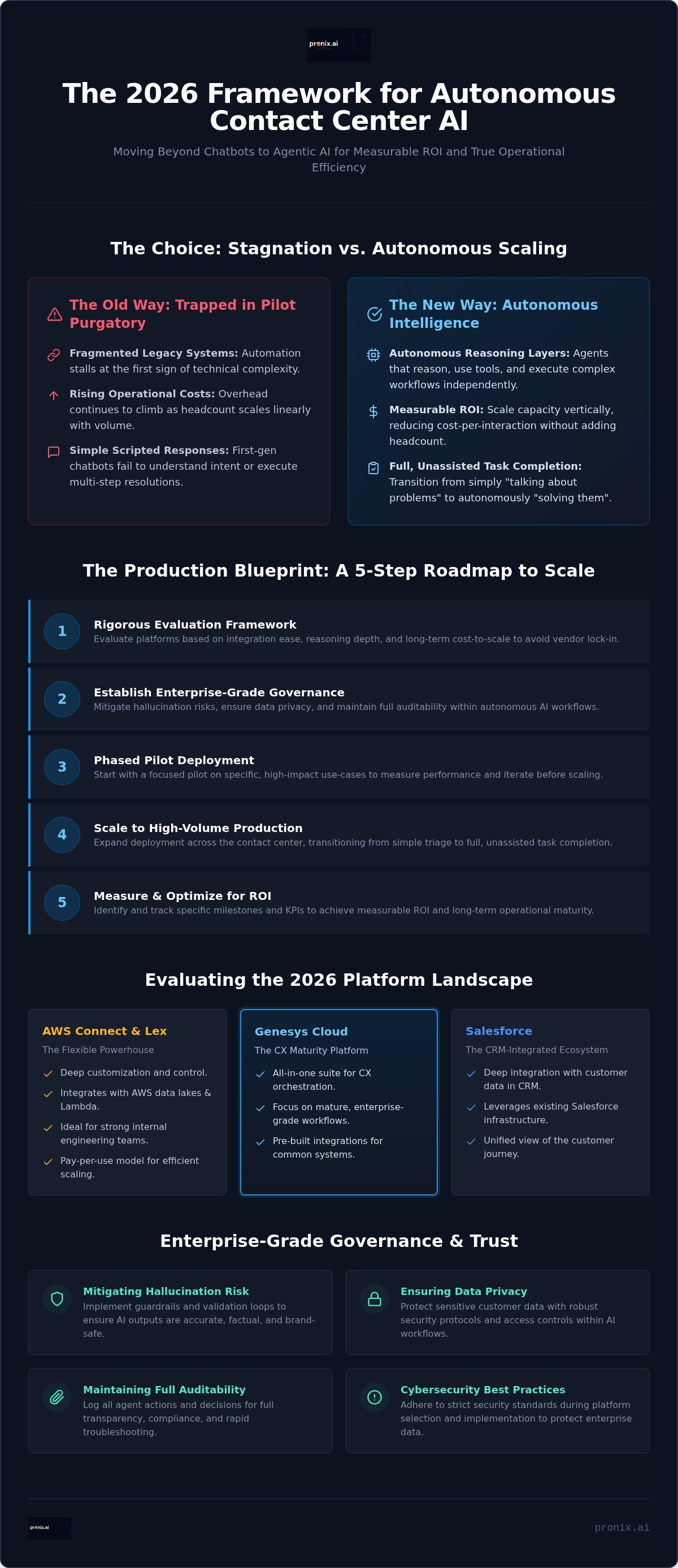
Selecting an ecosystem is a high-stakes decision that determines how effectively your organization can operationalize agentic ai for contact center efficiency. The 2026 market is dominated by three major ecosystems: AWS, Genesys, and Salesforce. Your choice depends heavily on your current roadmap for modernizing legacy contact centers. A fragmented backend will stall even the most advanced reasoning layers. Successful leaders prioritize platforms that offer modularity, allowing them to adapt as underlying models evolve.
Evaluate these platforms based on integration ease, reasoning depth, and long-term cost-to-scale. It's vital to avoid proprietary lock-in by maintaining a managed implementation strategy. Following cybersecurity best practices for agentic AI is non-negotiable during this selection phase to protect sensitive customer data. For many enterprises, partnering with an implementation expert is the fastest way to navigate these platform complexities and ensure production readiness.
AWS Connect and Lex: The Flexible Powerhouse
AWS provides unparalleled flexibility for organizations that require deep customization. It integrates seamlessly with AWS data lakes and Lambda functions, enabling sophisticated tool-use that basic bots can't handle. This is the "builder's choice." It's ideal for organizations with strong internal engineering or those working with specialized partners. The pay-per-use model provides a clear path to scaling agentic ai for contact center efficiency without over-provisioning resources.
Genesys Cloud: The CX Maturity Leader
Genesys remains a leader in CX maturity by building agentic features directly into established service workflows. The platform's primary strength is the human-in-the-loop (HITL) handoff. This ensures a friction-free transition when an autonomous agent requires human intervention. Pre-built industry templates allow for faster production timelines in complex, regulated sectors like finance or healthcare, where stability is paramount.
Salesforce Agentforce: The CRM-Centric Approach
Salesforce Agentforce prioritizes immediate customer context by leveraging the Salesforce Data Cloud. This creates a seamless flow of information between sales and service functions. It's designed for business users, offering a lower technical barrier to entry while maintaining powerful reasoning capabilities. This approach is best for enterprises that already use Salesforce as their primary system of record and want to accelerate deployment across the customer lifecycle.
The Production Blueprint: Moving AI Agents from Pilot to Scale
Scaling autonomous intelligence is the primary hurdle for enterprise leaders in 2026. While many organizations successfully launch initial tests, some industry reports indicate that up to 70% of AI initiatives stall before reaching full production. This "pilot purgatory" occurs when projects lack a rigorous Agentic AI implementation services framework that accounts for real-world complexity. Moving beyond a sandbox environment requires a "data-first" mindset where autonomous reasoning is treated as a core operational layer rather than a peripheral tool. Even highly regulated entities are proving this transition is possible; the FDA's deployment of agentic AI demonstrates that production-grade autonomous systems are viable when built on a foundation of strict governance and clear milestones.
To maximize agentic ai for contact center efficiency, you must establish KPIs that reflect business outcomes rather than just technical performance. Metrics like "deflection rate" are insufficient for autonomous agents. Instead, focus on autonomous task completion, resolution accuracy, and the reduction in total cost-per-case. This shift ensures that every deployment moves the needle on operational maturity.
Step 1: Establishing the Data & Governance Foundation
Autonomous agents are only as effective as the data they access. You must clean and structure legacy data to support Retrieval-Augmented Generation (RAG), ensuring the agent has a reliable knowledge base. Defining guardrails is equally critical; these rules dictate exactly what an agent can execute independently and when it must pause for authorization. To meet 2026 compliance standards, every autonomous decision must be traceable to its specific data source and reasoning logic through immutable audit logs.
Step 2: Intelligent Workflow Design
Success requires mapping the "Happy Path" while accounting for complex exceptions that traditionally require human intervention. True agentic ai for contact center efficiency comes from tool-use integration, where agents have secure access to CRM and billing systems to perform actions like processing refunds or updating account credentials. When an exception occurs, the system must design a seamless handoff to human agents, passing along the full interaction history and reasoning context to prevent customer frustration.
Step 3: Continuous Monitoring and Managed Services
A "set and forget" approach will lead to performance drift and increased risk. Agentic environments require constant oversight to iterate on prompt engineering and optimize reasoning loops. Many enterprises utilize managed services to bridge the significant AI talent gap, ensuring that specialized experts handle the technical maintenance of the agentic layer. This ongoing optimization allows the system to adapt to changing customer behaviors and emerging technical capabilities without disrupting daily operations.
Addressing the Enterprise Risk: Security, Governance, and Trust
Risk mitigation is the primary barrier to achieving true agentic ai for contact center efficiency. While standard generative models are prone to hallucinations, a well-architected reasoning layer minimizes these errors by validating every output against verified enterprise knowledge bases. This multi-step verification process ensures that agents don't just guess; they confirm facts before execution. Trust is further solidified through the "Agentic Audit Trail." Every decision, tool-use, and data access point must be traceable to ensure accountability. This transparency allows leaders to align autonomous behavior with their specific brand voice and ethical standards, ensuring that responsible AI adoption isn't just a goal but a measurable reality.
Data privacy and residency remain non-negotiable for large-scale organizations. Managing Personally Identifiable Information (PII) within autonomous workflows requires a "privacy-by-design" approach. You must ensure that reasoning layers can process intent without exposing sensitive data to underlying models. This architecture protects your customers while allowing the system to maintain the context necessary for complex problem-solving. Security isn't a secondary feature; it's the foundation of operational maturity.
Enterprise-Grade Security Protocols
Security in AI-driven contact centers must be proactive and rigorous. Compliance with SOC2 and HIPAA is a baseline requirement for any organization handling sensitive customer interactions. You need robust encryption for data both at rest and in transit to prevent unauthorized access during autonomous workflows. Implementing role-based access control (RBAC) ensures that digital agents only access the specific systems and PII required for their assigned tasks. This granular control limits the potential impact of technical failures and ensures that your agentic ai for contact center efficiency doesn't come at the cost of data integrity.
The Human-in-the-Loop (HITL) Safety Net
Moving toward autonomy doesn't mean removing humans from the workflow. It means redefining their role as supervisors. Establishing a "Confidence Threshold" allows the system to determine when it can act independently and when it must escalate to a human specialist. Many enterprises start by using AI as a co-pilot, providing real-time assistance to agents before granting it autonomous permissions. This creates a natural feedback loop where human agents validate and refine the reasoning logic of their digital teammates. To build a secure and compliant framework, partner with experts in agentic AI strategy and consulting who understand the complexities of enterprise governance.
Performance Partnering: Why Pronix.ai for Agentic Outcomes
Achieving agentic ai for contact center efficiency requires more than a software license. It demands a specialized implementation framework that bridges the gap between technical potential and production reality. Pronix.ai provides the strategic oversight and technical execution necessary to move complex AI initiatives out of the experimental phase. We focus on delivering measurable cost reduction and productivity acceleration through a platform-agnostic approach. Whether your stack relies on AWS, Genesys, or Salesforce, our expertise ensures that your autonomous operating layer is built for stability and scale.
Our methodology moves beyond the "set and forget" mentality of legacy automation. We act as a seasoned practitioner, navigating the friction points of modernizing legacy systems while maintaining rigorous enterprise-grade governance. By prioritizing evidence-based success over speculative hype, we help organizations build a resilient AI architecture that delivers immediate ROI and long-term operational maturity.
End-to-End Managed AI Services
The global AI talent gap remains one of the most significant hurdles for enterprise modernization. Pronix.ai solves this challenge by providing access to specialized AI practitioners who manage the lifecycle of your agentic workflows. Our managed services include ongoing optimization of reasoning loops, iterative prompt engineering, and proactive performance monitoring. This continuous engagement ensures that your digital agents adapt to shifting customer behaviors without requiring you to build an internal team from scratch. We provide the strategic consulting necessary to move your organization through the stages of AI maturity, ensuring that every deployment remains secure, compliant, and highly efficient.
The Path Forward: Your 90-Day Production Roadmap
Moving from a fragmented legacy environment to an autonomous contact center requires a disciplined, phased approach. Our 90-day roadmap is designed to mitigate risk while maintaining momentum. The first 30 days focus on assessment and data foundation, identifying the high-impact use cases where agentic ai for contact center efficiency will deliver the highest immediate value. The following 30 days involve the development and testing of the reasoning layer in a controlled pilot environment. The final 30 days are dedicated to production rollout and the establishment of managed optimization protocols. This structured timeline ensures that your transition is stable, auditable, and results-oriented. Contact us to begin your Agentic AI journey and secure your organization's place at the forefront of CX innovation.
Transitioning to Autonomous Operational Maturity
The window for experimental AI is closing. To remain competitive in 2026, enterprises must move beyond simple chatbots toward autonomous reasoning layers that execute complex workflows. Achieving true agentic ai for contact center efficiency requires a disciplined approach to data governance and a platform-agnostic strategy that avoids vendor lock-in. Whether you utilize AWS, Genesys, or Salesforce, your success depends on moving from pilot purgatory to production-ready outcomes. Stability and compliance are no longer optional; they're the foundation of any scalable AI architecture.
Pronix.ai serves as your strategic partner in this evolution. We provide the multi-platform expertise and managed services needed to ensure long-term ROI and operational stability. You don't have to navigate the talent gap or technical complexity alone. By focusing on evidence-based results and rigorous implementation, we help you transform your contact center into a proactive, value-driving asset. The path to a mature, autonomous service model is clear, and it begins with a commitment to production-grade execution.
Download the 2026 Enterprise Guide to Agentic AI Production to start your journey today. The future of CX is autonomous; it's time to build it.
Frequently Asked Questions
What is the difference between a chatbot and an AI agent in 2026?
Chatbots follow rigid scripts to predict text, while 2026 AI agents utilize autonomous reasoning to execute workflows. Agents access external tools and real-time data to solve problems independently. This shift is fundamental to achieving agentic ai for contact center efficiency. Unlike legacy systems, these agents don't just provide information; they perform actions like processing refunds or rescheduling appointments without human intervention.
How much can Agentic AI actually reduce contact center costs?
Agentic AI reduces costs by decoupling interaction volume from headcount. Organizations can scale capacity vertically while lowering the overall cost-per-interaction. By automating Tier 1 resolutions and proactive outbound service, contact centers see significant operational savings. These systems remove the linear relationship between growth and overhead, allowing for a more lean and stable fiscal model that prioritizes long-term ROI.
Is Agentic AI secure enough for regulated industries like finance or healthcare?
Enterprise-grade agents are designed with strict governance to meet SOC2 and HIPAA standards. Reasoning layers validate outputs against verified data sources, which minimizes hallucination risks. Role-based access control ensures agents only interact with necessary customer systems. This disciplined architecture makes agentic ai for contact center efficiency a viable reality for even the most sensitive financial and healthcare environments where data residency is critical.
Do I need to replace my existing contact center platform to use Agentic AI?
You don't need to replace your core infrastructure to deploy autonomous agents. Most enterprise solutions are designed to integrate with established ecosystems like AWS Connect, Genesys Cloud, or Salesforce. This modularity allows you to add a reasoning layer on top of your legacy systems. Managed implementation ensures that these new AI layers communicate effectively with your existing data architecture without requiring a total rip-and-replace.
How long does it take to move an AI agent from pilot to production?
A typical production roadmap takes approximately 90 days from initial assessment to full deployment. The process starts with a 30-day assessment phase followed by a controlled pilot to test reasoning logic. Final scaling occurs in the third month once governance and guardrails are verified. This phased approach mitigates risk while ensuring the system is ready for high-volume enterprise interactions and measurable productivity gains.
What data foundations are required for Agentic AI to function effectively?
Effective agents require structured, accessible data and a robust Retrieval-Augmented Generation (RAG) framework. You must clean legacy knowledge bases and ensure that your CRM data is ready for real-time access. Without a solid data foundation, an agent cannot reason accurately or provide reliable outcomes. High-quality data is the primary fuel for autonomous decision-making and ensures the system maintains operational maturity over time.
How do AI agents handle complex customer escalations?
Agents handle escalations by monitoring a "Confidence Threshold" for every interaction. If a customer's request falls outside the agent's reasoning guardrails, the system initiates a seamless handoff to a human specialist. The human agent receives the full context and interaction history, preventing the customer from repeating themselves. This collaborative model ensures that complex cases always receive the necessary level of empathy and nuanced judgment.
What is the role of managed services in an agentic contact center?
Managed services bridge the internal AI talent gap by providing specialized practitioners for ongoing optimization. They handle the iterative prompt engineering and reasoning loop adjustments required to maintain peak performance. This partnership ensures that your agentic layer evolves alongside new technology and changing customer behaviors. It's a pragmatic solution for organizations that prioritize long-term stability and evidence-based results over experimental pilots.