
Most enterprises are currently funding innovation theaters where AI pilots look impressive in a lab but fail to deliver measurable operational efficiency. Modernizing legacy contact centers in 2026 requires moving past the experimental phase and addressing the foundational rot of on-premise hardware and fragmented data silos. You likely recognize the friction. High maintenance costs are draining your budget while disconnected systems prevent a true 360-degree customer view. It's a common frustration to see AI potential trapped behind legacy infrastructure that simply wasn't built for the speed of modern CX.
This roadmap provides a strategic path to transition from fragmented systems to a unified, AI-driven architecture that delivers production-ready outcomes. You'll learn how to deploy Agentic AI workflows that actually reduce cost per interaction rather than just adding another layer of complexity. We will explore the essential data foundations required for scalability. We will also examine the governance frameworks that ensure your modernization efforts remain secure, compliant, and results-oriented from day one. This guide moves beyond theory to provide a practitioner-led approach for enterprise leadership.
Key Takeaways
- Identify how technical debt and legacy inertia drain innovation budgets, preventing the transition from AI pilots to scalable production outcomes.
- Discover a structured, five-step roadmap for modernizing legacy contact centers by building a governed AI orchestration layer over existing infrastructure.
- Learn to move beyond basic chatbots by implementing Agentic AI workflows that deliver measurable reductions in cost per interaction.
- Evaluate the strategic trade-offs between total replatforming and AI-driven CX modernization using enterprise-grade platforms like AWS and Salesforce.
- Establish the necessary Data & AI Foundations and managed services to maintain long-term operational stability and security in regulated industries.
The High Cost of Legacy Inertia in the Contact Center
Legacy infrastructure is no longer just an operational hurdle. It's a strategic liability. In the 2026 landscape, legacy systems are defined by their inability to participate in a unified data orchestration layer. These environments typically rely on rigid, site-specific hardware that remains disconnected from modern cloud applications. This fragmentation creates a technical debt trap where the majority of IT budgets are diverted to maintenance rather than innovation. Legacy Contact Center Operations were originally designed for voice-centric, transactional tasks. They lack the architectural flexibility required for the predictive, omnichannel experiences customers now demand.
Data silos are the most visible symptom of this outdated architecture. When customer history is trapped in isolated databases, agents lose the context needed for rapid resolution. This friction directly sabotages customer satisfaction and prevents the deployment of production-ready AI workflows. Modernizing legacy contact centers is the essential first step toward reclaiming the innovation budget and meeting modern performance benchmarks.
Quantifying the Hidden Operational Expenses
The financial drain of legacy systems extends far beyond simple repair costs. Traditional CAPEX models require heavy upfront investment in hardware that depreciates almost immediately. This stands in stark contrast to the flexible OPEX models of cloud-based AI platforms. Agent churn serves as another significant hidden expense. When employees are forced to navigate fragmented, slow, and unintuitive tools, frustration leads to higher turnover rates. We define legacy inertia as the primary barrier to CX ROI. It's the institutional resistance to technological change that prioritizes short-term stability over long-term operational maturity. This inertia effectively taxes every customer interaction through increased handle times.
The Compliance and Security Gap
Aging architectures present a growing risk to enterprise security and regulatory standing. Systems developed in the previous decade often lack the granular encryption and auditability required by 2026 standards, especially in regulated sectors like healthcare and finance. These vulnerabilities are prime targets for modern cybersecurity threats that bypass perimeter-based defenses. Transitioning to a modernized framework is a matter of institutional safety. Security protocols must now support zero-trust environments and real-time threat detection. Legacy systems cannot bridge this gap. Modernizing legacy contact centers ensures that your security posture evolves from 2010-era reactive defense to 2026-era proactive governance.
Architecting the AI-Driven CX: From Chatbots to Agentic AI
The journey toward a modern contact center has reached a critical inflection point. Traditional IVR systems relied on rigid decision trees that often frustrated customers through circular logic. While LLMs improved the conversational experience, they still lacked the ability to execute complex tasks. Today, the focus has shifted to Agentic AI. Within the context of AI-driven CX modernization, these agents function as autonomous problem-solvers. They don't just provide answers; they navigate systems, retrieve data, and complete transactions without human oversight. This evolution marks the transition from simple chat interfaces to sophisticated operational partners.
Modernizing legacy contact centers isn't an overnight task. It starts with Data & AI Foundations. If your data is siloed or unorganized, your AI will be unreliable and prone to errors. Intelligent workflows act as the connective tissue in this new architecture. They reduce manual agent intervention by handling routine queries at scale, ensuring that information flows seamlessly between the customer and your backend systems. This shift allows your human workforce to focus on complex, high-empathy scenarios where their skills are most valuable.
The Anatomy of an AI Orchestration Layer
An orchestration layer serves as the central nervous system for your CX architecture. It bypasses the need for messy, fragile API patchwork by creating a unified interface between modern AI and legacy systems. This layer allows you to connect legacy POS and CRM databases to modern AI agents effortlessly. By centralizing logic, you maintain a consistent brand voice and ensure factual accuracy across all autonomous workflows. It's a pragmatic way to leverage existing investments while adopting the latest technology. If you're ready to move beyond basic automation, a structured Agentic AI implementation provides the necessary framework for success.
Governance and Responsible AI Adoption
Enterprise-grade AI requires rigorous governance to be production-ready. In regulated industries like healthcare and finance, compliance with HIPAA and PCI-DSS is a baseline requirement, not an optional feature. You need a framework that provides full auditability for every AI-driven interaction. Implementing guardrails is essential to prevent AI hallucinations, which can lead to misinformation or security breaches. A disciplined approach to governance ensures that your AI remains a reliable partner in customer service. It moves the conversation from speculative technology to a stable, evidence-based operational asset that protects your brand and your customers.
Strategic Evaluation: Replatforming vs. AI Orchestration
Enterprise leaders often face a false binary: either commit to a total system overhaul or accept operational stagnation. This "Rip and Replace" myth suggests that modernizing legacy contact centers requires a complete destruction of existing infrastructure to achieve results. In reality, the decision hinges on the maturity of your data architecture and the specific outcomes you prioritize. Major platforms like Amazon Connect, Genesys Cloud, and Salesforce Agentforce offer powerful cloud-native features, but their effectiveness depends on how they interface with your current technical debt. A phased modernization often provides a more stable path to ROI than a high-risk, big-bang migration.
Conducting a cost-benefit analysis requires looking beyond licensing fees. You must evaluate the opportunity cost of a long-term migration project. If a total overhaul takes 24 months, you're losing two years of AI-driven efficiency gains. Assessing whether your current systems can support an orchestration layer is the first step in determining your roadmap. Modernizing legacy contact centers should be a strategic evolution, not just a technical upgrade.
When to Choose Cloud Replatforming
Full migration is the correct path when legacy hardware reaches "end-of-life" status and vendor support becomes non-existent. At this stage, the risk of catastrophic outages outweighs the cost of transition. Cloud-native platforms provide essential benefits like elastic scalability and automated disaster recovery that on-premise systems simply cannot provide. To ensure these new environments deliver on their promise, you must integrate Agentic AI implementation services from the start. This prevents you from simply moving old, inefficient processes into the cloud. It ensures your new architecture is built for autonomous workflows and real-time data orchestration.
The Case for the AI Overlay Approach
For organizations with stable but rigid systems, an AI overlay approach offers a faster route to production. This strategy bypasses infrastructure bottlenecks by deploying an intelligent worker layer on top of your existing tools. You can achieve immediate ROI by automating routine interactions while keeping your core systems intact. This method maintains service continuity and avoids the operational shock of a total platform swap. It allows you to modernize at the speed of software rather than the speed of hardware. By focusing on the orchestration of data rather than the replacement of servers, you move directly to the outcomes that matter: reduced handle times and improved customer satisfaction.
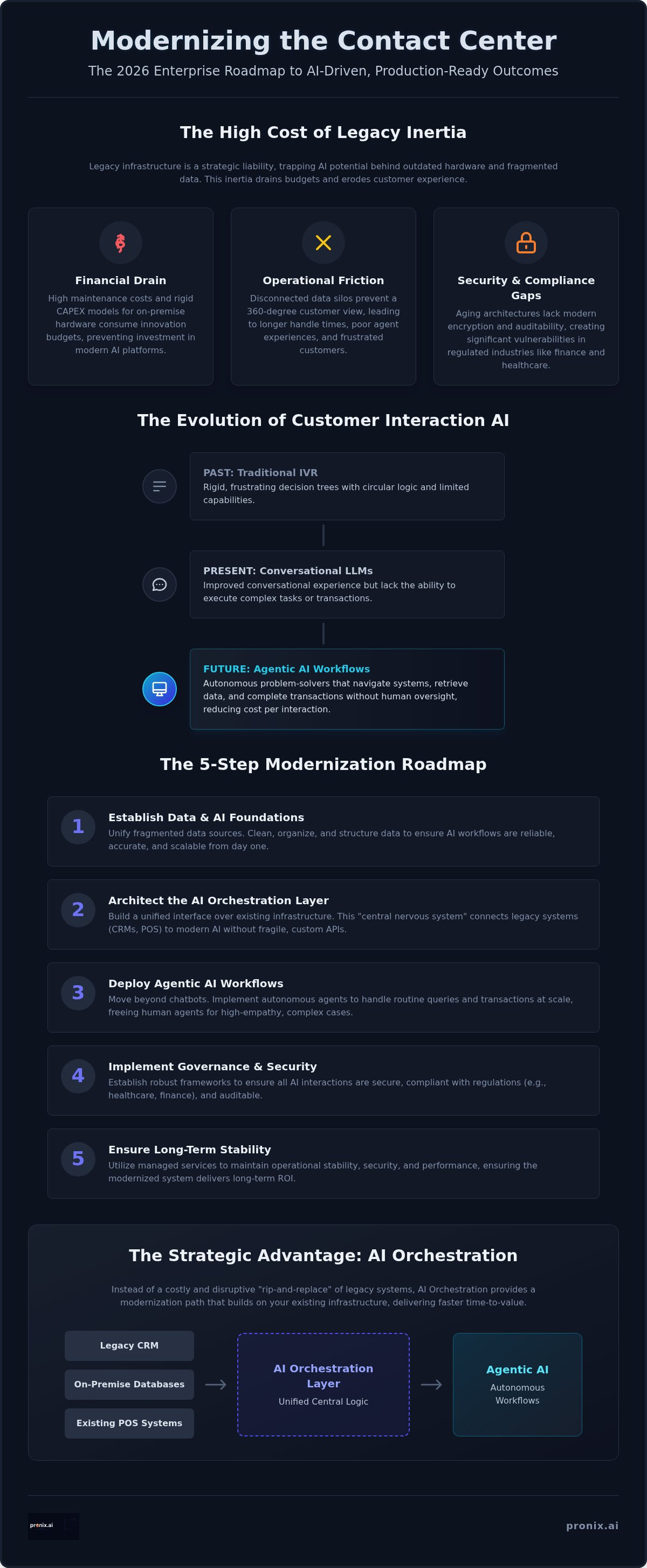
The 5-Step Roadmap to Contact Center Modernization
Execution at scale requires a transition from speculative experimentation to disciplined implementation. Modernizing legacy contact centers is not a single event but a structured lifecycle that prioritizes operational maturity. This roadmap focuses on building the necessary foundations to ensure that innovation delivers a measurable return on investment.
- Phase 1: Discovery and Data Foundation Audit. Evaluate your existing technical debt and identify the data silos that prevent a unified customer view.
- Phase 2: Defining the Agentic AI Strategy and Use Cases. Map specific business challenges to autonomous workflows that provide clear efficiency gains.
- Phase 3: Pilot Implementation with Guardrails. Deploy targeted solutions in a controlled environment to validate performance, security, and brand voice.
- Phase 4: Scaling to Production with Intelligent Workflows. Integrate validated AI agents across the enterprise to handle high-volume interactions seamlessly.
- Phase 5: Continuous Optimization via Managed Services. Maintain model accuracy and system stability through ongoing expert oversight and performance tuning.
Moving from AI Pilot to Production
"Pilot Purgatory" is where most enterprise AI projects stall. This occurs when organizations fail to plan for the complexities of scale, security, and governance from the outset. To move into production, you must establish KPIs that focus on measurable outcomes, such as reduced cost per interaction and improved first-contact resolution. Conduct adversarial testing on AI agents to ensure they remain within compliance boundaries during peak volume surges. This stress-testing is critical to maintaining stability in regulated markets. If you're ready to bridge the gap between proof-of-concept and scalable reality, a professional Agentic AI Strategy & Consulting engagement can provide the necessary framework.
Empowering the Modern Agent
A modernized architecture fundamentally changes the nature of the contact center workforce. AI Copilots reduce cognitive load by providing agents with real-time data and suggested resolutions, which significantly slashes training time for new hires. Human agents then transition from handling routine, repetitive tasks to solving complex problems that require high empathy and critical thinking. This shift improves the employee experience, which serves as a direct driver for superior customer experience. Modernizing legacy contact centers allows your team to function at their highest potential while autonomous agents handle the operational heavy lifting.
Ensuring Long-Term Stability with Managed AI Services
The final stage of modernizing legacy contact centers is the transition from implementation to long-term operational excellence. Enterprise AI is not a static asset. It requires "Always-On" strategic management to ensure that initial efficiency gains don't erode over time. Specialized talent is essential for maintaining AI model accuracy, as customer behaviors and language patterns shift unexpectedly. Managed services provide a critical safeguard for security and compliance, especially in high-stakes industries like healthcare and finance. Partnering with pronix.ai ensures your transformation is backed by decades of CX and AI excellence. This partnership moves your organization from a one-time upgrade to a state of continuous innovation. You gain access to a disciplined framework that prioritizes stability, auditability, and scalability.
Managed services provide several critical benefits for long-term stability:
- Continuous monitoring for model drift and performance degradation.
- Proactive security updates to maintain compliance in regulated sectors.
- Access to specialized talent for iterative prompt engineering and model tuning.
Operationalizing Generative AI
Deployment is just the beginning of the professional service lifecycle. You must actively monitor for model drift, which occurs when the AI's performance degrades as it encounters new data types or shifting market conditions. This requires a dedicated team to manage iterative prompt engineering. They keep responses aligned with evolving customer needs and strict brand standards. Managed security updates are equally vital for cloud-based contact center platforms. These updates protect your infrastructure against emerging threats without disrupting daily operations. A disciplined approach to operationalization ensures that your AI remains a reliable, high-performing asset that delivers evidence-based success.
Strategic Consulting for the Agentic Enterprise
CX modernization should never exist in a vacuum. It must align with your broader business automation goals to drive enterprise-wide value. This requires building a culture of responsible AI adoption where teams understand and trust the technology. Strategic consulting helps navigate the cultural shifts necessary for a successful transition to an agentic enterprise. It ensures that every technological move is backed by a rigorous framework and a clear path to production. Modernizing legacy contact centers requires this level of foresight to prevent technical debt from reforming. If you're ready to secure your operational future, schedule your CX Modernization Assessment with pronix.ai today.
Securing the Future of Enterprise Customer Experience
The transition toward Agentic AI is no longer a speculative trend; it's an operational necessity for the modern enterprise. Modernizing legacy contact centers requires moving beyond fragmented pilots and committing to a governed, production-ready architecture. By implementing a structured orchestration layer, you can leverage existing infrastructure while delivering the unified experience today's customers demand. This transition requires more than just new software. It demands a disciplined framework that prioritizes security, auditability, and measurable ROI across every interaction.
pronix.ai provides the specialized talent needed for complex implementations in regulated sectors like healthcare and finance. Our enterprise-grade AI governance frameworks ensure that your automation remains compliant and reliable at scale. With a proven track record in AWS and Genesys environments, we provide the technical stability required for high-stakes transformation. Move your CX from pilot to production with pronix.ai. The path to operational maturity starts with a single, strategic decision. Your future CX outcomes depend on the foundations you build today.
Frequently Asked Questions
What are the main challenges of modernizing a legacy contact center?
The primary challenges include technical debt, fragmented data silos, and the high operational cost of maintaining on-premise hardware. These legacy systems often lack the flexibility to integrate with modern AI orchestration layers. This fragmentation prevents a 360-degree customer view and stalls innovation. Overcoming these barriers requires a disciplined roadmap that prioritizes data foundations and security over speculative experimentation.
How much does it cost to modernize a contact center in 2026?
Total investment depends on the scale of integration and whether you choose full replatforming or an AI overlay. Enterprises typically move from a CAPEX-heavy model of hardware maintenance to an OPEX-driven cloud subscription model. This shift allows for more predictable budgeting while redirecting funds from maintenance to innovation. Costs are influenced by the complexity of your existing technical debt and the desired level of automation.
What is the difference between a cloud contact center and a legacy one?
Cloud contact centers offer elastic scalability and native AI integration that legacy on-premise systems cannot provide. Legacy environments are often tethered to physical hardware and site-specific limitations. Cloud platforms enable a unified omnichannel experience by centralizing data orchestration. This allows for real-time updates and faster deployment of new features without the need for manual hardware upgrades or localized maintenance.
Can I implement Agentic AI without replacing my current legacy system?
Yes, you can implement Agentic AI by deploying an intelligent orchestration layer on top of your existing systems. This overlay approach allows you to automate workflows and retrieve data from legacy POS or CRM databases without a total system replacement. Modernizing legacy contact centers through this method provides immediate ROI. It bypasses the long timelines often associated with total replacement projects while maintaining service continuity.
How long does a contact center modernization project typically take?
A typical modernization project can deliver initial production-ready outcomes within three to six months. This timeline assumes a phased approach starting with a data foundation audit and a targeted pilot program. While a full enterprise-wide transformation may take longer, focusing on high-impact use cases allows for rapid deployment. This incremental strategy mitigates risk and ensures that each phase of the project delivers measurable operational value.
What role does data governance play in AI-driven CX modernization?
Data governance provides the essential framework for ensuring AI accuracy, security, and auditability. Without rigorous governance, AI models are prone to hallucinations and compliance breaches. Modernizing legacy contact centers requires establishing clear protocols for data access and model training. This foundation ensures that your AI agents operate within defined guardrails, protecting both sensitive customer information and your brand's reputation in regulated markets.
How do I ensure my AI agents are compliant with healthcare or finance regulations?
Ensuring compliance requires implementing strict governance guardrails and adversarial testing for all AI interactions. You must use platforms that support HIPAA for healthcare and PCI-DSS for finance as a baseline. Managed AI services provide ongoing monitoring to detect model drift and ensure that autonomous agents remain within regulatory boundaries. This proactive oversight is critical for maintaining auditability and security in high-stakes enterprise environments.
What is the first step in moving an AI pilot to full production?
The first step is conducting a comprehensive Discovery and Data Foundation Audit. You must identify where your customer data lives and how it's structured before scaling any AI initiatives. This audit reveals the silos that need to be bridged to support intelligent workflows. Starting with a clear understanding of your data architecture ensures that your move to production is backed by evidence rather than speculation.