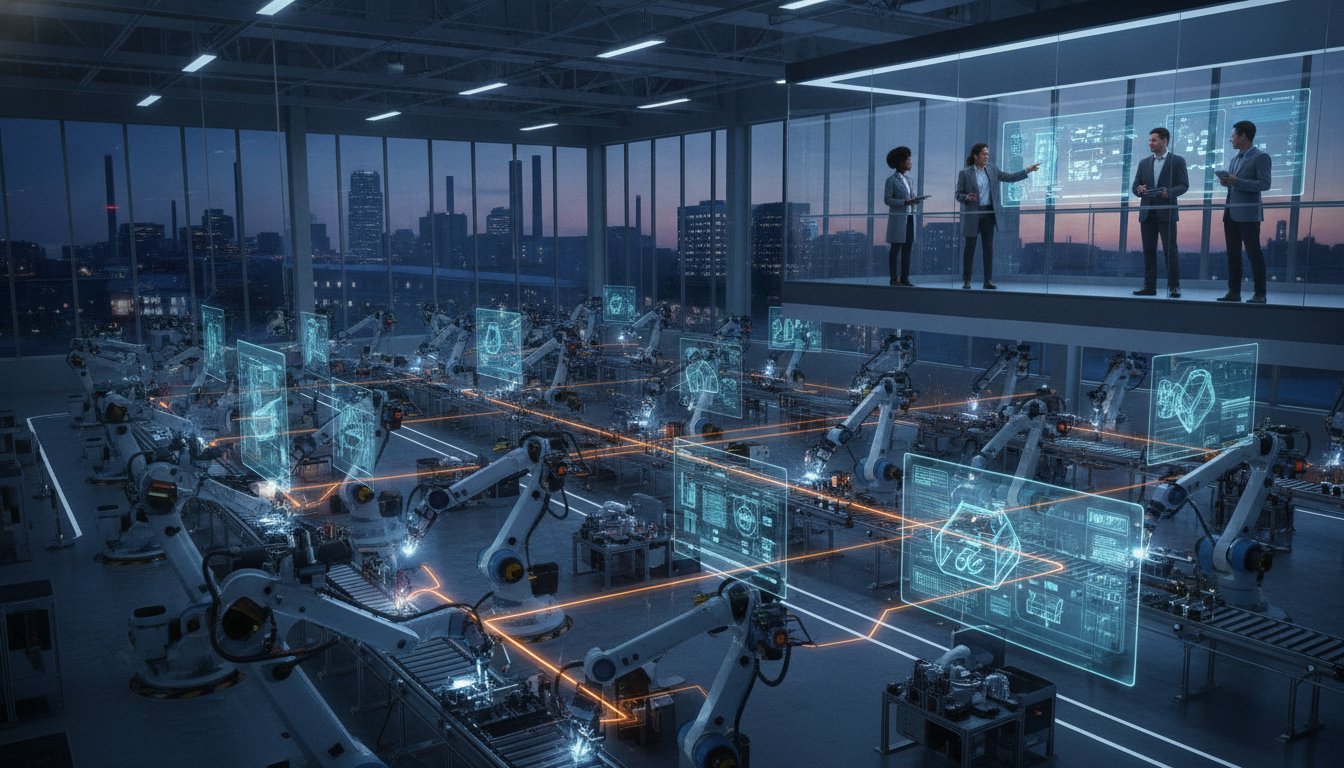

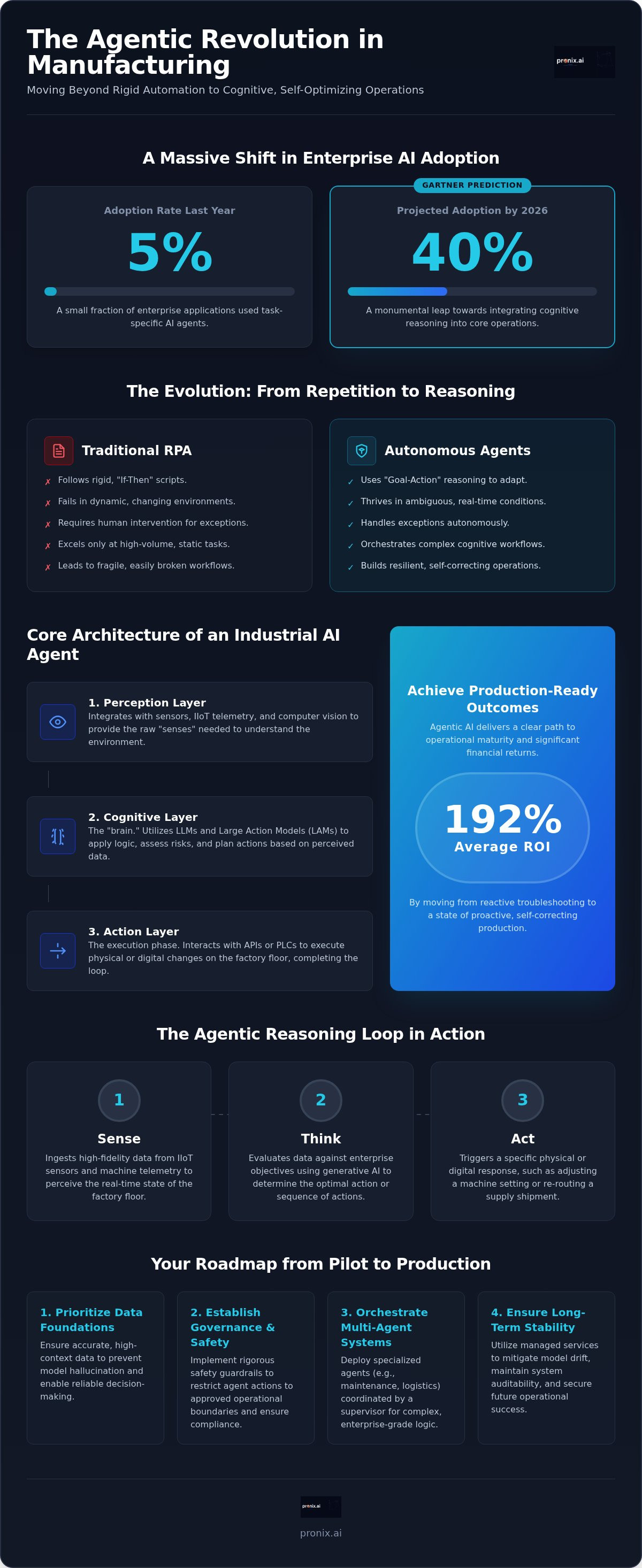
Gartner predicts that 40% of enterprise applications will embed task-specific AI agents by the end of 2026. This represents a massive shift from the 5% adoption rate seen just last year. Most leaders recognize that traditional, rigid automation often fails in dynamic production environments. High costs from reactive maintenance and disconnected data silos continue to stall growth. Integrating autonomous agents for manufacturing automation allows your facility to move beyond simple, repetitive robotics toward cognitive reasoning that adapts in real time.
You'll discover how these agentic systems drive enterprise-grade efficiency and deliver production-ready outcomes. We'll outline the path to reduced operational overhead and zero-downtime predictive maintenance. This guide previews the transition from isolated AI pilots to a fully orchestrated supply chain. It's a pragmatic look at the frameworks, safety standards, and governance needed to achieve a 192% average ROI. Learn how to build a resilient, self-optimizing operation that scales with confidence.
Key Takeaways
- Identify the critical transition from rigid RPA logic to goal-oriented autonomous agents for manufacturing automation capable of reasoning in dynamic environments.
- Learn how the "Sense-Think-Act" loop enables agents to move beyond simple alerts to autonomously orchestrating maintenance and supply chain logistics.
- Implement computer vision agents that learn novel production defects without manual retraining to maintain high-scale quality assurance.
- Establish a clear roadmap from pilot to production by prioritizing data foundations, enterprise governance, and security.
- Ensure long-term operational stability by utilizing managed services to mitigate model drift and maintain system auditability.
Beyond RPA: Defining Autonomous Agents in Modern Manufacturing
Traditional Robotic Process Automation (RPA) has reached its functional ceiling in the factory environment. It excels at high-volume, static tasks but fails when the environment shifts. Autonomous agents for manufacturing automation represent a fundamental evolution. These are reasoning entities designed for goal-oriented action rather than following a rigid, linear script. They don't just follow instructions; they evaluate outcomes and adjust their behavior to meet a defined objective.
To understand what are autonomous agents in an industrial context, you must distinguish between "If-Then" logic and "Goal-Action" reasoning. RPA requires a human to map every possible variable. In contrast, Agentic AI uses Large Action Models (LAMs) to interpret complex factory floor data and determine the best path forward. This capability allows systems to handle ambiguity. Agentic Manufacturing is the orchestration of cognitive workflows across physical and digital assets.
The Shift from Repetition to Reasoning
Rigid automation systems are fragile. When a supply chain delay occurs or a raw material specification changes, traditional workflows stop. Human intervention becomes the only way to resume production. Agents solve this by using real-time IIoT data to adjust production schedules autonomously. They see the delay, calculate the impact on downstream processes, and re-route resources to maintain efficiency. Transitioning to this model requires a strategic focus on AI for business process reengineering. You aren't just adding software; you're redesigning how work happens to support cognitive autonomy.
Core Components of an Industrial AI Agent
Deploying autonomous agents for manufacturing automation requires a three-tier architecture that mirrors human decision-making. Each layer must be robust and production-ready to ensure operational stability.
- Perception Layer: This integrates with physical sensors, telemetry feeds, and computer vision. It provides the raw "senses" the agent needs to understand its environment.
- Cognitive Layer: This is the brain. It utilizes LLMs and LAMs to apply logic, assess risks, and plan actions based on the data gathered by the perception layer.
- Action Layer: This is the execution phase. The agent interacts directly with APIs or Programmable Logic Controllers (PLCs) to execute physical or digital changes on the floor.
This structure ensures that every action is grounded in real-world context. It moves the enterprise away from reactive troubleshooting toward a state of proactive, self-correcting production. Results are measured in reduced downtime and higher yield, providing a clear path to operational maturity.
The Anatomy of Agentic Reasoning in Industrial Workflows
The Sense-Think-Act loop defines how autonomous agents for manufacturing automation process information at scale. Unlike traditional systems that execute pre-programmed commands, agentic reasoning begins with high-fidelity perception. The "Sense" phase ingests data from IIoT sensors and machine telemetry. In the "Think" phase, the agent evaluates this data against enterprise objectives using generative AI. Finally, the "Act" phase triggers a specific physical or digital response. This cognitive framework drives transformation by ensuring every action is grounded in real-time telemetry rather than static assumptions.
Enterprise leaders must prioritize robust data foundations to enable this reasoning. Generative AI requires accurate, high-context data to provide reliable outcomes. Without a clean data architecture, agents risk hallucination or suboptimal decision-making. Passing the "Trust Test" is the final hurdle for deployment. You must implement rigorous safety guardrails that restrict agent actions to approved operational boundaries. This ensures that while the agent is autonomous, it remains fully compliant with factory safety protocols and quality standards.
Multi-Agent Orchestration for Complex Logic
Modern production environments are too complex for a single AI model. Success requires a federated approach where specialized agents manage distinct functions. A "Supervisor Agent" coordinates between maintenance, logistics, and production units to maintain balance. For instance, if a maintenance agent identifies an imminent motor failure, it must negotiate with the production agent to find a repair window that minimizes throughput loss. You can explore the technical requirements for these hierarchies in our guide on multi-agent AI systems for enterprise. Effective orchestration also resolves conflicts between competing objectives, such as balancing maximum output speed against energy consumption targets.
Legacy Integration: Connecting Agents to the Factory Floor
The greatest barrier to autonomy is often the existing technology stack. Legacy ERP and MES systems weren't built for real-time agentic interaction. Implementation teams must wrap these systems in modern, agent-friendly APIs to bridge the gap. Working with experienced Kore.ai implementation partners can accelerate this process by providing pre-built connectors and governance frameworks. Furthermore, these integrations must support edge computing to ensure low-latency execution. When an agent needs to stop a conveyor belt due to a safety hazard, a delay of even a few milliseconds is unacceptable. If you are ready to modernize your infrastructure, seeking Agentic AI strategy and consulting can provide the roadmap needed for a secure transition.
Real-World Applications: Manufacturing AI Process Efficiency in Action
Implementing autonomous agents for manufacturing automation moves efficiency from theoretical pilots to measurable floor results. These systems don't just monitor; they execute complex, multi-step workflows across the enterprise. Predictive Maintenance 2.0 represents the first major shift. While traditional tools flag potential failures, an autonomous agent goes further. It analyzes machine telemetry, identifies the required spare part, verifies inventory levels, and places the purchase order through the ERP. Simultaneously, it coordinates with the MES to schedule a maintenance window that minimizes production disruption. This end-to-end orchestration eliminates the latency inherent in human-led workflows.
Autonomous Quality Assurance (QA) provides another high-impact application. Traditional computer vision requires extensive retraining for every new defect type. Modern agents use reasoning to identify anomalies they haven't seen before, adapting to new product iterations without manual intervention. In the supply chain, agents rewrite production orders in real time based on global logistics shifts. If a shipment is delayed, the agent automatically re-prioritizes jobs that use available materials. Additionally, energy grid optimization agents manage peak-load shaving. They throttle non-critical systems during high-tariff periods to protect margins without halting core production.
Case Study: Aerospace and Automotive Precision
Aerospace assembly lines manage over 10,000 components per unit. Agents track these parts with granular precision, ensuring that the right component reaches the right station at the exact millisecond it's needed. In the automotive sector, this drives "Just-in-Time 2.0" where inventory overhead is slashed through agentic forecasting. Industry data indicates that autonomous agents can reduce unplanned downtime by up to 35% in heavy industry. This is a critical metric for executives focused on high-yield production and asset utilization. It transitions the facility from reactive firefighting to a state of disciplined, predictive stability.
The "Dark Factory" Concept: Towards Full Autonomy
The vision of the "Dark Factory" or lights-out manufacturing is becoming a practical consideration for 2026. While full autonomy is feasible for specific high-volume lines, most enterprises maintain a human-in-the-loop requirement for high-stakes decision points. This hybrid approach ensures that agents handle the cognitive heavy lifting while humans provide strategic oversight. Scaling these complex environments requires more than just software. It demands a robust framework for monitoring model drift and performance. Many organizations bridge this gap by utilizing enterprise AI automation managed services. This ensures that autonomous systems remain secure, compliant, and production-ready as they scale across global operations.
Operationalizing Agentic AI: The Pilot-to-Production Framework
Most manufacturing leaders encounter "Pilot Purgatory." This is the phase where promising AI initiatives stall after the proof-of-concept. Gartner predicts that over 40% of agentic projects may be abandoned due to unclear ROI or misapplied autonomy. Scaling autonomous agents for manufacturing automation requires moving beyond experimental setups toward a disciplined, production-ready framework. Success isn't just about the algorithm; it's about the infrastructure supporting it.
Your transition to a fully agentic operation should follow a methodical four-step process:
- Step 1: Data Foundation and Governance. Secure, structured data architecture is non-negotiable. You must establish clear rules for how agents access legacy systems and protect proprietary intellectual property.
- Step 2: Identify High-Value, Low-Risk Use Cases. Don't automate the entire plant at once. Start with targeted workflows, such as predictive maintenance or inventory forecasting, where the impact is measurable and the risk is contained.
- Step 3: Champion-Challenger Model. Validate agent logic by running the AI "challenger" alongside your existing "champion" automation. This ensures the agent consistently outperforms legacy logic before it takes control.
- Step 4: Full Deployment and Auditability. Transition to live operations with continuous monitoring. Every decision must be logged to mitigate risks like model drift or unexpected system behavior.
Governance and Auditability in Regulated Manufacturing
Regulated industries require more than just performance. You must maintain compliance with evolving standards like ISO 10218:2025 while delegating decisions to AI. The "Black Box" challenge remains a significant hurdle for many executives. You need to ensure that every agentic decision is explainable and auditable for safety inspections. Our Agentic AI implementation services provide the specific frameworks needed to bridge the gap between innovation and regulatory maturity.
The Human-AI Collaborative Workforce
Deploying autonomous agents for manufacturing automation changes the role of the factory worker. Employees must be upskilled to become "Agent Orchestrators" who manage the AI's goals rather than performing manual tasks. This cultural shift requires transparency and clear safety protocols. Hard-coded overrides must remain in place for all autonomous systems to ensure human control during emergencies. If you're ready to move from pilot to production, Agentic AI Strategy & Consulting can help you build a roadmap that prioritizes both speed and operational safety.
Securing the Future: Managed Services for Autonomous Manufacturing
The complexity of autonomous agents for manufacturing automation demands a fundamental shift in operational philosophy. Traditional software follows a "set and forget" model. Self-learning agents do not. These systems evolve based on the data they ingest, which introduces the risk of model drift or agent hallucination. Without continuous oversight, an agent's reasoning can diverge from enterprise objectives or safety protocols. Enterprise AI Managed Services provide the necessary governance to maintain system integrity over time.
Managed services bridge the critical talent gap that stalls many digital transformations. Finding elite AI practitioners who understand both neural architectures and industrial PLCs is difficult. A partner model provides immediate access to this expertise. It allows your internal teams to focus on strategy while experts handle the critical aspects of security, integration, and auditability. pronix.ai serves as the operational backbone for the agentic enterprise, ensuring that every deployment is backed by a rigorous framework and a clear path to production.
Continuous Optimization and Scaling
A centralized AI Command Center is essential for national manufacturing operations. This hub monitors performance across multiple facilities, allowing for real-time optimization as business objectives change. Managed services ensure that your autonomous agents for manufacturing automation evolve alongside your production needs. This approach future-proofs your infrastructure for the 2027-2030 AI roadmap, where multi-agent systems will become the industry standard. Continuous optimization prevents the performance degradation that often follows initial deployment, protecting your long-term ROI.
Next Steps: From Strategy to Execution
Assessing your current AI maturity is the first move toward execution. You must evaluate your data readiness and existing infrastructure before deploying cognitive workflows. Most organizations can launch their first production-ready agent within a 90-day roadmap. This timeline prioritizes high-impact use cases that deliver immediate results while building the foundation for broader scale. It's a pragmatic approach to innovation that values stability over hype. To begin this transition, consult with pronix.ai to move your manufacturing AI from pilot to production.
Mastering the Agentic Manufacturing Frontier
The transition to autonomous agents for manufacturing automation is no longer a strategic option; it is a 2026 operational mandate. You've identified how cognitive reasoning loops outpace traditional RPA by adapting to real-time production variables. Success now depends on moving beyond "Pilot Purgatory" toward a disciplined, production-ready framework. This shift requires a robust data foundation and continuous managed oversight to mitigate model drift. High-scale efficiency is achieved when every innovation is backed by rigorous governance and auditability.
At pronix.ai, we specialize in this transition. Our expertise covers the entire lifecycle from initial strategy to long-term managed services. Partnered with AWS, Microsoft, and Salesforce, we provide the secure infrastructure needed for enterprise-grade outcomes. We handle the critical complexities of integration and security so your facility can focus on growth. Deploy Governed Agentic AI with pronix.ai to secure your competitive advantage. The path to a self-optimizing, zero-downtime operation starts today.
Frequently Asked Questions
What is the difference between an AI agent and traditional manufacturing automation?
Traditional automation follows fixed scripts and linear "if-then" logic. AI agents use cognitive reasoning to achieve specific goals. While RPA executes repetitive tasks without deviation, autonomous agents for manufacturing automation evaluate environmental variables to adjust their actions in real time. This shift allows the system to solve problems like supply chain delays or material variations without human intervention. Agents are designed for dynamic environments where linear logic fails.
How do autonomous agents integrate with legacy ERP and MES systems?
Integration occurs through the deployment of agent-friendly APIs that wrap around legacy systems. Most ERP and MES platforms lack native agentic support. We build bridge connectors that allow agents to read machine telemetry and write back to production orders. Utilizing platforms like Kore.ai or Microsoft Copilot Studio accelerates this process. This architecture ensures that agents have the real-time context needed to make informed decisions across the enterprise floor.
Are autonomous AI agents safe for high-stakes factory environments?
Safety is ensured through hard-coded overrides and predefined operational guardrails. Agents operate within a "Trust Test" framework where their autonomy is limited to non-critical or approved decision paths. In high-stakes environments, humans remain in the loop for final approvals. This hybrid approach combines AI speed with human oversight. Every action is logged to ensure that safety protocols, such as emergency stops, remain prioritized over production speed at all times.
What are the most common use cases for AI agents in manufacturing process efficiency?
Primary applications include Predictive Maintenance 2.0 and Autonomous Quality Assurance. Agents don't just flag failures; they order parts and schedule technicians. In QA, computer vision agents learn new defects without manual retraining. Other high-value cases include energy grid optimization and dynamic supply chain orchestration. These use cases provide a clear path to a 192% average ROI, as documented in recent 2026 industry reports on agentic automation and operational maturity.
How long does it take to move an AI agent from pilot to production?
Moving from pilot to production generally follows a 90-day roadmap. The first 30 days focus on establishing a secure data foundation and identifying a high-value use case. The subsequent 60 days involve implementing the "Champion-Challenger" model and refining agent logic. This structured approach prevents "Pilot Purgatory" by prioritizing auditability and security from the start. It's a disciplined timeline designed to deliver measurable results for large-scale enterprise operations without compromising stability.
What kind of data infrastructure is required for autonomous agents?
Successful deployment requires a robust, structured data foundation. Agents need high-fidelity access to IIoT sensors, machine telemetry, and historical maintenance logs. Without clean data, generative AI models risk hallucination or suboptimal reasoning. We focus on building secure Data & AI Foundations that allow agents to ingest information from disparate silos. This infrastructure must support low-latency edge computing to ensure that agentic decisions happen in real time on the factory floor.
Can AI agents help with manufacturing labor shortages?
AI agents mitigate labor shortages by automating cognitive heavy lifting. They don't replace humans; they upskill them into "Agent Orchestrators." This allows your existing workforce to manage complex systems rather than performing repetitive manual tasks. By handling the "boring but critical" parts of operations, agents fill the talent gap in specialized areas like maintenance forecasting. This strategy helps national manufacturers maintain high-scale throughput despite a shrinking pool of available skilled labor.
How do we ensure AI agent decisions comply with industry regulations?
Compliance is maintained through explainable AI and continuous auditability. Every decision made by an agent is logged in a transparent audit trail for regulatory review. This ensures adherence to standards like ISO 10218:2025 and the EU AI Act. We implement governance frameworks that monitor for model drift, ensuring that agents stay within legal and ethical boundaries. This level of oversight is critical for moving autonomous agents for manufacturing automation into highly regulated production environments.