

A fraud system can stop a suspicious payment and still block a legitimate one. AI for financial fraud detection helps banks assess transactions against customer behavior, transaction history, and other risk signals, so they can flag or stop suspicious activity as payments occur. For example, a rules-based system might block a $200 withdrawal if the account has never previously withdrawn more than $100. AI can help prioritize alerts and support investigations while reducing false-positive friction.
That balance matters: detecting fraud quickly is essential, but unnecessary declines and alert overload create operational costs of their own. An effective approach combines models with reliable data, clear decision workflows, and human oversight.
This guide explains how AI detects banking fraud, which models can help prevent payment fraud, and what implementation involves. You’ll learn how machine learning, behavioral analysis, and network analytics surface risk, and how businesses can connect these capabilities to existing data and operational systems.
Key Takeaways
- Learn how fraud models help distinguish risky payment patterns from legitimate activity, reducing avoidable review friction.
- Understand why synthetic identities and AI-enabled impersonation require detection approaches that adapt to emerging fraud patterns.
- See how machine learning, behavioral signals, and network analysis contribute to a stronger fraud detection system.
- Identify the data, workflows, and operational foundations businesses need to implement AI fraud detection effectively.
What is AI fraud detection for banking?
AI fraud detection evaluates transactions against patterns in account activity and other risk signals. Banks use it to flag suspicious behavior, prioritize alerts, and support faster investigations.
False Positives and Transaction Declines
A false positive occurs when a legitimate transaction is flagged as fraud, potentially triggering a decline or investigation. For example, an unusual purchase may appear risky even when it is authorized. Repeated declines can erode trust and contribute to customer churn, while too many alerts leave investigators less time to assess credible threats. Reducing false positives supports payment access and helps teams focus their reviews.
Dynamic Rules for Reducing False Positives
Dynamic rules adjust risk thresholds as account behavior and transaction signals change, rather than applying the same fixed condition to every payment. A bank might assess a payment’s amount alongside the customer’s prior activity, device context, and transaction history. Machine learning can help identify which signals matter in a given pattern. Regularly reviewing outcomes helps teams refine rules as fraud methods evolve.
AI and Rule-Based Detection
Rule-based systems flag transactions that match predefined conditions. AI can learn patterns across behavior and transaction history to identify less obvious anomalies. A fixed rule may flag a legitimate payment simply because it differs from past activity, while a model can weigh several signals together. In the United States, applicable legal and regulatory requirements depend on the institution, data, and use case. System costs also depend on transaction volume, data readiness, integration needs, and ongoing oversight.
Fraud Types AI Can Detect
AI can help identify payment fraud, account takeover, suspicious transfers, and coordinated activity across related accounts. Login behavior, device use, navigation, and authentication context can signal account takeover even when credentials appear valid. Network analysis can connect accounts, entities, and transactions to surface possible mule networks. These signals help banks investigate evolving fraud patterns, but a model flags risk for review rather than proving that a transaction is fraudulent.
What types of AI models are most useful for payment fraud prevention?
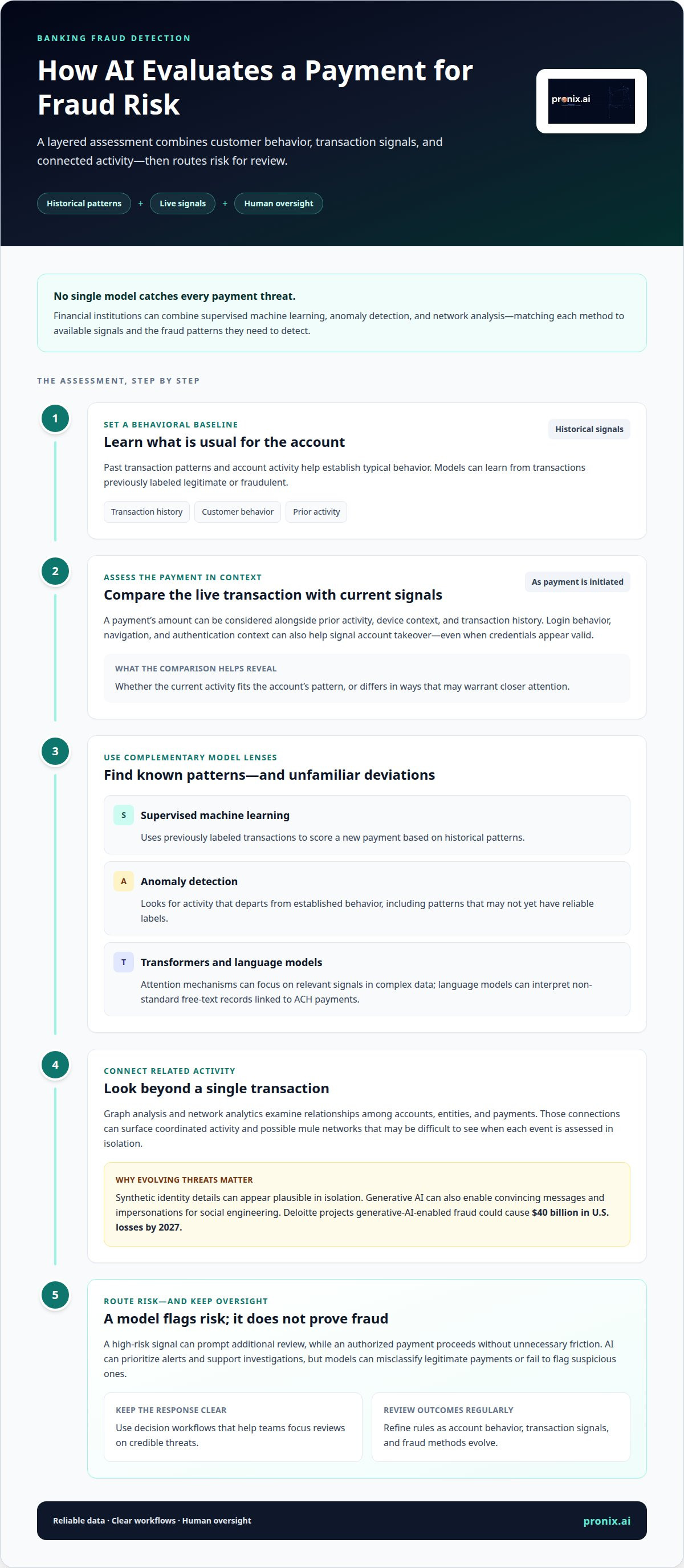
No single model catches every payment threat. Financial institutions often combine supervised machine learning, anomaly detection, and network analysis, matching each method to the available signals and the fraud patterns they need to detect.
Supervised models learn from transactions previously labeled legitimate or fraudulent. They can score a new payment based on historical patterns, while anomaly detection looks for activity that departs from established behavior. This distinction matters as fraud evolves: a new pattern may not yet have a reliable label. Network analysis adds another perspective by examining relationships among accounts, identities, and transactions.
Generative AI changes both sides of the risk equation. Criminals can use it to generate convincing messages, impersonations, or supporting material for social engineering. Synthetic identity fraud presents a related challenge: fabricated or blended identity details can appear plausible when assessed in isolation. Models that connect signals across transactions and accounts can help surface inconsistencies for review. Deloitte projects generative-AI-enabled fraud could cause $40 billion in U.S. losses by 2027.
For fraud detection, language models can interpret non-standard text associated with payment records, while transformer models use attention mechanisms to focus on relevant signals. These tools can help identify relationships fixed rules may miss. They do not replace transaction controls: financial institutions still need to assess model outputs alongside payment context and established review processes.
Effective fraud prevention pairs detection with a clear response. A high-risk signal can prompt additional review, while an authorized payment proceeds without unnecessary friction. For organizations shaping those workflows, AI implementation planning can connect model selection with data and operational requirements.
Machine learning and AI models for fraud detection
AI detects financial fraud by analyzing billions of data points for patterns that may signal suspicious activity. Models combine historical transaction information with current risk signals to help prioritize or flag payments for review.
Historical and Real-Time Fraud Signals
These models compare past transaction patterns with signals arriving as a payment is initiated. Historical data can establish typical activity, while current details can show when a transaction differs from that pattern. Graph analysis adds relationships among accounts, entities, and payments. For example, a first-time payment may merit closer review if its sender is linked to fraud flagged elsewhere. Organizations can run machine-learning models alongside existing rules, then continuously assess whether their combined decisions remain useful.
Transformer Models and Subtle Patterns
Transformer models use attention mechanisms to focus on relevant signals in complex data. This can surface subtle relationships that fixed rules may miss, including patterns across sequences of activity. Language models can also interpret non-standard free-text records linked to ACH payments, extracting context that structured fields may not capture. Together, these AI models give fraud teams additional intelligence from transaction records and connected networks, rather than relying on a single indicator to explain risk.
Model Errors and Safeguards
Models can misclassify legitimate payments or fail to flag suspicious ones, so deployment needs active oversight. According to the 2025 Alloy State of Fraud report, 59 percent of respondents used supervised machine-learning models alongside rule-based systems for anomaly detection. A hybrid approach lets organizations use model scores with established rules and defined review paths. Continuous validation should examine false positives, missed cases, and changes in transaction patterns. When performance shifts, teams can investigate the underlying signals, adjust thresholds, and maintain human review for decisions that need context. This keeps automated intelligence accountable as fraud behavior evolves.
Business implementation of AI fraud detection
Implementation means connecting models to trusted data, payment decisions, and investigation workflows. The practical goal is to identify suspicious activity accurately and support timely action.
U.S. banks and fintech companies use a mix of internally developed systems and third-party fraud platforms. The right platform depends on payment channels, existing data architecture, and how the institution routes alerts and decisions.
Start by defining the decision the system should support, such as flagging a payment for review. Then connect relevant transaction and account data, establish a baseline, and test model outputs against known cases. In a 2025 Alloy survey, 99 percent of respondents reported using AI as part of their fraud prevention systems. Adoption alone doesn't establish performance, so organizations need clear measures, such as suspicious activity detected, unnecessary reviews, and investigation outcomes.
Production deployment also requires a defined response path. For example, a model can send a high-risk alert to an investigator, while an established control handles a transaction requiring immediate intervention. Human review, clear escalation ownership, and feedback from case outcomes help teams identify errors and improve decisions. Institutions should monitor performance continuously as payment behavior and fraud patterns change.
The U.S. Department of the Treasury’s AI-powered fraud detection process helped prevent and recover a combined $4 billion in fiscal year 2024, including $1 billion recovered in Treasury check fraud cases. The example shows how AI can support detection and recovery workflows, while also emphasizing the need to connect analytical signals to operational action.
For organizations moving from experimentation to production, plan an AI implementation pathway around data readiness, decision points, and accountable workflows.
Pronix.ai
pronix.ai helps enterprises move from fraud-detection concepts to secure, scalable AI operations. Turn to the team when deployment requires stronger data foundations, integration with existing workflows, or a clear path from pilot to production.
Its work connects AI strategy, implementation, and automation with the operational systems that support payment review and investigation. Data & AI Foundations help establish the underlying data capabilities, while Agentic AI Implementation and AI Business Automation support the design and deployment of intelligent workflows. The right scope depends on your architecture, decision processes, and readiness to operationalize AI.
If you’re planning the next step in fraud detection, contact pronix.ai to discuss your implementation needs.
Move from model selection to operational readiness
The next decision is how fraud intelligence will fit your operating model. Define who owns model decisions, how alerts reach investigators, and how feedback will inform ongoing improvement. This governance work gives AI for financial fraud detection a clear path into production, rather than treating deployment as a standalone technology project.
pronix.ai helps enterprises align AI capabilities with business workflows through Agentic AI Implementation, AI-Driven CX Modernization, and AI Business Automation. The focus is on connecting implementation to the systems, teams, and decision processes that support reliable operations.
When you’re ready to map the next phase, discuss AI fraud detection with pronix.ai. A disciplined implementation can help your organization turn its priorities into a practical path forward.
Frequently Asked Questions
How does AI reduce the risk of false positives in transaction monitoring?
AI can weigh several transaction signals together instead of triggering an alert based on one condition alone. For example, a payment’s amount, timing, account history, and authentication context can inform a combined risk score. Teams can review cases later deemed legitimate and use those outcomes to tune thresholds. This feedback helps distinguish normal changes in customer behavior from activity that warrants investigation.
How is generative AI used in digital fraud?
Generative AI can help fraudsters create convincing messages, impersonations, and other content for social engineering. A fabricated payment request may imitate a familiar business contact and pressure an employee to act quickly. Financial teams can counter this risk by independently validating changed payment instructions and following established authentication procedures. Treating urgent language as a risk signal helps staff pause before releasing funds.
What AI techniques should my company adopt to prevent fraud?
Choose techniques based on the decisions your organization needs to improve and the data it can use reliably. AI for financial fraud detection can combine supervised learning, anomaly detection, and network analysis, depending on the use case. A limited initial application, such as prioritizing payment alerts, helps teams assess operational fit. Reviewing results with investigators can guide adjustments before the system is extended to other decisions.
What machine learning techniques are used for fraud detection in banking and payments?
Banking and payment teams use supervised classification, anomaly detection, graph analysis, and sequence-based models. Classification learns from labeled fraud cases; anomaly detection highlights activity that differs from established patterns. Graph methods assess links among entities, while long short-term memory models can analyze sequences over time. The right combination depends on whether a signal appears in a single payment, across relationships, or throughout activity sequences.
How accurate are AI fraud detection systems, and what are their false-positive rates?
There is no single accuracy or false-positive rate for every system. Results depend on data quality, fraud patterns, and alert thresholds, and one institution’s performance may not predict another’s. Evaluate models against labeled cases and track missed fraud alongside legitimate transactions flagged. A useful assessment also considers how often investigators overturn alerts and whether risk changes after deployment.
What data and steps are needed to implement AI fraud detection?
Useful inputs can include transaction records, account history, authentication context, and investigation outcomes. For AI for financial fraud detection, first define the decision the model should support, then map the relevant data and assess its quality. Test against historical cases before connecting predictions to live workflows. Set alert ownership, escalation paths, and monitoring criteria so teams can review outcomes and respond when patterns shift.