

What should directors approve: an AI vision, or a plan they can measure and govern? Presenting an AI strategy to the board means making the case in business terms, not leading with models, tools, or technical possibilities. The strategy should show how AI supports enterprise priorities, what value it could create, and who is accountable for results.
That is a high bar. Directors may be wary of proposals that sound like hype or introduce risk without clear controls. Executives, meanwhile, need to turn promising use cases into a decision-ready plan with evidence, ownership, and practical milestones.
This guide shows you how to build a focused board presentation that connects business value, risk management, and accountable execution. You’ll learn how to frame opportunities in agentic AI, business automation, customer experience, and data foundations; define measures for value and risk; and make governance part of the plan from the start. The aim is a clear path from strategic priorities to secure, scalable implementation, with specific decisions and next steps for the board.
Key Takeaways
- Lead with the board decision you need, then frame AI as a set of business choices rather than a catalogue of technologies.
- Structure your presentation around strategic context, prioritized opportunities, controls, a roadmap, and clear decisions.
- Rank use cases by strategic fit, value potential, feasibility, dependencies, and risk to make trade-offs easier to assess.
- When presenting an AI strategy to the board, pair each value hypothesis with risk exposure, readiness, control requirements, and an accountable owner.
- Translate approval into phased decision gates, with evidence thresholds and stop-or-proceed criteria to guide execution.
Presenting an AI strategy to the board starts with a business decision
A board presentation should begin with the choice directors need to make, not a tour of models, platforms, or pilots. An AI strategy sets out business choices: where AI can advance enterprise priorities, which opportunities to pursue, what risks to control, and how execution will be governed.
A board-ready AI strategy connects enterprise priorities to a focused set of opportunities, evidence-based value hypotheses, defined controls, accountable executives, and clear decisions for directors.
This framing keeps the discussion grounded in outcomes such as growth, productivity, resilience, or customer experience. It also clarifies the boundary between board oversight and management execution. Directors set direction, challenge assumptions, and oversee risk. Management develops use cases, selects implementation approaches, and delivers within approved guardrails.
What does the board need to decide about AI?
State the request directly. Are directors being asked to authorize a strategic direction, prioritize investment across opportunities, approve governance expectations, or sequence the next phases? For each request, explain why action is needed now, what decision is due, and which executive is accountable for follow-through.
Label agenda items by purpose: for information when management is reporting progress, for challenge when directors should test assumptions or risk tolerance, and for approval when a formal decision is required. This prevents a broad AI discussion from obscuring the specific decision. It also keeps technical implementation choices with management rather than the board.
How should executives frame AI value without hype?
Translate technical capability into an operational change. Instead of saying an AI agent can reason across systems, explain which workflow it could improve, who will use it, and what measurable outcome would indicate progress. Distinguish observed evidence from hypotheses to test, assumptions behind projections, and benefits that remain uncertain.
For example, an enterprise might consider using AI to help customer service teams triage inquiries and draft responses. The strategic case could be more consistent service or faster handling, but those are value hypotheses until measured against agreed criteria. Before presenting projected benefits as expected results, management should identify the baseline, validation method, human review points, data dependencies, and executive owner.
That discipline makes presenting an AI strategy to the board more credible. A concise business case connects the priority, process change, evidence, risk, and requested decision. It gives directors enough context to govern the strategy without turning the meeting into a technical review.
Build the AI strategy presentation around priorities, choices, and evidence
A credible board narrative moves in a deliberate sequence: strategic context, prioritized opportunities, management choices, controls, roadmap, and decisions. Each step should answer the question raised by the one before it. This keeps the presentation focused on why AI matters to the enterprise, where it could create value, and what must be in place before investment scales.
Which AI opportunities belong in the board discussion?
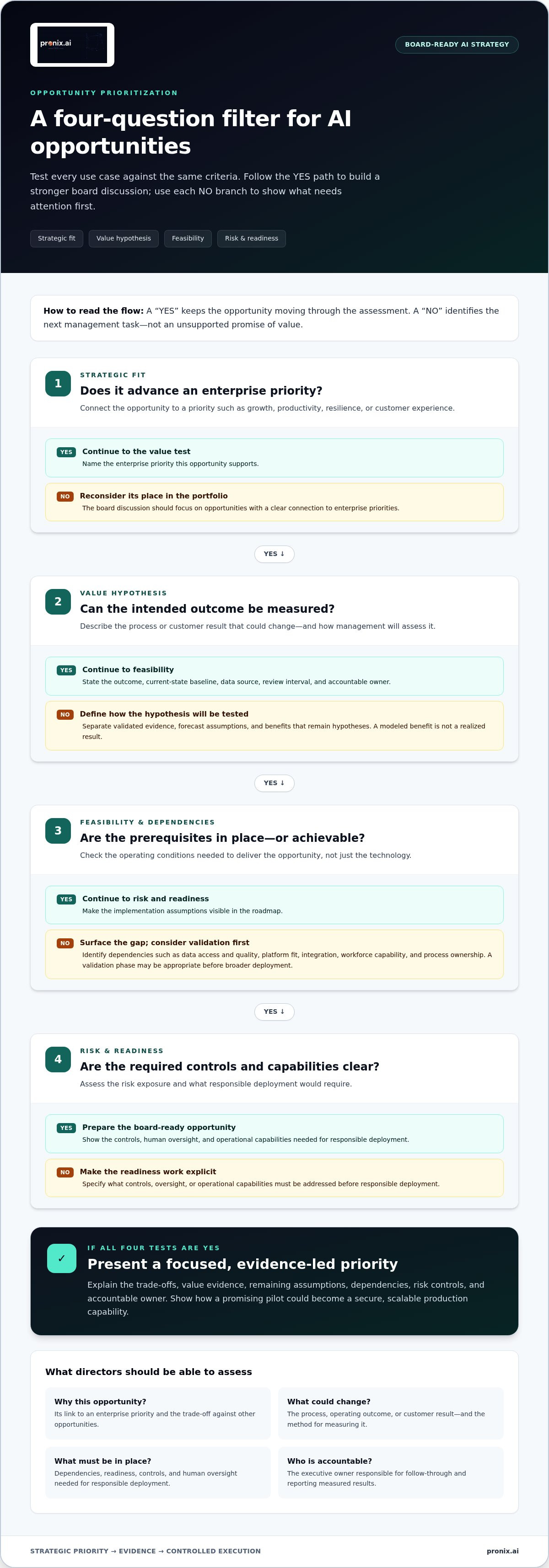
Bring a prioritized portfolio, not an exhaustive inventory of proposed use cases. Compare opportunities against the same criteria so directors can see why one deserves attention before another:
- Strategic fit: Which enterprise priority does it advance, such as growth, productivity, resilience, or customer experience?
- Value hypothesis: What process, operating outcome, or customer result could change, and how will you measure it?
- Feasibility and dependencies: Are the required data, platforms, integration, talent, and process ownership in place or achievable?
- Risk and readiness: What controls, human oversight, and operational capabilities would responsible deployment require?
Use these criteria to explain trade-offs, not just rankings. An opportunity may strongly support a strategic priority but depend on data quality or workflow redesign that is not yet ready. That may justify a validation phase before broader deployment. Another use case may offer a narrower benefit but fit existing processes and controls, making it a more practical early priority.
What evidence makes the investment case credible?
For each selected opportunity, show the current-state baseline and how results will be measured. Define the outcome, data source, review interval, and accountable owner. Label what is validated, what is a forecast assumption, and what remains a hypothesis. A modeled benefit is not a realized result, so make the distinction explicit.
Surface dependencies that could affect timing or value, including data access and quality, platform fit, system integration, workforce capability, and process ownership. These details help directors judge whether the roadmap reflects operating reality rather than an idealized scenario.
Board-level strategy should also explain how a promising pilot could become a secure, scalable production capability. The enterprise AI production guide outlines considerations for that transition. For organizations connecting board priorities with delivery, enterprise AI strategy and execution links strategic planning with implementation and ongoing operations.
Address the board’s toughest AI objections: value, risk, and accountability
A compelling AI strategy answers three questions directly: what value should the organization expect, what could go wrong, and who is accountable for managing both? When presenting an AI strategy to the board, pair each value hypothesis with its risk exposure, readiness, control requirements, and named owner. This gives directors a basis for informed challenge without relying on broad claims or unsupported assurances.
How can executives make AI value measurable?
Define measures around the intended business outcome, and keep different outcomes distinct. A productivity measure, such as time spent on a process, is not the same as a cost, service, or growth measure. Name the executive responsible, establish a baseline, and set a regular interval for reviewing results.
For example, an AI system that helps identify invoice exceptions could be assessed on processing time, exception accuracy, and the proportion of cases requiring staff review. These are candidate measures, not promised benefits. Management should explain how results will be compared with the current process, what assumptions underpin any forecast, and what action follows if performance misses the agreed threshold. Reassess, adjust, pause, or stop based on evidence.
How should the presentation explain AI risk and governance?
Map each material risk to a control, a decision owner, a monitoring approach, and an escalation path. The board does not need a technical risk register on every slide, but directors should be able to see how controls work in practice and who acts when they fail.
- Value hypothesis: Reduce manual effort in invoice exception handling. Validate against a documented baseline and review processing time and accuracy.
- Risk exposure: Incorrect classifications or exposure of sensitive financial data.
- Readiness: Confirm data quality, system integration, process ownership, and staff capacity for review.
- Controls: Limit data access, monitor outputs, retain reviewable records, and route uncertain or high-impact cases to an accountable employee.
- Escalation: Define who can restrict or pause the workflow, investigate an issue, and authorize resumption.
Match human oversight to the consequence and reversibility of a decision. A low-impact recommendation may need sampling and monitoring; an action that could materially affect a person or business operation may need review before execution. State what remains uncertain, then explain how controls and decision rights will adapt as deployment changes.
Strong data foundations support this discipline. The enterprise AI data strategy explores how data readiness underpins secure, measurable AI execution.
Turn board approval into an AI roadmap with owners and decision gates
Approval is a starting condition, not proof that an initiative is ready to scale. Convert the board’s decision into a phased roadmap that links business outcomes to accountable owners, evidence requirements, and explicit stop-or-proceed criteria. This gives management room to execute while keeping investment and risk under oversight.
What belongs in an AI strategy roadmap?
Sequence work according to business urgency, readiness, and dependencies. A practical roadmap moves through discovery, validation, controlled deployment, and a decision to scale, revise, or stop. Each phase should answer a different question: Is the opportunity well defined? Does the approach meet agreed measures? Can it operate within controls? Is there enough evidence to justify expansion?
For every phase, document the executive owner, evidence threshold, key dependencies, and decision authority. A business leader should own the outcome; technology and data leaders should own relevant integration and foundation work; risk leaders should define and assess controls. For example, a validation gate might require results against a current-state baseline, documented data and integration readiness, and confirmation that monitoring and escalation processes are in place. If evidence falls short, address the gap rather than assume the case for scale.
How can the board monitor progress after approval?
Use a compact dashboard to report outcomes, delivery status, adoption, risk, control effectiveness, and unresolved decisions. Keep measures tied to the approved business case. Show actual results alongside targets or forecasts, explain material variances, and flag changes in assumptions or dependencies. A concise dashboard helps directors judge whether progress supports continued investment without drawing them into routine project management.
Set the reporting cadence according to the initiative’s pace and risk. Management should also define what triggers escalation between scheduled updates, such as a material deviation from expected outcomes, a significant incident, weakening control effectiveness, or a change that alters the original value or risk assessment. State who receives the escalation, who can pause or adjust deployment, and when the board will be asked to revisit its decision.
Presenting an AI strategy to the board becomes more actionable when approval leads to a governed delivery path, not an open-ended mandate. pronix.ai helps large enterprises connect AI strategy, implementation, governance, and managed services as initiatives move toward secure, scalable production. Its enterprise AI services bring these capabilities together.
Move from board strategy to governed enterprise AI execution with pronix.ai
Board approval creates direction. Execution turns that direction into scoped workstreams, measurable outcomes, operating controls, and clear ownership. The transition matters: an initiative that remains a pilot may not deliver its intended enterprise value, while expansion without integration and governance can introduce avoidable operational risk.
What should executives expect after the board presentation?
Translate approved priorities into delivery plans with an executive sponsor, business and technical owners, success measures, dependencies, and governance routines. Align the teams responsible for the process with technology, data, security, and risk functions before making deployment decisions. This makes ownership practical, not just a name on a slide.
Maintain executive visibility as each workstream moves from validation to production and ongoing operations. Progress reviews should connect delivery status to business outcomes, control performance, and decisions that may change scope or timing. Leadership can then address integration gaps, data readiness, or adoption barriers before they undermine the strategy.
How can pronix.ai support strategy through implementation?
pronix.ai works with large enterprises across AI strategy, implementation, and managed services, connecting strategic priorities to secure, scalable production. Its capabilities span agentic AI, business automation, customer experience modernization, and data and AI foundations. This lets organizations address the business workflow, supporting data, platform integration, and operating model as connected parts of execution.
pronix.ai works with platforms including AWS, Microsoft, Salesforce, Kore.ai, and Genesys. Integration should fit the enterprise’s existing environment and the needs of each initiative. Governance and operational management continue beyond launch, with clear ownership, monitoring, and processes for responding to issues and reviewing performance.
For executives presenting an AI strategy to the board, the execution path is part of the case for approval. It shows how priorities will become delivery, how teams will coordinate, and how leadership will maintain oversight as initiatives mature. pronix.ai connects strategy with technical integration and ongoing operations, emphasizing measurable value, security, governance, and auditability.
Turn board alignment into measurable AI progress
A strong AI strategy presentation ends with a clear decision and a disciplined path forward. Anchor the proposal in enterprise priorities, distinguish proven results from projected benefits, and make ownership and risk controls visible. Then turn approval into phased work with evidence gates, accountable leaders, and ongoing oversight.
That is what makes presenting an AI strategy to the board more than a case for technology. It gives directors a practical basis to govern investment and gives management a framework to move from promising pilots toward secure, scalable production.
pronix.ai supports large enterprises across AI strategy, implementation, and managed services. Its platform experience includes AWS, Microsoft, Salesforce, Kore.ai, and Genesys, connecting strategy with the systems and operations needed for execution.
With the right decisions, evidence, and ownership in place, your organization can move from board priorities to governed delivery.
Frequently Asked Questions
How do you present an AI strategy to the board?
Presenting an AI strategy to the board works best when you lead with the business decision, not a technology tour. State whether you need directors to authorize a direction, prioritize opportunities, set governance expectations, or sequence investment. Then connect selected use cases to enterprise priorities, explain the evidence and assumptions behind expected value, identify controls and accountable owners, and close with milestones and the executive responsible for delivery.
What should an AI strategy presentation to the board include?
Include the strategic context, a prioritized set of opportunities, the choices management recommends, key risks and controls, a phased roadmap, and the decisions requested from directors. For each priority, show its business rationale, current evidence or value hypothesis, readiness, dependencies, accountable owner, and measurement approach. Keep technical detail proportional to the decision. The board needs enough information to assess value, risk, and execution discipline without managing implementation.
How do you demonstrate the business value of an AI strategy?
Demonstrate value by linking each AI initiative to a measurable business outcome and a documented baseline. Define the metric, data source, accountable owner, and review interval before presenting projected benefits. Keep productivity, cost, service, and growth outcomes distinct. Clearly label validated results, modeled projections, and assumptions. Explain how management will test results against the existing process and what it will do if actual performance does not meet expectations.
How should a board evaluate AI risks and governance?
The board should assess whether material risks have clear owners, controls, monitoring, and escalation paths. Review how the organization protects data, secures system access, oversees AI outputs, maintains auditability, and responds to incidents. Ask where human review is required, especially for consequential or difficult-to-reverse actions. Management should disclose unresolved uncertainties and explain how governance will adapt as an initiative moves from validation to production and wider use.
Can a board approve AI investment without a detailed ROI forecast?
Yes. A board can approve a bounded discovery or validation phase without treating an uncertain ROI forecast as a proven return. Management should explain the value hypothesis, known assumptions, evidence gaps, expected validation measures, and proposed decision gate. Any approval should define the scope and accountable executive. Further investment can depend on results against agreed criteria, so uncertainty is managed through staged decisions rather than hidden behind false precision.
How much detail about AI technology should executives include in a board presentation?
Include enough technical detail for directors to understand feasibility, dependencies, security, and material risks, but keep the main presentation focused on business implications. Explain how the proposed system affects a process, what data and platforms it depends on, where human oversight applies, and how outputs will be monitored. Put architecture diagrams or technical assessments in supporting materials when needed. Avoid asking directors to choose implementation details that belong to management.
What happens after the board approves an AI strategy?
Management converts approval into scoped workstreams with owners, measures, dependencies, governance routines, and decision gates. Initiatives typically progress through discovery, validation, controlled deployment, and a decision to scale, revise, or stop. The board receives updates on outcomes, delivery, adoption, risks, control effectiveness, and unresolved decisions. Management should escalate material incidents, deviations, or changed assumptions through defined channels, and return for further approval when a decision exceeds its authority.
Connect your board priorities to a governed AI execution plan. Discuss your enterprise AI strategy with pronix.ai.