AI in retail supply chain management uses data and predictive models to support decisions across demand forecasting, inventory, fulfillment, and logistics. It helps retailers anticipate changes, spot bottlenecks, and coordinate execution while people oversee decisions that affect procurement, pricing, or customer commitments. Reliable results depend on accurate, consistent supplier, product, and shipment data.
The operational case is clear: better forecasts and inventory visibility can help control fulfillment costs and protect service levels. But AI cannot fix unreliable data or unclear decision rules on its own. This article explains how the technology works, where it can support retail operations, and how governance and human review keep recommendations aligned with business priorities.
Key Takeaways
- Assess data quality and decision controls before relying on AI recommendations for high-impact supply chain actions.
- See how forecasting and inventory visibility can shape fulfillment costs, logistics performance and customer service.
- Understand how connecting planning with execution helps teams act on disruptions while keeping people involved in approvals.
- Explore retail uses such as demand planning, replenishment and shipment monitoring to identify practical opportunities.
What is AI in supply chain management?
AI in supply chain management applies machine learning and automation to retail decisions, including forecasting, replenishment, and exception handling. It connects sales, inventory, supplier, order, and shipment data to identify patterns and recommend actions. For example, a demand model can combine historical sales with seasonality to inform stock planning. Its usefulness depends on accurate inputs: inconsistent supplier lead times can undermine a recommendation just when a disruption occurs.
Retailers should compare platforms by the work they support, not by a universal ranking. Planning and order systems manage inventory and replenishment; cloud and data platforms support integration and analytics; workflow and contact-center platforms support employee or customer interactions. AWS, Microsoft, Salesforce, Kore.ai, and Genesys are examples used in enterprise AI architectures, but they serve different roles and are not interchangeable. Assess fit against existing workflows, data connections, governance, and the operational demands the system must meet.
For US retailers, privacy and security reviews should map applicable federal and state requirements to the personal data involved. Customer identifiers and purchase histories call for clear access controls, retention rules, and limits on model use. Governance should also address security risks, potential bias, and human review of high-impact recommendations.
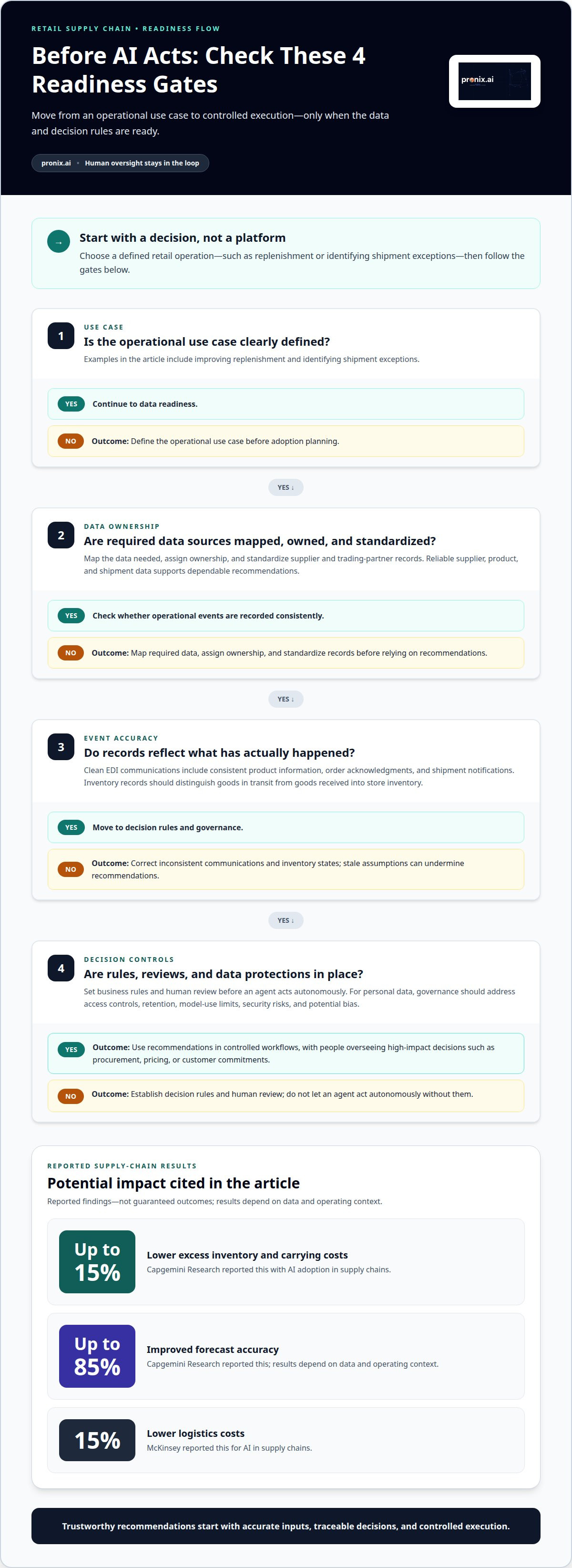
Adoption starts with a defined operational use case, such as improving replenishment or identifying shipment exceptions. Next, map the required data, assign ownership, and standardize supplier and trading-partner records. Clean EDI communications matter: consistent product information, order acknowledgments, and shipment notifications give models a reliable view of events. Distinguishing goods in transit from goods received into store inventory also prevents automation from acting on stale assumptions.
A unified AI architecture connects governed data sources to reusable retail data products, models, and workflows. A data product might organize item, order, or shipment information for forecasting and execution. Customer data can support buying-pattern analysis and personalized recommendations, while access controls keep that use separate from supply decisions. Establish business rules and human review before allowing an agent to act autonomously. This approach builds trust through accurate inputs, traceable recommendations, and controlled execution.
AI’s effects on fulfillment costs, forecasting, inventory, logistics, and service levels
AI connects demand signals, inventory records, and order workflows to inform retail decisions. Its impact depends on how accurately each system reflects current operations.
Inventory Tracking and Stockout Reduction
AI-enabled inventory tracking combines order, shipment, and stock records to show where goods are and when they can be sold. That visibility helps leaders distinguish items in transit from stock received at a store. Models can flag likely shortages and recommend replenishment, while order management systems coordinate stock across locations. Capgemini Research reported that AI adoption in supply chains helped lower excess inventory and carrying costs by up to 15%.
Demand Forecasting and Dynamic Pricing
AI forecasting analyzes historical sales, seasonality, market trends, and external variables to estimate demand. Retailers can use the results to plan stock and respond to changing buying patterns. Dynamic pricing systems can adjust prices using demand, competitor pricing, or inventory levels, helping retailers align offers with current conditions. Capgemini Research reported that AI adoption in supply chains improved forecast accuracy by up to 85%, though results depend on the data and operating context.
Warehouse Automation and Order Fulfillment
In warehouse workflows, AI can prioritize orders, identify picking sequences, and direct tasks based on stock location and fulfillment deadlines. This helps teams coordinate picking, packing, and dispatch as order volumes change. AI can also surface exceptions, such as an order awaiting inventory that has not yet been received. These capabilities connect warehouse execution with order management and can help reduce avoidable fulfillment delays.
AI supports warehouse automation and order fulfillment by analyzing order volume, stock locations, and delivery priorities, then coordinating task recommendations across picking, packing, and dispatch. Workers can review exceptions when inventory records or order conditions require human judgment.
Transportation Routing and Last-Mile Delivery
AI transportation tools analyze shipment status, delivery destinations, and logistics constraints to identify bottlenecks and support route planning. Retailers can use shipment visibility to spot delays and coordinate fulfillment changes before an order reaches the customer. McKinsey reported that AI in supply chains reduced logistics costs by 15%. The value comes from connecting transport decisions with inventory and order data, rather than treating delivery as a separate workflow.
For retailers, AI can optimize transportation, routing, and last-mile delivery by assessing shipment information and logistics constraints, then identifying route options or delivery exceptions. Connected AI workflows can help bring these operational decisions into coordinated processes.
Supply chain orchestration across planning and execution
Orchestration connects planning decisions with operational workflows, helping teams coordinate responses to changing supply conditions. Gartner identified connected supply chains and workflow automation as must-haves for 2025.
Intelligent Planning Agents
Agentic AI uses intelligent agents to interpret operational data, recommend actions, and carry tasks through defined workflows. In retail, an agent could identify a replenishment risk, prepare an order recommendation, and route it for planner approval. This links forecasting to execution without removing human control. Agents can also surface dependencies between purchase timing, stock allocation, and fulfillment priorities.
Planning agents coordinate decisions that might otherwise sit in separate tools. A change in demand can affect stock allocation, purchase timing, and fulfillment priorities. An agent can identify these connections and present the next action in context. Human-in-the-loop planning keeps planners responsible for reviewing and approving AI-generated recommendations, especially when supplier constraints or customer commitments change.
AI Recommendations and Scenario Planning
AI recommendations turn planning signals into proposed actions, while scenario planning tests how different conditions could affect supply and execution. Generative AI can help planners explore scenarios such as a demand spike, supplier delay, or logistics constraint. Teams can compare possible responses before adjusting plans, rather than treating each forecast as a fixed instruction.
Generative AI assistants can also help supply chain workers find relevant resources, such as planning guidance or operational information, within existing workflows. The planner retains decision authority. Clear business rules define which recommendations can be automated and which require approval. For example, routine updates may proceed through an established workflow, while changes affecting procurement or customer commitments remain subject to human review.
Orchestration also closes the loop between plans and actual execution. Teams can compare expected actions with order and shipment outcomes, then use exceptions to refine workflows and planning assumptions. This feedback can show where a recommendation needs adjustment, an approval step slows execution, or a process needs clearer ownership. The result is an operating model that makes AI part of routine planning while keeping people accountable for decisions and outcomes.
AI applications in retail supply chains
Retail applications connect AI to decisions across stores, suppliers, and customer-facing processes. Practical value comes from matching each use case to a clear operational need, rather than adding automation without defined ownership or controls.
Walmart uses AI to support daily supply chain workflows and anticipate demand cycles, including peak events and unexpected changes in customer traffic. Timely signals help teams adapt plans as conditions shift. H&M uses AI to inform how much to buy, when to buy, and where to place products in stores. Together, these examples show how AI-driven planning can connect buying decisions with retail execution.
Retailers can use AI to monitor shelves, identify gaps, and flag inventory that needs attention. For returns, accurate item data helps distinguish a product defect from a customer preference, informing decisions about product quality, assortment, and return handling. AI can also analyze customer data to identify buying patterns and preferences, supporting tailored marketing and product recommendations without treating every shopper alike.
Other applications address physical operations. A digital twin uses 3D virtual modeling to help a business examine facility layouts and assess potential changes before altering a real site. Retailers can also use AI to optimize returns, reduce packaging waste, and forecast more precisely to avoid overproduction. These applications target different challenges, so teams should connect each model to the process and decision it is meant to support.
Retailers may combine vendor-provided agents for standard workflows with customized agents that reflect their own customer data and business rules. The first approach can support common processes; customization can address brand-specific priorities. In either case, defined permissions and review points help keep automated recommendations within operational boundaries.
To turn these use cases into connected retail workflows, develop an AI-driven retail strategy that links data, decisions, and execution.
Pronix.ai
pronix.ai helps retailers connect AI strategy with the data, workflows, and controls required for practical execution. Turn to the team when forecasting or inventory use cases need stronger data foundations, or when AI recommendations need to become governed operational workflows.
Its work spans Data & AI Foundations, AI Business Automation, Agentic AI Implementation, and AI-Driven CX Modernization. These capabilities can support retailers addressing connected supply chain processes alongside customer-facing experiences. The right starting point depends on the business objective, existing systems, data readiness, and which decisions people need to retain.
For a focused discussion about applying AI to retail operations, contact pronix.ai.
Move from AI ambition to an accountable operating plan
The next step is to define where AI should influence a decision, who remains accountable, and what evidence will show whether the workflow is working. For a retail use case, connect the business objective to clear operating rules, decision ownership, and a practical path from planning to execution. This keeps AI in retail supply chain management focused on outcomes, not technology for its own sake.
pronix.ai offers Agentic AI Implementation, AI-Driven CX Modernization, and AI Business Automation to help enterprises move from strategy to operational workflows. The right approach depends on the business process, its data, and the level of human oversight required. A focused conversation can clarify where AI fits and what needs to be in place before expanding its role.
Discuss your AI priorities with pronix.ai and take the next step with a clear operational focus.
Frequently Asked Questions
How do intelligent agents help planners make better, faster decisions?
Intelligent agents help planners gather relevant signals, identify exceptions, and present recommended actions in one workflow. For example, an agent can connect a supplier delay to affected purchase orders and store allocations, then route the issue to the responsible planner. Decision logs and approval rules make recommendations easier to review, while teams retain authority over choices that affect commitments or budgets.
What challenges do companies face when implementing AI?
Companies often face fragmented systems, unclear data ownership, and difficulty explaining how a model reached its recommendation. Security teams also need to govern access to sensitive supplier, operational, and customer information. These challenges affect adoption as much as model performance. Assigning data owners, documenting decision logic, and defining escalation paths gives operations teams a practical basis for trust and control.
How is AI used in retail supply chain management?
Retailers use AI to connect planning signals with operational decisions across procurement, distribution, stores, and customer service. A system might detect a likely supplier disruption, identify which product flows are exposed, and help teams prioritize responses. Other applications support labor planning, returns analysis, and coordination between store and distribution operations. The most useful deployment links a specific business decision to accountable execution.
What are the main benefits of AI in retail supply chains?
The main benefits are faster decisions, more coordinated operations, and better use of inventory and workforce capacity. AI can help teams identify exceptions earlier, focus attention on urgent issues, and reduce manual analysis across disconnected processes. Retailers can assess value through measures such as order completion, waste, stock availability, and time spent resolving exceptions, alongside customer service outcomes.
How does AI improve retail demand forecasting and inventory management?
AI can improve forecasting by identifying patterns at the product and location level, then comparing predicted demand with current stock and replenishment plans. Planners can use forecast error and bias to identify where models consistently overestimate or underestimate demand. This supports replenishment thresholds tailored to products, rather than one stock rule for every item. Teams can then adjust plans as actual sales arrive.
What measurable ROI and cost savings can retailers expect from AI supply chain tools?
Retailers should measure ROI against a documented baseline, rather than assume one savings figure applies across deployments. Track implementation and operating costs alongside changes in fulfillment expense, inventory carrying costs, forecast error, labor effort, and service performance. Compare results for the specific workflow and period under review. Clear measurement helps leaders distinguish realized savings from projected value and decide whether to expand the use case.