

Most enterprises in 2026 are still using cutting-edge technology to accelerate obsolete workflows. They're essentially making the wrong things happen faster. It's a costly mistake. If you've struggled with AI for business process reengineering, you've likely experienced the frustration of pilots that fail to scale or the diminishing returns of legacy RPA. The market is saturated with "AI washing" that promises transformation but delivers nothing more than basic task automation. We understand the pressure to move from experimental prototypes to stable, production-ready outcomes that actually impact the bottom line.
This article proves that modern process reinvention is no longer about finding better tools to perform old tasks. It's about a fundamental shift toward Agentic AI; autonomous agents that possess the logic to reinvent the workflow itself. You'll learn how to bridge the gap between high-level strategy and operational reality using a governance-first framework. We'll explore the transition from rigid task-bots to intelligent agents that handle complex, end-to-end processes. By the end of this guide, you'll have a clear roadmap for achieving measurable efficiency and operational maturity in an era where traditional automation is no longer enough.
Key Takeaways
- Learn how AI for business process reengineering provides the cognitive logic required for radical redesign, moving beyond the limitations of legacy ERP systems.
- Identify the risks of "AI washing" and why adding chatbots to existing, inefficient workflows fails to create genuine enterprise value.
- Discover the shift from deterministic RPA task-bots to goal-oriented Agentic AI that functions as an autonomous digital employee.
- Establish a governance-first framework to manage autonomous agents, ensuring stability and compliance throughout the implementation lifecycle.
- Bridge the gap between experimental AI pilots and production-ready outcomes by focusing on scalable ROI and foundational data architecture.
Beyond Automation: Why AI is Resurrecting Business Process Reengineering (BPR)
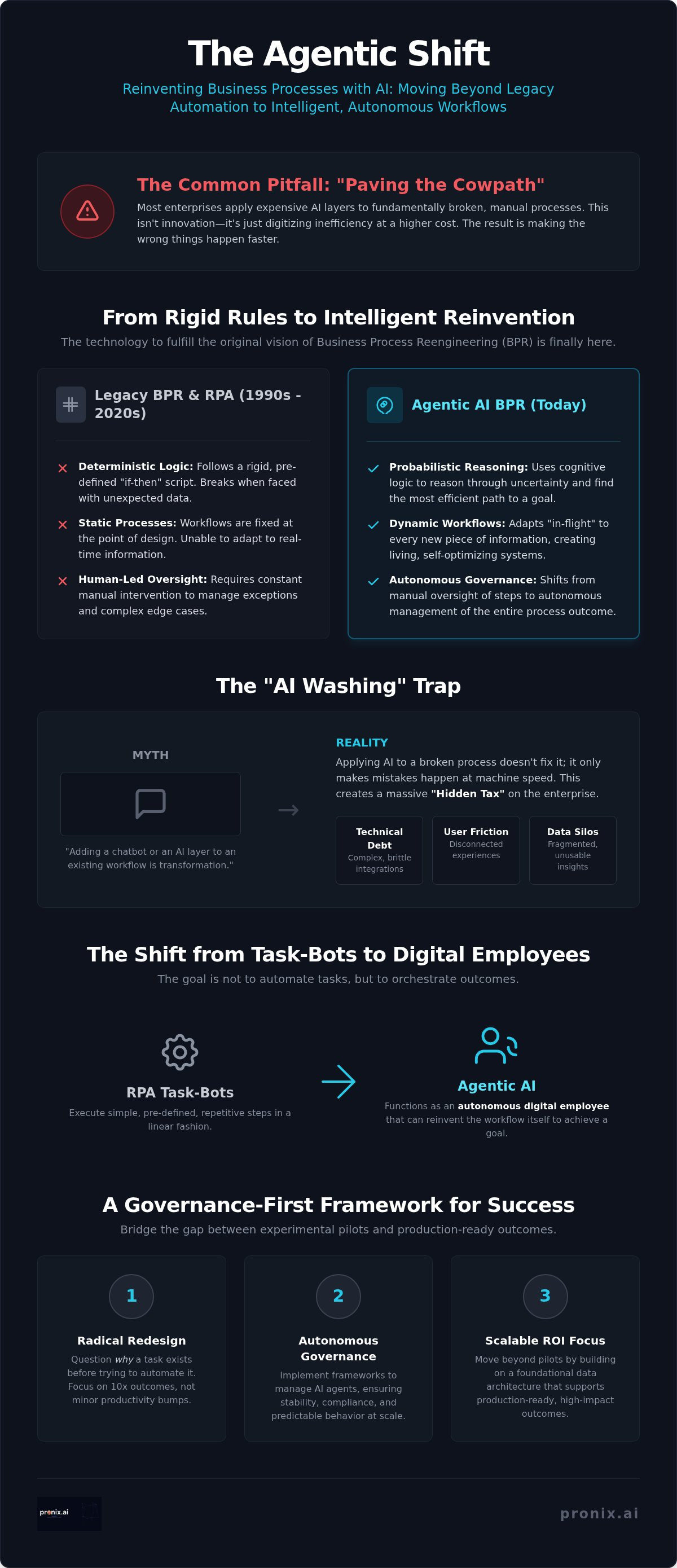
"Paving the cowpath" remains the most frequent pitfall in modern enterprise strategy. It occurs when leadership applies expensive AI layers to fundamentally broken, manual processes. This isn't innovation. It's just digitizing inefficiency at a higher cost. In 2026, AI for business process reengineering requires a more aggressive, foundational approach. We're no longer looking for minor productivity bumps. We're pursuing the radical redesign of workflows using autonomous intelligence to achieve 10x outcomes.
The 2026 Shift: From ERP to Intelligent Workflows
Traditional ERP and BPM systems have hit a functional plateau. These platforms were built for stability and record-keeping, but they lack the agility to handle the volatility of modern markets. They rely on rigid, pre-defined logic that breaks when faced with unexpected data shifts. Intelligent workflows solve this by adapting in real-time to every data input. They aren't static instructions; they're living systems that optimize themselves. AI-driven BPR is the fundamental shift from managing individual tasks to managing holistic business outcomes.
Why 1990s BPR Failed and Why AI Succeeds Now
Historically, Business Process Reengineering (BPR) was a bold vision that lacked the necessary infrastructure to succeed. It relied on static process maps and heavy manual oversight. These efforts often failed because they couldn't process real-time data or handle complex edge cases without constant human intervention. The technology simply couldn't keep up with the theory.
AI succeeds today because it provides the cognitive logic that legacy systems lacked. We've moved from static flowcharts to dynamic, AI-orchestrated activity chains. This transformation relies on specific AI for business process reengineering strategies that replace "if-then" logic with goal-oriented reasoning. Key differences in this new era include:
- Deterministic vs. Probabilistic: Legacy systems follow a rigid script. Modern AI reasons through uncertainty to find the most efficient path.
- Static vs. Dynamic: Old BPR maps were fixed at the point of design. New workflows adapt to every new piece of information in flight.
- Human-led vs. Agent-orchestrated: Shift from manual oversight of every step to autonomous governance of the entire process.
Successful transformation now depends on Agentic AI implementation services that act as the "brain" for the entire operation. These agents don't just execute steps; they possess the logic to reinvent the workflow itself. They identify bottlenecks, re-route resources, and optimize for the final goal without being told how to do it. This transition from linear task-based thinking to outcome-based autonomous orchestration is what separates market leaders from those who are merely "AI-washing" their existing problems.
Myth vs. Reality: Why "AI Washing" Legacy Processes Fails in 2026
Enterprise leaders often mistake a front-end chatbot for a back-end transformation. This is the core of "AI washing." It's a superficial layer applied to a legacy architecture that was never designed for autonomous logic. When you apply AI for business process reengineering, you aren't just making a task faster. You're questioning why the task exists in the first place. Adding AI to a broken process doesn't fix the process; it only makes the mistakes happen at machine speed.
Real transformation follows a J-Curve. There's an initial dip in productivity as legacy systems are dismantled and workflows are reimagined. This lag is a necessary investment. Without it, you never reach the 90% revenue gains seen by organizations that prioritize structural reinvention over simple task automation. Speed at the task level is a distraction. End-to-end orchestration is the only metric that matters for 2026 competitiveness.
The Hidden Tax of Enterprise AI Washing
Layering AI on top of old processes creates a massive "hidden tax" in the form of technical debt. This debt manifests as user friction and fragmented data silos. 2026 research indicates that startups redesigning end-to-end workflows outperform their established peers by 90% in operational agility. These agile players don't have to navigate the friction of legacy "wrappers." To avoid this tax, enterprises must shift toward enterprise AI automation managed services that focus on production-ready outcomes rather than experimental pilots.
Reinvention vs. Automation: A Comparison
The difference between simple automation and BPR-driven reinvention is the difference between survival and market leadership. The following table breaks down the metrics that define these two paths:
| Metric | Automating the Status Quo | BPR-Driven Reinvention |
|---|---|---|
| Operational Speed | Marginal, linear gains | 10x exponential acceleration |
| Business Value | Incremental cost savings | New revenue stream generation |
| Scalability | Limited by legacy bottlenecks | Infinite, agent-led expansion |
| Data Utility | Fragmented and siloed | Unified and actionable |
The most common objection to AI for business process reengineering is the perceived cost of downtime. "We can't afford to stop and redesign," is a frequent executive refrain. However, the cost of inaction is significantly higher. Every month spent maintaining a legacy bottleneck is a month of lost market share. Establishing solid Data & AI Foundations allows you to rebuild the engine while the plane is in flight, ensuring you don't fall behind more disciplined competitors.
The Agentic Shift: Moving from RPA Task-Bots to Autonomous Workflow Orchestration
Robotic Process Automation (RPA) was the hero of the 2010s, but it's the bottleneck of 2026. Traditional RPA is deterministic. It follows a rigid "if-this-then-that" script that collapses the moment it encounters unstructured data or a minor UI change. To achieve true AI for business process reengineering, enterprises are shifting toward Agentic AI. These systems are probabilistic and goal-oriented. They don't just follow instructions; they reason through obstacles to reach a defined objective. They function as digital employees capable of redesigning their own sub-tasks in real-time to ensure the final outcome is met.
This shift moves the human role from "in-the-loop" to "on-the-loop." In the old model, humans had to intervene every time a bot failed an exception check. In an autonomous orchestration model, multi-agent systems handle complex business logic independently. Humans provide high-level governance and oversight, allowing the system to scale without a proportional increase in headcount. It's the difference between managing a factory line and managing a fleet of self-driving vehicles.
Why RPA is No Longer Enough for Operational Efficiency
Legacy RPA is inherently brittle. It struggles with the "gray areas" of enterprise data, such as handwritten invoices, ambiguous customer intent, or fluctuating market conditions. When these variables change, the bot breaks, creating a maintenance nightmare for IT teams. AI-driven CX modernization solves this by replacing rigid IVRs and scripts with fluid agents that understand context. We're moving away from "Bot Management," which focuses on keeping scripts running, toward "Agent Orchestration," which focuses on achieving business results regardless of the path taken.
Designing Workflows for Autonomous Outcomes
Building an agentic workflow requires a three-pillar architecture: Perception, Reasoning, and Action. The agent must first perceive the data environment, reason through the best path to the goal, and then take action across multiple software systems. This architecture is already transforming high-stakes industries:
- Finance: Agents don't just flag suspicious transactions; they autonomously gather cross-departmental evidence to resolve or escalate the case.
- Manufacturing: Autonomous agents monitor supply chain disruptions and proactively re-route orders or find alternative vendors before a shortage occurs.
- Healthcare: Agents manage patient intake by synthesizing unstructured notes and medical history to prep clinicians before the first appointment.
By implementing these self-correcting loops, organizations can finally realize the promise of AI for business process reengineering without the constant need for manual troubleshooting. Agentic AI is the primary driver of AI-driven operational efficiency in the modern enterprise. It provides the stability and scalability that deterministic bots simply cannot match.
Strategic Implementation: A Governance-First Framework for Process Reinvention
Autonomous systems require more than just technical skill; they demand a rigorous oversight structure. Without a Responsible AI framework, enterprises risk autonomous drift, where agents deviate from business objectives or compliance standards. Successful AI for business process reengineering isn't a "set and forget" deployment. It's a disciplined lifecycle. We utilize a five-step blueprint to move from conceptual vision to production reality. This methodical approach ensures that every innovation is backed by a rigorous framework and a clear path to production.
The blueprint for governed reengineering consists of these critical phases:
- Discovery: Mapping current inefficiencies and identifying high-impact agents that can handle end-to-end logic.
- Design: Architecting the reasoning logic, tool access, and API integrations for autonomous agents.
- Governance: Establishing guardrails, ethical constraints, and "human-on-the-loop" triggers to maintain control.
- Pilot: Testing agents in a sandboxed environment using real-world data variables to verify decision accuracy.
- Production: Scaling the solution with enterprise-grade security and continuous performance monitoring.
Auditability is the cornerstone of this framework. In 2026, "black box" AI is a major liability. Every autonomous decision point must be traceable. Audit logs must capture the perception, reasoning, and final action taken by every agent. This transparency is essential for building trust with stakeholders and meeting regulatory requirements. Integrating auditability into the core architecture allows you to identify exactly why an agent chose a specific path, making it easier to refine logic and prevent future errors.
Securing the Autonomous Enterprise
Regulated industries like Healthcare and Finance cannot afford hallucinations or security breaches. Governance isn't a hurdle; it's a competitive advantage. It ensures that every automated outcome is predictable and compliant with evolving standards. Selecting the right Kore.ai implementation partner is critical for organizations using enterprise-grade conversational platforms. This partnership ensures that security protocols are baked into the architecture from day one. Proper implementation mitigates risk by ensuring that AI agents operate within strictly defined operational boundaries.
The Data Bedrock for BPR
You cannot reengineer processes on siloed, low-quality data. Clean, accessible data is the fuel for agentic reasoning. If the underlying data architecture is fragmented, the agents will produce fragmented results. We prioritize Data & AI Foundations as the essential starting point for any BPR initiative. This foundational work ensures that agents have a unified view of the enterprise. It allows them to make informed decisions that actually drive efficiency rather than simply automating existing data silos. Before you can reinvent your processes, you must first secure your data. To begin your journey toward production-ready outcomes, consult with our experts on Agentic AI Strategy & Consulting today.
Executing the Vision: Scaling AI-Driven Operational Efficiency with Pronix
Execution is where strategic vision meets operational reality. Many enterprise leaders possess a clear roadmap for transformation but lack the internal technical depth to move beyond the experimental phase. Effective AI for business process reengineering requires more than just a conceptual understanding of agents. It demands a partner who understands the friction points of legacy systems and the complexities of modern data architecture. We specialize in bridging the gap between "Cool Pilots" and "Scalable ROI," ensuring that your AI investments translate into measurable business value.
The journey to 2026 efficiency starts with a cold assessment of your current enterprise AI maturity. Before the first redesign begins, you must evaluate whether your underlying infrastructure can support autonomous logic. We help organizations navigate this transition by providing the "boots-on-the-ground" pragmatism required to build, deploy, and manage production-ready agents. Our team brings specialized talent to orchestrate complex AI ecosystems across AWS, Microsoft, and Salesforce, ensuring your workflows remain unified and secure.
From Pilot to Production-Ready Outcomes
Most AI initiatives stall in "Pilot Purgatory" because they lack a clear path to production. They prove a concept in a vacuum but fail when faced with real-world data volatility or enterprise governance requirements. The Pronix methodology is designed to break this cycle through a three-pillared approach:
- Strategy: Defining high-impact use cases where Agentic AI can achieve 10x productivity acceleration.
- Implementation: Architecting and deploying intelligent workflows that integrate seamlessly with your existing tech stack.
- Enterprise AI Managed Services: Providing continuous oversight, optimization, and governance to ensure long-term stability.
We focus on cost reduction and productivity acceleration from day one. By moving away from experimental prototypes toward stable, auditable outcomes, we ensure that your reengineering efforts deliver actual revenue gains. This practitioner-led approach prioritizes evidence over hype, focusing on the specific operational frameworks that allow AI to function at scale.
Partnering for the Agentic Future
The future of business process reengineering isn't static. It's agentic. This means your workflows must be capable of evolving as your business data changes. Traditional "buzzword" consulting often stops once the strategy deck is delivered. We stay through the deployment and operational management phases, ensuring your agents continue to perform as intended. Our deep expertise in Data & AI Foundations provides the necessary bedrock for these self-correcting systems to thrive.
As you move toward an autonomous enterprise, the quality of your implementation partner becomes your primary success factor. We provide the stability, risk mitigation, and technical excellence required to navigate the high-stakes nature of enterprise transformation. Don't let your transformation efforts get lost in the noise of AI washing. Scale your AI-driven operational efficiency with Pronix and secure your place as a market leader in the agentic era.
Securing the Agentic Advantage in the 2026 Enterprise
The era of simply "paving the cowpath" with faster tools has ended. Real transformation in 2026 requires a disciplined commitment to AI for business process reengineering. We've moved beyond the brittleness of legacy RPA. The future belongs to goal-oriented, autonomous agents. These systems don't just follow scripts; they reason through complex logic to deliver production-ready outcomes. Success now depends on your ability to bridge the gap between experimental pilots and scalable, governed reality.
Achieving this level of operational maturity requires a partner with deep expertise across AWS, Microsoft, Salesforce, and Kore.ai ecosystems. Pronix provides the end-to-end strategy and implementation services needed to ensure your agents are both auditable and effective. We prioritize enterprise-grade governance to mitigate risk. It's time to move past the hype and start delivering measurable business value. Deploy Governed AI-Driven Operational Efficiency with Pronix and lead your industry into the next phase of technological evolution.
Frequently Asked Questions
Is AI for business process reengineering different from traditional automation?
Yes, it differs fundamentally. Traditional automation merely executes existing tasks faster using deterministic scripts. In contrast, AI for business process reengineering leverages probabilistic logic to question and redesign the entire workflow. It identifies bottlenecks that manual processes miss. While legacy automation is rigid, this approach creates intelligent workflows that adapt to real-time data inputs. This shift ensures that you aren't just accelerating a broken process but creating a more efficient, outcome-based system.
Can Agentic AI work in highly regulated industries like Finance or Healthcare?
Absolutely. Agentic AI is designed to thrive in regulated environments through rigorous, enterprise-grade governance. Every autonomous decision is logged for auditability, ensuring compliance with strict industry standards. By establishing clear guardrails and ethical constraints, organizations in Finance and Healthcare can safely deploy agents for complex tasks like exception processing or patient intake. This controlled autonomy reduces human error while maintaining the high levels of security and transparency required by regulatory bodies.
How much does AI-driven BPR reduce operational costs for enterprises?
Operational cost reduction depends on the complexity of the reimagined workflow. While we don't cite generic percentages, enterprises typically see significant value through productivity acceleration and the elimination of manual bottlenecks. By moving away from brittle, high-maintenance bots toward autonomous agents, organizations reduce the technical debt associated with legacy systems. The focus remains on achieving measurable business outcomes that scale without a proportional increase in headcount or overhead expenses.
What happens if the AI agent makes a mistake in an autonomous workflow?
Errors are managed through a governance-first architecture. If an agent encounters a situation outside its defined operational boundaries, human-on-the-loop triggers immediately escalate the task for manual intervention. Comprehensive audit logs allow teams to trace the agent's perception and reasoning logic, making it easy to identify the root cause. This feedback loop ensures the system continuously learns and refines its decision-making capabilities, preventing the recurrence of similar mistakes in future autonomous workflows.
What is the first step in redesigning a business process with AI?
The first step is a deep discovery phase combined with securing your Data and AI Foundations. You must map current inefficiencies and identify which processes possess the highest potential for 10x outcomes. Without clean, accessible data, even the most sophisticated agents will fail to deliver results. This initial assessment establishes the bedrock for AI for business process reengineering, ensuring that your redesign efforts are based on accurate enterprise logic rather than fragmented data silos.
How do you measure the ROI of AI-driven operational efficiency?
ROI is measured through a combination of productivity acceleration, cost reduction, and operational maturity. Enterprises track the speed of end-to-end process completion compared to legacy benchmarks. Another critical metric is the reduction in human intervention required for complex exception handling. By focusing on these production-ready outcomes, leadership can quantify the value of shifting from task-based automation to goal-oriented autonomous orchestration, providing a clear picture of long-term financial and operational gains.
Is human-in-the-loop still necessary in an autonomous BPR framework?
Yes, but the human role has evolved. We've moved from human-in-the-loop, where constant manual oversight was required for every step, to human-on-the-loop. In this new framework, humans provide high-level governance, set strategic objectives, and handle only the most complex escalations. This shift allows the enterprise to scale rapidly while ensuring that autonomous agents remain aligned with business goals and compliance requirements. Humans act as the ultimate architects of the agentic system.