

What makes an AI proposal convincing to a CFO? Not the boldest return forecast, but a clear, testable promise. CFOs are right to challenge claims framed only around productivity or innovation. Only 29% of executives say they can confidently measure AI ROI today, according to AI Assembly Lines (June 8, 2026). That gap is why justifying AI investment to CFO requires evidence before ambition: a defined baseline, an accountable owner, and an outcome the organization can measure.
This article explains how to build that case without asking for an open-ended AI budget. Connect a specific workflow to financial and operational measures, account for the full investment across implementation, integration, usage, and operations, and make assumptions visible. Then define how benefits, costs, and risks will be monitored after approval, with decision points to continue, adjust, or stop. The result is a proportionate next step grounded in business evidence, not a promise that AI will transform everything.
Key Takeaways
- Frame justifying AI investment to CFO around a specific business problem, not a broad innovation pitch.
- Build a clear case by separating observed performance, forecast benefits, implementation costs, and recurring operating expenses.
- Compare automation, employee-assist, and customer-experience opportunities by value potential, risk, readiness, and time to evidence.
- Turn the proposal into a decision memo with success measures, accountable owners, review dates, and conditions to adjust or stop.
- Connect approval to execution through strategy, integration, governance, and ongoing operational oversight.
Why justifying AI investment to a CFO requires more than an innovation pitch
AI can create meaningful opportunities, but opportunity alone doesn’t justify spending. Finance needs a decision it can evaluate: which business problem is being addressed, what will change, what resources are required, and what evidence will show whether the investment is working? The broader AI boom and investment trends help explain why investment is accelerating, but market momentum isn’t proof that a particular use case deserves funding.
A finance-ready AI business case documents a testable connection between an investment, a change to an operating process, and measurable business outcomes, with assumptions, ownership, and risks made explicit. It doesn’t promise a return. It gives decision-makers a disciplined way to evaluate one.
Separate the AI capability from the business value mechanism. A system may summarize information, classify requests, or generate responses. Those capabilities don’t automatically reduce handling time, improve customer experience, or change financial performance. Value depends on how the workflow changes: who uses the output, which steps are removed or revised, how exceptions are handled, and how results are measured. If the process stays the same, the tool may add activity without improving the outcome.
What does a CFO need to see before approving AI investment?
Start with a named business problem, the process it affects, and an executive owner accountable for the outcome. Establish the baseline using existing measures, such as cycle time, rework, service levels, or cost per transaction. Then state the decision being requested, what the investment covers, and what evidence leaders need before they expand the work.
Make the boundary concrete. For example, a proposal might address one defined stage of a claims-review or service workflow, rather than asking to “apply AI across operations.” Specify the teams and systems in scope, the measures to track, and the review point at which leaders will assess progress. This helps finance distinguish a bounded test from a commitment to scale.
Why does an AI transformation pitch lose financial credibility?
Broad claims such as “employees will be more productive” leave essential questions unanswered. Which workflow will change? What is its current performance? Who owns the measurement? Without those details, an anticipated benefit is difficult to validate or connect to a budget decision.
Customer and financial outcomes also need a visible link. Faster responses may matter to customers, but a business case should explain how the organization will assess that change and whether it relates to a financial measure, such as retained business or service cost. Don’t treat one as automatic proof of the other. Define each outcome and its measurement method.
An unbounded pilot can also blur the line between learning and ongoing operation. Without a defined scope, stop conditions, and an owner for production operations, costs and risks can grow while accountability remains unclear. A credible proposal makes the next decision explicit: what the organization will test, what it will monitor, and what evidence will support continuing, adjusting, or stopping.
Build an AI investment business case around baselines, benefits, and full costs
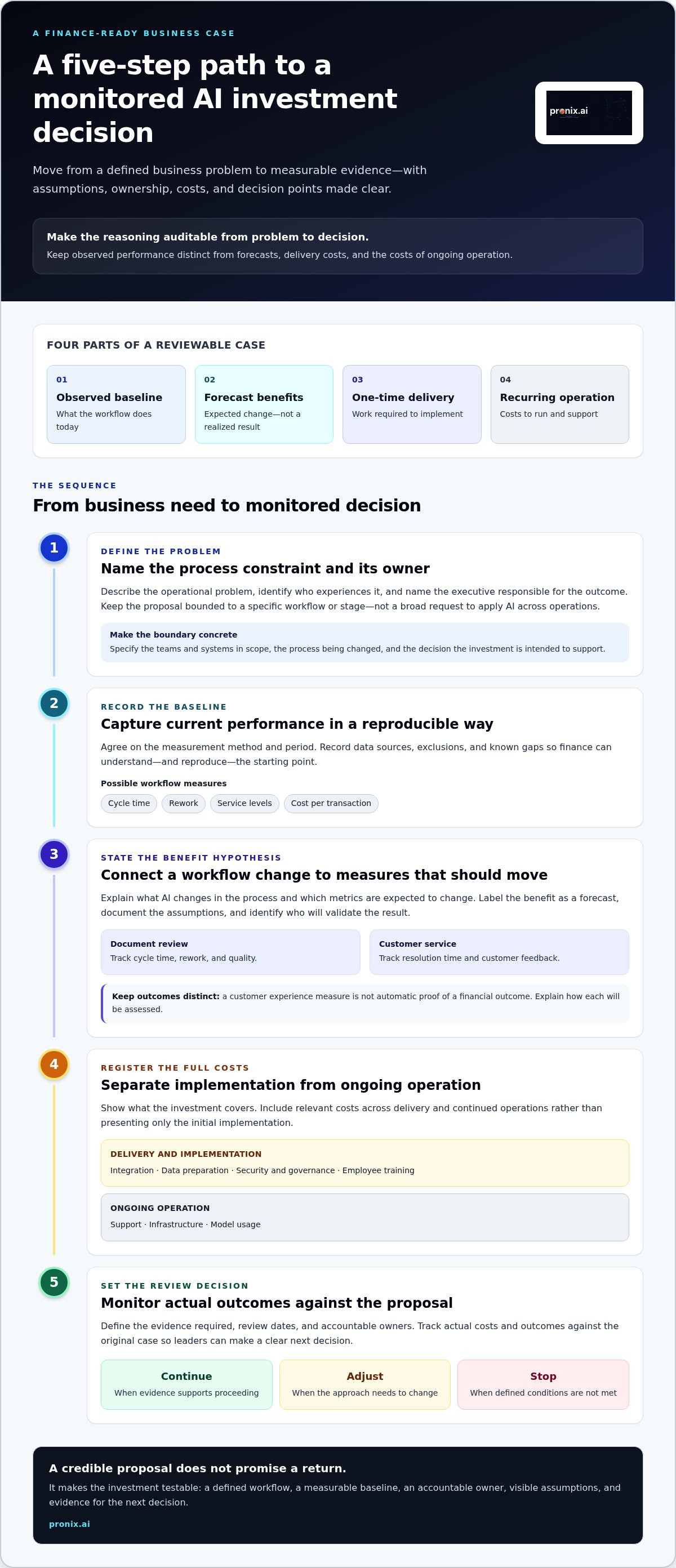
A strong business case makes the reasoning auditable from problem to decision. Keep four categories separate: the observed baseline, forecast benefits, one-time delivery costs, and recurring operating costs. This prevents estimates from being presented as measured results and makes the assumptions behind the case easier to review.
Every projected AI benefit should identify the workflow baseline it is expected to change, the accountable owner who will validate the change, and the measurement period used to assess it. This keeps forecasts testable and gives finance a clear basis for reviewing progress.
Use this sequence to move from a business need to a monitored investment decision:
- Define the problem. Describe the process constraint in operational terms, identify who experiences it, and name the executive responsible for the outcome.
- Record the baseline. Capture current performance using an agreed method and period. Note data sources, exclusions, and known measurement gaps so the starting point can be reproduced.
- State the benefit hypothesis. Explain what AI changes in the workflow and which metrics should move. Label the benefit as a forecast, not a realized result, and document the assumptions behind it.
- Register the full costs. Separate delivery from ongoing operation. Include integration, data preparation, security and governance, employee training, support, infrastructure, and model usage where applicable.
- Set the review decision. Define the evidence required, review dates, accountable owners, and conditions to continue, adjust, or stop. Track actual costs and outcomes against the proposal.
Which AI benefits can be measured credibly?
Map each proposed benefit to a workflow, a metric, a baseline, and a measurement period. For example, a customer-service use case might track resolution time and customer feedback, while a document-review workflow could measure cycle time, rework, and quality. Choose measures that reflect the specific use case instead of relying on a generic claim of greater productivity.
Distinguish cash-releasing savings from capacity gains. Reduced handling effort may free employee time, but it becomes a financial saving only if the organization changes staffing, workload, or another cost-bearing process. State that dependency explicitly. Customer, quality, and cycle-time improvements can still be valuable; show how they relate to business priorities without presenting them as direct financial returns.
How should teams calculate the full cost of AI?
Maintain a cost register with a line for each cost category, its owner, timing, assumptions, dependencies, and uncertainty. Separate one-time implementation and integration work from recurring support, infrastructure, security oversight, data maintenance, and model usage. Where costs depend on volume or adoption, document the driver and how it will be monitored rather than presenting an unsupported point estimate.
Use the same evaluation period for costs and benefits. Record what is included, what remains uncertain, and who will update the figures as actual usage becomes visible. This gives leaders a more useful decision model than a single total, because they can see which assumptions drive the case and where controls are needed. Teams shaping enterprise AI investment plans can connect financial assumptions with delivery and operational oversight.
Compare AI investment options using value, risk, and time to evidence
Once costs and measures are defined, compare candidate investments on equal terms. A use case with modest projected value but reliable data and a short path to evidence may be a stronger first investment than a larger opportunity that depends on extensive integration or process change. The right choice depends on the organization’s workflow, readiness, and risk tolerance.
Use this matrix as a starting point, then replace the indicative assessments with evidence from your own environment:
These are comparison prompts, not universal rankings. A customer-facing use case may be unsuitable if reliable escalation is difficult; an employee assistant may be hard to evaluate if its source content is inconsistent. Justifying AI investment to CFO means showing why the selected option fits the actual process, not simply why its technology looks compelling.
How do direct savings differ from productivity and growth value?
A measurable productivity gain is an observed improvement in time, throughput, or capacity; realized financial savings occur only when costs are actually removed or avoided. Released employee capacity may support more work, but capturing that value can require workflow redesign and management decisions. Treat revenue growth and experience improvements as hypotheses until operational evidence supports them, and distinguish those measures from cash savings.
How should finance weigh uncertainty and operational risk?
Assess evidence quality, implementation dependencies, and exposure together. Record data readiness, integration complexity, security and governance needs, auditability, and where human review is required. Choose models and platforms based on workload, data, security, and integration requirements. A local model is not automatically cheaper or safer; its full operating requirements matter too. Prefer the option whose assumptions and controls can be tested clearly.
Turn the AI business case into a CFO-ready decision and measurement plan
A decision memo should make the requested approval clear before explaining the technical approach. State the business outcome, proposed scope, and decision needed now in the opening lines. Then summarize the baseline, cost categories, expected benefits, assumptions, and material risks. This gives finance a concise view of what the organization is committing to and what it expects to learn.
For teams justifying AI investment to CFO, the memo should also assign measurement ownership. Name the executive accountable for the business outcome, the operational lead responsible for tracking performance, and the owner of cost reporting. Set review dates and define what evidence would support continuation, adjustment, or stopping. Without decision criteria, a bounded investment can drift into ongoing spend without a deliberate review.
What belongs in a one-page AI investment memo?
Keep the memo concise, but make its logic traceable. Include the business problem and baseline, proposed scope, one-time and recurring cost categories, benefit hypothesis, key assumptions, risks, and accountable owners. State the evidence threshold for the next decision in operational terms, such as whether the agreed measure can be tracked reliably and whether the process change is being adopted.
How can a staged investment reduce approval friction?
Use explicit decision gates rather than seeking approval for an undefined rollout. Each stage should produce evidence for the next commitment, while financial, security, and governance checks run alongside delivery. An enterprise AI governance framework can help clarify oversight responsibilities and controls. Enterprise AI data strategy planning can also surface data readiness and foundation dependencies.
- Discovery: Confirm the workflow, baseline, data access, dependencies, risks, and measurement method. Proceed when the use case and evaluation approach are sufficiently clear.
- Controlled implementation: Limit deployment to the approved scope. Track agreed operating measures alongside usage, exceptions, costs, security controls, and human review.
- Operational review: Compare observed evidence with the memo’s criteria. Decide whether to continue, adjust the scope or controls, or stop before expanding the investment.
These gates keep exposure proportionate to what is known. They also make a negative or inconclusive result useful: leaders can identify whether the constraint was data quality, integration, adoption, process design, or the value hypothesis. They can then decide what to change instead of relying on optimism.
Governance belongs in the approval logic, not as a final deployment check. Assign responsibility for monitoring, escalation, and audit records before implementation begins, and review those controls at each gate. This connects the investment decision to operational accountability as the initiative moves from evaluation toward production.
pronix.ai connects AI strategy, implementation, and ongoing oversight to defined business outcomes through its enterprise AI services.
Move from approved AI investment to accountable enterprise execution
Approval is a funding decision, not the finish line. The next test is whether the initiative can operate within real workflows while preserving the outcomes, cost assumptions, and controls in the business case. That takes coordinated strategy, implementation, and ongoing operational oversight, not a handoff from an AI pilot to an unowned production system.
As scope expands, integration connects AI to the systems and teams doing the work. Governance defines who can access the system, how outputs are reviewed, and what happens when results need escalation. Operational monitoring keeps agreed performance and cost measures visible after launch. Together, these practices make the original investment case actionable: teams can assess whether the deployed workflow is producing the evidence that justified it.
What changes when an AI initiative moves from pilot to production?
A bounded test becomes part of an operating process. Teams need clear ownership for workflow performance, system support, exceptions, and human review. Integration must fit the organization’s data and existing systems, while security, governance, and auditability remain in place as usage grows. Production readiness is not simply a successful demonstration; it means the process can be operated and overseen consistently.
Measurement continues after launch. Track agreed business outcomes alongside usage, operating costs, exceptions, and relevant control checks. If performance shifts or costs diverge from approved assumptions, accountable owners need a defined route to investigate and adjust. This discipline helps leaders distinguish a system that is merely live from one that remains aligned with its approved purpose.
How can pronix.ai support the investment lifecycle?
pronix.ai helps enterprises move AI initiatives from pilots toward secure, scalable production. Its work connects strategy and consulting with technical implementation and managed services, aligning delivery and operational oversight with the business case. Across agentic AI, business automation, and AI-driven customer experience, pronix.ai integrates AI into enterprise environments with governance and measurable operational outcomes in view.
For implementation considerations across the production journey, see this enterprise AI production guide. This lifecycle approach maintains continuity: the problem defined during strategy informs implementation, and the approved measures remain relevant as the solution is operated and reviewed.
For leaders justifying AI investment to CFO, execution should preserve the connection between approved spend and accountable outcomes. pronix.ai provides enterprise AI services across healthcare, finance, and manufacturing, where integration and oversight are central to moving beyond experimentation.
Make the next AI decision evidence-led
The next step isn’t to fund AI in the abstract. Select a business outcome worth pursuing and determine what evidence would make further investment responsible. That keeps the discussion focused on a decision the organization can own, rather than a technology roadmap that expands before its value is understood.
For teams justifying AI investment to CFO, the work continues after approval: translate the agreed outcome into delivery priorities, operational measures, and clear accountability. pronix.ai’s platform ecosystem includes AWS, Microsoft, Salesforce, Kore.ai, and Genesys, supporting enterprise AI work across established technology environments.
Bring your priority use case, the outcome you want to measure, and the questions finance needs answered into the next discussion. Discuss an AI investment tied to measurable business outcomes with pronix.ai. Start with one well-defined opportunity, then build from what the organization learns.
Frequently Asked Questions
How do you justify AI investment to a CFO?
Start with a business problem that has a visible operational effect, such as repeated manual checks delaying invoice approvals. Establish how the process performs now, then explain what the AI use case would change and how that change will be assessed. A clear method for justifying AI investment to CFO also identifies who owns the outcome, what the proposed scope excludes, and what evidence will inform the next funding decision.
What metrics should be included in an AI business case?
Choose measures that reflect the task and the reason for changing it. For a customer-support assistant, a team might examine response quality, escalation frequency, and time to resolution; for document processing, it could assess rework and completion time. Define each measure’s data source and reporting owner. If an AI system handles only selected cases, separate those results from the wider workflow so the comparison remains meaningful.
How do you calculate the ROI of an AI investment?
Calculate ROI over a stated period by comparing the value attributed to the use case with its full costs during that same period. Make clear whether each benefit is observed or forecast, and avoid counting the same benefit twice across teams or processes. For example, if faster review is expected to reduce backlog, measure backlog change separately from any claimed cost reduction. Update the calculation as actual adoption and usage become known.
Can AI investment be justified without direct revenue growth?
Yes. An investment may support objectives such as improving service consistency, reducing avoidable rework, or enabling staff to handle more complex requests. The case should show why that outcome matters to the organization and how it will be observed. For example, track a quality improvement through review results, while capacity gains require a plan for reallocating the time released. Keep indirect value distinct from booked revenue or savings.
What costs should a CFO consider before approving an AI project?
Consider the work required to make the use case function in its operating environment, not just the AI component. Depending on scope, costs may include process analysis, system integration, data preparation, security review, governance, testing, employee training, support, and ongoing model usage. Identify which costs are one-time and which continue after launch. For a workflow connected to several systems, make integration dependencies visible rather than burying them in a general project estimate.
How can an organization manage the risk of an AI investment?
Match controls to the use case before users depend on AI outputs. For example, define which information the system can access, who reviews consequential outputs, and how staff flag errors or escalate uncertain cases. Assign owners for security, operational monitoring, and governance, then document how issues will be recorded and addressed. A limited trial can reveal specific risks, but it does not by itself establish that the system is ready for wider operational use.
Should an enterprise start with an AI pilot or a full deployment?
Choose the starting scope based on process criticality, data readiness, integration complexity, and the consequences of an incorrect output. A bounded pilot can be useful when it tests a clear assumption, such as whether staff can use AI-generated summaries in an existing review process. Set boundaries on users and workflow, and plan what must change before expansion. If the use case is already well understood, a narrowly scoped production rollout may be more informative than a disconnected experiment.