

A fluent AI answer can still be fabricated. Generative AI hallucinations are incorrect, misleading, or nonexistent claims, citations, code, or events presented in language that sounds factual. Troubleshooting generative AI hallucinations means more than correcting a bad response: it means identifying why the system produced it and reducing the risk that the same failure reaches a decision, employee, or customer.
That risk is familiar to teams deploying AI in high-stakes workflows. A plausible sentence may conceal missing evidence, outdated knowledge, or a mismatch between a question and the information retrieved. Retrieval-augmented generation (RAG) can ground responses in relevant sources, but retrieval alone does not prove an answer is accurate or safe to act on. This article explains what hallucinations are, how RAG changes the failure pattern, and where expert review remains essential. It also explores what changes when AI can take actions, pass outputs between tools, or trigger downstream processes, and why controls must cover the full workflow, not just the generated text.
Key Takeaways
- Distinguish a fluent answer from a reliable one by identifying fabricated claims, citations, and other unsupported details.
- Understand how retrieval can ground responses in current, relevant knowledge, and why retrieved evidence still needs evaluation.
- See where subject-matter review adds control, especially when an answer could affect a customer, employee, or business decision.
- Trace how an unsupported output can create downstream risk in agentic workflows, and why safeguards must cover the entire process.
Table of Contents
Definitions of hallucinations in large language models
Large language models predict likely word sequences based on patterns learned during training. Troubleshooting generative AI hallucinations starts with distinguishing plausible language from evidence-backed answers.
Meaning of Model Hallucinations
A hallucination is inaccurate, misleading, or nonexistent content presented as fact. It might be a fabricated citation, an incorrect date, or an event that never happened. Fluent language can make these errors hard to spot, especially when an answer mixes accurate details with unsupported claims. In professional settings, a credible tone does not establish that a response is reliable.
How Models Produce Fabricated Content
Models generate text by predicting what language is likely to follow a prompt, based on patterns learned during training. They do not independently verify each statement against reality. When information is missing, obscure, or outside a model’s knowledge, it may produce a convincing completion instead of acknowledging the gap. A fabricated citation, complete with a plausible title and author, shows how fluent output can conceal a lack of evidence.
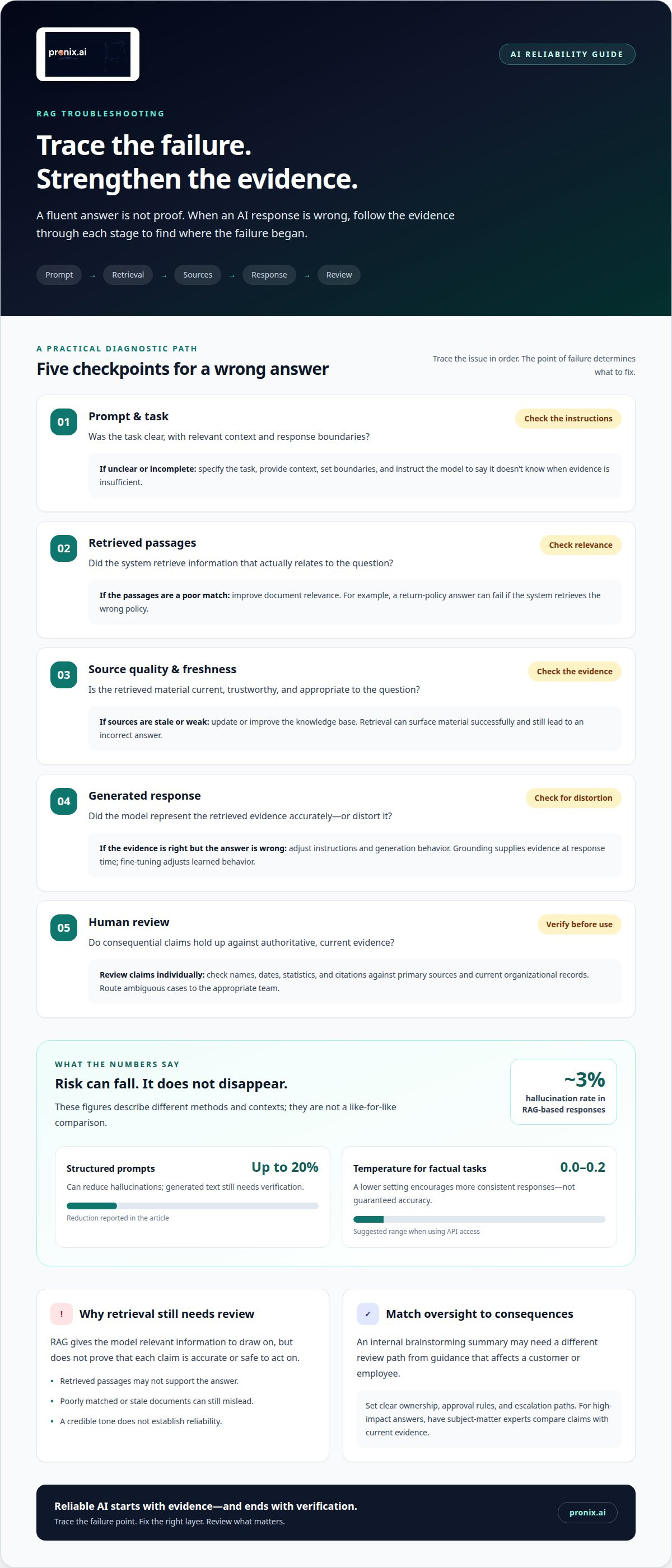
Professionals use prompt design and system instructions to constrain that behavior. They specify the task, provide relevant context, define response boundaries, and instruct the model to say it doesn’t know when evidence is insufficient. Structured prompts can reduce hallucinations by up to 20%, though they don’t turn generated text into verified fact.
Temperature settings influence output variation. For factual tasks, professionals may set temperature between 0.0 and 0.2 when using API access; lower settings encourage more consistent responses, not guaranteed accuracy. Detailed instructions and other model settings should be evaluated against the actual use case.
Trusted or domain-specific models are not automatically accurate. Specialized domains can still produce hallucination rates of 60-80%, particularly in legal or technical reasoning. In a study of 2023-era models, general-purpose AI chatbots hallucinated on 58-82% of legal research queries. Those figures underscore why model choice alone cannot establish reliability.
Retrieval-augmented generation
Retrieval-augmented generation (RAG) retrieves relevant information before a language model drafts its response. This gives an AI tool evidence to draw on instead of relying only on patterns learned during training.
Grounding Responses in Knowledge Bases
RAG connects a model to a knowledge base, such as current product policies or internal process documents. The system retrieves passages related to a question and uses them as context for its answer. For a return-policy query, it can retrieve the applicable policy rather than rely on an outdated pattern from training. The response can therefore reflect an organization’s own sources of truth.
Retrieval as a Mitigation Method
Retrieval can reduce hallucinations by grounding generated claims in relevant external sources. General-purpose LLMs hallucinate in roughly 3% of RAG-based responses, so retrieval lowers risk but does not eliminate it. Professionals assess whether retrieved passages actually support the answer, using confidence scoring and contextual overlap analysis. Poorly matched or stale documents can still produce incorrect responses, even when the platform retrieves material successfully.
Grounding, Fine-Tuning, and Chatbot Troubleshooting
Fine-tuning adjusts a model’s learned behavior, while grounding supplies evidence at response time. For changing policies or product details, retrieval can use updated knowledge rather than relying solely on training data. To troubleshoot a chatbot, trace an error through the prompt, retrieval results, source quality, and final response. If a bot gives the wrong return window, for example, determine whether it retrieved the wrong policy or misrepresented the right one.
That distinction guides remediation: improve document relevance when retrieval fails, or adjust instructions and generation behavior when the model distorts supporting text. A review of retrieval and grounding design can help teams assess these failure points within an enterprise workflow.
Using subject-matter expertise to review AI output
Subject-matter experts assess whether an AI response is factually sound in its domain, not merely fluent. They compare consequential claims with primary sources, peer-reviewed publications, and current organizational records. Reviewers can check names, dates, statistics, and citations individually, then flag unsupported statements for correction or escalation. This separates evidence from confident wording and helps teams decide whether an answer is fit for use.
Organizational policies define which outputs need human approval before employees or customers act on them. An HR assistant answering questions about leave policies, for example, needs oversight and regular updates to avoid inaccurate or outdated guidance. Reviewers can compare its answers with the current policy and route ambiguous cases to the appropriate team. Clear ownership makes review part of operations, not an informal final check.
Red-teaming deliberately challenges an AI tool. Human experts probe it with edge cases, conflicting information, and questions designed to expose bias or unsupported certainty. They record how the model responds, whether it cites relevant evidence, and where it fails to distinguish fact from assumption. These findings help teams improve prompts, retrieval, escalation paths, and review criteria before errors recur in production.
Oversight should match the consequences of an output. A factual summary for internal brainstorming may need a different review path from guidance that affects a customer or employee. In a 2023 US legal case, ChatGPT-generated filings included fabricated case law. A judge fined the attorney and firm $5,000. This demonstrates why reviewers must verify legal citations and claims against authoritative records before submission.
Effective review also creates a learning loop. Teams categorize issues, such as factual errors, bias, missing context, or outdated policies, then adjust controls and test similar prompts again. This helps organizations assess whether changes improve output quality. It also reinforces a core operating principle: no large language model should be treated as the sole source of truth.
Risks of hallucinations in agentic workflows
An agentic workflow can turn a fabricated answer into a series of actions. Unlike a standalone chatbot, an AI agent may pass outputs to another system, update a record, or trigger a business process. Each handoff creates another point where an incorrect claim can influence what happens next.
Consider an agent that summarizes a customer request and sends instructions to a service platform. If the summary invents an approval, a downstream tool could act on that claim as if it were reliable. A second agent may treat the first output as trusted context, compounding the error. Teams need controls across the workflow, not just checks on the initial response.
In healthcare, finance, and legal applications, fabricated details can distort decisions about care, transactions, or case analysis. A model may produce an inaccurate summary or misstate evidence, and later steps may treat that output as correct. The risk depends on what the workflow can access, decide, and execute, and how quickly a human can intervene.
In a 2024 survey, 38% of business executives reported making incorrect decisions based on hallucinated AI outputs. In an agentic system, the same failure can travel beyond one decision. For example, an unsupported analytics result might shape a recommendation, then feed a report used by another team. Monitoring answer drift and unusual outputs helps surface failures as workflows operate.
Effective controls set boundaries for each agent, keep evidence traceable, and route high-impact actions for human approval. Teams can test edge cases, review logs across handoffs, and define a stop condition for conflicts between retrieved evidence and generated answers. These checks make the system more auditable and limit how far fabricated content can travel.
For organizations designing these controls across connected agents, explore agentic AI implementation to assess workflow risks and establish operational safeguards.
Pronix.ai
pronix.ai helps organizations address hallucination risks as part of enterprise AI strategy and implementation. Its specialized teams can help when retrieval, review processes, or agentic workflows need to align with operational requirements and enterprise governance.
Work may involve strengthening Data & AI Foundations, modernizing AI-driven customer experiences, automating business processes, or implementing agentic AI. The focus is on fitting AI capabilities to an organization’s information, workflows, and governance needs, with controls that account for how outputs are used and where errors could travel.
If a system is producing unreliable answers, start by defining the affected workflow, evidence sources, and decisions that require human oversight. Contact pronix.ai to discuss your organization’s AI hallucination challenges and implementation needs.
Turn AI risk into a governed capability
A disciplined approach to troubleshooting generative AI hallucinations starts with a broader operational question: where does an unsupported answer lead next? Map its path across teams, customer touchpoints, and automated decisions. Then define who owns evidence quality, escalation, and ongoing review. This shifts the focus from fixing isolated outputs to building a system that can be monitored and improved as workflows evolve.
For organizations moving from evaluation to deployment, pronix.ai can align AI implementation with business processes through services such as AI-Driven CX Modernization and AI Business Automation. Start by identifying the workflow where unreliable outputs create the greatest operational exposure, then shape controls around that use case.
Discuss AI troubleshooting with pronix.ai and take a considered next step toward more dependable AI operations.