

A model’s production performance is about more than its accuracy score. Optimizing AI model performance post-deployment means measuring how well it serves its real-world task, including accuracy, precision, recall, and response latency. Teams also need to monitor end-to-end performance as data and user behavior change.
Accuracy alone can hide slow responses, missed cases, or a model that has become unreliable on live data. The right measures depend on what the system must deliver and the operational limits it needs to meet.
This article explains how teams select performance metrics, set measurable objectives, and evaluate models in production. It also covers responses to drift and common infrastructure failures, helping decision-makers assess performance against business outcomes and establish a disciplined path to improvement.
Key Takeaways
- Benchmark model size, latency, throughput, and resource use together to understand production trade-offs.
- Pair infrastructure monitoring with quality measures so operational issues and model degradation are visible.
- Address weak MLOps foundations before expanding the number of models in production.
- Set objectives that connect a defined quality threshold with response-time and traffic requirements.
Table of Contents
How Do Professionals Optimize AI Models for Clients?
Teams optimize deployed models against production requirements, not isolated test scores. When optimizing AI model performance post-deployment, start by identifying the outcomes that matter and the infrastructure needed to support them.
Benchmarking Model Size and Resource Use
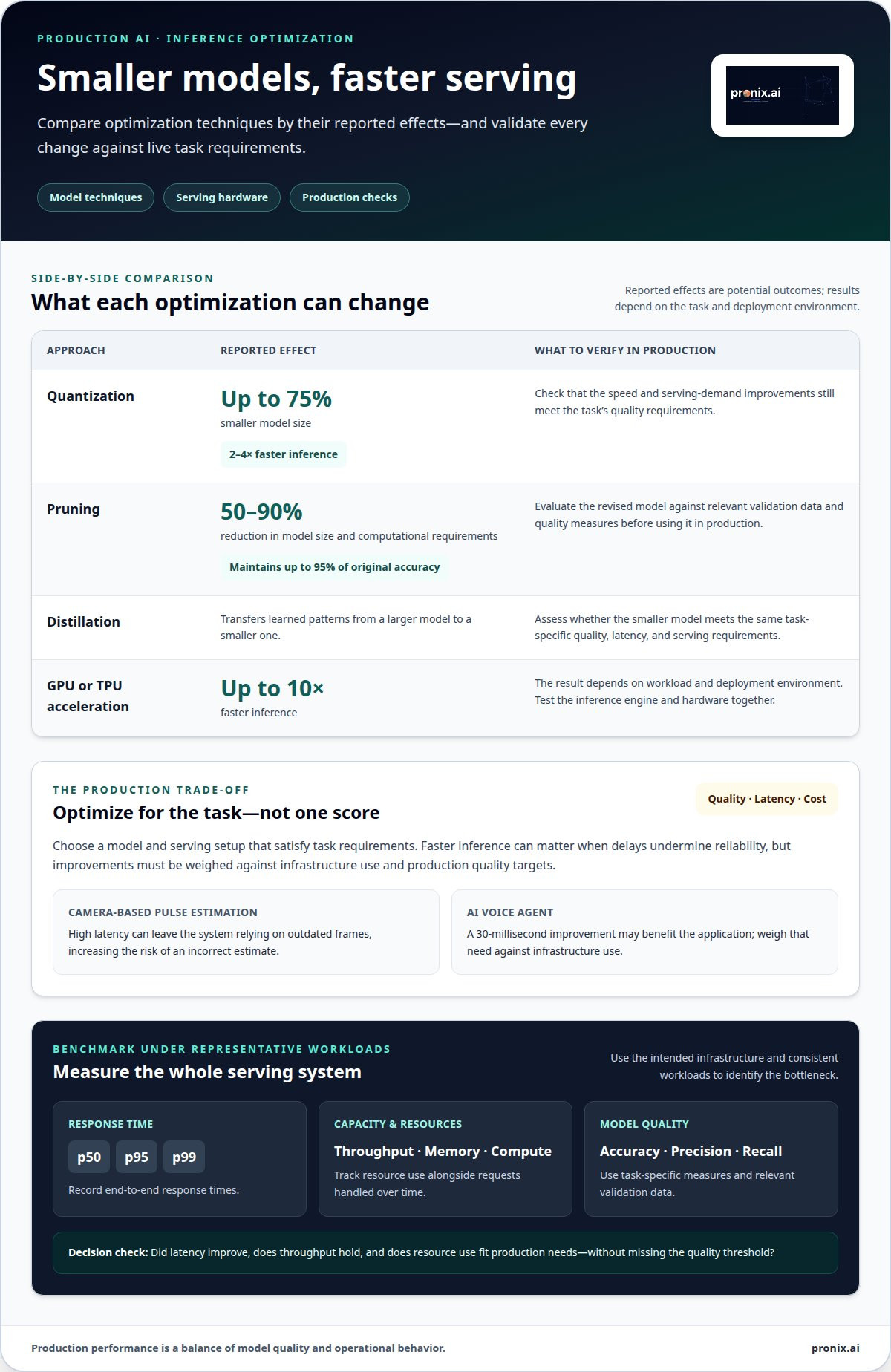
Benchmarking measures model size, latency, throughput, and resource use under representative workloads. It matters because deployment hardware and traffic shape performance. Professionals test the model on its intended infrastructure, then record end-to-end p50, p95, and p99 response times. They also track memory and compute use alongside requests handled over time. Comparing results under consistent workloads helps identify whether the model or serving setup limits performance.
Balancing Accuracy, Latency, and Cost
Balancing accuracy, latency, and cost means choosing a model and serving setup that meet task requirements. This matters in real-time applications, where delays can undermine reliability. In camera-based pulse estimation, high latency can leave the system relying on outdated frames, raising the risk of an incorrect estimate. An AI voice agent may also benefit from a 30-millisecond improvement. Professionals weigh those needs against infrastructure use and set production targets for quality, throughput, and cost.
Reducing Inference Latency and Serving Costs
Inference optimization applies model and serving techniques to reduce computation or improve execution efficiency. Quantization can reduce model size by up to 75% and speed inference by 2-4x. Pruning can reduce model size and computational requirements by 50-90%, while maintaining up to 95% of original accuracy. Distillation transfers learned patterns from a larger model to a smaller one. These techniques can lower serving demands, but each change needs evaluation against the task’s quality requirements.
Professionals also assess the inference engine and hardware together. GPU or TPU acceleration can improve inference speed by up to 10x. The result depends on workload and deployment environment. A disciplined approach to optimizing AI model performance post-deployment tests whether latency improves, throughput holds, and resource use fits production needs.
How Do Professionals Measure AI Model Performance?
Effective monitoring combines production infrastructure signals with model-quality evaluation. This helps teams spot operational failures and declining performance before they undermine outcomes.
Monitoring Model Quality and Production Inference
Production monitoring checks whether inference is operational and produces useful results. A healthy service can still return lower-quality predictions, so a monitoring framework should connect model outputs with infrastructure signals such as latency, memory, resource use, and service errors. Teams also assess predictions against validation datasets and task-specific measures such as accuracy, precision, and recall. Together, these views help distinguish a serving issue from a quality issue.
Tracking Model Drift Across Training and Serving
Drift monitoring compares the data and outcomes seen during training with those observed in production. This matters because production data, user behavior, and operating environments can change over time. Teams examine shifts in incoming data and review model results against relevant validation datasets. If performance moves beyond intended thresholds, they investigate the cause and decide whether a model update or retraining is appropriate. This connects training decisions to live behavior.
Evaluating Changes with A/B Tests and Shadow Deployments
A/B testing compares a candidate model with the current model under live conditions. Shadow deployment runs the candidate alongside production without using its outputs to make live decisions. Both methods help assess whether a change improves model quality and operational behavior before wider adoption. Define comparison criteria first, then examine outcomes and inference performance. This gives decision-makers evidence to determine whether a candidate is ready to serve users.
Using Feedback and Error Analysis
Feedback and error analysis turn production outcomes into specific model improvements. Aggregate metrics can conceal recurring failures in particular inputs or user scenarios. Review incorrect predictions, group related errors, and trace patterns to data, model behavior, or serving conditions. Use the findings to guide updates, then evaluate the revised model against validation data. This links user experience to model-quality decisions.
Common production optimisation failures
Production optimization often fails when teams tune a model before fixing its operating environment. Twenty-eight percent of organizations report that their machine-learning infrastructure doesn’t meet newer algorithms’ technical requirements. A model may perform well in testing yet struggle on production hardware, resulting in slower inference, unstable serving, or resource limits that undermine expected performance. Optimization must account for the entire production system, not just model code.
Weak MLOps foundations create another failure pattern: teams add models before stabilizing existing ones. When separate pipelines handle similar workloads, teams may struggle to compare outcomes and maintain consistent monitoring. Addressing gaps in production models first creates a clearer basis for future learning. It also helps engineering teams identify which workflows need better data, infrastructure, or ownership before expanding deployment.
A mismatch between metrics and the task can make an apparent improvement harmful. For example, a fraud detection model may achieve higher accuracy while missing more fraudulent transactions. Choose relevant measures, such as precision and recall, in line with the costs of false positives and missed cases. A threshold that works for one transaction pattern may fail on another. Reviewing errors by category helps expose these trade-offs before accepting a model change.
Poor data quality and drift can also erode results after launch. If incoming records change format or omit important fields, predictions may become less reliable even when the model remains unchanged. Trace failures to data pipelines, feature transformations, or changing inputs. Then correct the relevant source and assess whether retraining or a model update addresses the cause. Without this diagnosis, repeated tuning may treat only the symptoms.
Teams can also optimize the wrong layer. A latency problem may stem from serving architecture, memory pressure, or unsuitable hardware, rather than model complexity. Isolate each stage, from incoming data through inference and output delivery. Compare production behavior with the intended workload, then prioritize the constraint limiting results. This helps avoid costly changes that improve one metric while leaving the underlying failure untouched.
Defining measurable model performance objectives
A measurable objective turns business expectations into testable production criteria. It specifies the task, acceptable quality, operating conditions, and evaluation method. For example, an objective can require 95% accuracy for online predictions. That threshold gives teams a clear basis for evaluating learning models against actual outcomes, rather than treating deployment as proof of success.
Set thresholds to match the decision the model supports. A classification system designed to find every relevant case may need to emphasize recall; one designed to limit false alerts may prioritize precision. Define which errors matter, then select metrics that reveal them. This reduces the risk of improving an overall score while worsening the outcome users or operations depend on.
Objectives also need a defined workload. A performance target evaluated under light demand may not hold during peak traffic. One example objective describes a peak of 100 billion transactions. That scale makes workload assumptions part of the objective, not a footnote. Professionals align evaluation data and serving conditions with the production machine, so results reflect how the system must operate.
Quality targets work best alongside operational criteria. Specify response expectations, throughput needs, and resource constraints, then assess them together. A model that meets its accuracy threshold but consumes excessive compute may not be viable. Faster inference also has limited value if it reduces quality beyond an acceptable level. Clear trade-offs help teams make decisions and explain why a change is approved.
Objectives must account for changing data and business needs. Record the baseline, evaluation method, and conditions used for each assessment. Compare production results with that baseline and review whether thresholds still support the intended decision. When performance shifts, the objective helps determine whether the cause calls for a model update, an infrastructure change, or a revised evaluation.
For enterprise teams translating targets into production-ready systems, discuss AI implementation with pronix.ai.
Pronix.ai
pronix.ai helps enterprise teams translate performance objectives into production-ready AI systems. Turn to the team when a deployed model needs clearer evaluation criteria, stronger data foundations, or coordinated optimization across models and workflows. Its work spans AI strategy, implementation, automation, and customer experience modernization, connecting technical decisions with operational requirements. That can help teams address performance within the broader system, rather than treating model metrics in isolation. The right next step is to define the business outcome, current production constraint, and measures that will demonstrate progress. Contact pronix.ai to discuss your AI performance objectives.
Build a durable path from measurement to action
Production performance is an ongoing operational concern, not a one-time release decision. A disciplined approach to optimizing AI model performance post-deployment connects technical changes to business outcomes and gives teams a basis for continued improvement. The next step is to align model priorities with the workflows, customer needs, and operating constraints the system must support.
pronix.ai helps enterprises advance that work through Agentic AI Implementation, AI-Driven CX Modernization, and AI Business Automation. These offerings can support teams applying AI across workflows and customer experiences while keeping performance objectives connected to implementation needs.
Bring your production goals and current constraints into a focused discussion. Contact pronix.ai to discuss AI performance and identify a practical next step. With clear priorities and an evidence-led approach, your team can move forward with greater confidence.