A major risk for an AI team is treating model research and production engineering as the same job. Data scientists focus on statistical analysis, experimentation, and model development; machine learning engineers focus on training, serving, and optimizing models for reliable production use. Clear roles and responsibilities in an AI team connect these strengths to a defined business outcome.
That distinction matters, but it is only part of the operating model. AI work also depends on usable data, application design, evaluation, domain expertise, and clear ownership of risk. When responsibilities overlap without clear accountability, teams can struggle to turn a promising model into a dependable product.
This guide explains how core AI roles differ, what product managers contribute throughout the AI lifecycle, and how team structure changes with the initiative. It shows how technical delivery, business decisions, and governance fit together, helping you identify the capabilities your team needs and where ownership should sit.
Key Takeaways
- Separate model development from production engineering so each specialist can focus on the work they do best.
- Use product management to connect AI requirements, business outcomes, and lifecycle decisions.
- Shape the team around the initiative’s architecture, delivery needs, and governance responsibilities rather than a fixed staffing formula.
- Make ownership clear across data, application development, technical design, evaluation, and business expertise.
Table of Contents
What is the difference between an ML Engineer and a Data Scientist?
A data scientist turns data into evidence for a business decision. The work includes collecting, cleaning, and preprocessing data, then selecting features, developing models, and evaluating performance. Statistical analysis helps determine whether the results support the intended use. For example, an e-commerce data scientist might test recommendation approaches against shopper behavior and refine the model based on the results.
A machine learning engineer focuses on making models work reliably in real applications. That includes building training and serving pipelines, optimizing performance, and integrating models into production systems. At a ride-sharing company, an ML engineer might develop demand forecasts to help allocate drivers. Data scientists emphasize statistical methods and experimentation; ML engineers emphasize deployment, scale, and operational performance.
Related job titles reflect different scopes. Data science applies statistical and mathematical methods to derive insights and build predictive or prescriptive models. Machine learning is a set of methods for training systems on data. AI is broader, covering systems that perform tasks associated with intelligent behavior. An AI or LLM engineer builds model-powered features, including integrations, retrieval-augmented generation (RAG), and agents. An MLOps engineer manages deployment and lifecycle controls for recurring model operations.
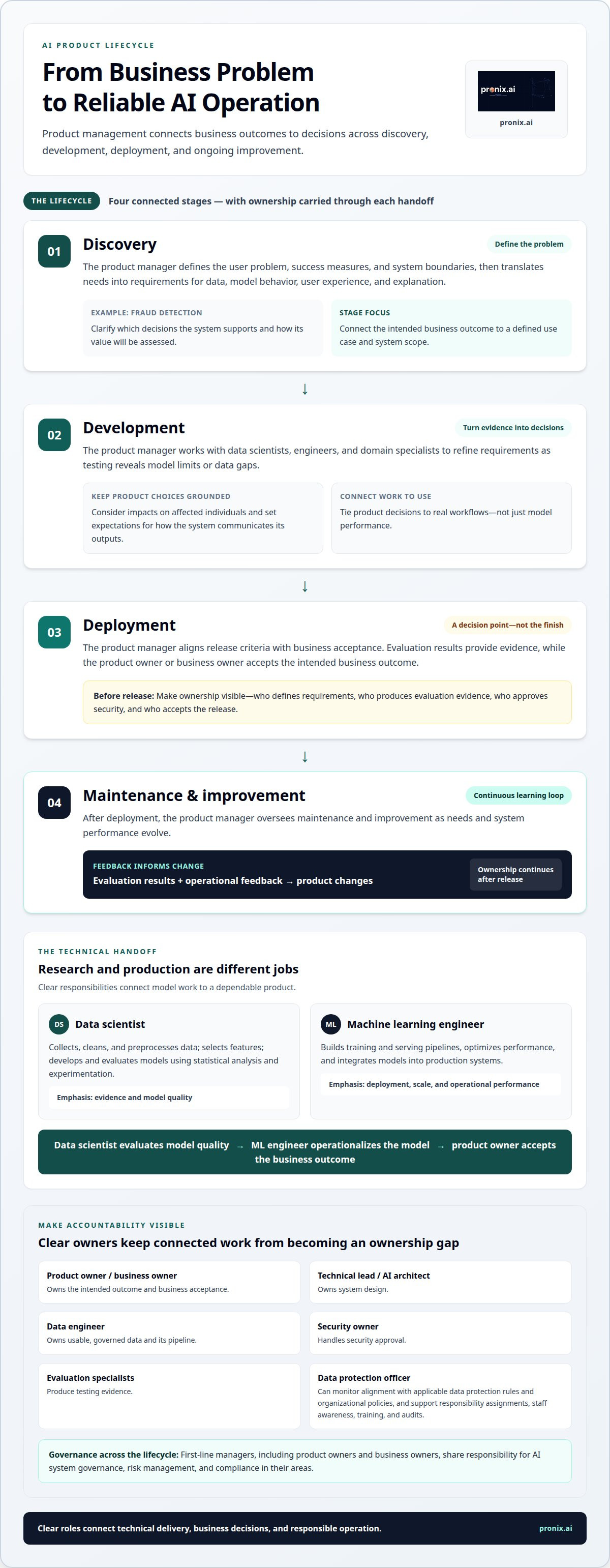
Defining roles and responsibilities in an AI team connects technical work to business decisions. The product owner or business owner owns the intended outcome and business acceptance. A technical lead or AI architect owns system design; the data engineer owns usable, governed data and its pipeline. A security owner handles security approval, while evaluation specialists produce testing evidence.
Compliance and privacy responsibilities also need clear ownership. A data protection officer can monitor alignment with applicable data protection rules and organizational policies, while supporting responsibility assignments, staff awareness, training, and audits. This oversight works alongside the owners accountable for product, technical, data, and security decisions.
Mapping roles and responsibilities in an AI team across handoffs makes gaps visible. The data scientist evaluates model quality, the ML engineer operationalizes the model, and the product owner accepts the business outcome. Clear ownership also helps the team manage changes to data, models, or workflows after release.
Product manager responsibilities across the AI lifecycle
An AI product manager connects the intended business outcome to decisions throughout an AI system’s lifecycle. At discovery, they define the user problem, success measures, and system boundaries. For a financial institution considering fraud detection, that means clarifying which decisions the system supports and how its value will be assessed. The product manager translates those needs into requirements for data, model behavior, user experience, and explanation.
During development, the product manager connects business priorities with technical evidence. They work with data scientists, engineers, and domain specialists to refine requirements as testing reveals model limits or data gaps. They also consider potential impacts on affected individuals and set expectations for how the system communicates its outputs. These choices keep product decisions tied to real workflows, not just model performance.
Deployment is a decision point, not the end of product ownership. The product manager aligns release criteria with business acceptance, then oversees maintenance and improvement as needs and system performance evolve. Evaluation results and operational feedback inform changes through a continuous learning loop. First-line managers, including product owners and business owners, share responsibility for AI system governance, risk management, and compliance in their areas.
Project and technical program management provide distinct delivery controls. A project manager oversees scope, goals, resources, budgets, risks, day-to-day progress, and communication with stakeholders and vendors. A technical program manager coordinates software development teams building AI capabilities; technical knowledge can strengthen collaboration with engineers. Senior technical specialists assess architecture, feasibility, and deployment constraints, while the product manager remains accountable for business outcomes.
Strong product management requires prioritization, clear communication, and enough technical fluency to translate trade-offs without replacing specialist judgment. It also means making ownership visible: who defines requirements, who produces evaluation evidence, who approves security, and who accepts the release. For organizations that need ongoing operational support after deployment, Enterprise AI Managed Services can support the work of managing AI systems through their operational lifecycle.
What Is an AI Product Team Structure?
An AI product team structure assigns the capabilities and decision rights needed to move an AI feature from concept into operation. Its design should reflect the organization’s workflows, system architecture, and implementation demands.
AI Development Team Functions
AI development functions bring together the work needed to design, build, integrate, and operate an AI feature. A product owner connects the use case to business priorities, while data and technical specialists build the supporting capabilities. For example, a customer-service feature may need workflow expertise, data access, model integration, application engineering, and evaluation.
This structure matters because an AI system depends on connected work, not model development alone. A data engineer prepares reliable infrastructure; application engineers connect the feature to existing systems; and domain practitioners test whether it fits real workflows. Mapping these functions early helps an organization identify capability gaps before implementation begins.
Responsibility Coverage by Development Stage
Responsibility coverage means assigning accountable owners to decisions from use-case selection through ongoing operation. During discovery, business and mission practitioners define the problem; during design and development, technical specialists shape the system and assess its evidence. Before release, security approval and business acceptance need distinct owners.
After deployment, engineering leads oversee production operations, while product and business owners monitor whether the system continues to serve its intended purpose. This stage-based structure makes handoffs visible. For an AI feature connected to an existing workflow, teams can identify who owns integration, evaluation, release, and responses to operational issues.
Redesigning work also means reviewing how tasks change as AI enters a workflow. For example, an analyst using AI to answer routine operational questions may spend more time interpreting results and resolving exceptions. The organization should connect new responsibilities to role expectations, training, and career development rather than treat automation as a standalone technical change.
Career paths can evolve alongside team needs. AI practitioners may move into management, and technical program management can be a natural transition for people with data engineering or data science experience. This path draws on technical context while adding coordination across teams, delivery milestones, and stakeholders.
Team composition should follow the product architecture and its delivery bottlenecks, not a fixed staffing template. An AI agent that acts on business systems needs defined permission and approval boundaries; a predictive feature may place greater emphasis on data pipelines and model operations. Matching specialists to those needs helps the team cover implementation and ongoing work without assuming every organization needs the same structure.
Core AI product team roles and responsibilities
A production AI product needs accountable owners for the business outcome, system design, data, application, evaluation, and operations. The exact team depends on the feature, but each responsibility must connect to a decision-maker and a delivery task.
- Product owner: Defines the user problem, intended outcome, and acceptance criteria. For a support assistant, this includes deciding which customer requests it should handle.
- Technical lead or AI architect: Designs the system and its integrations. This role decides how models, application components, and existing platforms fit together.
- Data engineer: Builds and maintains data infrastructure, pipelines, and quality controls. The team depends on this role for usable, governed data.
- Data scientist: Develops and evaluates models when statistical analysis or experimentation is central to the use case.
- ML or AI engineer: Trains, integrates, and optimizes models for production. For an AI assistant, an AI engineer may handle model integrations, retrieval-augmented generation, or agent behavior.
- Application engineer: Builds the backend or user-facing application that connects the AI capability to a workflow.
- UX or product designer: Designs how people interact with the feature, including how outputs and next steps appear.
- QA and AI evaluation engineer: Produces testing evidence by assessing outputs against defined acceptance criteria.
- Domain expert and business analyst: Validate that the system fits operational needs and that the problem, business context, and data are understood.
- Security owner and operations lead: The security owner provides security approval; the engineering lead owns production operations, with platform support.
Governance is part of delivery, not an afterthought. First-line owners who develop or deploy AI systems also manage associated risks. Keep evaluation evidence distinct from security approval and business release acceptance. That separation clarifies accountability when a model changes or a feature affects a live workflow.
To define ownership and delivery responsibilities for an AI solution, plan your AI implementation.
Pronix.ai
pronix.ai helps enterprises turn AI plans into secure, scalable production outcomes. When unclear role boundaries, technical ownership, or data foundations slow implementation, its strategy, implementation, and managed services can align the work with business needs. Relevant capabilities include Agentic AI Implementation, AI-Driven CX Modernization, AI Business Automation, and Data & AI Foundations.
Bring team structure into the conversation when an AI initiative needs to move beyond a pilot, coordinate technical and business responsibilities, or prepare a solution for production. The right focus depends on the use case, existing systems, and delivery needs.
Contact pronix.ai to discuss your AI team and implementation needs.
Make AI team design an operating discipline
A clear operating model for the roles and responsibilities in an AI team should evolve with the work. As use cases move into production, new integrations, workflows, and operational demands can shift where ownership needs to sit. Treat team design as an ongoing management decision, not a one-time staffing exercise.
For organizations moving from AI plans to implementation, pronix.ai offers Agentic AI Implementation, AI-Driven CX Modernization, and AI Business Automation. These capabilities connect team structure to the practical work of building and operating AI solutions.
Bring your priorities and delivery challenges into the next discussion. Contact pronix.ai about your AI team to explore a suitable path forward.