

An enterprise AI center of excellence is a dedicated organizational unit that brings AI expertise, resources, standards, and oversight together to support responsible adoption across the business. If you’re asking what an enterprise AI center of excellence does, its core role is to align AI work with business goals while establishing the practices teams need to develop, deploy, and manage AI consistently.
That structure matters when teams build AI independently, duplicate work, or apply inconsistent practices to data, security, and governance. A CoE coordinates expertise across functions, evaluates use cases, sets shared guidelines, and helps teams move promising initiatives toward production.
The right operating model depends on how your organization works and how widely AI capabilities are distributed. This article explains the CoE’s purpose and role, outlines its responsibilities and expertise, and compares centralized, federated, and hub-and-spoke structures to clarify the trade-offs.
Key Takeaways
- An AI Center of Excellence coordinates expertise, standards, and oversight so teams can develop and manage AI more consistently.
- Governance is practical: track policy adherence, define when people can override AI decisions, and monitor the organization’s governance posture.
- Centralized, federated, and hub-and-spoke models distribute decision-making differently; the right structure depends on how the organization needs to balance shared standards with local ownership.
- When AI initiatives need implementation or ongoing operational support, enterprise AI managed services can help move them into managed practice.
Table of Contents
What Is an AI Center of Excellence (CoE)?
An enterprise AI Center of Excellence is a dedicated unit that coordinates AI expertise, resources, standards, and oversight. It connects AI strategy to business goals and gives teams a consistent framework for responsible development and operations.
Its remit spans governance, technical foundations, and project workflows. The structure helps teams apply shared practices while keeping business outcomes in view.
Governance and Responsible AI
AI CoE governance defines how teams assess risk, secure systems, meet compliance requirements, and apply ethical standards. Clear controls make AI-supported decisions more accountable and easier to audit.
The CoE can establish responsible AI policies, data-quality rules, model lifecycle controls, and security standards. It can also create compliance checklists and review whether teams follow them. Measures might include policy adherence, governance posture, and human override rates. Clear override processes define when people can intervene in AI-supported decisions. Together, these controls support safer platform and infrastructure workflows.
Roles and Skills
An AI CoE brings together technical, operational, security, governance, and business expertise. That breadth matters because reliable AI depends on more than model development.
Typical roles include senior data scientists, machine learning engineers, AI governance experts, AI security specialists, and AI operations professionals. A dedicated leader drives initiatives and serves as the point of contact for implementing AI strategy. Staffing and costs depend on the team’s scope, existing capabilities, and platform and infrastructure needs. To prioritize projects, the CoE weighs business value, technical feasibility, and required resources. It can track ROI and progress through adoption, compliance levels, project cycle times, time saved, and operational outcomes.
Establishing an AI CoE
Establishing an AI CoE means defining its mandate, assigning accountability, and creating repeatable processes. A clear sequence matters because disconnected teams and inconsistent practices can increase inefficiency and costs.
Define the CoE’s mission, success measures, and governance model, then assign core roles. Assess existing tools, data, and AI skills before setting shared standards. Establish project-intake and agent-development workflows, alongside security and data-management practices. Involve business leaders and product managers in identifying use cases, then rank requests by value, feasibility, and resources. Common pitfalls include fragmented ownership, weak alignment with business goals, and governance that slows adoption. Monitor deployed models and services, measure outcomes, and refine processes as needs evolve.
Centralized, federated, and hub-and-spoke operating models
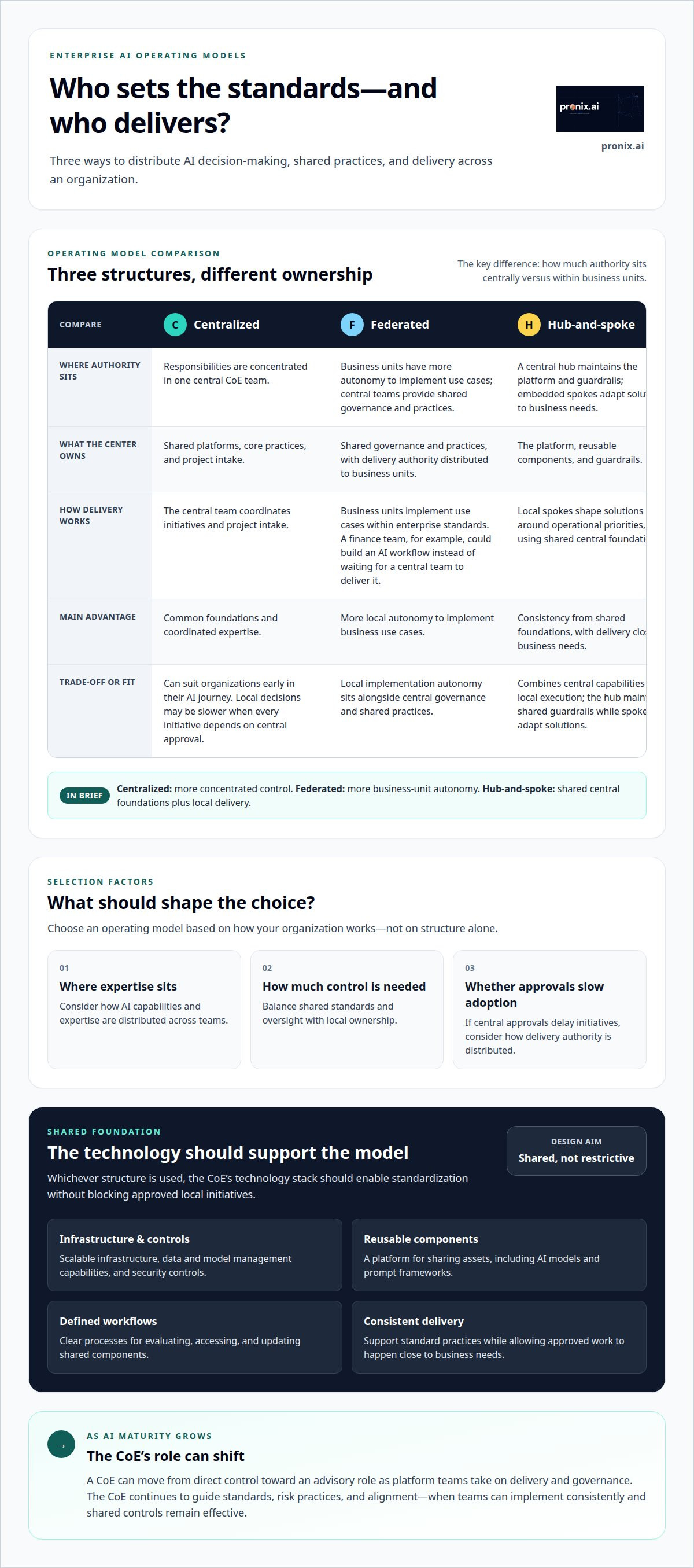
An AI CoE’s operating model determines who sets standards, owns infrastructure, and delivers initiatives. A centralized model concentrates these responsibilities in one team; federated and hub-and-spoke models distribute more delivery authority across business units.
In a centralized structure, the CoE manages shared platforms, core practices, and project intake. This can suit organizations early in their AI journey, where teams need common foundations and coordinated expertise. The trade-off is slower local decision-making when every initiative depends on central approval. A federated model gives business units more autonomy to implement use cases, while central teams provide shared governance and practices. For example, a finance team could build an AI workflow within enterprise standards instead of waiting for a central team to deliver it.
Hub-and-spoke combines these approaches: a central hub maintains the platform, reusable components, and guardrails, while embedded spokes adapt solutions to business needs. This can preserve consistency while keeping delivery close to operational priorities. A decentralized model gives individual teams greater control; a hybrid model combines central capabilities with local execution. Choose based on where expertise sits, how much control is needed, and whether centralized approvals are slowing adoption.
Technology needs follow the operating model. An enterprise CoE typically needs scalable infrastructure, data and model management capabilities, security controls, and a platform for sharing reusable assets. AI models and prompt frameworks can be managed as shared components, with defined workflows for evaluation, access, and updates. The technology stack should support standardization without blocking approved local initiatives.
As AI maturity grows, a CoE can shift from direct control to an advisory role. Platform teams can take on delivery and governance, while the CoE guides standards, risk practices, and alignment. This transition works when teams can implement consistently and shared controls remain effective. For organizations connecting AI workflows to business operations, AI business automation can be a practical next step.
AI Center of Excellence definition and organizational role
An AI Center of Excellence coordinates AI expertise, resources, processes, and standards. Its role is to connect leadership priorities with operational delivery. For example, it can translate a company-wide AI objective into shared criteria for assessing use cases, managing data, and supporting deployed models.
Organizational pressures often reveal the need for coordination. Independent data science teams may develop overlapping solutions, use inconsistent practices, or duplicate infrastructure. An initial assessment may identify 40-60 separate AI initiatives across an organization. Unexpectedly high infrastructure costs and inconsistent practices can also signal shadow AI, where teams adopt AI without coordinated oversight. These patterns make it harder to align investment, risk management, and business value.
Organizational placement affects whether the CoE can influence decisions. Executive sponsorship gives it budget, authority, and credibility. Some organizations establish it within technology or data leadership; others integrate AI expertise into an existing Cloud Center of Excellence. The practical test is whether the unit can work across business functions, engage decision-makers, and support teams building AI capabilities.
To define its remit, leadership should specify which decisions the CoE owns, advises on, or delegates. For example, it might set enterprise standards and review high-impact initiatives while business teams own local workflows. This division connects governance to delivery. The CoE can also assess current skills, identify gaps, and establish learning pathways through hands-on experimentation. That builds organizational capability alongside technical infrastructure.
A CoE is especially useful when AI work is expanding faster than shared practices, or when teams cannot trace ownership and outcomes. A clear mandate helps distinguish coordination problems from isolated project needs. Leadership can align the CoE’s authority, resources, and responsibilities with organizational priorities while preserving accountability within each operational team.
Definition and role of an enterprise AI center of excellence
An enterprise AI Center of Excellence turns disconnected AI experiments into an organizational capability. It connects executive priorities with delivery and helps sustain value after deployment. For example, an initiative should have an accountable business owner, a defined operational outcome, and a plan for ongoing performance monitoring.
A CoE’s success is reflected in repeatable outcomes, not simply the number of models launched. For example, a customer-support assistant might move from a controlled pilot into a maintained service, with adoption and answer quality tracked over time. A forecasting capability might be reused across business units, with teams adapting it to local decisions while retaining shared controls.
These examples describe operating patterns, not named-company case studies. The common thread is a continuous lifecycle: identify a business need, validate the approach, deploy it into real workflows, and monitor outcomes. If usage remains low or performance declines, the CoE helps teams diagnose causes and refine the solution instead of treating launch as the finish line.
Executive sponsorship gives this lifecycle authority, while business owners make adoption practical. A CoE can define reusable patterns for data access, evaluation, deployment, and support. Product and operations teams apply those patterns to specific processes. For instance, a claims team could evaluate whether AI-supported review improves workflow quality before expanding its use across additional claims operations.
The key measure is whether AI capabilities produce sustained business value under accountable ownership. A CoE should connect adoption, productivity, quality, operational performance, and trust to the use case’s goals. To strengthen the path from deployment to ongoing operation, develop an enterprise AI operating model.
Pronix.ai: Enterprise AI Managed Services
pronix.ai provides Enterprise AI Managed Services for organizations that need ongoing support for enterprise AI initiatives after defining their CoE structure. This can help internal teams sustain AI adoption and manage deployed solutions as business needs evolve.
For organizations moving from strategy into execution, Agentic AI Implementation and AI Business Automation support implementation and workflow automation. AI-Driven CX Modernization is relevant when the priority is improving customer experience through AI. The right focus depends on your organization’s goals, operating model, and existing AI capabilities.
Discuss your enterprise AI priorities with Contact pronix.ai.
Turn the CoE mandate into your next decision
Defining what an enterprise AI center of excellence is matters when the definition guides clear decisions. Give the CoE a mandate that identifies the outcomes it enables, where accountability sits, and how its role can evolve as AI becomes part of routine operations.
A practical next step is to select a business priority and agree on the evidence needed to justify expanding it. That evidence might include adoption, operational performance, or decision quality. Use the results to refine the CoE’s remit rather than letting its structure remain fixed as organizational needs change.
For support translating AI priorities into implementation and ongoing operations, discuss your enterprise AI needs with pronix.ai. A focused conversation can help clarify where to begin and what capabilities your organization needs next.
Set clear ownership, learn from operational evidence, and use successful practices to build momentum for the next initiative.