

AI readiness starts with evidence about data, not enthusiasm for a model. A data readiness assessment for AI determines whether data is available, reliable, governed, and fit for a defined use case. It examines quality, provenance, lineage, and suitability, making gaps and risks visible before an organization decides whether to proceed with an AI initiative.
Even a large dataset may be unreliable for a specific task if records are incomplete, their origin is unclear, or their meaning differs across systems. Data quality matters, but readiness also depends on whether teams can trace how data was collected and transformed, and whether it represents the problem the AI must address. This article explains what AI data readiness means and how an assessment evaluates these dimensions. It also outlines what findings can reveal about governance, risk, and the improvements needed to support an AI use case.
Key Takeaways
- Define the AI use case first so the assessment can identify which data characteristics matter most.
- Evaluate completeness, consistency, uniqueness, and encoding to uncover issues that can undermine model outputs.
- Trace data origins and transformations, then assess whether the information fits the intended task.
- Use assessment findings to prioritize governance and data improvements before moving toward implementation.
Table of Contents
What is AI data readiness?
AI data readiness means data is available, governed, and fit for a defined use case. Common gaps include unclear ownership, inconsistent formats, weak lineage, and access controls that either expose sensitive information or prevent legitimate use.
Data Governance and Stewardship
Data governance defines who may use data, for what purposes, and under which controls. Stewardship applies those rules to specific data assets. For an AI project, this clarifies responsibilities across business, IT, and data teams for definitions, quality standards, and approved uses. A steward can resolve conflicting definitions before a dataset feeds a model, supporting more reliable outputs.
Governance should connect each asset to its owner, description, permitted use, and source systems. Teams can then assess whether data access and infrastructure support the intended AI use case. Documented lineage adds traceability by recording where data came from and how it changed, helping teams reconstruct reported figures and investigate unexpected AI outcomes.
Governance Checks and Security Risks
Governance checks test whether data classification, masking, and access policies match the sensitivity and intended use of each asset. Classification identifies sensitive data; masking limits exposure in appropriate contexts; access policies define which roles can view or use the information. For example, a team assessing customer records can examine whether its controls distinguish restricted fields from data approved for model use.
Weak controls can create security and governance risks, including inappropriate access, unclear accountability, or use beyond an asset’s approved purpose. Under the EU AI Act, penalties can reach EUR 35 million, depending on the violation, according to the European Union. Under the EU AI Act, penalties can reach 7% of a company’s worldwide annual turnover, depending on the violation, according to the European Union. These figures relate to the EU Act; assess applicable requirements in the jurisdictions relevant to the system. Governance reviews should connect each policy to its owner, evidence, and enforcement process, then assess whether that control supports responsible AI success.
Data quality checks for completeness, uniqueness, and encoding
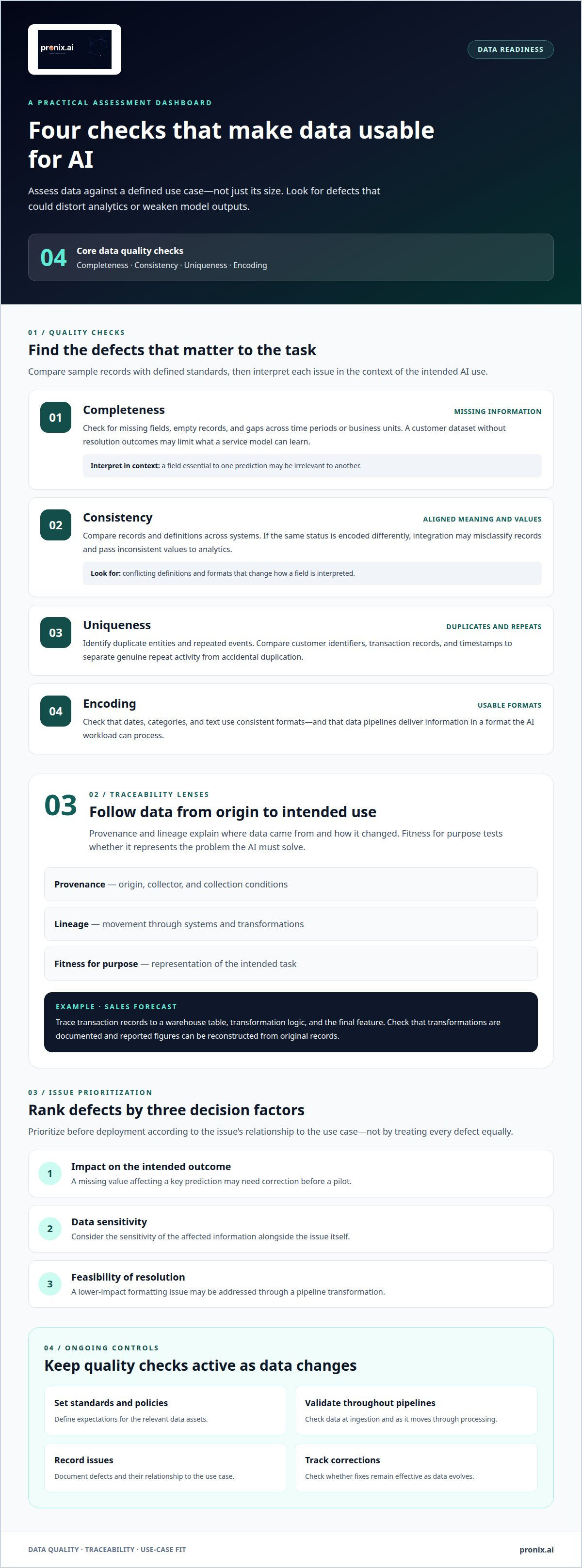
An assessment tests whether enterprise data is complete, consistent, and usable for the intended AI task. Professionals compare sample records with defined standards and document defects that could distort analytics or weaken model outputs.
Completeness checks identify missing fields, empty records, and gaps across time periods or business units. For example, a customer dataset may include contact histories but omit resolution outcomes, limiting the insights available to a service model. Quality teams assess missing data in context, since a field essential to one prediction may be irrelevant to another.
Uniqueness checks identify duplicate entities and repeated events. Professionals can compare customer identifiers, transaction records, and timestamps to distinguish genuine repeat activity from accidental duplication. Encoding checks look for consistent formats across dates, categories, and text. If two systems encode the same status differently, integration may misclassify records and feed analytics inconsistent values.
To assess access and infrastructure readiness, professionals map the data assets required for the use case to their source systems, permissions, and integration paths. They examine whether approved users can access relevant data, whether security controls remain effective, and whether pipelines deliver data in a format the AI workload can process.
To prioritize issues before deployment, professionals rank defects by their impact on the intended outcome, data sensitivity, and feasibility of resolution. Missing values affecting a key prediction may need correction before a pilot, while a low-impact formatting issue may be addressed through a pipeline transformation. This ties data quality decisions to business risk rather than treating every defect equally.
Quality management continues as data changes. Professionals establish standards and policies, validate data at ingestion and throughout pipelines, record issues, and track whether corrections remain effective. For an evolving enterprise, this lifecycle turns assessment findings into ongoing controls that support reliable AI and analytics.
Data provenance, lineage, and fitness for purpose
Provenance records where data originated, who collected it, and under what conditions. Lineage maps how it moves through systems and transformations. Together, they help professionals determine whether an AI system relies on accurate, explainable inputs. This traceability supports decisions about whether an organization is prepared to advance an AI initiative.
Professionals trace representative records from source to model input. For a sales forecast, they might connect transaction records to a warehouse table, transformation logic, and the final feature. They examine whether each transformation is documented and whether reported figures can be reconstructed from original records. This can expose broken links, undocumented changes, and conflicting definitions across systems.
Fitness for purpose asks whether data represents the problem the AI must solve. A support model trained on cases without resolution details may not learn which responses worked. For a demand forecast, professionals assess whether historical sales represent the products, channels, and conditions relevant to the intended prediction. Data can be accurate yet still unsuitable for the use case.
Freshness checks establish when data was created, updated, and made available to the AI workflow. Professionals compare timestamps with the use case’s decision cycle. A customer service assistant may need current account details, while historical trend analysis may use older records. Change detection then identifies shifts in fields, values, or source processes that could alter model inputs.
Assessment findings should connect each issue to its source, transformation, and affected AI use. Professionals can distinguish stale feeds from missing lineage or unsuitable data, then prioritize remediation. For example, a changed product category may require updated mapping before downstream analytics can use it. This evidence clarifies which assets are ready, which need corrective work, and how teams can monitor changes.
AI data readiness assessment
A professional assessment links a specific AI use case to evidence about data, pipelines, and governance. Its findings should identify readiness gaps and the work required before implementation.
Assessment Frameworks and Maturity Models
Frameworks organize readiness criteria, while maturity models describe how consistently an organization meets them. The Virginia Office of Data Governance and Analytics checklist covers governance frameworks and policies, data quality and management, and data security and privacy. The AI-Ready Data Framework defines 62 measurable requirements across five workload profiles, helping teams assess data against the needs of particular AI workloads.
Professionals select criteria based on the use case, risk tolerance, and data sources. They assess availability, volume, diversity, quality, governance, and responsible use, then record evidence and gaps. Some checklists also use yes-answer bands: 20-24 indicates solid foundations, while fewer than 10 signals fragile foundations. These scores guide prioritization, not a blanket claim of readiness.
Automated Assessment Tools
Automated assessment tools apply repeatable checks to datasets and pipelines, then surface issues for professional review. Teams can configure ingestion checks for missing values and anomalies, monitor data-quality changes, and gather evidence about recurring failures. Automation supports consistent evaluation across large data assets, but specialists still determine whether a defect matters for the intended AI outcome.
Assessment findings become an improvement plan when professionals connect each gap to business impact, risk, ownership, and remediation effort. A missing field that affects a key prediction may take priority over a minor issue in a secondary source. Teams can then implement controls, retest affected data, and monitor whether changes remain effective as sources and requirements evolve.
Use the findings to direct investment toward the gaps that limit safe, useful AI. Assess your AI data foundations before advancing deployment.
Pronix.ai: Data & AI Foundations
pronix.ai’s Data & AI Foundations offering is a natural next step when an assessment identifies gaps in data access, quality, governance, or integration. It helps enterprises strengthen the foundations needed to turn assessment findings into practical AI initiatives.
This work is relevant when teams have identified priority improvements but need to connect them to their data environment and business goals. As those foundations mature, they can support related work such as Agentic AI Implementation, AI-Driven CX Modernization, or AI Business Automation when those use cases fit.
Bring your assessment findings, target use case, and key data challenges into the discussion. Contact pronix.ai to discuss your data and AI foundations.
Turn readiness into your next AI decision
A readiness assessment creates value when its findings inform a clear decision: strengthen data foundations, proceed with a defined use case, or address a risk before scaling. Treat the results as a working input to planning, not a permanent label. As systems, business priorities, and data sources change, revisit the assumptions behind each AI initiative.
A focused data readiness assessment for AI connects technical evidence to business priorities and helps leaders determine where investment matters most. The next step is to assign ownership for improvements, align teams around the intended outcome, and choose an implementation path that fits the organization’s operational needs.
pronix.ai can support that path through Data & AI Foundations, Agentic AI Implementation, AI-Driven CX Modernization, and AI Business Automation. Discuss AI data readiness with pronix.ai and identify a practical next step for your organization.
With clear priorities and accountable execution, your AI program can move forward with greater discipline.
Frequently Asked Questions
What is a data readiness assessment for AI?
A data readiness assessment for AI tests whether the information behind a specific AI decision is usable and responsibly managed. For a fraud detection model, professionals might examine whether transaction records cover relevant fraud patterns and whether the intended team can use them appropriately. The assessment turns that evidence into a practical decision: proceed, narrow the use case, or resolve priority gaps first.
What dimensions should an AI data readiness assessment evaluate?
Assess whether data sources cover the use case, represent relevant populations or scenarios, and can be accessed through suitable infrastructure. Also consider governance, privacy, security, integrity, diversity, and responsible use. For a customer support assistant, professionals might assess whether available knowledge covers the questions customers ask and whether its content is approved for that purpose. The assessment criteria should reflect the model’s intended role and risk.
What steps do professionals take when conducting a data readiness assessment for AI?
Professionals begin by clarifying the business decision, intended users, and acceptable risks with the use-case owner. They then map relevant data sources, review representative samples, and assess governance and technical access. Next, they document evidence, rank gaps by their impact on the use case, and recommend remediation or a narrower scope. A final review with business, data, and IT stakeholders connects the findings to implementation decisions.
How do professionals measure data quality, completeness, and representativeness for AI?
Professionals compare records with agreed definitions, profile missing and invalid values, and examine whether examples represent the use case’s population and operating conditions. For a loan support model, they might compare application records across product types and decision periods, then investigate groups or situations with sparse examples. They document how sampling choices affect conclusions, because an apparently clean dataset may still omit important cases.
How do privacy, security, and regulatory requirements affect AI data readiness in the United States?
Professionals determine which data may be used, by whom, and under what safeguards. In the United States, applicable requirements can vary by industry, data type, and jurisdiction, so they map relevant obligations before a use case proceeds. For example, a health-related workflow may require stricter access and handling controls than a general internal knowledge search. Security and privacy requirements shape both data access and system design.