

Enterprise AI in financial services applies governed AI to business-critical work, including regulatory change summaries, compliance mapping, document analysis, customer support, and creditworthiness and risk assessment. The most practical generative AI use cases for financial services support research and decision-making while keeping consequential outcomes under human oversight. The aim is not merely to generate text, but to make complex workflows more consistent, traceable, and efficient.
Adoption takes more than choosing a model. Trusted data, secure integration, clear governance, and measurable workflow outcomes all shape whether AI can move from a pilot into daily operations. This article explains how financial institutions can summarize regulatory changes and map them to internal controls, support credit and risk analysis, and build a disciplined adoption path. It also shows how enterprise AI foundations and implementation connect promising use cases to operational requirements while maintaining compliance and accountability.
Key Takeaways
- Prioritize financial AI use cases that address real workflow friction, then measure their effect on productivity, decision support, and risk.
- Use AI to summarize regulatory changes and connect them to internal policies and controls, keeping outputs traceable for review.
- Apply AI to organize credit and risk signals, while reserving consequential decisions such as loan approvals for human oversight.
- Move beyond pilots with trusted data, secure workflow integration, clear governance, and defined measures of operational value.
Table of Contents
Why is generative AI in banking important?
Generative AI can turn unstructured documents and market signals into usable analysis. Traditional AI typically classifies data or applies predefined rules, while automation executes set workflows; generative systems can also draft summaries and responses.
Forecasting and Scenario Analysis
Forecasting uses historical and current information to estimate possible market or business outcomes. Scenario analysis explores how different conditions might affect them. A financial team can use AI to summarize market reports, compare assumptions, and draft scenario narratives for review. This helps leaders examine possible shifts in rates, portfolios, or client demand without mistaking generated analysis for a certain prediction.
Customer Service and Financial Advice
At a bank, generative AI can answer service questions using approved account and product information, then summarize account history and earlier interactions for an agent. Retrieval-augmented generation can ground tailored recommendations in current institutional data, supporting personalized financial guidance without making generated text a final decision. In insurance, AI can summarize applications and claims documents to support underwriting review and claims processing.
Financial AI Challenges and Market Expectations
Financial AI can improve workflows, but it also brings integration, data, and governance challenges. Legacy systems and fragmented data can complicate deployment. A sound framework connects each application to reliable information, appropriate controls, and a defined business outcome.
Marketing teams can use customer needs and preferences to shape personalized product recommendations, identify business opportunities, and refine campaigns. Risk teams can analyze account-holder behavior and other signals to assess credit and market risks, with analysts reviewing generated outputs before acting on them.
Regulatory change summaries and compliance mapping
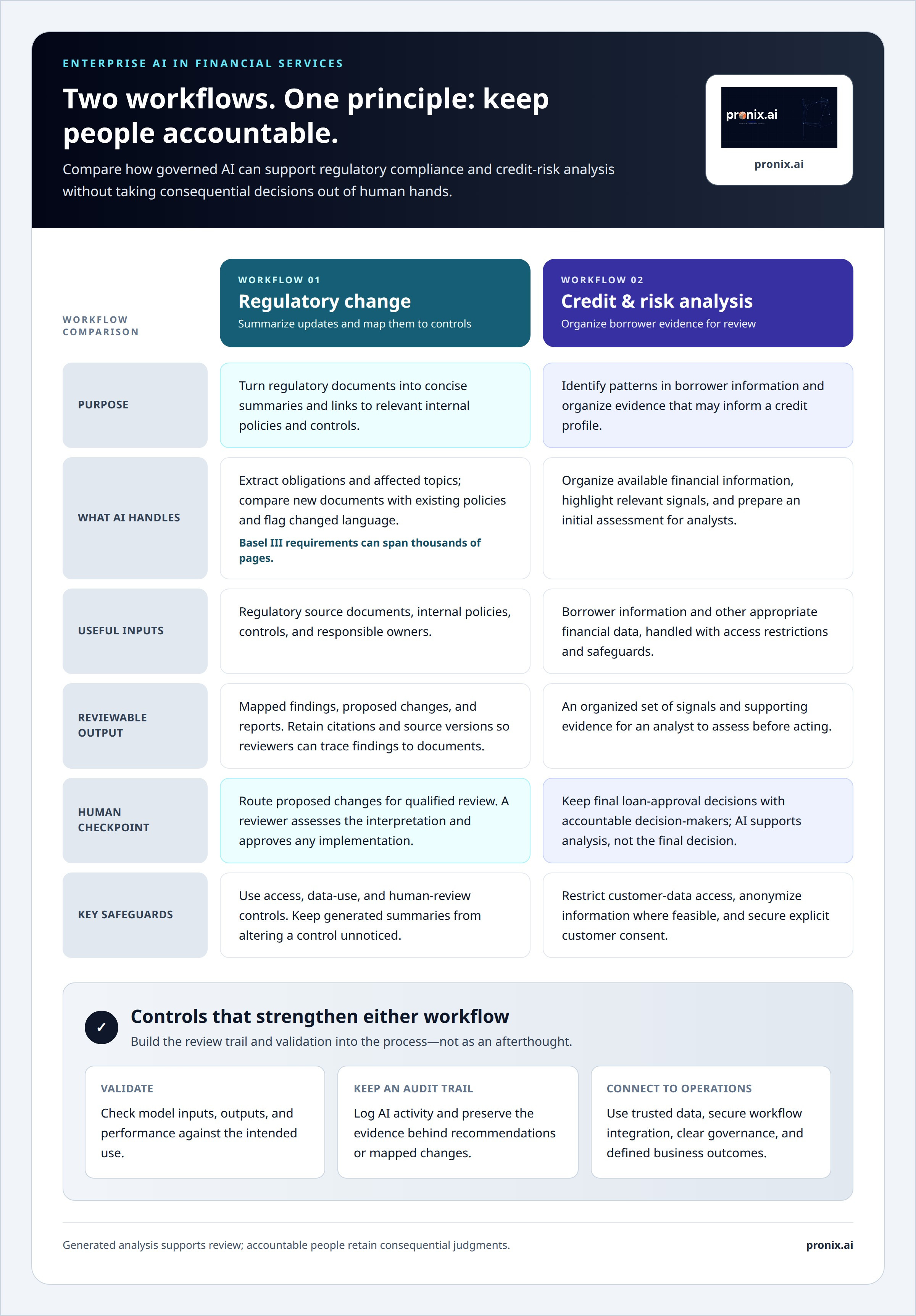
Generative AI can turn regulatory documents into concise summaries and links to relevant internal policies and controls. Banking teams can use this workflow to organize regulatory intelligence, then route proposed changes for review instead of treating generated analysis as approved guidance.
From regulatory updates to mapped controls
A practical process starts with a source document, extracts obligations and affected topics, then maps each finding to policies, controls, and owners. Basel III requirements can span thousands of pages, so structured summaries can help locate relevant passages and prepare reports. Retaining citations and source versions lets reviewers trace each mapped change back to its document.
When a change affects software or operational procedures, AI can draft a proposed code or process update and explain how it relates to the source. A qualified reviewer assesses the interpretation and approves any implementation. This separation can improve efficiency without allowing a generated summary to alter a control unnoticed.
Compliance, fraud, and responsible AI
Suspicious activity reporting can involve jurisdiction-specific requirements, so workflows should be reviewed for applicable reporting obligations. AI can organize transaction information, summarize relevant evidence, and prepare material for compliance review. It can also surface unusual activity for investigation, supporting fraud detection and anti-money laundering workflows without automatically making a report or determination.
Customer data also needs careful handling. GDPR and CCPA are privacy laws relevant to financial information. According to EUR-Lex, deployers should conduct a fundamental rights impact assessment before using certain high-risk AI systems in banking or insurance. Access, data-use, and human-review controls help make the resulting workflow more accountable.
Monitoring changes and competitors
Regulatory monitoring can compare new documents with existing policies, flag changed language, and route findings to responsible teams. Market and competitor monitoring can summarize public announcements, helping analysts distinguish business developments from regulatory obligations. Keep the outputs separate: a competitor’s announcement is intelligence, not evidence of a compliance requirement.
Financial institutions can use governed AI workflows to connect document analysis with review steps, access controls, and traceable outputs.
AI-based creditworthiness and risk assessment
Financial institutions can use AI to identify patterns in borrower information and support creditworthiness assessments. When deploying generative AI, they can protect customer data by restricting access, anonymizing information where feasible, and securing explicit customer consent.
Creditworthiness and Credit Risk Modeling
AI-based credit assessment analyzes available financial information for patterns that may inform a borrower’s credit profile. Models can help analysts organize evidence, highlight relevant signals, and prepare an initial assessment. For loan approvals, generative AI should support analysis, not make the final decision. This keeps consequential judgments with accountable decision-makers while making supporting information easier to review.
Before deploying a model, institutions should validate its inputs, outputs, and performance against the intended use. Reviewers can assess whether it uses appropriate data, produces consistent results, and records the evidence behind its recommendations. Logging AI activity creates an auditable trail for governance and compliance. Validation helps teams identify weaknesses before model outputs influence lending or risk decisions.
Emerging Risk Detection
AI can help institutions detect emerging risks by analyzing signals across transactions, account behavior, and other relevant data. A model, for example, may flag an unusual pattern for investigation, while generative AI summarizes the supporting information for a risk team. This can help analysts focus on developing concerns without treating an alert as proof of misconduct or loss.
Risk teams can use AI to support fraud detection and credit risk monitoring, then review flagged cases and document their decisions. To reduce shadow AI risk, institutions can provide approved tools, set clear usage policies, control data access, train employees, and monitor adoption. These governance measures help keep sensitive information within secure workflows and make automation more accountable. Model owners should track changes in data and outputs, then reassess whether the system remains suitable for its assigned task.
Generative AI adoption in financial services
Adoption means embedding AI in governed financial workflows, not simply launching a pilot. Before deployment, financial institutions should assess operational fit, data, security, integration, and measurable value.
Evaluating Generative AI Solutions
Evaluation tests whether a solution fits a defined business process and enterprise controls. Start with a workflow, such as analyst research or transaction document review, then assess data licensing, provenance, citations, metadata, API integration, security, and scalability. Include governance, validation support, cost control, and regulated-industry experience. These criteria help leaders assess operational readiness rather than rely on a polished demonstration.
Implementing Generative AI in Financial Firms
Implementation connects an approved use case to trusted data, existing operations, and accountable review. Financial institutions can start with a bounded task, such as summarizing internal documents, then evaluate outputs against source material and user needs. Integrate access controls and usage policies before expanding deployment. Track workflow quality, turnaround, adoption, repeat usage, and business impact to guide scaling decisions.
More than 80% of financial services organizations have adopted AI, but adoption alone doesn’t show whether it is embedded in daily work. Leaders need to distinguish experimentation from operational use by tracking who uses a system, which tasks it supports, and whether its outputs improve the workflow.
Choose an initial application with a clear owner and review path. A research team, for example, can test whether AI summaries help analysts find relevant information faster while checking each summary against source documents. Define escalation steps for unsupported outputs and gather user feedback before extending the workflow.
Plan a governed enterprise AI rollout around workflow readiness, integration, and ongoing operational oversight.
Pronix.ai: Enterprise AI Managed Services
Pronix helps financial institutions move enterprise AI from isolated pilots into secure, scalable production workflows. Its Enterprise AI Managed Services provide ongoing operational oversight, while Agentic AI Implementation and AI Business Automation support governed workflows and repeatable tasks.
For customer-facing priorities, AI-Driven CX Modernization can support more capable service experiences. These offerings fit when a use case has clear business value but needs stronger integration, governance, or a practical path into daily operations. The focus is disciplined implementation, with workflows designed around enterprise requirements rather than experimentation alone.
Contact pronix.ai to discuss how enterprise AI can support your financial services workflows.
Turn a Priority Into a Governed Next Step
The next step is to select a financial workflow where better information handling can make a practical difference. The strongest generative AI use cases for financial services start with a clear operational need, defined ownership, and criteria for evaluating performance. Leaders can then determine how the workflow should fit existing systems and where human review remains essential.
Moving from use case to production takes coordinated strategy, implementation, and ongoing management. pronix.ai offers Agentic AI Implementation, AI-Driven CX Modernization, and AI Business Automation to support enterprise initiatives across workflows and customer experiences. The right starting point depends on the process your organization is ready to improve and the governance it requires.
Discuss AI with pronix.ai and identify a practical next step for your financial services organization. Build with purpose, establish oversight early, and give promising ideas a disciplined path forward.