

The strongest first move with generative AI may be to reduce operational friction, not automate clinical judgment. Prioritize generative AI applications in healthcare administration where staff spend time coordinating schedules, tracking bed availability, reconciling supply information, or moving routine details into EHR workflows. Keep accountable staff in control of decisions that affect patient care.
That focus reflects a practical reality: scheduling, beds, supplies, and workforce capacity are connected. A change in one area can put pressure on another, so automating a single task may shift the workload instead of reducing it.
This article explains how to assess opportunities in scheduling, bed management, supply chains, EHR integration, administrative tasks, and workforce allocation. You’ll learn which workflows make sensible starting points, how generative AI can support them, and why human oversight and reliable data remain essential.
Key Takeaways
- Prioritize operational workflows where coordination delays affect patient flow, such as scheduling, bed management, and supply planning.
- Connect AI to EHR and scheduling workflows carefully so generated information supports accurate records and staff decisions.
- Start with repetitive administrative work, then assess how automation can improve staff capacity and workforce allocation.
- Use AI to support patient intake and communications while keeping people involved in sensitive or high-impact decisions.
Table of Contents
AI-based hospital scheduling, bed management, and supply chain optimization
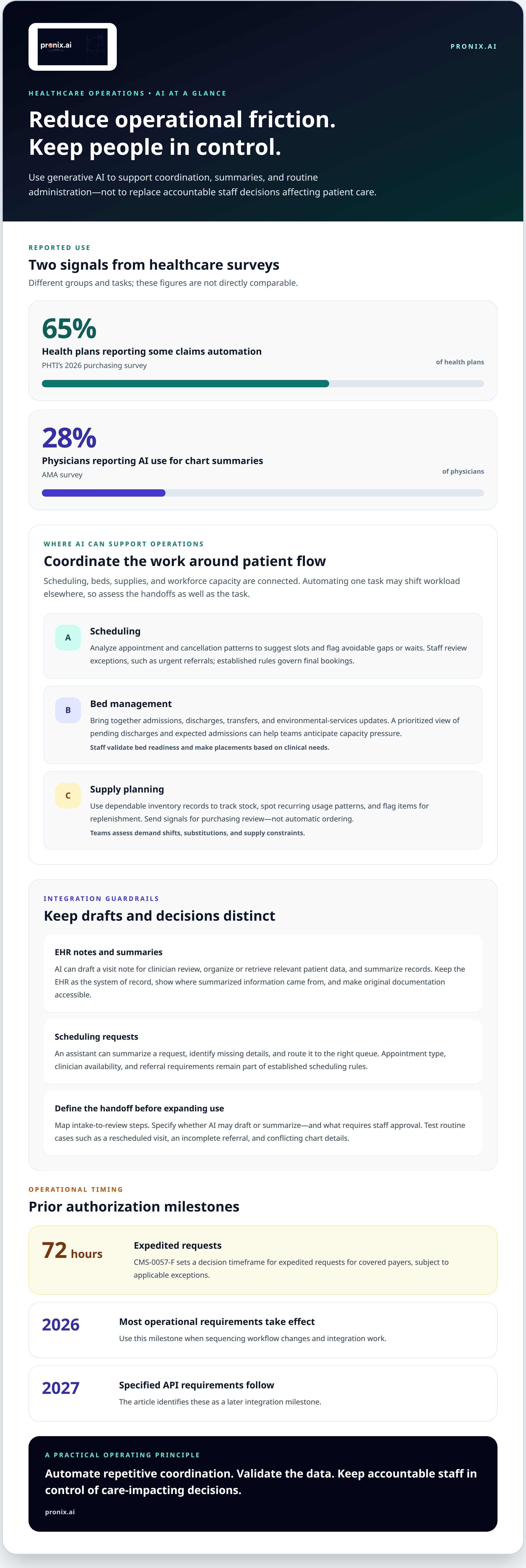
AI-driven scheduling can analyze appointment patterns and help reduce avoidable gaps, long waits, and patient-flow bottlenecks. A hospital could use historical booking and cancellation patterns to suggest appointment slots, with staff reviewing exceptions such as urgent referrals. Generative AI assistants can summarize schedule changes for teams, while established scheduling rules govern final bookings.
Bed management depends on timely updates about admissions, discharges, transfers, and environmental services. AI can bring these operational signals together to show current bed status and anticipate where demand may exceed capacity. For example, a bed coordinator could receive a prioritized list of pending discharges and expected admissions. Staff still validate readiness and make placement decisions based on clinical needs.
Supply chain optimization starts with dependable inventory records. AI tools can track stock levels, identify recurring usage patterns, and flag items that may need replenishment. A practical workflow sends inventory signals for purchasing review rather than letting a generated recommendation place an order automatically. Teams can then assess demand shifts, substitutions, and supply constraints before they affect care.
Diabetes management shows why prediction needs clear boundaries. A generative adversarial network predicted blood glucose levels 30 minutes ahead with an average root mean square error of 18.34 mg/dL. That example illustrates a forecasting capability, not a substitute for clinical judgment. Any use in care requires validation, appropriate oversight, and a defined role in patient outcomes.
Prior authorization can also affect scheduling and care coordination. According to the Centers for Medicare & Medicaid Services, the CMS Interoperability and Prior Authorization Final Rule (CMS-0057-F) sets a 72-hour decision timeframe for expedited requests for covered payers, subject to applicable exceptions. The Centers for Medicare & Medicaid Services states that most operational requirements took effect in 2026, while specified API requirements follow in 2027. These regulatory milestones can inform how organizations sequence workflow changes and integration work.
AI integration with EHRs and scheduling systems
Integrating artificial intelligence with an electronic health record (EHR) starts with a defined workflow, not a model. For example, a system could analyze a visit conversation and draft a note for clinician review. It can also organize, update, and retrieve patient data, helping staff find relevant records without replacing the EHR as the system of record. Clear boundaries specify what AI may summarize, where drafts appear, and who approves changes.
Scheduling integration should connect appointment requests to operational rules, including appointment type, clinician availability, and referral requirements. An AI assistant might summarize a patient’s request, identify missing details, and route it to the right scheduling queue. Staff can then book the appointment in the established system. This keeps language generation separate from decisions that affect appointment availability and clinical workflows.
- Map the handoffs: Document how a request moves from intake to the EHR, scheduling queue, and staff review.
- Define permitted actions: Separate drafting and summarizing from editing records, confirming appointments, or changing clinical information.
- Test routine cases: Include a rescheduled visit, an incomplete referral, and a chart with conflicting details.
In the AMA survey, 28% of physicians reported using AI for chart summaries. Summaries can help clinicians scan patient history, but the source record remains essential when details conflict. A useful integration displays where summarized information came from and keeps the original documentation accessible. The same principle applies to diagnostic content: AI can organize information, while qualified staff retain clinical responsibility for interpretation and action.
Multidisciplinary review helps align EHR integration, workflow design, and end-user education. Include clinicians, schedulers, IT, and operations staff when defining success measures, such as fewer manual handoffs or clearer queue ownership. For a structured approach to AI integration and workflow design, align the system’s capabilities with existing processes before expanding its role.
Administrative efficiency and workforce allocation
The leading generative AI tools for U.S. healthcare administration are workflow-specific assistants for claims, billing, documentation, and records. In PHTI’s 2026 purchasing survey, 65% of health plans reported some form of claims automation. That points to a practical distinction: assess tools by the task they support, their connection to existing systems, and the staff review they require, not by a broad “AI” label.
For U.S. organizations, workflows using patient information must account for HIPAA privacy and security safeguards. Access controls, encryption, and data anonymization can help reduce exposure; assess any other applicable federal or state requirements for the specific workflow. Training should explain what information staff may enter, how to review outputs, and where to escalate errors.
Costs and potential return on investment depend on the workflow, integration effort, oversight needs, and staff adoption. Establish a baseline, then compare measures such as time spent on billing tasks, correction rates, and administrative queue delays after implementation. Include training and ongoing review alongside operational savings. Reclaimed staff time matters only if it can be redirected to useful work.
Privacy, security, accuracy, and bias risks can arise when sensitive patient data enters an AI workflow or staff accept generated text without review. A billing assistant, for example, could misclassify an item, while uneven data patterns could lead to inconsistent results. A controlled rollout should test representative cases, document errors, restrict access, and require human review of low-confidence or consequential outputs.
- Prioritize: Start with repetitive, high-volume administrative work.
- Prepare staff: Train users on approved inputs, review, and escalation.
- Measure: Compare operational results with a baseline before expanding.
How are healthcare organizations using generative AI for scheduling, intake, and patient communications?
Healthcare organizations use AI chatbots and automated phone systems to handle routine patient inquiries around the clock. These tools can explain appointment preparation, collect a reason for a visit, and route requests to the appropriate team. For scheduling, an assistant can gather preferred times and appointment details, then pass them into an established booking workflow. Staff retain control of appointment confirmation and exceptions.
At intake, generative AI can turn a patient’s free-text description into a concise summary for staff. For example, it can organize a request about a medication renewal, a new symptom, or a referral and route it to the right administrative queue. The workflow should distinguish administrative routing from clinical triage. Urgent symptoms or unclear messages need a defined escalation path, not an automated response that could delay attention.
Patient communications are another practical use. In the AMA survey, 19% of physicians reported using AI to draft patient portal replies. A draft can help staff respond consistently to common questions about appointments or paperwork. Review remains important: staff should confirm that the response matches the patient’s record, answers the actual question, and does not imply clinical advice beyond the sender’s role.
- Scheduling: Collect appointment preferences and identify missing booking details.
- Intake: Summarize requests and route them to the correct administrative team.
- Communications: Draft portal replies for staff review before sending.
Track routing accuracy, unresolved requests, and the time staff spend correcting drafts to measure these workflows. A team could review recurring misroutes and refine intake categories before expanding automation. Clear escalation rules and assigned review ownership help keep service responsive and accountability visible.
To connect patient communications with operational workflows, modernize AI-driven patient experiences with a defined implementation and review model.
Pronix.ai
pronix.ai helps healthcare organizations turn AI priorities into governed, operational workflows. Engage the team when scheduling, patient communications, or administrative processes need a clear path from experimentation to implementation.
Its work connects strategy, data readiness, and workflow design, with execution through Agentic AI Implementation, AI Business Automation, or AI-Driven CX Modernization where those capabilities fit. Data & AI Foundations can address the data and integration needs that shape reliable outcomes. The right starting point depends on the workflow, existing systems, and oversight requirements.
For healthcare leaders, the next step is to identify the operational challenge, the people affected, and the decisions AI should support. Contact pronix.ai to discuss how generative AI could fit your administration priorities.
Turn AI priorities into an operating plan
The next decision is not how many AI use cases to launch, but how to create a repeatable way to select, govern, and improve them. Treat each workflow as an operational change: define the intended result, assign ownership, and establish how staff will review outputs and raise problems. This gives leaders a basis for expanding useful applications without treating automation as a substitute for accountability.
Generative AI applications in healthcare administration create value when they fit real processes and include clear human oversight. Moving from a promising pilot to reliable use depends on the organization’s workflows, data foundations, and implementation priorities. pronix.ai provides Agentic AI Implementation, AI-Driven CX Modernization, and AI Business Automation to support this work.
Discuss your AI plans with pronix.ai and identify a practical next step for your organization. With a defined priority and accountable team, you can move forward with greater focus.