

The more capable option isn’t always the better enterprise choice. In the enterprise chatbot vs intelligent virtual agent decision, the key distinction is how much context a system can use and what it can do: a rule-based chatbot follows defined paths, while an AI-powered virtual agent can handle more flexible, multi-step interactions.
Both can make service faster and more consistent. A chatbot can answer common questions, capture details, and route requests. A virtual agent can interpret intent, retain context, and support tasks involving several steps. The right fit depends on the work, the systems involved, and the level of control your organization needs.
This guide explains what chatbots and virtual agents do, how rule-based and AI-powered approaches differ, and which enterprise considerations shape the decision. It also shows how the options can work together, so you can match automation to the task instead of treating one as a universal replacement for the other.
Key Takeaways
- Match automation to the work: use defined conversational flows for predictable requests and more adaptive systems for tasks that require context or multiple steps.
- Assess how customer self-service and contact-center workflows can fit together, rather than treating automation as a replacement for every human interaction.
- Compare enterprise options by their context handling, workflow reach, system integration, and governance needs before selecting an approach.
- When moving from evaluation to deployment and ongoing operations, enterprise AI managed services can help connect implementation with long-term management.
Table of Contents
What is a virtual agent?
A virtual agent is software that uses natural language to understand a request and respond or take action. In enterprise customer service, it can answer questions, identify intent, retrieve relevant information, and complete tasks across connected workflows. Its capabilities depend on its design, data access, and approved actions.
A customer-support chatbot commonly handles FAQs, password resets, ticket creation, and basic troubleshooting. An AI-powered virtual agent can take a request further, for example, by gathering context before routing a service issue or helping an employee complete onboarding steps. In IT service management, virtual assistants can also support incident reporting, report generation, trend analysis, and anomaly detection.
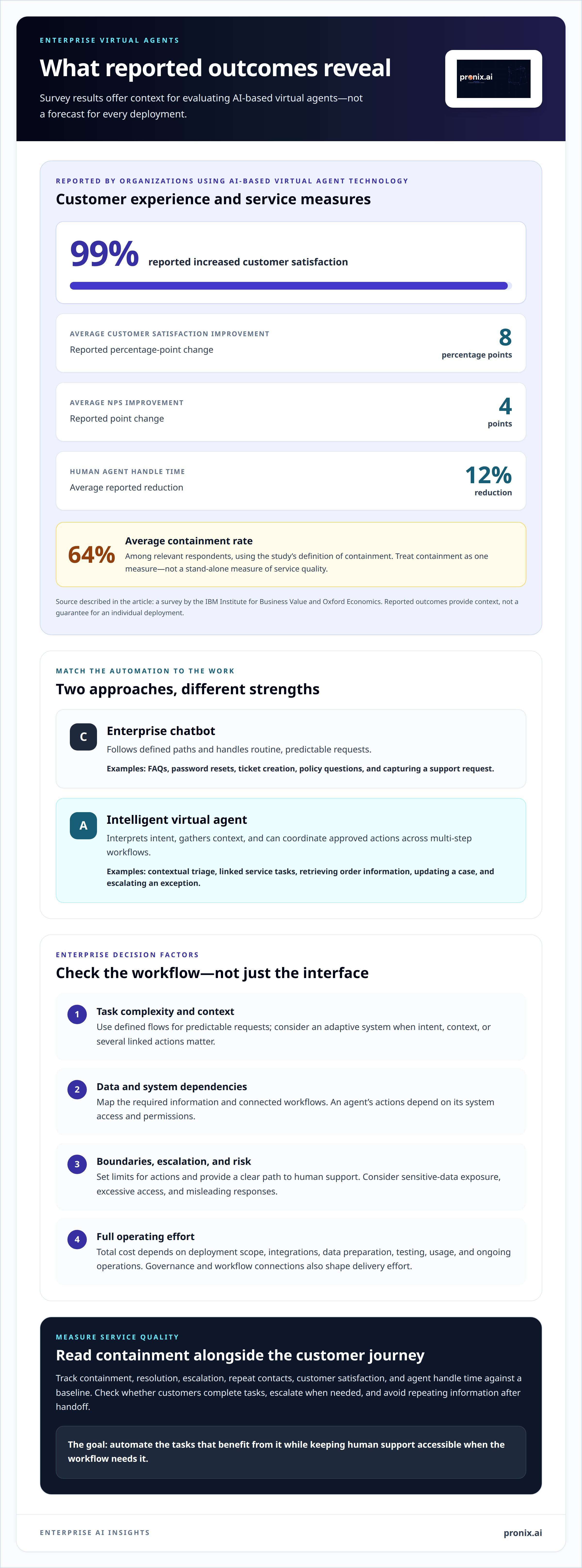
Which use cases suit an enterprise chatbot versus an IVA? A chatbot fits predictable, bounded tasks, such as answering policy questions or capturing a support request. An IVA suits interactions that need intent recognition, context gathering, or several linked actions, such as triaging an IT incident.
How should a company choose and implement one? Define the target task, map its data and system dependencies, then set boundaries for actions and escalation. Start with a workflow that has clear inputs and outcomes, and test responses against real request types before expanding.
What do they typically cost? Total cost depends on deployment scope, integrations, data preparation, testing, usage, and ongoing operations. Assess the full operating model, not just the conversational interface: workflow connections and governance also shape delivery effort.
What security, privacy, and compliance risks matter in the United States? Risks include exposing sensitive data, granting excessive system access, and generating misleading responses. The National Center for Biotechnology Information, U.S. National Library of Medicine, notes that security diagnostics can reveal vulnerabilities and privacy threats in commercial IVAs. The University of Michigan Law School identifies data access and deception among issues in legal disputes involving automated assistants.
| Option | Best-fit task | Typical capability |
|---|---|---|
| Enterprise chatbot | FAQs, password resets, ticket creation | Follows defined paths and answers routine requests |
| Intelligent virtual agent | Contextual triage, multi-step service tasks | Interprets intent and can coordinate approved actions |
Choose based on task complexity, required context, system access, and the consequences of an incorrect action.
What is the difference between AI agents and chatbots?
A chatbot typically responds to a prompt through a defined conversational flow. An AI agent can interpret intent, use context, and pursue a goal through multiple actions. In customer self-service, that difference shapes how well automation handles interactions that don’t follow a fixed script.
Consider a contact-center request about a delayed delivery. A chatbot can provide a status answer or route the customer to support. An AI agent may gather relevant details, retrieve order information, update a case, and escalate an exception. These capabilities depend on the agent’s system access and the actions it is permitted to take.
Contact-center automation should preserve a clear path to human support. Measure whether customers complete the task, how often they escalate, and whether they have to repeat information after handoff. These signals show where automation supports customer experience and where a workflow needs redesign.
Reported outcomes offer context, not a forecast for every deployment. In a survey by the IBM Institute for Business Value and Oxford Economics, 99% of organizations using AI-based virtual agent technology reported increased customer satisfaction. Respondents reported an average 8 percentage-point improvement in customer satisfaction, a 4-point improvement in NPS, and a 12% reduction in human agent handle time.
The study’s average containment rate was 64% among relevant respondents, using its definition of containment. Treat containment as one measure, not a stand-alone measure of service quality.
How do you measure performance and ROI? Track containment, resolution, escalation, repeat contacts, customer satisfaction, and agent handle time against a baseline. Compare measurable benefits with implementation and operating costs, then use interaction research to find workflows where automation improves outcomes without obstructing human support.
Rule-based chatbots versus AI-powered intelligent virtual assistants
Rule-based chatbots follow defined paths, while AI-powered assistants can interpret varied requests and retain context. The practical distinction is how each handles a conversation that moves beyond its expected script.
AI-Powered Intelligent Virtual Assistants
An AI-powered intelligent virtual assistant uses natural language processing to interpret requests and respond with relevant information. For example, an employee can ask an assistant to summarize a meeting or help schedule a calendar event. Unlike a rule-based chatbot, it can retain some context within a session or over time, supporting a more connected exchange. It still generally depends on the user to initiate an interaction.
That makes an assistant useful for tasks such as summarizing or research support, where requests vary but remain user-directed. An AI agent goes further when it can plan or take actions toward a goal. The distinction depends on the system’s actual workflow capabilities, not its label.
Converging Assistant and Agent Roles
Chatbots, assistants, and agents increasingly work together in modern AI tools. A customer conversation might begin with a chatbot answering a defined FAQ, shift to an assistant that uses context to clarify the request, then involve an agent coordinating an approved workflow. Each capability serves a different role in the same interaction.
These systems have distinct strengths and limits. A rule-based chatbot offers predictable responses to high-volume, repeatable questions, but needs manual updates for new scenarios. An assistant handles more flexible requests, such as summarizing a meeting, while still relying on user direction. An agent can plan and execute dynamic tasks, but needs appropriate data and clear boundaries.
To choose, map the work in sequence: identify whether the request is predictable, needs context, or requires action across a workflow. Use a chatbot for a defined response, an assistant for user-led support, and an agent when the task requires planning or coordinated action. Combining them can extend coverage without forcing every conversation through one interaction model.
Enterprise chatbot and virtual agent distinctions
At enterprise scale, the distinction goes beyond the conversational interface. Chatbots can use natural language processing while following defined paths. Intelligent virtual agents can interpret requests in context and connect that understanding to broader workflows.
Natural Language Understanding
Natural language understanding helps a system identify meaning and intent in a customer’s language. A rule-based chatbot may recognize a phrase and provide a predefined answer, such as directing a billing question to a help article. Its performance depends on how closely the request matches its configured paths.
An IVA can interpret more varied wording and use conversation context to respond. For example, it may distinguish a request to change an address from a question about an address update. That flexibility depends on data quality and the boundaries set for its responses.
Automation Capabilities
Automation turns a conversation into an operational task. A chatbot can collect fields for a support ticket or route a request using established rules. An IVA can use connected systems to gather relevant information and coordinate permitted steps, such as updating a case after identifying the customer’s intent.
The enterprise difference lies in workflow reach and control. A system connected to customer records or ticketing tools needs clear permissions, reliable data, and an escalation path for requests outside its scope. Broader automation can reduce manual handoffs, but it also makes testing actions and monitoring outcomes more important.
Compare systems by tracing one request from entry to resolution. Assess language understanding, data access, actions, and how each system responds when it cannot complete the task. This reveals whether a chatbot’s defined flow is sufficient or an IVA’s contextual automation better fits the workflow.
For a practical next step, map an enterprise AI workflow around its data connections, permitted actions, and escalation controls.
Pronix.ai: Enterprise AI Managed Services
pronix.ai helps enterprises move AI from evaluation into secure, scalable operations through Enterprise AI Managed Services. Turn to this service when a chatbot or virtual agent needs to connect with business workflows, operate reliably, and remain managed beyond initial deployment.
For a defined implementation, Agentic AI Implementation can help put agentic workflows into production. AI-Driven CX Modernization supports organizations improving customer-facing service, while AI Business Automation applies AI to operational workflows. The right path depends on the task, data, integrations, and operational needs.
Contact pronix.ai to discuss how enterprise AI managed services can support your chatbot or virtual agent goals.
Turn the Comparison Into an Enterprise Decision
The enterprise chatbot vs intelligent virtual agent decision is a starting point, not the end state. Identify a workflow where better service, faster resolution, or less manual handling would matter. Define the intended outcome, assign operational ownership, and establish how the system should respond when a request falls outside its scope.
Then connect that goal to the right implementation path. pronix.ai supports enterprises with Agentic AI Implementation, AI-Driven CX Modernization, and AI Business Automation. These services can help align conversational AI with customer experience and operational priorities, rather than adding automation without a clear purpose.
Start with the workflow that has the strongest business case and a manageable path to production. Contact pronix.ai to discuss your options, and take the next step toward an enterprise AI approach built around your goals.