
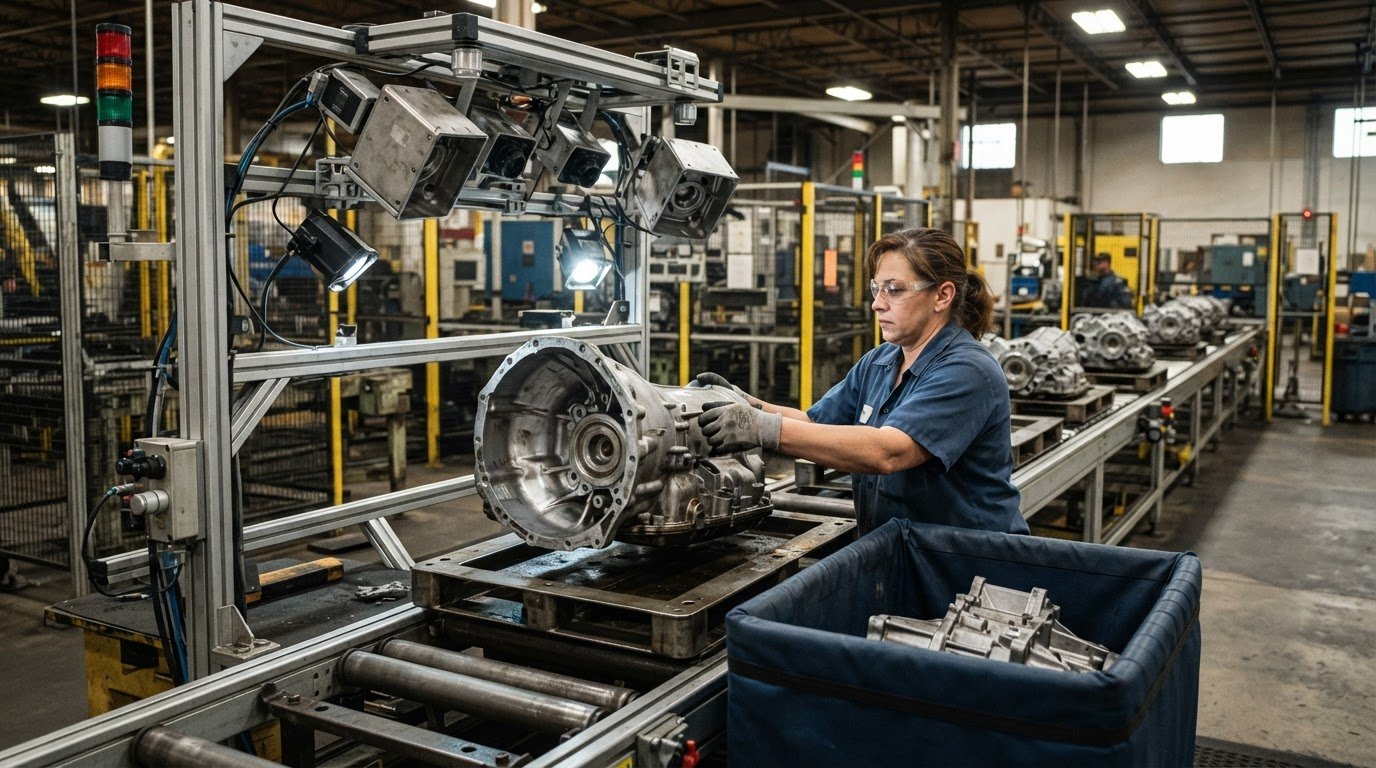
The cloud a manufacturer already uses does not have to dictate its AI platform. Enterprise AI for manufacturing workflows can span cloud providers and AI platforms, with architecture shaped by data, existing systems, governance, and the task at hand. The practical question is not simply which model to choose, but where AI can support production, maintenance, quality, and planning without adding operational friction.
Manufacturing environments rarely start from a clean slate. Teams need to connect operational data and enterprise applications while preserving oversight, security, and a clear path from pilot to production. Platform choice is only part of the decision: workflow fit and integration determine whether AI supports the work or creates another silo.
This article explains how enterprise AI works across providers and platforms, which manufacturing workflows may benefit, and what to consider when designing a production-ready approach. It clarifies how cloud infrastructure, AI services, and workflow orchestration fit together, helping leaders assess options against operational priorities rather than platform labels.
Key Takeaways
- Match AI applications to manufacturing workflows where they can support operational decisions and work processes.
- Identify the data, systems, and infrastructure needed to move from an AI concept toward production use.
- Plan integrations with MES, ERP, PLM, SCADA, and industrial IoT systems around how information flows across operations.
- Assess implementation costs and potential returns through project scope, operating requirements, and measurable business outcomes.
Manufacturing workflow applications
AI can support maintenance, inspection, production planning, and material flow when it connects to real operational decisions.
In the United States, manufacturers must account for applicable workplace-safety, environmental, privacy, and sector requirements. AI does not replace existing controls. Relevant obligations depend on the process, the data involved, and whether the system influences safety-critical actions.
To pilot and scale AI, select a defined workflow, establish a baseline, and test the system against that measure. Validate results with operators, then expand only when performance, integration, and oversight meet production needs.
Key risks include exposing sensitive production data, unreliable predictions, and recommendations that conflict with safe operating procedures. Limit access, monitor model outputs, and retain human review for decisions that could affect equipment or worker safety.
Integration with Manufacturing Systems
Integration connects AI with MES, ERP, PLM, SCADA, and industrial IoT data so analysis can inform production work. Equipment signals, for example, can feed a maintenance model, while MES records provide production context. ERP data can inform material planning, and PLM records can help relate product changes to quality patterns. Defined interfaces, access controls, and clear data ownership help prevent isolated models and unsafe actions.
Measurable Manufacturing Outcomes
Manufacturers can assess outcomes using measures such as unplanned downtime, defect rates, inspection time, schedule adherence, and material waste. A quality model, for example, can be evaluated against defect trends, while predictive maintenance can be assessed against equipment interruptions. Compare results with the workflow baseline and account for changes in product mix or operating conditions. These measures show whether AI improves the process, not merely whether it produces predictions.
What data, systems, and infrastructure are needed to deploy AI in manufacturing workflows?
Start with data tied to a specific production decision. Predictive maintenance may use vibration readings, temperature, machine alarms, and maintenance logs. Visual inspection workflows may use images or sensor readings, with labels to help interpret inspection outcomes. Production context matters: timestamps, equipment identifiers, product types, and process settings help distinguish meaningful signals from normal variation.
Data quality depends on consistent definitions and usable history. If two lines record the same machine state differently, a model may learn misleading patterns. Teams can establish a shared data dictionary, identify missing or duplicated records, and connect labels to their source, such as an inspection result or work order. Access controls should protect sensitive production and employee information.
The system landscape provides that context. A historian can retain process measurements; MES records production events; ERP provides order and inventory context; PLM holds product and engineering information. Industrial IoT gateways can bring equipment signals into analytics environments. A deployment needs clear ownership for each data source and interfaces that preserve timestamps and equipment identity.
Infrastructure choices depend on the workflow. Edge computing can process information near a machine when local response or connectivity matters. Cloud infrastructure can support centralized storage, model development, and analysis across facilities, while a hybrid design can use both. Teams also need managed access, secure data movement, model deployment controls, logging, and monitoring to govern production use.
Before release, validate the model on data that reflects operating conditions, including product changes and different machine states. Define who reviews outputs, how operators report errors, and how model changes are controlled. These controls connect technical readiness to day-to-day accountability. For organizations that need ongoing operational oversight, managed AI operations can support deployment and continued management.
How do manufacturers integrate AI with MES, ERP, PLM, SCADA, and industrial IoT systems?
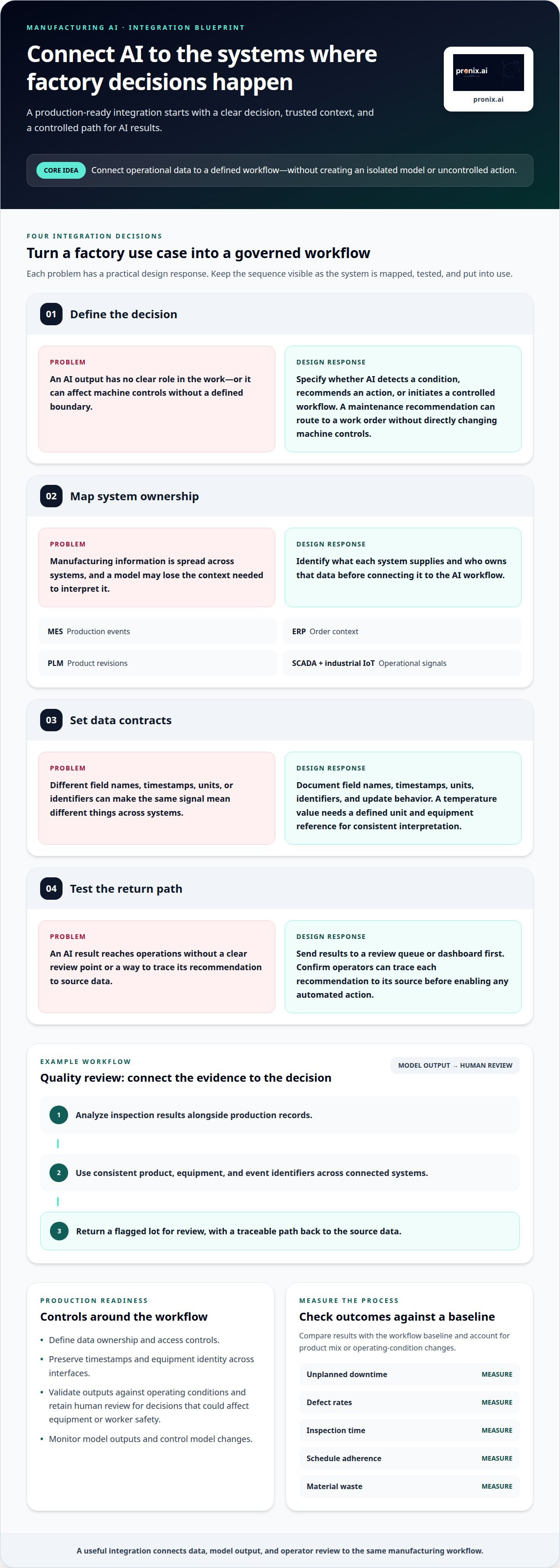
Integration connects AI outputs to the systems where manufacturing data is created and acted on. Define what information moves among MES, ERP, PLM, SCADA, and industrial IoT platforms, and whether the model only reads data or can trigger actions.
Map the workflow before choosing interfaces. For a quality use case, a model might analyze inspection results alongside production records, then return a flagged lot for review. That flow requires consistent product, equipment, and event identifiers across connected systems.
- Define the decision. Specify whether AI detects a condition, recommends an action, or initiates a controlled workflow. A maintenance recommendation can route to a work order without directly changing machine controls.
- Map system ownership. MES can supply production events, ERP order context, and PLM product revisions. SCADA and industrial IoT systems provide operational signals, each with its own source and meaning.
- Set data contracts. Document field names, timestamps, units, identifiers, and update behavior. For example, a temperature value needs a defined unit and equipment reference before a model can interpret it consistently.
- Test the return path. Send AI results to a review queue or dashboard first. Confirm that operators can trace each recommendation to its source data before enabling any automated action.
Use an integration layer or governed APIs to manage exchanges between systems instead of building fragile point-to-point links. A shared equipment identifier, for example, can connect a SCADA signal with an MES event and an ERP work order. Data lineage helps teams trace an output back through those systems.
Separate analytics from control. A model can identify an unusual operating pattern while established SCADA logic and authorized personnel retain control of equipment. Log model versions, inputs, outputs, and approvals so production teams can review decisions and investigate unexpected results.
For complex environments spanning cloud and plant systems, governed AI integration can help align data flows, operational controls, and deployment practices.
Before expanding an integration, validate access permissions, failure handling, and the meaning of each returned signal with the teams responsible for the connected systems. Keep manual review available when data is incomplete or a model result conflicts with established processes. Reassess mappings and controls as workflows change, so updates do not silently alter how recommendations are interpreted or acted on.
What is the typical cost and ROI of enterprise AI implementations in manufacturing?
Manufacturing AI has no single typical cost or return. Implementation cost depends on the workflow, data readiness, system integration, infrastructure, security controls, and ongoing model operations. The price depends on the case and is provided after a quote request; scope, integration complexity, and support requirements shape it.
Build the business case around one defined use case, such as reducing scrap on a production line. Record the current baseline, including defect frequency, material waste, inspection effort, and rework costs. Then identify which measures the AI system can influence and how operations will track them.
- Scope: Count the processes, production lines, facilities, and decisions included in the initial deployment.
- Data work: Assess data availability, quality, labeling, access, and preparation across relevant systems.
- Integration: Account for connections to MES, ERP, SCADA, industrial IoT, and existing analytics environments.
- Operations: Include monitoring, governance, user training, model updates, and support after deployment.
Calculate ROI by comparing verified benefits with full implementation and operating costs over the same period. For predictive maintenance, measure changes in unplanned downtime, maintenance effort, and production disruption. For visual inspection, track defect detection, rework, and inspection labor. Use finance-approved cost assumptions and avoid counting the same benefit twice.
A pilot should test both model performance and business value. For example, compare a selected line’s defect and rework records before and after introducing AI, while accounting for product mix or process changes. If results support expansion, estimate the added integration and operating costs for each new line or facility before scaling.
For a disciplined business case and deployment plan, plan an enterprise AI implementation around measurable manufacturing outcomes, operational costs, and a path to production.
Pronix.ai: Enterprise AI Managed Services
pronix.ai helps enterprises move AI workflows from implementation into ongoing operations through Enterprise AI Managed Services. For manufacturers, this support can align deployment, governance, and operational oversight as AI moves from a defined use case into production. It is a natural next step when internal teams need help managing AI workflows across systems and cloud platforms.
When a workflow needs a tailored implementation, Agentic AI Implementation supports the design and deployment of AI agents within enterprise processes. The focus is operational fit: clear workflow boundaries, appropriate controls, and a plan for monitoring the solution after launch. Managed services can then support ongoing operations as business needs and systems evolve.
Use this approach when AI initiatives need coordinated execution beyond an initial pilot, or when production teams need an operating model for ongoing management. Contact pronix.ai to discuss your manufacturing AI priorities.
Make the Next AI Decision Operational
The next step is to treat AI as part of the operating model, not a standalone technology project. For enterprise AI for manufacturing workflows, that means assigning ownership for model decisions, maintenance, governance, and responses when results change. These responsibilities help keep AI aligned with production priorities as processes and platforms evolve.
pronix.ai supports enterprise implementation through Agentic AI Implementation and Enterprise AI Managed Services. Its broader capabilities also include AI Business Automation and AI-Driven CX Modernization, connecting AI initiatives to business processes and customer operations where relevant. Start with a clearly defined business need and a practical path from design to ongoing use.
Bring your operational priorities and implementation questions into a focused discussion. Discuss your AI needs with pronix.ai, and take the next step toward an approach your teams can govern and sustain.
Frequently Asked Questions
What manufacturing workflows can enterprise AI automate or augment?
Enterprise AI for manufacturing workflows can automate routine information handling while helping people assess exceptions. Examples include drafting an engineering change summary, sorting supplier correspondence by issue, and preparing a shift handoff from approved records. Use AI where staff can review results before acting. For decisions involving product release or process changes, preserve existing approval authority and traceability.
What are the leading enterprise AI platforms for manufacturing, and how do they compare?
There is no universal platform leader; the right fit depends on architecture and operating needs. For enterprise AI for manufacturing workflows, compare cloud-provider services such as AWS and Microsoft with platforms including Salesforce, Kore.ai, and Genesys. Assess how each fits current investments, supports required data flows, and meets governance needs. Focus the comparison on the target workflow rather than a broad feature ranking.
How is generative AI used in manufacturing operations, maintenance, quality control, and supply chains?
Generative AI can help staff work with existing documents and records through natural-language summaries and drafts. An engineer might ask it to summarize approved process documentation; a planner could use it to draft a supplier-issue brief from correspondence. In quality, it can organize investigation notes for review. Keep outputs tied to source material, and have responsible staff validate them before decisions affect production or procurement.