
A reusable template is a starting point, not an implementation plan. An AI implementation project plan template becomes useful when tailored to a defined business outcome, organizational readiness, data and system dependencies, and the controls needed to move from pilot to production. It should make phases, owners, decision gates, success measures, and ongoing operations visible, rather than treating deployment as the finish line.
A standard structure helps teams organize the work, but it cannot account for every organization’s data, workflows, or risk profile. A complete AI project plan shows how to assess readiness, audit data, map dependencies, and adapt implementation phases to the use case. The result is a clearer path from initial planning through deployment, with decisions and responsibilities defined along the way.
Key Takeaways
- Define the business outcome, success measures, owners, and decision gates before adapting a plan format.
- Assess organizational readiness and data quality to identify gaps that could block deployment.
- Map technical, workflow, and governance dependencies so implementation phases follow a workable sequence.
- Use AI-generated plans as a starting point, then tailor milestones and controls to the specific use case.
Table of Contents
Readiness assessment and data auditing
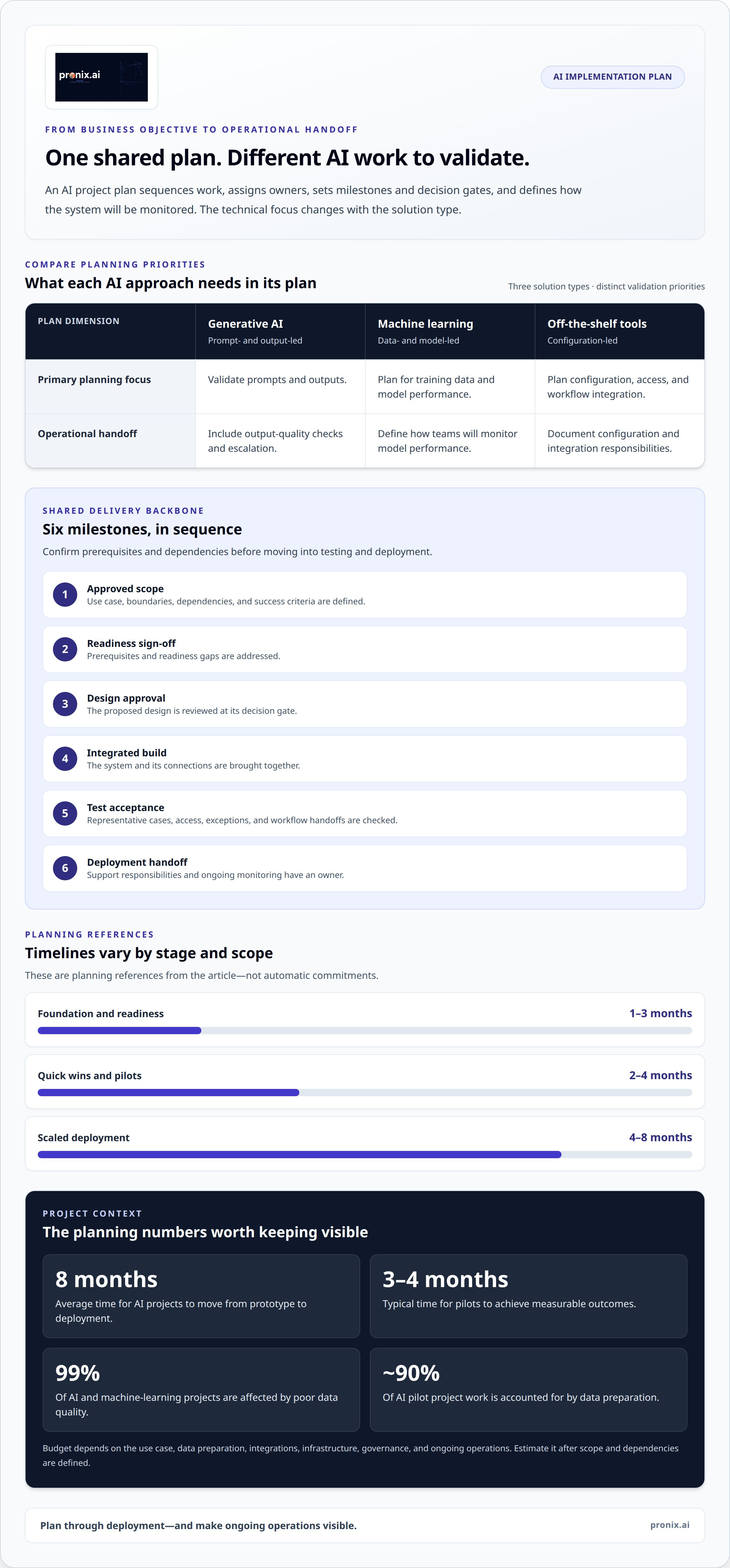
AI projects average 8 months to move from prototype to deployment, while pilots typically achieve measurable outcomes within 3-4 months. Budget depends on the use case, data preparation, integrations, infrastructure, governance, and ongoing operations, so estimate it after defining scope and dependencies.
- Assess operational readiness before selecting an AI tool. Document the business owner, process owner, technical lead, and decision rights. Test whether teams can access the required systems, support workflow changes, and communicate issues. Record gaps in skills, processes, and infrastructure as prerequisites, not assumptions.
- Build the business case around a measurable process outcome. Compare the current baseline with a target, such as shorter case handling or fewer manual handoffs. Identify how the project will measure progress, who owns each metric, and what evidence will support a decision to continue, revise, or stop.
- Audit data by source, format, completeness, freshness, ownership, and permitted use. Trace a representative sample from its system of record through transformation and access controls. Poor data quality affects 99% of AI and machine-learning projects, and data preparation accounts for roughly 90% of AI pilot project work. Treat cleansing and access as planned work.
- Assess risks alongside the data audit. Map exposure involving sensitive information, inaccurate outputs, access, integration failure, and workflow disruption. For each risk, document its owner, likelihood, impact, mitigation, and escalation path. Use human review when an output could materially affect a customer or business decision.
- Translate readiness findings into a budget structure and delivery framework. Separate data remediation, integration, infrastructure, testing, training, governance, and operational support. Assign each cost driver to a phase, owner, and approval gate. Tie contingency decisions to identified risks, and update estimates when scope or dependencies change.
What is an AI project plan?
An AI project plan turns a business objective into sequenced work, assigned owners, milestones, decision gates, and monitoring. Generative AI plans prioritize prompt and output validation; machine-learning plans emphasize training data and model performance; off-the-shelf tools focus on configuration, access, and workflow integration.
- Start with a structured template, then tailor it to the use case. An AI implementation project plan template should capture scope, assumptions, dependencies, risks, approvals, and success measures. A blank template leaves those fields open, while an AI-generated draft can suggest tasks from a project brief. Neither replaces expert review of ownership or feasibility.
- Convert the approved scope into tasks and milestones. For a support workflow, milestones might include process mapping, data access, configuration, testing, and deployment readiness. Assign an owner and acceptance condition to each task. Link the timeline to dependencies, so a delayed integration shifts downstream testing rather than hiding the impact.
- Use generative AI assistants to draft work products, not approve them. A summarizer can turn meeting notes into a decision report, open questions, and action items. The project lead should reconcile each output with the agreed scope, named owners, and source documents. Record corrections so the roadmap reflects decisions, not generated assumptions.
- Separate AI-generated planning suggestions from committed work. Ask the assistant to propose tasks for a defined outcome, then have subject-matter experts remove duplicates, identify missing approvals, and sequence dependencies. For example, a suggested model test is incomplete if the plan omits who reviews failure cases or how results feed into operational monitoring.
- Build change management and operational handoff into the plan. Identify affected workflows, training needs, communications, support ownership, and the process for reporting defects. For generative AI, include checks for output quality and escalation. For machine learning, define how teams will monitor model performance. For a purchased tool, document configuration and integration responsibilities.
Dependencies and implementation phases
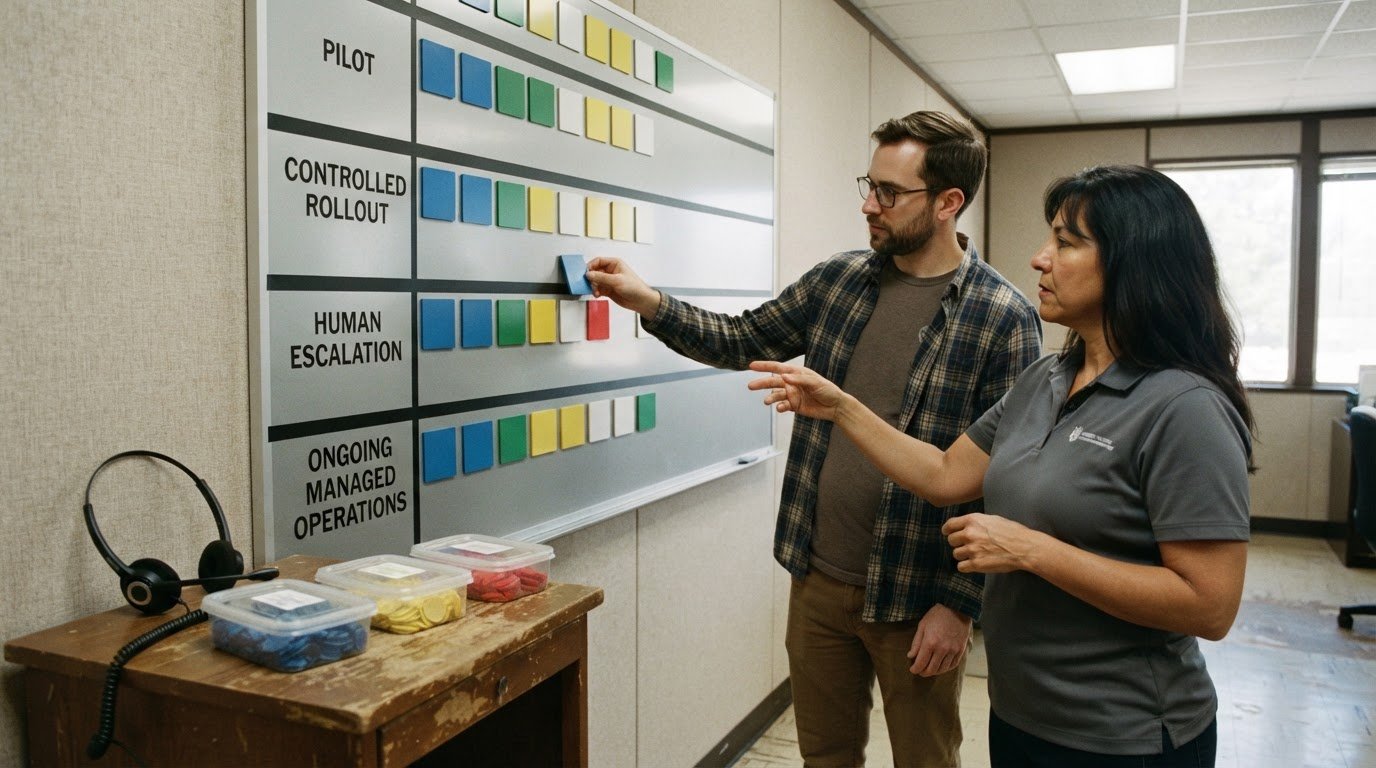
Sequence work around prerequisites, approval gates, and operational ownership. A six-phase roadmap can move from scope and readiness to design, build, test, deployment, and ongoing monitoring.
-
Define Project Scope and Phases
Set the use case, boundaries, dependencies, and success criteria before assigning dates. The six milestones are approved scope, readiness sign-off, design approval, integrated build, test acceptance, and deployment handoff. Use the milestone sequence to identify dependencies and confirm that prerequisites are in place before testing begins.
In a project management office, a suggested foundation and readiness phase lasts 1-3 months, quick wins and pilots 2-4 months, and scaled deployment 4-8 months. Treat these as phase-planning references, not automatic commitments. Name a business stakeholder, technical lead, data owner, and operational owner; involve analytics and process teams where their systems or workflows are affected.
-
Test and Deploy AI Systems
Define test criteria before implementation begins, then test the integrated workflow against representative cases. Check output quality, system connections, access, exception handling, and handoff to employees. For example, a customer-service workflow should test routine requests and cases that require escalation, not only successful automated responses.
Assign the business owner to approve acceptance criteria, technical specialists to resolve integration defects, and users to assess workflow impact. Deploy only after the agreed checks pass and support responsibilities are assigned. Use a controlled rollout with a rollback path, and record decisions at each approval gate. This makes test results actionable rather than a final report with no owner.
-
Monitor and Maintain AI Systems
Assign an operational owner before deployment, then define monitoring for output quality, workflow performance, exceptions, and system availability. Set thresholds that trigger investigation, and route issues to named technical or business stakeholders. Analytics teams can distinguish a model issue from changes in source data or process behavior.
Schedule reviews to assess whether the system still meets its success criteria. Document incidents, fixes, model or configuration changes, and approval decisions. Update training and communications when workflows change. Maintenance should also revisit dependencies, such as data access or connected systems, so a change in one internal initiative does not silently disrupt the deployed AI service.
Customizing an AI project plan
Tailor the plan to the decision the AI system will support, the workflow it changes, and the controls it requires. A project management structure becomes useful when each action reflects those conditions.
- Translate the strategy into one operational outcome. For example, a customer support project might aim to summarize case histories for agents rather than automate every customer interaction. Define the intended users, boundaries, and success measures. This keeps the scope specific and gives stakeholders a basis for approving changes.
- Map the current workflow before scheduling integration. Identify where information enters, which systems hold it, who acts on it, and where exceptions go. An AI assistant for contact center agents needs different integration tasks from a tool supporting internal document review. Record each system dependency and its owner.
- Set acceptance criteria that match the AI approach. For generative AI, define how reviewers assess output relevance and factual accuracy. For a predictive model, specify the business decision it informs and how performance will be evaluated. For an off-the-shelf tool, include configuration, access, and workflow fit. Do not treat a demo as production approval.
- Customize milestones for language, users, and operating conditions. If a service handles customer conversations in multiple languages, include representative language samples in testing and assign reviewers with relevant expertise. Specify how changes to prompts, data, integrations, or user permissions enter change control, with an accountable approver for each.
- Connect project management decisions to ongoing ownership. Name who reviews outputs, resolves incidents, approves updates, and communicates workflow changes. Include training and operational handoff as scheduled work, not informal follow-up. When a dependency changes, identify which milestone, success measure, or integration needs reassessment before the plan proceeds.
For help aligning an enterprise AI strategy with project scope, dependencies, and operational controls, discuss tailored AI planning.
Pronix.ai: Agentic AI Implementation
pronix.ai’s Agentic AI Implementation helps enterprises move from a defined use case to an implementation plan shaped around workflows, integrations, governance, and operational ownership. This work fits projects with strategic value that need a practical route from pilot planning to production. If readiness depends on data quality or architecture, Data & AI Foundations can address those foundations. For customer-facing workflows, AI-Driven CX Modernization may be the right path; for repeatable operational processes, AI Business Automation can align AI with business needs.
The next step is to discuss the use case, desired outcome, current systems, and delivery constraints. That conversation can clarify which workstream fits and which planning decisions should come first. Contact pronix.ai to discuss your AI implementation project.
Turn the Plan Into an Operating Model
A plan creates value when it shapes decisions after deployment, not just the path to launch. Build the operating model around clear ownership, user feedback, and a defined process for addressing changes in workflows or business priorities. That discipline keeps the AI implementation project plan template connected to the work it is meant to improve.
When a project needs experienced implementation support, pronix.ai offers Agentic AI Implementation, AI-Driven CX Modernization, and AI Business Automation. Each service can align an AI initiative with its operational context and production needs.
Discuss your AI project with pronix.ai and identify a practical next step for moving your initiative forward.