

An AI initiative can be technically achievable and still be a poor investment. An AI business value assessment evaluates whether a project supports strategic goals, can be delivered with available data and systems, and justifies its expected investment. It also clarifies implementation complexity, including dependencies, risks, and organizational changes that could affect delivery.
That complexity matters. A strong use case can stall when data is fragmented, workflows are difficult to change, or teams lack the capacity to adopt new processes. A credible assessment looks beyond the model or tool to the operating conditions that determine whether the initiative can move from concept to production.
This article explains how to assess strategic fit, technical feasibility, project complexity, and investment considerations. You’ll learn what evidence informs the decision, how assumptions shape expected business impact, and when an initiative may be better phased, redesigned, or deprioritized. The result is a clearer basis for deciding what to advance and what needs to change before implementation.
Key Takeaways
- Connect each AI initiative to a specific business goal and define the outcome that would make it worthwhile.
- Assess data, systems, workflow dependencies, and organizational readiness to understand implementation complexity.
- Use transparent assumptions and multiple impact scenarios to evaluate investment decisions without overstating returns.
- Treat the assessment as a discovery and decision-shaping tool, not just a final approval step.
Table of Contents
Alignment with organizational strategy and goals
Compare AI projects against strategic priorities, expected outcomes, operational impact, and delivery dependencies. Prioritize initiatives whose benefits support executive goals and whose assumptions withstand scrutiny.
Cross-Functional Stakeholder Alignment
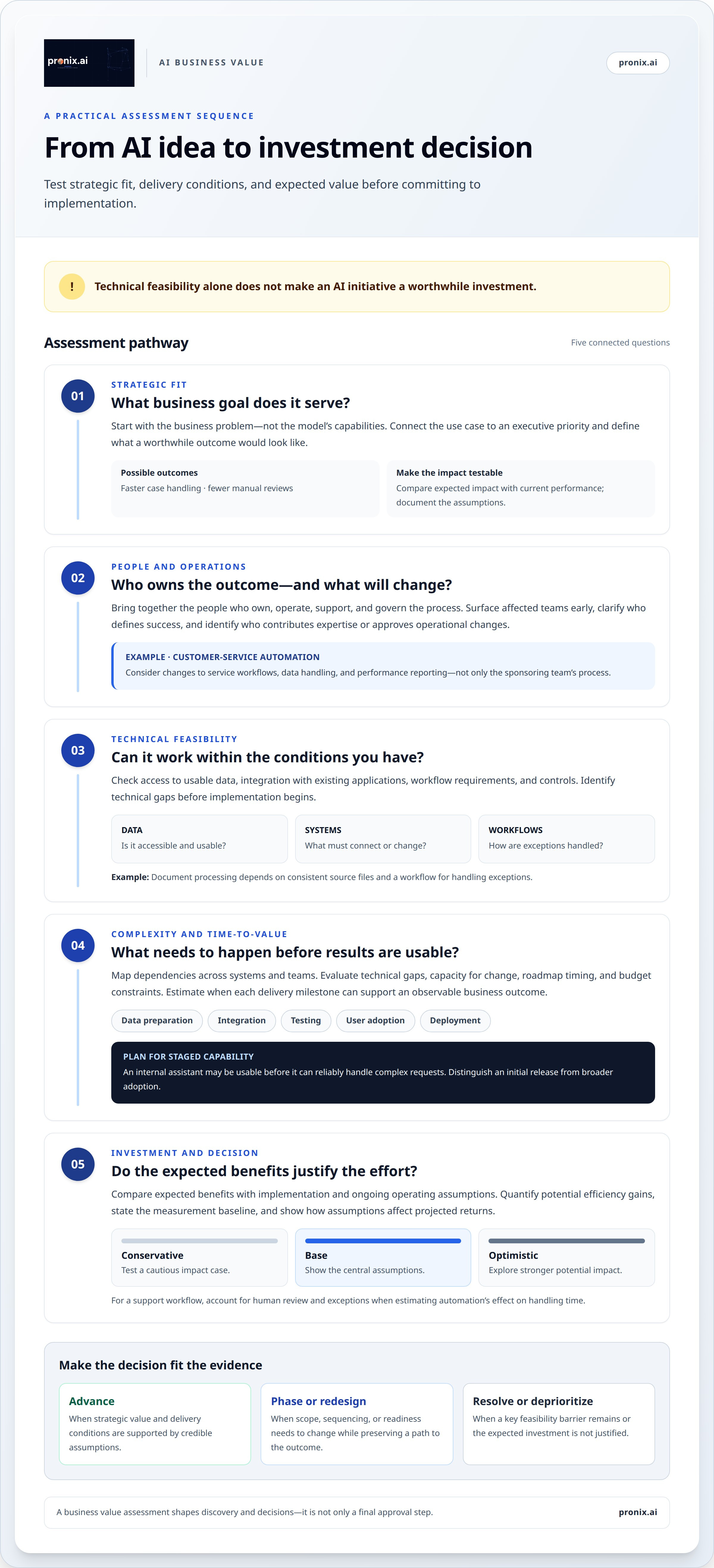
Cross-functional stakeholder alignment connects the people who own a business outcome with those who operate, support, and govern the process. It matters because an AI initiative can affect several functions, not just the sponsoring team. For example, customer-service automation may change service workflows, data handling, and performance reporting. An assessment surfaces these impacts early and clarifies who defines success, contributes expertise, and approves operational changes.
Strategic alignment starts with the business problem, not a model’s capabilities. Connect the proposed use case to an executive priority, then define measurable outcomes such as faster case handling or fewer manual reviews. Assess expected impact against current performance and document the assumptions behind it. The Internal Revenue Service identifies potential generative AI value in tax administration, including fraud detection and audit risk assessment. This illustrates how a defined organizational need can shape a relevant AI use case.
Comparing and Prioritizing AI Projects
Compare AI projects by evaluating their expected business contribution against shared strategic criteria. This helps leaders prioritize value over visibility or technical novelty. Examine each project’s target outcome, affected operations, dependencies, and evidence for expected impact. For example, two initiatives may both reduce manual work, but one may support a more urgent executive objective or improve a core customer process. Making these trade-offs explicit gives decision-makers a defensible basis for sequencing work.
Performance-aligned consulting pricing links payment to agreed outcomes rather than activity alone. An engagement could define a business metric, establish its baseline, and specify how progress will be assessed. Clarify which outcomes the consulting work can influence and which depend on internal decisions, data, or adoption. Clear measures and transparent assumptions help organizations understand what performance alignment means before they commit.
Technological feasibility and project complexity
Technical feasibility measures whether an AI initiative can work within an organization’s data, systems, workflows, and controls. Assess access to usable data, integration with existing applications, and deployment requirements. For example, a document-processing system depends on consistent source files and a workflow for handling exceptions. An AI business value assessment connects these conditions to project objectives before implementation begins.
Project complexity increases when delivery depends on several systems or teams. Map those dependencies, identify technical gaps, and evaluate the organization’s capacity for change. Weigh roadmap timing and budget constraints against the proposed scope. A project requiring data cleanup, system integration, and workflow redesign may need phased implementation. Phasing can reduce delivery pressure while preserving a path toward the intended outcome.
Time-to-value projections should reflect the work between approval and operational use. Estimate when data preparation, integration, testing, user adoption, and deployment can support measurable results. For example, an internal assistant may become usable before it can reliably handle complex requests. Distinguish an initial release from broader adoption, then connect each milestone to an observable business outcome.
Assess business value and ROI by comparing expected benefits with implementation and ongoing operating assumptions. Quantify potential efficiency gains, identify the baseline used to measure them, and show how assumptions affect projected returns. Conservative, base, and optimistic scenarios help expose uncertainty. For a support workflow, the model might estimate how automation affects handling time while accounting for human review and exceptions.
A credible projection also tests what could change the result. Limited technical change capacity, delayed roadmap timing, or constrained budgets can shift deployment plans and value realization. Make these dependencies visible, then show how scope or sequencing affects objectives. This gives executives a practical basis for deciding whether to proceed, phase implementation, or resolve a key feasibility barrier first.
AI adoption and business investment
AI business value varies by industry, workflow, and the outcome being measured. A mining operation may prioritize decision support for field actions, while a service organization may focus on productivity or customer response. The use case determines which internal processes change, what evidence matters, and whether value comes through efficiency, revenue, or improved forecasting.
Mining adoption illustrates how industry risk shapes deployment. Mining leaders representing 41% of the reported group let AI recommend actions that require human approval. None allow AI to execute high-risk actions, even under strict guardrails. This distinction affects investment: decision support can augment operational intelligence while keeping people responsible for consequential actions. An assessment should connect each proposed capability to its risk level and intended business outcome.
Phased adoption lets organizations introduce capabilities according to internal readiness, staffing, or technical maturity. A company might begin with an internal forecasting task, measure its usefulness, then expand to a workflow requiring broader integration. Each phase creates a decision point: continue, adjust scope, or pause. This approach aligns investment with the organization’s ability to absorb change, rather than treating enterprise-wide transformation as a single launch.
Investment analysis should distinguish projected productivity from realized results. Around 7 in 10 reported enterprise AI benefits relate to cost savings, productivity, and throughput. Those categories can guide a forecast, but the assessment still needs to identify the affected process and the baseline for comparison. For example, an automation initiative should account for exception handling and human review, not just the tasks it can process automatically.
Business value also depends on adoption after deployment. If employees keep using the previous process, projected gains may not materialize in day-to-day operations. Connect the forecast to workflow changes, ownership, and measures that show whether the new capability is being used. The resulting investment case gives executives a clearer view of how AI could transform a specific operation, what must change internally, and which phase should follow.
Definition and purpose of a business value assessment
An AI business value assessment is a structured evaluation of whether an AI initiative can create meaningful business outcomes. It connects proposed capabilities to a defined problem, expected impact, delivery requirements, and investment assumptions. Its purpose is to help enterprise leaders make an evidence-based decision: advance the initiative, reshape its scope, phase it, or stop pursuing it. The assessment should show how innovation supports business objectives, not simply that a model works.
Start by clarifying the business problem and the decision the assessment must inform. Map the affected workflow, identify intended outcomes, and establish how current performance is measured. Then assess the required data, systems, people, and operational changes. Finally, model expected impact using transparent assumptions and conservative, base, and optimistic scenarios. This sequence turns an AI concept into a decision-ready case.
To assess business value, gather the organization’s objectives, relevant workflow data, and a clear view of existing operations. Useful inputs include current performance measures, process volumes, exception patterns, data sources, system dependencies, and stakeholder perspectives. For example, assessing an AI-powered support process requires understanding how requests are handled today, which cases need human review, and what outcome matters to the business. These inputs help distinguish measurable value from unsupported expectations.
A strong assessment also separates technical capability from operational value. A tool may demonstrate accurate results in a controlled test, yet require workflow redesign before it can improve enterprise performance. Professionals document dependencies, risks, assumptions, and the measures that will indicate progress after deployment. The resulting analysis gives executives a clear basis for prioritizing investment and defining the next decision point. Engage specialists to assess your AI initiative when the business case needs structured analysis before implementation.
Pronix.ai: AI Business Automation
pronix.ai helps organizations move from an assessed AI opportunity to practical execution through AI Business Automation. Turn to this service when a business case identifies repeatable processes, clear operational goals, and a need to integrate AI into existing workflows. The focus is implementation grounded in business priorities, not technology for its own sake.
For opportunities involving autonomous workflows, Agentic AI Implementation can support the move from a defined use case toward deployment. AI-Driven CX Modernization applies when the opportunity centers on customer interactions, while Data & AI Foundations can address underlying readiness needs. The right next step depends on the assessment’s findings, including which process needs to change and what capabilities it requires.
Contact pronix.ai to discuss how AI Business Automation could support your initiative.
Move from assessment to accountable action
The next decision is not simply whether to adopt AI. It’s how to translate the opportunity into an initiative with clear ownership, governance, and a practical route into operations. An AI business value assessment gives leaders a basis for that decision, while execution must keep the business objective visible as workflows and responsibilities change.
When the case is ready to advance, align implementation with the problem it is meant to solve. pronix.ai offers AI Business Automation, Agentic AI Implementation, and AI-Driven CX Modernization to support initiatives across business processes and customer experiences. The appropriate path depends on the initiative’s scope and operating context.
Bring your priorities and assessment findings into a discussion about the next stage. Contact pronix.ai to discuss your AI project, and take the next step toward putting a well-grounded initiative into practice.