
AI licensing is often only one part of the bill. Over three years, the total cost of ownership for enterprise AI includes data preparation, governance, integration, deployment, talent, and ongoing operations, not just software and compute. To manage spending without compromising performance, match models and infrastructure to each workload and include the work needed to put AI into production.
It makes sense to start with platform fees and processing costs. But those figures alone can hide the engineering, oversight, and operational effort that shapes the true cost of running an AI system. A reliable estimate accounts for these costs before deployment and considers how usage and maintenance needs may change as the system scales.
This article covers the main cost drivers and how to assess them over a three-year horizon. It explains where data quality and governance add effort, why integration continues after launch, and how to manage deployment and operating costs while keeping the system fit for purpose.
Key Takeaways
- Build a three-year cost view that includes more than licenses and compute, so ongoing operations and people costs don’t disappear from the forecast.
- Assess data quality, preparation, storage, and governance together; gaps in these areas can increase effort and limit performance.
- Account for integration as continuing engineering work, not a one-time launch expense, when estimating deployment timelines and costs.
- Use workload needs to guide model and infrastructure choices, then consider managed services when operating and scaling AI requires sustained support.
Table of Contents
How can enterprises reduce AI's total cost of ownership without sacrificing performance?
Manage spending by matching infrastructure and models to each workload, then accounting for operating needs before deployment. Cloud APIs combine hosted compute with model access; self-hosted models require more infrastructure operations; and on-premises systems add local hosting responsibilities. The right comparison depends on the workload, data requirements, and your organization’s operating capacity.
Infrastructure and Model Operating Costs
GPU infrastructure and model operations cover the compute needed for training, inference, and hosting. Simply having access to a model does not account for the resources required to serve it reliably. Reserve heavier models for complex tasks and use lighter options for routine requests when they meet performance needs. Forecast training separately from repeated inference, then compare hosted APIs with self-hosting in light of your organization’s operating capacity.
Model Call and Latency Overheads
Model-call overhead is the additional compute and vendor usage generated by each request, its context, retries, and response time. One user task can trigger multiple calls, so long conversations, repeated retrieval, and retries after failed responses can increase usage without improving results. Map each workflow step, remove redundant calls, and limit context to the information the model needs.
Integration and Data Preparation Costs
Integration and data preparation cover the engineering required to connect AI software to enterprise systems and usable information. Fragmented or inconsistent data can require substantial preparation. Connecting a service workflow to customer records, for example, may involve access controls, data transformation, and testing. Budget for these tasks and ongoing integration engineering, not just initial implementation.
Compliance and Governance Expenses
Compliance and governance expenses cover oversight, documentation, access controls, and monitoring. They matter because exposure can extend across jurisdictions. According to the European Union, GDPR violations can result in fines of up to €20 million or 4% of global annual turnover, whichever is higher. According to the European Union, under the EU AI Act, non-compliance with high-risk AI obligations can incur fines of up to €15 million or 3% of global turnover. US enterprises with relevant European operations should account for applicable obligations in governance planning.
Data preparation, labeling, storage, and governance
In the United States, data preparation, security, compliance, and governance add engineering and operational work before launch and throughout adoption. Costs can include data cleanup, labeling, access controls, storage, monitoring, and the people needed to maintain oversight.
Start with a representative dataset. For a customer-support model, teams may need to remove duplicate records, label intents, and separate sensitive fields before training or retrieval. Storage costs depend on the data the platform retains, how often it is accessed, and applicable retention rules. Clear ownership and quality checks help make these decisions part of the budget instead of late-stage fixes.
Governance also takes ongoing work. Assign owners for model monitoring, incident review, access permissions, and regular data-quality checks. A change in product terminology, for example, can make support labels outdated, reducing relevance and increasing correction work. Record who approves dataset changes and how each model version is evaluated. This improves traceability and makes operational effort visible.
Budget governance works best when forecasts connect usage to measurable drivers. Track data volume, labeling effort, storage growth, model incidents, retraining work, and adoption by team. Compare actuals with approved forecasts at regular review points, then investigate specific variances. If storage spending is 10% above plan, trace the difference to new records, retention, or duplicate copies before cutting useful data.
Include training in the plan. Employees need guidance on approved use, sensitive-data handling, and escalation paths; otherwise, uneven adoption can lead to rework and inconsistent outputs. Forecast data preparation and governance alongside platform usage, then update assumptions as workloads scale. This makes future spending more predictable and gives finance and technical owners a shared view of the trade-offs.
For sustained monitoring and budget governance, align AI operations with clear data controls and ownership.
Deployment timelines and integration complexity
Deployment costs depend on the systems an AI solution must connect to, how they exchange data, and the testing needed for production. A chatbot that reads one approved knowledge base has a different integration path from an AI system that retrieves customer records and updates a case-management platform. Define the workflow before estimating implementation effort.
Integration is a scaling bottleneck: 49% of organizations view integration with enterprise data as the main obstacle. Legacy systems can add work when they use different data formats, access controls, or update schedules. For example, connecting an AI assistant to an older claims database may require a translation layer and separate testing. Include those engineering tasks in project estimates.
Build a deployment framework around production workloads, not just a successful demonstration. Map each dependency, including data infrastructure, identity controls, APIs, and failure handling. Then estimate the first production workload and the 10th production workload separately. The first may require foundational connectors; later projects can reuse tested components, but still need workflow-specific configuration and validation.
Integration effort also continues after launch. Changes to a customer relationship system or an internal API can break data flows, requiring engineering updates and regression testing. Budget for that maintenance alongside initial implementation. A 30-40% contingency on integration effort estimates can help account for uncertainty in system complexity and project scope.
To manage timelines, break implementation into clear stages: confirm data access, build connections, test end-to-end workflows, and release to production. Record dependencies and unresolved issues at each stage. For a service workflow, test whether the AI system can retrieve a case, produce a response, and hand it off correctly. This reveals integration gaps before broader adoption.
Compare delivery assumptions across projects. Separate reusable platform work from one-off connections, and identify where legacy infrastructure adds engineering effort. This gives finance a clearer view of deployment costs and helps technical teams prioritize integrations that support measurable business workflows.
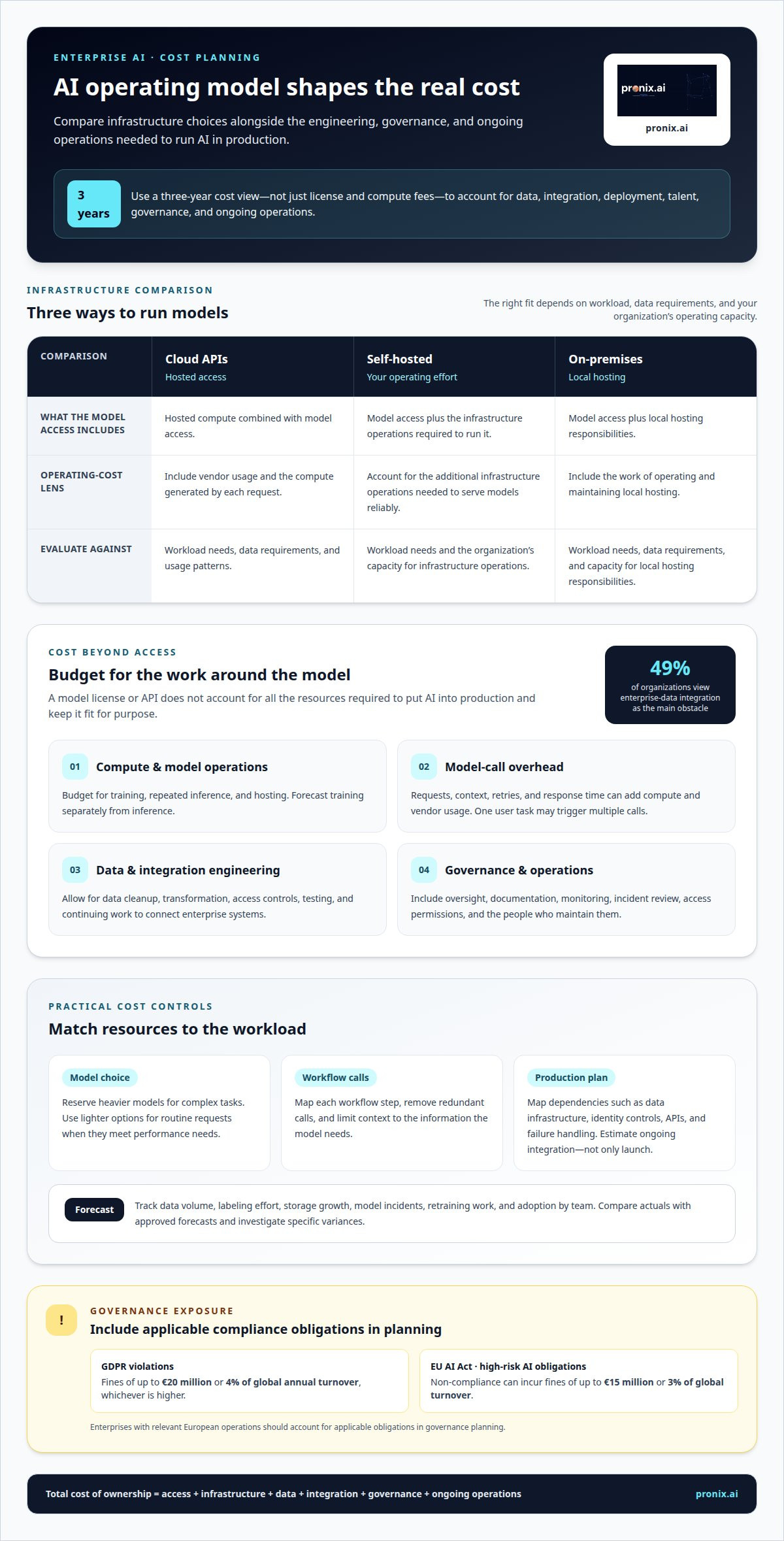
Enterprise AI total cost of ownership over three years
There’s no single build cost: architecture, data work, integrations, staffing, and usage shape the investment. Typical payback is often 12-24 months, varying by implementation effort, adoption, workload volume, and business value.
Building and Maintaining Enterprise AI
Building an enterprise AI system includes acquisition, deployment, operations, and people costs. A three-year model matters because production work continues after launch. Include data engineering, integration, infrastructure, staffing, and ongoing monitoring. Maintenance, scaling, and optimization account for 60% of five-year TCO for AI deployments. Document assumptions for inference volume, storage growth, retraining, and support, then distinguish one-time implementation work from recurring operations.
Implementation Costs and Payback by Use Case
Implementation costs reflect the workflow’s complexity and the systems it must support, while payback compares those costs with measurable value. A demand-forecasting system, for example, has different data and integration needs from a customer-support assistant. Estimate benefits using the relevant business outcome, such as reduced handling effort or improved forecast quality. A 12-24-month payback period is a useful planning reference, not a substitute for use-case-specific assumptions.
Build the forecast across three years. Project query or transaction volumes at launch and at 12, 24, and 36 months. Separate recurring costs from setup work, and model how increased inference affects compute, monitoring, and staffing. Include a sensitivity case where usage doubles or implementation takes twice as long as projected. This shows which assumptions drive the actual spend.
After production begins, compare actual costs with forecasts at six and twelve months. Document variances by category, including integration, storage, staffing, and model operations. If adoption grows faster than expected, update the usage forecast before approving expansion. This turns the three-year estimate into a working budget, not just a launch calculation.
Plan a three-year enterprise AI implementation with clear cost assumptions and production milestones.
Pronix.ai: Enterprise AI Managed Services
pronix.ai’s Enterprise AI Managed Services supports organizations that need ongoing oversight after an AI system enters production. When monitoring, maintenance, and operational ownership become difficult to manage internally, managed services can align those responsibilities with enterprise workflows.
For organizations moving from pilot to production, Agentic AI Implementation connects deployment with defined business processes. AI-Driven CX Modernization and AI Business Automation support customer experience and operational workflows where integration, adoption, and performance need coordinated attention. The right starting point depends on the system’s role, existing infrastructure, and support needs after launch.
Bring a clear view of the use case, current systems, and operating requirements to a discussion about next steps. Contact pronix.ai to discuss your enterprise AI needs.
Turn the Cost Model Into a Production Decision
A sound AI investment case does more than approve a budget. It establishes who owns the business outcome, how success will be measured, and what conditions justify expanding the system. This keeps the total cost of ownership for enterprise AI connected to operational value, rather than treating spending as a technology-only decision.
Set a clear decision point for each deployment. Define the workflow, the accountable business owner, and the performance evidence needed to continue or adjust the initiative. When implementation requires specialized delivery, Pronix.ai offers Agentic AI Implementation, AI-Driven CX Modernization, and AI Business Automation for enterprise use cases.
Bring the intended outcome and current operating constraints into the next planning conversation. Discuss enterprise AI with pronix.ai and identify a practical path from strategy to production. A disciplined decision today can give your teams a stronger foundation for responsible growth.