Replacing a maintenance system isn’t the only way to add AI. AI system maintenance and support can help teams investigate defects, create work orders from reports, and connect AI workflows to existing systems while keeping maintenance decisions under human control.
New technology should fit the processes and records your operation already relies on. Its value depends on whether AI can use those records, identify gaps or inconsistencies, and pass relevant information into the right workflow without treating an alert as a confirmed fault.
This article explains how AI can support troubleshooting and work order creation, how to assess data quality, and how to integrate AI while preserving existing maintenance systems. It also covers production monitoring and the factors that shape reliable, ongoing support.
Key Takeaways
- AI can help turn defect reports into structured troubleshooting workflows, while keeping maintenance decisions and approvals under human control.
- Reliable outputs start with sound records. Learn how providers identify missing, inconsistent, or duplicated maintenance data before relying on AI alerts.
- AI can work alongside existing maintenance systems, using data already held and writing back only where the operator chooses.
- Ongoing monitoring helps teams track production behavior and decide when a model or workflow needs attention.
Table of Contents
How a provider handles AI troubleshooting and work order creation
A well-designed workflow connects defect intake, technical records, and human review. In aircraft maintenance, it can help teams move from a reported symptom to a traceable work order without turning an AI alert into an approved maintenance decision.
Production Maintenance by a Provider
Production maintenance is the ongoing work of monitoring an AI workflow, investigating failures, and managing changes after deployment. It matters because inaccurate recommendations or broken connections can disrupt the maintenance process. A provider reviews production behavior, traces incidents to their source, and adjusts the workflow when approved requirements or operating conditions change. NIST’s AI Risk Management Framework subcategory MEASURE 2.4 calls for monitoring an AI system’s functionality and behavior in production.
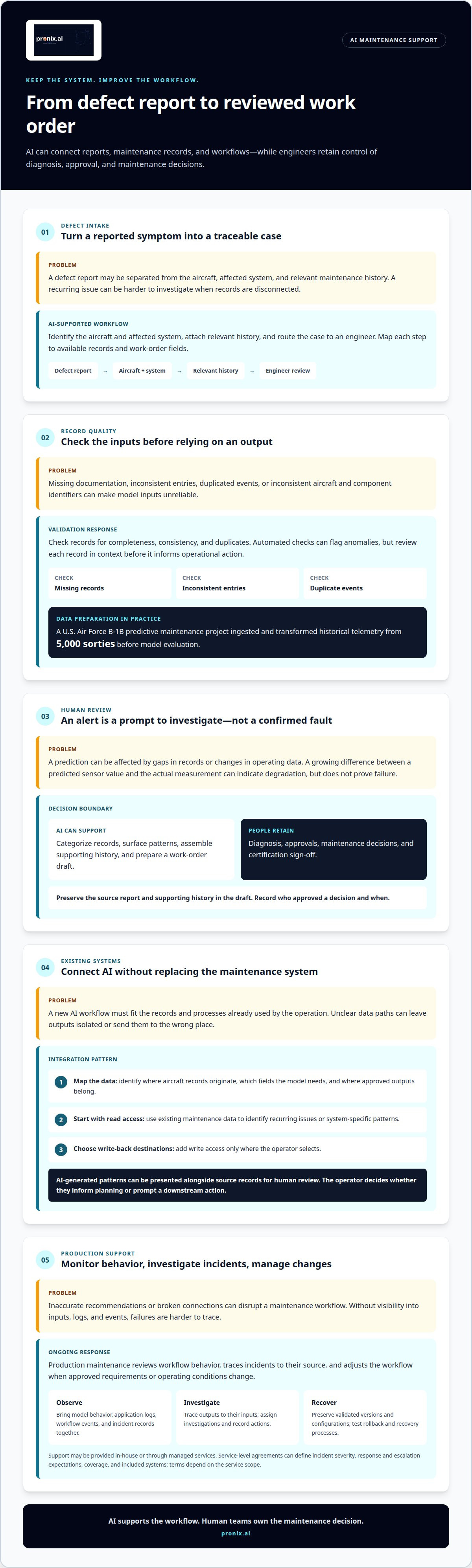
For a defect report, a workflow can identify the aircraft and affected system, attach relevant maintenance history, and route the case to an engineer. Map each step to available records and work order fields. For example, link a report of a recurring component issue to prior records before creating a work order draft.
The draft should preserve the source report and supporting history for review. Engineers retain control over diagnosis, approvals, and maintenance decisions. In airline engineering, AI should reduce administrative work around airworthiness decisions and certification sign-off, not make those decisions. The workflow can also record who approved a decision and when.
In-house support gives an organization direct control and draws on its own staff and operational knowledge. Managed services add ongoing support for AI operations, with responsibilities and escalation paths defined for the engagement. Service-level agreements commonly specify incident severity, response and escalation expectations, coverage, and included systems. The terms depend on the service scope.
Tools Providers Use for Observability, Monitoring, and Incident Response
Observability tools bring together model behavior, application logs, workflow events, and incident records, helping teams trace an output back to its inputs. This is useful when an aircraft report is misrouted or a work order draft lacks key history. Monitoring views help identify failures, while response workflows assign investigations, record actions, and track resolution.
How providers validate data quality and system performance
Validation starts before an AI output enters an operational maintenance workflow. Providers assess whether source records are complete, consistent, and suitable for the intended decision. In a U.S. Air Force B-1B predictive maintenance project, historical telemetry from 5,000 sorties was ingested and transformed, showing how much preparation can precede model evaluation.
For maintenance records, check for missing documentation, inconsistent entries, and duplicates. Assess whether fields use consistent identifiers for aircraft, components, and events. These checks help determine whether model inputs reflect operating conditions or a recording gap. Automated checks can flag anomalies, but each flagged record needs context before it informs operational action.
Performance testing should assess more than whether a model returns an answer. Compare predictions with known outcomes, review errors, and check whether results remain useful across relevant aircraft systems. A virtual sensor, for example, predicts a sensor value from surrounding sensors under healthy conditions, then compares the prediction with the actual measurement. A growing difference can indicate degradation, but does not prove failure.
Common failure modes include incomplete records, duplicated events, inconsistent labels, and changes in operating data that reduce prediction quality. Treat AI alerts as prompts for investigation, not confirmed faults. Document validation criteria and review false alarms alongside missed issues so teams understand where the system performs reliably and where human judgment remains essential.
For backup and recovery, preserve validated model versions, configurations, and data-processing logic. A rollback plan restores a previously tested version if a release disrupts performance; disaster recovery also covers the systems and data needed to resume the workflow. Test the recovery process and record the outcome rather than assuming backups will work automatically.
For organizations building data controls into operational workflows, AI workflow automation can connect validation steps with existing business processes.
How a provider integrates AI with existing maintenance systems
Integration connects AI workflows to maintenance data without requiring operators to replace existing systems. Map where aircraft records originate, which fields the model needs, and where approved outputs should go. Start with read access, then add write-back only to destinations the operator selects. This boundary keeps AI assistance aligned with established work processes.
In aviation operations, an integration can use maintenance history to identify recurring issues or system-specific patterns. AI can categorize records by ATA chapters, inspections, and aircraft systems, making information easier to analyze consistently. Map identifiers for each aircraft and component, too, so a prediction can be traced to the relevant operational record rather than treated as an isolated result.
Predictive maintenance workflows can analyze trends to identify component wear or early signs of system problems. Integration can also assemble due-date lists from existing operator data and route them to the appropriate planning workflow. For example, present an AI-generated pattern for human review alongside its source records. The operator decides whether it informs planning or prompts a downstream action.
In the United States, applicable security, privacy, and aviation controls depend on the data and operation. Map those obligations before enabling access. Practical controls include limiting permissions to the data and actions a workflow needs, recording changes, and defining which outputs require human approval.
Typical AI system maintenance and support costs depend on the scope of work, data condition, integration complexity, monitoring needs, and support coverage. The price depends on the case and is given after a quote request. A defined scope helps connect the investment to specific systems, workflows, and operational responsibilities, rather than treating AI maintenance as a standalone model task.
How often should providers monitor, update, and retrain AI systems?
Monitoring cadence should match the workflow’s operational risk, data volatility, and impact of an incorrect output. The National Institute of Standards and Technology notes that some industrial AI systems support continuous monitoring to track model performance over time. For a maintenance workflow, providers can use continuous signals to detect outages or changing inputs, then review deeper performance measures on a planned schedule.
Providers define what to monitor before production use. Signals can include system availability, processing failures, data changes, and prediction quality against reviewed outcomes. A shift in aircraft usage or record patterns may make earlier examples less representative. Monitoring these signals helps teams distinguish a technical fault from a model whose performance is changing.
Updates and retraining should respond to evidence, not an arbitrary calendar. Investigate performance changes, identify whether the cause is a data pipeline, software release, or changed operating conditions, then choose the appropriate response. Repairing a pipeline may restore expected inputs without changing the model. Retraining is more relevant when validated examples show that the model no longer performs adequately for its intended task.
Before deploying a revised model, compare it with the production version using representative data and agreed evaluation criteria. Document the change, review results with operational stakeholders, and define a rollback path. After release, monitor whether the new version behaves as expected in actual workflows. This controlled sequence limits unreviewed changes and preserves a record of decisions.
Monitoring frequency should also respond to meaningful events, such as an upstream system change or a new data source. Providers can record the event, assess affected workflows, and increase review attention until performance stabilizes. That makes AI system maintenance and support an ongoing operating discipline, not a one-time launch task.
Plan production monitoring and model updates around your workflows, data changes, and operational risk.
Pronix.ai
pronix.ai helps enterprises move AI workflows from design into secure, scalable production. Turn to the team when maintenance processes need stronger data foundations, clearer integration, or a disciplined path from pilot to operational use.
pronix.ai connects AI capabilities with existing business workflows, establishes the data foundations they depend on, and supports implementation aligned with operational needs. This matters when AI outputs must fit established processes, remain reviewable, and adapt as requirements change. The focus is practical: define where AI adds value, connect it to the right workflow, and establish foundations for ongoing performance.
If you’re planning AI system maintenance and support for enterprise workflows, contact pronix.ai to discuss your priorities.
Build the next phase on a clear operating model
Treat AI system maintenance and support as part of the operating model, not work that begins only after deployment. Define who owns decisions, how changes are assessed, and what evidence teams need before expanding a workflow. That clarity helps leaders connect technical work to operational priorities and decide deliberately where AI belongs next.
As needs evolve, pronix.ai helps enterprises move from strategy into implementation with a focus on secure, scalable production. Its offerings include Agentic AI Implementation, AI-Driven CX Modernization, and AI Business Automation. The right direction depends on your workflows, data foundations, and the outcomes your teams need to support. A focused discussion can turn those priorities into a practical path forward.
Contact pronix.ai to discuss your needs and take the next step with confidence.