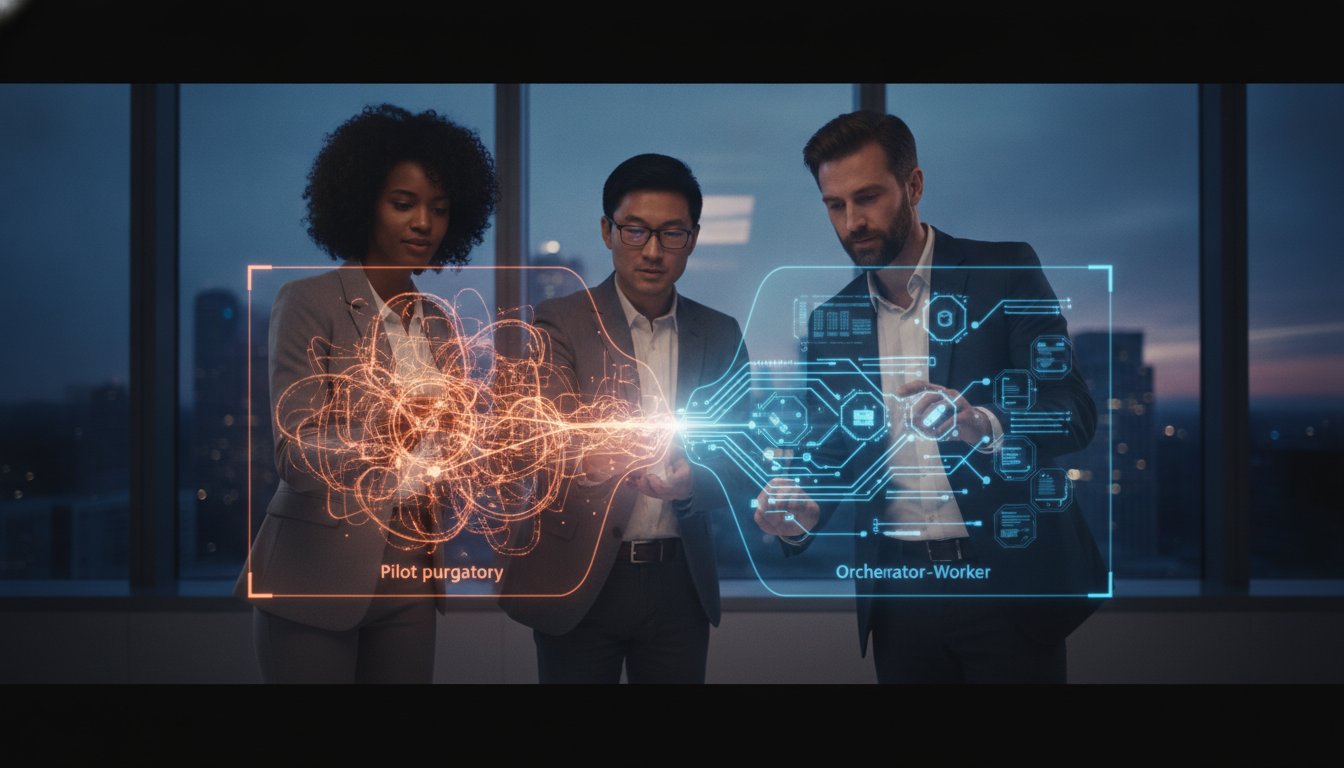
Passing a test doesn’t prove an AI model will keep performing reliably in production. Testing evaluates a model under defined conditions; continuous monitoring of AI models tracks behavior as live data, user activity, and operating conditions change. These practices work together, but address different needs.
Testing can catch problems before launch, but production may reveal drift, performance issues, or unexpected behavior that pre-deployment evaluation missed. This article explains how monitoring differs from testing and traditional security monitoring, how to set meaningful alert thresholds, and who should own the response. It also connects technical performance, operational reliability, and governance, so teams can act with clear accountability rather than relying on periodic reviews.
Key Takeaways
- Set thresholds against a production baseline, then tune them to catch meaningful drift without flooding teams with alerts.
- Use statistical measures such as Population Stability Index to spot changes in live input data, and connect alerts to clear response owners.
- Separate ongoing production monitoring from testing: monitoring detects behavior changes in use, while testing evaluates models under defined conditions.
- Treat significant drift as a trigger for review, retraining when needed, and renewed evaluation and security testing before deployment.
Table of Contents
How do professional teams set monitoring thresholds and alerts for client AI models?
Teams establish production baselines and compare live signals with expected behavior. Effective continuous monitoring of AI models pairs alert thresholds with context and clearly assigned owners.
Statistical Drift and Stability Measures
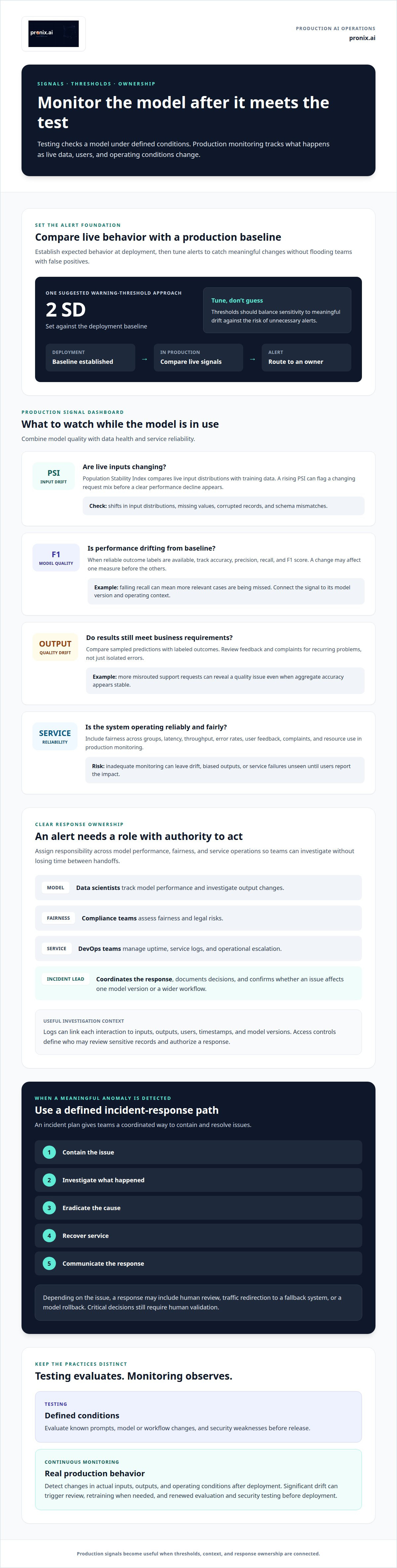
Statistical drift detection compares live input distributions with training data to detect changing patterns. The Population Stability Index (PSI) measures how much those distributions differ. A rising PSI can flag shifts, such as a new mix of customer requests, before teams see a clear performance decline. Teams set warning thresholds against deployment baselines; one suggested approach uses 2 standard deviations. They tune thresholds to balance sensitivity against false positives, then route meaningful alerts to a responsible owner.
Performance Drift in Production
Performance drift is a decline in model quality against its deployment baseline. Teams monitor accuracy, precision, recall, and F1 score when reliable outcome labels become available. A change in customer behavior or input data may affect one measure before others. For example, falling recall can indicate more relevant cases are being missed. Monitoring connects that signal to its model version and operating context, helping teams detect a sustained pattern rather than react to one unusual prediction.
Quality Drift Detection
Quality-drift detection checks whether outputs continue to meet defined business requirements. Teams can compare sampled predictions with labeled outcomes and review customer feedback and complaints for recurring issues. For a support classifier, an increase in misrouted requests can reveal a quality problem even when aggregate accuracy appears stable. Alerts should distinguish isolated errors from recurring patterns, helping owners investigate causes and determine whether model adjustments or further evaluation are appropriate.
Production Metrics and Monitoring Risks
Production monitoring combines model-quality measures with service and data-health signals. What metrics should be monitored for AI models in production? Track accuracy, precision, recall, F1 score, fairness across groups, input and output distributions, latency, throughput, error rates, user feedback, complaints, and resource use. Check inputs for missing values, corrupted records, and schema mismatches. Inadequate monitoring can leave drift, biased outputs, or service failures undetected, reducing visibility until users report the impact. Automated alerts should focus on significant threshold breaches, with an owner and response procedure for each alert.
AI monitoring roles and responsibilities
Effective monitoring assigns each alert to a role with authority to act. The NIST AI RMF recommends monitoring AI systems, while organizations define ownership across model performance, fairness, and service operations. Clear assignments help teams investigate anomalies without losing time between handoffs.
Data scientists track model performance and investigate output changes. Compliance teams assess fairness and legal risks, while DevOps teams manage uptime, service logs, and operational escalation. A designated incident lead coordinates these roles, documents decisions, and confirms whether an issue affects one model version or a wider workflow.
Monitoring records should link each interaction to useful context. Logs can capture inputs, outputs, users, timestamps, and model versions. These records support incident investigations and help establish the scope of an issue. Access controls clarify who may review sensitive records and authorize a response.
An AI incident response plan defines how teams contain, investigate, eradicate, recover, and communicate. A detected anomaly might trigger human review, traffic redirection to a fallback system, or a model rollback. Critical decisions still require human validation. The response should reflect the model’s function, the users affected, and the potential impact of incorrect output.
Climate and disaster-response systems illustrate why roles need clear escalation paths. If a model helps prioritize incoming reports, responders need to know who reviews anomalous recommendations and who can override them. Tracking model versions and decision context can help distinguish a data issue from a service interruption. Human responders remain responsible for urgent decisions.
Defined ownership turns monitoring signals into coordinated action. Organizations aligning governance with deployment can connect those responsibilities to operational AI workflows.
How is continuous monitoring different from testing?
Testing evaluates an AI system under defined conditions; monitoring tracks its behavior in production. Pre-deployment tests can assess known prompts, while live monitoring can detect changes in actual inputs, outputs, and operating conditions.
Post-deployment testing remains useful when teams change a model, prompt, or workflow. They can assess the updated version against business requirements before deployment, then monitor its behavior after release. For example, a support model may pass tests on routine requests but respond differently when customers describe the same issue in unfamiliar ways. Monitoring makes those live patterns visible.
Red teaming and adversarial testing deliberately probe weaknesses. Teams can simulate prompt injection, test whether an agent follows unsafe instructions, and assess security controls before releasing changes. These are focused evaluations, not continuous observation. Production monitoring complements them by detecting malicious patterns, sensitive-data exposure, or policy violations across real interactions.
Prompt A/B testing compares alternative prompt versions against agreed evaluation criteria. Teams can route test cases or controlled traffic through each version, then compare output quality and relevant service metrics. This helps identify which prompt performs better for a specific task. It does not replace monitoring, because user context and input patterns can shift after deployment.
Response workflows connect monitoring signals to decisions. A concerning production pattern can trigger human review, traffic redirection, or rollback, depending on the system’s function and the potential impact. Before an update reaches users, a shadow model can evaluate it in the background. Teams can then test the candidate model and review its results before deployment.
Each method addresses a different gap: testing examines defined scenarios, red teaming challenges defenses, A/B testing compares alternatives, and monitoring tracks real use. Lessons from production failures and attacks can inform future evaluations, prompt revisions, and model updates. This feedback loop makes ongoing oversight part of the AI system lifecycle, rather than a final test before release.
How does monitoring an AI system differ fundamentally from traditional security monitoring?
Traditional security monitoring focuses on infrastructure, access, and threats. AI oversight also examines model behavior, outputs, and changing data patterns.
Retraining and Renewed Security Testing
A significant drift alert can prompt teams to retrain or adjust a model. That change creates a candidate version, not an automatic production release. Teams evaluate its accuracy and business performance, then repeat red teaming and security testing before deployment. This sequence checks whether the update addresses the issue without introducing new weaknesses.
Security analysis also needs AI-specific signals. Alongside infrastructure events, teams monitor for prompt injection, data leakage, and misuse. For example, a sudden pattern of requests seeking sensitive information may indicate an attack even when servers remain healthy. Connecting model inputs and outputs with operational context helps investigators understand the behavior and its scope.
Secure prototyping environments reduce exposure during development. Teams can isolate experiments, limit data access, and monitor shadow deployments before rollout. If testing reveals a weakness, the findings can inform model design, safeguards, and the next evaluation cycle.
Monitoring Generative AI and Traditional Models
Generative AI produces open-ended text, so teams assess output behavior, sensitive-data exposure, and policy violations. Traditional machine-learning models often return structured predictions, such as a category or score. Monitoring those models can focus on prediction accuracy and changes in input-output relationships. Both types need security and performance oversight, but their output patterns call for different evaluation criteria.
Generative systems also face prompt injection, where crafted input attempts to alter model behavior. Monitoring can detect suspicious prompts and outputs, while security testing probes defenses before an update goes live. For a classifier, a shift in input data may instead affect category accuracy. These signals help teams define an appropriate investigation and response.
Use AI implementation support to strengthen monitoring across model behavior, security analysis, and deployment workflows.
Pronix.ai
pronix.ai helps enterprises move AI systems from pilots into secure, scalable production operations. When monitoring needs to connect model behavior, data foundations, and operational response, its teams can help align implementation with business requirements.
Depending on the need, this work can connect with Agentic AI Implementation, AI-Driven CX Modernization, AI Business Automation, or Data & AI Foundations. The aim is an operating approach in which model performance, alert ownership, and response workflows support reliable delivery across enterprise environments.
If your organization is defining monitoring responsibilities or strengthening AI operations, contact pronix.ai to discuss your requirements.
Make monitoring part of the operating model
Production oversight is most useful when built into how teams manage AI, not treated as a separate technical task. As workflows evolve, continuous monitoring of AI models can help keep operational decisions aligned with current system behavior, business priorities, and accountable ownership.
The next step is to align monitoring with the work AI supports. pronix.ai offers Agentic AI Implementation, AI-Driven CX Modernization, and AI Business Automation to help enterprises advance AI initiatives toward production. The right starting point depends on the workflow, the risks it carries, and the operational capabilities the team needs to strengthen.
Set a clear direction for your AI operations and bring the right expertise into the conversation. Contact pronix.ai about AI monitoring to discuss your organization’s needs. A deliberate operating model gives teams a stronger foundation for responsible progress.