

A first-contact resolution (FCR) rate of 70% to 80% is a useful benchmark for live-agent support. Calculate it by dividing cases resolved in the first interaction by total customer cases, then multiplying by 100. Improving first contact resolution with AI means finding why customers need to return, not simply ending conversations faster.
That distinction matters. A fast response can still leave the customer’s issue unresolved, while repeat contacts may point to gaps in knowledge, process, routing, or authority. An FCR score alone won’t show which factor is driving the problem.
This article explains what FCR measures, how to calculate it, and how to interpret it alongside customer satisfaction and handle time. You’ll also learn how AI can surface patterns behind repeat contacts, where automation and intelligent routing may help, and what trade-offs to monitor so efficiency doesn’t come at the expense of a complete, reliable resolution.
Key Takeaways
- Equip agents with relevant knowledge and customer context during conversations to support complete resolutions.
- Balance efficiency measures with customer feedback; a shorter interaction isn’t useful if the issue remains unresolved.
- Use interaction patterns and customer language to identify process, training, or information gaps behind repeat contacts.
- Connect AI capabilities to a defined service problem, then track outcomes before expanding to additional use cases.
What is First Contact Resolution (FCR) and why it matters
First Contact Resolution (FCR) is the percentage of customer cases solved during the first interaction, without a follow-up or escalation. It matters because repeat contacts can involve more agents, add effort, and expose gaps in knowledge or process. For live-agent support, a 70% to 80% FCR rate is a useful benchmark. Simple-request AI chatbots can use an above-80% target, provided they resolve issues rather than merely end conversations.
Which AI tools best improve FCR: chatbots, agent assist, knowledge search, or routing? The right fit depends on where resolution breaks down. Chatbots handle repeatable requests, knowledge search surfaces approved answers, agent assist supports live conversations, and intelligent routing directs cases to suitable agents.
For example, when an agent handles a billing question, AI can surface a relevant knowledge-base article and suggest a concise response. It can retrieve information from FAQs, product documentation, and internal resources, so agents spend less time searching across systems. The knowledge base must stay current: outdated guidance can turn a quick answer into a wrong one. Measure resolution by interaction type to see where assistance helps and where customers still return.
AI needs to connect with the service workflow. CRM and support systems can supply customer history and case details, while intelligent routing can use urgency, complexity, call history, and account status to direct each contact. This can reduce transfers by connecting cases with agents who have relevant skills. Improving first contact resolution with AI depends on connected data, useful knowledge, and a clear handoff when automation cannot resolve the issue.
Agents need practical training and a voice in deployment. Test real scenarios, such as a chatbot escalating a disputed charge while preserving the conversation context. Frontline feedback can show whether suggestions fit actual workflows or add steps. Managers can use that feedback to refine guidance, routing rules, and training around recurring gaps.
What risks can AI create for FCR, including hallucinations, failed handoffs, and privacy issues? A generated answer may misstate a policy, a poor handoff may make customers repeat details, and mishandled personal information can undermine trust. Ground answers in approved knowledge, preserve context during escalation, and limit customer data to what the task requires.
Relationship between FCR, handle time, and customer satisfaction
Handle time measures how long a conversation takes; FCR measures whether the issue stays resolved. Read both alongside customer satisfaction to distinguish efficient service from rushed, incomplete support.
Quantitative and Qualitative Service Data
Quantitative data shows service patterns, while qualitative data explains the customer experience behind them. Repeat contacts, transfers, and handling time can reveal where work accumulates; conversation reviews and customer comments help explain why. For example, more repeat billing contacts may coincide with confusing explanations in agent conversations. Together, these views connect a measurable symptom to a service cause.
Efficiency and Satisfaction Metrics
Efficiency and satisfaction metrics assess whether service is both productive and useful. Track FCR, handle time, transfer rates, and customer feedback consistently, then compare results by contact reason. SQM Group reports that customers resolved on the first call have CSAT scores 18% higher than customers requiring multiple contacts. Treat handle time as a diagnostic metric, not the sole target; a fast conversation can still leave the customer’s issue open.
To calculate AI ROI, compare measurable benefits, such as fewer repeat contacts and recovered agent capacity, with implementation and operating costs over the same period. Divide net benefits by total costs and express the result as a percentage.
Customer Effort and Repeat Contacts
Customer effort is the work people must do to resolve an issue. Repeating account details, explaining the same problem to multiple agents, or restarting a conversation adds friction. Review these moments alongside repeat-contact data. If customers keep calling after a status inquiry, for example, improve the clarity and availability of status information instead of focusing on handle time alone.
Automation can reduce effort when it completes routine actions, not just answers questions. Tasks such as password resets, record updates, appointment scheduling, and service requests can move through a defined workflow. Track whether automation completes the task, prompts another contact, or requires agent intervention. For service teams assessing that operational fit, AI business automation connects routine workflows with broader customer-service processes.
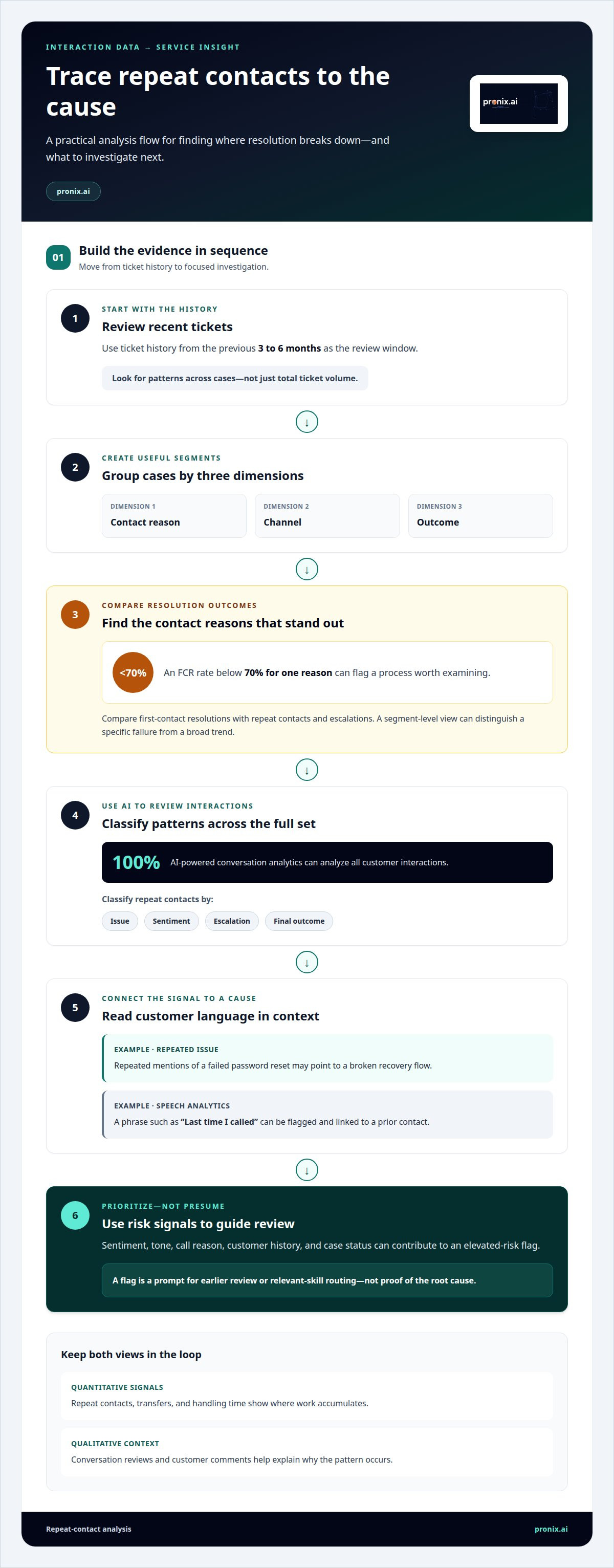
Analyzing interaction data to identify repeat-contact causes
Review ticket history from the previous three to six months. Group cases by contact reason, channel, and outcome. Compare first-contact resolutions with repeats and escalations, not just total ticket volume. An FCR rate below 70% for one reason can flag a process worth examining. That segment-level view helps separate a broad trend from a specific failure.
AI-powered conversation analytics can analyze 100% of customer interactions. Teams can classify repeat contacts by issue, sentiment, escalation, and final outcome. For example, repeated mentions of a failed password reset may point to a broken recovery flow. Speech analytics can flag “Last time I called” and link it to prior contact.
Sentiment signals add context to call analytics, especially when customers sound urgent or dissatisfied. Predictive models can combine tone with call reason, customer history, and case status. An elevated-risk flag can prompt earlier review or route cases to agents with relevant skills. Use these signals to prioritize intervention, not as proof of a root cause.
Root cause analysis traces a repeat contact to the process, policy, or information gap that started it. Compare transcripts, ticket notes, and escalation outcomes for the same issue. If agents repeatedly override an AI suggestion, inspect the source content and workflow rules. Revise the knowledge or escalation path, then test the change against later interactions. Frontline review matters: agents can explain why a technically correct response failed in practice.
Refine workflows based on measured outcomes. Track whether repeat contacts decline after a change. Separate cases resolved through self-service from those transferred, abandoned, or reopened. Preserve the original issue category and customer context during escalation, then review FCR by issue type, channel, and escalation path. This turns analytics into operational decisions, not just another dashboard.
First contact resolution definition and calculation
FCR measures whether a customer’s case is resolved during the first interaction. A consistent definition makes the resolution rate useful across channels and teams.
First Contact Resolution Definitions
First-contact resolution counts cases resolved during the initial interaction; first call resolution applies the same idea specifically to phone calls. Both exclude cases that need a follow-up contact or escalation. When a platform combines phone, chat, and email, label the interaction type so results remain comparable across channels. Clear definitions also help connect effective service with customer loyalty instead of simply counting closed records.
First Contact Resolution Calculation
Calculate the first-contact resolution rate by dividing cases resolved at first contact by total customer cases, then multiplying by 100%. For example, resolving 180 of 200 tickets on the first attempt produces a 90% rate. Define what “first contact” means across channels and set a repeat-contact window, such as 7-30 days. For teams improving first contact resolution with AI, consistent rules make comparisons across routing paths and service workflows more meaningful.
Choose the denominator carefully. Count cases, not every message or transfer, and define how reopened cases are treated. If one customer sends three messages about the same unresolved issue, counting each message as a separate case can distort the rate. Report results by issue type and channel to show where resolution is holding.
First Call Resolution Calculation
First call resolution uses the same basic formula but focuses on cases handled by phone. One practical method is to match calls from the same phone number within a defined period and identify whether the original issue required another call. Keep the period consistent; otherwise, teams may report different results for identical call patterns.
Include transfers in the measurement rule. A transfer that resolves the issue during the same interaction may count differently from a later callback, depending on the organization’s definition. Document the rule alongside the result so leaders can interpret changes accurately. To align measurement rules with an AI-enabled service workflow, explore AI implementation planning.
Pronix.ai: Agentic AI Implementation
pronix.ai helps enterprise teams turn repeat-contact findings into practical AI workflows through Agentic AI Implementation and AI-Driven CX Modernization. When fragmented systems or inconsistent customer context contribute to the problem, Data & AI Foundations can support connected service operations. AI Business Automation can also address routine processes that lead to avoidable contacts.
This is a useful next step when your team has identified a clear service problem and needs to move from analysis to secure, scalable production. Start with the customer journey, the causes of repeat interactions, and the measures that will show whether a workflow is helping. This keeps implementation tied to service outcomes rather than technology for its own sake.
Contact pronix.ai to discuss your customer experience priorities.
Make FCR improvement an operational priority
Choose a service problem with clear ownership and direct customer impact. Define a better outcome for customers and agents, then align the workflow, knowledge, and escalation path around it. This makes improving first contact resolution with AI an operational initiative, not a technology experiment.
Keep the work grounded in frontline practice. Agents can identify where a proposed process creates friction, while service leaders set the measures and review results. Use those insights to refine the experience and decide where to apply the approach next. The aim is steady progress that supports customer trust and operational performance.
For a structured path from service priorities to implementation, contact pronix.ai to discuss FCR. A clear starting point can help your team move forward with focus.
Frequently Asked Questions
What is First Call Resolution (FCR)?
First Call Resolution (FCR) measures whether a customer’s issue is solved during the initial phone interaction. It is the phone-specific form of first-contact resolution, which can also cover chat, email, and other channels. A transfer within the same conversation may count as resolved, depending on the team’s measurement rules. Define those rules clearly so routing changes don’t distort comparisons.
How to calculate FCR?
Divide cases resolved during the first interaction by all cases in the measurement group, then multiply by 100. For example, a team can calculate the rate separately for password resets and billing disputes to see whether one issue category needs attention. Use cases rather than individual messages as the denominator, and apply the same counting rules across reporting periods.
What is first contact resolution (FCR), and how is it measured?
First-contact resolution tracks whether a customer’s issue is resolved in its initial interaction, regardless of channel. Teams can identify repeat contacts in CRM or ticketing records by matching a case, customer, or phone number within a chosen window, such as 7-30 days. Pair that data with customer confirmation, since a closed ticket alone doesn’t prove the issue was solved.
How can AI improve first contact resolution in customer support?
AI can support resolution by retrieving customer history, checking relevant details, suggesting answers, and completing defined service actions during an interaction. For example, a support system may verify identity, retrieve an order, check shipping status, and suggest a relevant next step. It can also escalate cases that need human judgment while carrying conversation context forward to reduce repetition.
What benchmarks show FCR improvement from AI customer service implementations?
Live-agent FCR benchmarks commonly fall between 70% and 80%, while simple-request AI chatbots can target above 80%. Contact centers implementing predictive routing are reported to see a 10 to 15 percent boost in first call resolution. Treat benchmarks as comparison points, not guaranteed outcomes: contact mix, case complexity, knowledge quality, and the definition of a resolved case all shape results.
What steps should a company follow to implement AI for higher FCR?
Start with a defined service issue and baseline measures, then select an AI use case that fits the workflow. Integrate it with existing CRM and support systems, prepare current knowledge, and involve frontline teams in design and testing. Pilot the deployment for two to four weeks before expanding. Track support metrics weekly during the first month, then monthly, and refine the approach using agent and customer feedback.