

Churn is more than a cancellation count; it can reflect warning signals that appear before a customer leaves. Customer churn prediction uses AI to analyze behavior and interactions, estimate which customers are at risk, and help teams prioritize retention actions. The churn rate is customers lost during a period divided by the number at the start of that period, multiplied by 100. Reducing customer churn with AI analytics means connecting those risk signals to business impact, not treating every departure alike.
It’s reasonable to focus on customers who have already left, but churn can also mean lost future revenue, higher acquisition costs, and weaker growth opportunities. This article explains how AI analytics can identify churn risk, which signals to consider, and how teams can turn insights into proactive retention campaigns. It also looks at how churn affects business performance, helping leaders weigh retention decisions against their wider commercial impact.
Key Takeaways
- Connect churn predictions to CRM and marketing workflows so risk signals can inform timely, relevant engagement.
- Use customer-level risk indicators to shape retention campaigns, from targeted support to personalized follow-ups.
- Read changes in customer behavior and sentiment as early warning signals, then prioritize accounts for human review.
- Assess churn beyond lost revenue by considering its effects on acquisition costs, retention, and future growth.
What is Customer Churn Prediction?
Customer churn prediction uses customer data to estimate who may leave and which signals contribute to that risk. Teams can connect predictions to CRM and marketing automation systems, then prioritize retention actions based on the results.
AI Churn Prediction and Machine Learning
Machine learning identifies patterns in past customer activity and uses them to estimate churn risk for current accounts. Teams can use those estimates to focus retention efforts on customers whose behavior resembles that of previous departures. To choose AI churn analytics tools, look for the ability to use relevant data sources, explain risk factors, and pass predictions into CRM or marketing workflows. The right fit depends on the business’s data environment.
Customer Behavior Signals
Behavior signals are changes in how customers use products, communicate, and engage with a business. A subscription company might examine the previous 30 days for declining product usage, failed payments, renewal history, and unresolved support issues. Changes in feature use, website visits, email opens, purchases, and support interactions can also add context. Combining these sources helps distinguish an isolated problem from a pattern that warrants follow-up.
Predictive Analytics Versus Health Scores
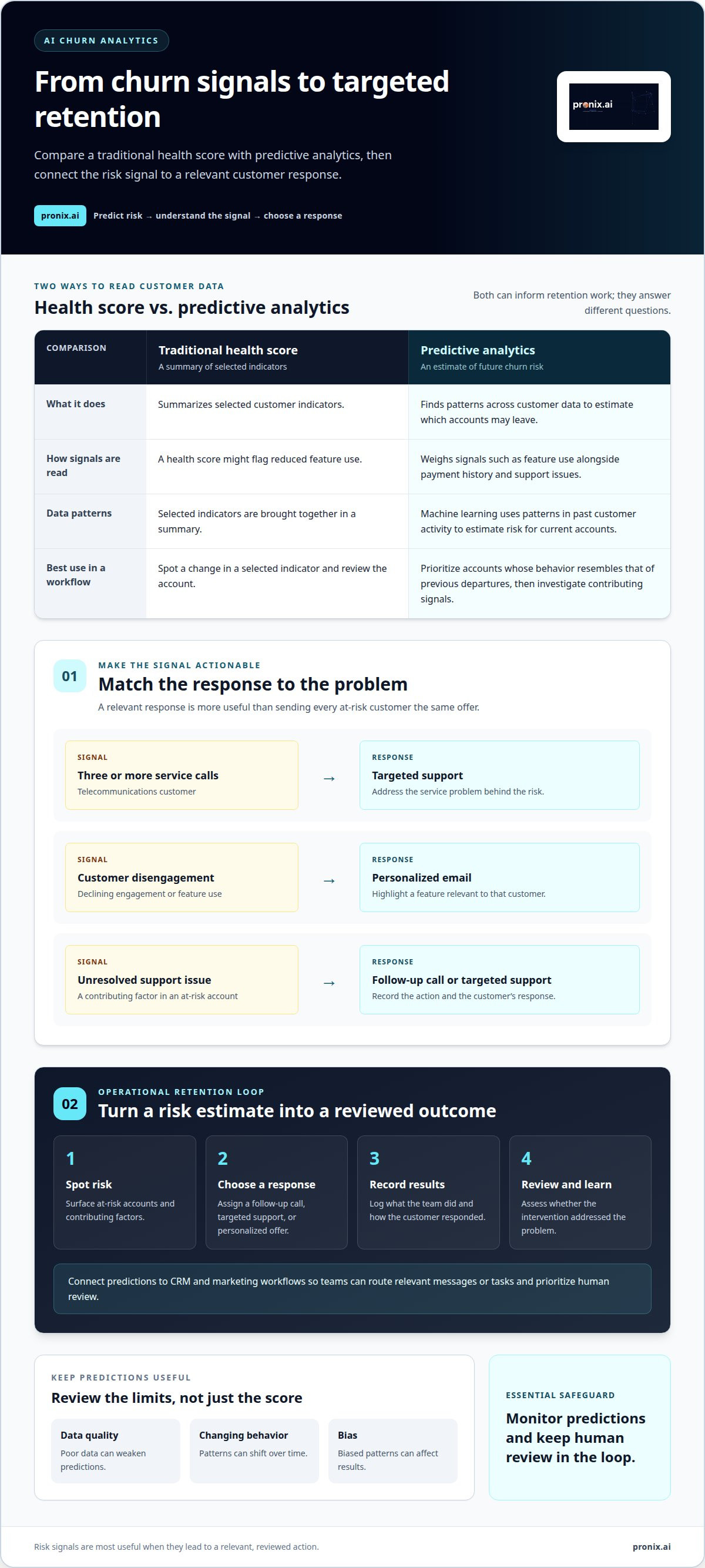
A traditional health score summarizes selected indicators, while predictive analytics estimates future churn risk from patterns across customer data. A health score might flag reduced feature use; a predictive model can weigh that signal alongside payment history and support issues. Integrate the results with CRM records, then use marketing automation to route relevant messages or tasks. Segmenting customers by behavior and purchase history supports targeted retention campaigns instead of sending the same message to every account.
Model Accuracy and Limitations
Model accuracy describes how well predictions match observed outcomes, but results depend on the data and evaluation method. In one telecommunications test, a Random Forest model recorded 95.13% accuracy and an AUC of 0.89; these figures describe that test, not every business. What risks and limitations should teams consider? Poor data quality, changing behavior, and biased patterns can weaken predictions, so teams need monitoring and human review. U.S. privacy requirements depend on sector, customer location, and data collected; federal, state, and sector-specific rules may apply. How much do AI churn analytics platforms cost? Pricing depends on deployment scope, data connections, usage, and support, and is provided after a quote request.
Proactive retention campaigns
Predictions are useful when teams turn them into timely, relevant retention actions. A practical approach to reducing customer churn with AI analytics connects risk signals to measurable outcomes and assigns clear ownership.
Retention Metrics
Customer retention tracks whether existing customers stay, while revenue retention measures how much revenue remains from them. Net revenue retention (NRR) also reflects expansion and contraction within the customer base. These metrics show whether retention protects account numbers, revenue, or both. Enterprise NRR above 100% is described as strong, and 120% or more as world-class. Revenue churn benchmarks differ: below 15% for enterprise businesses and below 20% for SMBs.
Matching Actions to Customer Signals
Matching actions to signals means responding to the indicated problem instead of sending every at-risk customer the same offer. For example, a telecommunications customer with three or more service calls could receive targeted support, while a disengaged customer might get a personalized email highlighting a relevant feature. Automated follow-ups can offer assistance, with human judgment reserved for complex issues. Automated customer workflows can connect risk indicators to appropriate next steps.
Retention Dashboards and Recommendations
A retention dashboard can show at-risk accounts, contributing factors, and suggested actions for the teams responsible for customer relationships. Pair each risk estimate with signals such as unresolved support issues or declining engagement. Assign a follow-up call, targeted support, or a personalized offer, then record the action and the customer’s response. Reviewing those results helps teams assess whether an intervention addressed the problem. This makes reducing customer churn with AI analytics an operational process, not just a reporting exercise.
E-commerce Churn and Retention
In e-commerce, churn can mean that customers stop purchasing or reduce their activity over time. Purchase patterns and customer feedback may reveal weakening loyalty or service problems. For example, unexpected fees, taxes, or high shipping costs revealed near checkout can lead shoppers to abandon a purchase. Reviewing feedback and checkout patterns helps teams identify friction, improve the customer experience, and tailor retention campaigns to the underlying cause instead of relying on broad discounts.
Can AI identify different types of churn?
Yes. Models can identify patterns associated with declining engagement, service problems, or reduced purchasing. Teams can use churn risk estimates to prioritize accounts, investigate contributing signals, and choose targeted retention actions.
Early Churn Risk Identification
Early identification uses changing customer patterns to flag possible churn before an account leaves. Predictive analytics can help businesses identify at-risk accounts up to 80% faster. For example, a sudden drop in feature use combined with negative support interactions can prompt a timely review. Learning from new customer outcomes helps models adjust as behavior changes, keeping risk signals actionable for retention teams.
Prioritizing High-Value Customers
Prioritization combines churn likelihood with account value, helping teams focus on departures that could have a greater business impact. A high-value account with declining engagement may warrant personal follow-up, while a lower-risk account could receive a relevant automated message. Consider the account’s relationship history and current problems, then match outreach to the likely reason for the risk. A score can support prioritization, but it should not automatically trigger a discount.
Risk Scores and Dynamic Segmentation
A churn risk score ranks accounts by estimated likelihood of leaving, while dynamic segmentation groups customers as their signals change. Teams can use these views to assign outreach and compare outcomes across cohorts. For example, a company that loses 50 of 1,000 customers in a month has a 5% monthly churn rate. A segment’s movement relative to its own history can help teams investigate emerging risk rather than treating one score as a universal threshold.
Churn Risk Feature Importance
Feature importance shows which inputs contributed most to a model’s predictions. In one Random Forest analysis, its three most important features accounted for over 40% of total feature importance. That result can guide investigation, but it doesn’t establish that the same patterns drive churn elsewhere. Teams should review influential signals against customer context, then use the findings to shape targeted support and test whether interventions address the underlying problem.
Business costs and effects of churn
Churn reduces recurring revenue and raises the resources required to replace departing customers. U.S. companies lose $136.8 billion per year due to avoidable consumer churn. For subscription businesses, lost accounts can weaken Annual Recurring Revenue and Net Revenue Retention, while also reducing opportunities to expand existing relationships. The impact compounds when teams must spend more acquiring replacements instead of developing current accounts.
Retention has a direct connection to profitability, but the effect depends on industry, margins, customer economics, and how retention improves. Research summarized by Amy Gallo suggests a 5% increase in customer retention can increase profits by 25% to 95%. That range highlights why leaders should examine customer behavior and service interactions alongside revenue. Machine learning can help identify patterns associated with departure, giving teams a chance to intervene before those patterns become cancellations.
How do you measure the ROI of AI-powered churn reduction? Compare the incremental value of retained customers and any acquisition savings against the costs of analytics and retention activity. Use a consistent measurement period, compare similar customer groups, and account for revenue retained rather than counting every prevented cancellation equally. Predictive churn analytics can deliver up to a 10x return on investment from retention efforts, but this is an upper-end result, not a planning assumption for every business.
Connect churn predictions with revenue and customer-success reporting to see where interventions matter most. For example, a SaaS team can compare renewal outcomes, retained recurring revenue, and expansion activity for customers who received targeted support. Teams can also track whether a campaign helped address service problems that might otherwise affect other accounts. This links predictive insights to business outcomes instead of treating model accuracy as the only measure of success.
For teams ready to connect customer signals with repeatable operational workflows, explore AI Business Automation to support coordinated retention processes.
Pronix.ai: Agentic AI Implementation
pronix.ai helps enterprises move churn prediction initiatives from pilots toward secure, scalable production workflows. Its Agentic AI Implementation service can help organizations connect AI insights with operational processes, while AI-Driven CX Modernization can align those processes with customer experience priorities.
This work is relevant when risk estimates exist but teams struggle to turn them into coordinated action, or when fragmented data limits useful predictions. Data & AI Foundations supports the underlying data environment, while AI Business Automation helps operationalize repeatable workflows. The right starting point depends on whether the priority is data readiness, customer experience, or implementation.
For a practical discussion about applying AI to retention workflows, contact pronix.ai.
Turn churn insight into operational change
The next step is to make retention part of everyday team workflows, not a separate analytics exercise. A disciplined approach to reducing customer churn with AI analytics connects insights to clear ownership, appropriate customer engagement, and ongoing review. Keep human judgment involved, especially when a customer’s situation calls for a response beyond an automated workflow.
For organizations ready to operationalize this work, pronix.ai offers Agentic AI Implementation, AI-Driven CX Modernization, and AI Business Automation. These services can support different needs, from implementing AI workflows to aligning customer-facing operations with retention priorities. Start with the operational challenge your teams need to address.
Contact pronix.ai to discuss your retention priorities and identify a practical next step. Consistent execution can turn customer insight into a stronger foundation for lasting relationships.
Frequently Asked Questions
Does using AI for churn reduction require a data science team?
No. A dedicated data science team isn’t essential for every churn program. Customer Success and analytics teams can begin by defining the business outcome, reviewing available data, and using risk indicators generated by their platforms. Technical expertise becomes more important when teams need custom models, complex integrations, or rigorous validation. Assign clear ownership for data quality and intervention decisions, even when existing tools manage model development.
What Does AI Add Beyond Basic Rules?
AI can assess combinations of signals that simple rules may treat separately. A rule might flag an account after missed payments; a model can weigh payment history alongside product engagement and service interactions. Models can also learn from past outcomes and update risk estimates as patterns change. This can help teams move beyond fixed thresholds, but recommendations still need to be tested to ensure they support sound decisions.
What churn metrics should AI SaaS founders track?
Track customer churn alongside revenue churn and net revenue retention, then break results down by acquisition cohort, plan, and customer segment. Cohort views can show whether newer customers leave sooner than established accounts. Also monitor renewal outcomes, expansion, contraction, and the share of flagged accounts that renew. Together, these measures help founders distinguish a broad retention issue from one concentrated in a particular product or customer group.
Which Customer Signals Matter Most?
The most useful signals depend on how customers get value from a product. For a team-based SaaS product, examine whether key roles are active and whether customers complete core workflows. For a service-led business, look for repeated unresolved requests or stalled implementations. Compare each account with its own previous behavior and expected usage pattern. A meaningful change can matter more than a single observation of low activity.
How can AI analytics predict customer churn?
AI analytics compares historical customer patterns with current activity to estimate which accounts may leave. Models use past outcomes to identify relationships among available signals and produce risk estimates for active customers. Teams can review the factors behind a prediction and decide which response fits. Predictions are most useful when they arrive early enough to inform a real customer interaction.
What customer data is needed for churn prediction models?
Models need reliable records of customer outcomes and the activity that preceded them. Useful inputs can include account start and renewal dates, purchases or subscription changes, product events, billing status, support history, and customer feedback. Keep identifiers consistent across systems so events connect to the correct account. Define what counts as churn for the business before training, or the model may learn an inconsistent target.