NewNew: The enterprise guide to Agentic AI — 24 min read.

Read →
50–70% — WISMO and returns deflection
Slide 1 of 2
50–70%
WISMO and returns deflection
60–80%
Digital containment at peak
Faster
Markdown cycles, fewer stockouts (merchandising agents)
80%+
Touchless vendor-invoice processing

Ranges reflect outcomes observed across Pronix retail and ecommerce engagements; results vary by category mix, commerce stack and peak-season plan.

Certified partner platforms
  • Amazon Connect platform logo
  • Amazon Lex platform logo
  • Genesys Cloud CX platform logo
  • NICE platform logo
  • Five9 platform logo
  • Talkdesk platform logo
  • Cresta platform logo
  • Microsoft Azure AI platform logo
  • Microsoft Copilot Studio platform logo
  • Salesforce Agentforce platform logo
  • Kore.ai platform logo
  • Retell AI platform logo
  • AWS Advanced Partner platform logo
  • AWS Generative AI Competency Partner platform logo
  • Microsoft platform logo
  • Google Cloud platform logo
  • OpenAI platform logo
  • Anthropic Claude platform logo
The enterprise challenge

Retail's real omnichannel challenge is context, not channels.

Customers move fluidly across web, app, marketplace and store. Their context doesn't. AI applied across service, commerce, merchandising and store — with peak-season ops engineered in — closes that gap.

  • Peak-season economics
    Contact-center staffing for peak is the industry's biggest CX cost — AI containment moves that number materially.
  • Returns drive customer lifetime value
    Returns UX is a retention lever masquerading as a cost.
  • Merchandising decisions bound by analyst time
    Markdown and replenishment across thousands of SKUs are analyst-bound — agentic AI proposes actions, humans approve.
  • Store associates as the ceiling on CX
    Store CX depends on associates having the right knowledge and product context in the moment.
Capabilities

Retail-first AI and CX capabilities.

01
Omnichannel order & returns bot

Salesforce Agentforce service agents backed by Commerce Cloud + OMS APIs, voice fallback via Amazon Connect + Lex — 50–70% WISMO/returns deflection.

02
Conversational commerce

Product discovery, guided selling and post-purchase support on web, mobile and messaging.

03
Semantic product search & merchandising RAG

AWS Bedrock semantic search + LLM re-ranking tuned on conversion signal — search-driven conversion lift on long-tail queries.

04
Merchandising & inventory agents

AWS Bedrock agents monitor sell-through, propose markdown and replenishment actions with rationale, execute after buyer approval.

05
Store-associate copilots

In-store copilots for product knowledge, inventory look-up and clienteling on associate handhelds.

06
Vendor invoice processing (D365)

IDP + 3-way match automation, exception queue and analyst copilot for coding — 80%+ touchless invoice rate.

07
Peak-readiness AI ops

Load-tested containment, elastic CCaaS capacity, extended managed-ops coverage and daily war-room during peak.

Reference architecture

The retail CX and merchandising AI architecture.

Conversational commerce and merchandising agents wired into the commerce, OMS and store stack you already run.

Shopper channelsSystems of record
  1. 01

    Shopper & associate channels

    Web, app, marketplace, store associate devices, voice and messaging.

  2. 02

    AI orchestration

    Order and returns agents, semantic product search, merchandising agents and store copilots.

  3. 03

    Commerce decision controls

    Buyer approval on markdown and replenishment actions, brand-safe content rules and peak-load guardrails.

  4. 04

    Integration layer

    Commerce, OMS, inventory and loyalty APIs with peak-season capacity headroom designed in.

  5. 05

    Commerce & systems of record

    Shopify, Salesforce Commerce, Manhattan OMS, Dynamics 365 and SAP.

Executive brochure · Retail & ecommerce

AI for order care, returns, merchandising and peak readiness

A 6-page executive brochure for retail and ecommerce executives: self-service and agent assist across order care and returns, store-associate copilots, and peak-season readiness with measured outcomes.

  • Six named workflows across order care, returns, search and merchandising
  • Peak-readiness model with elastic CCaaS capacity and load testing
  • Two production case studies with measured containment and CSAT results
  • A costed 90-day plan from baseline workshop to production rollout
PDF · 6 pages · no sales follow-up required
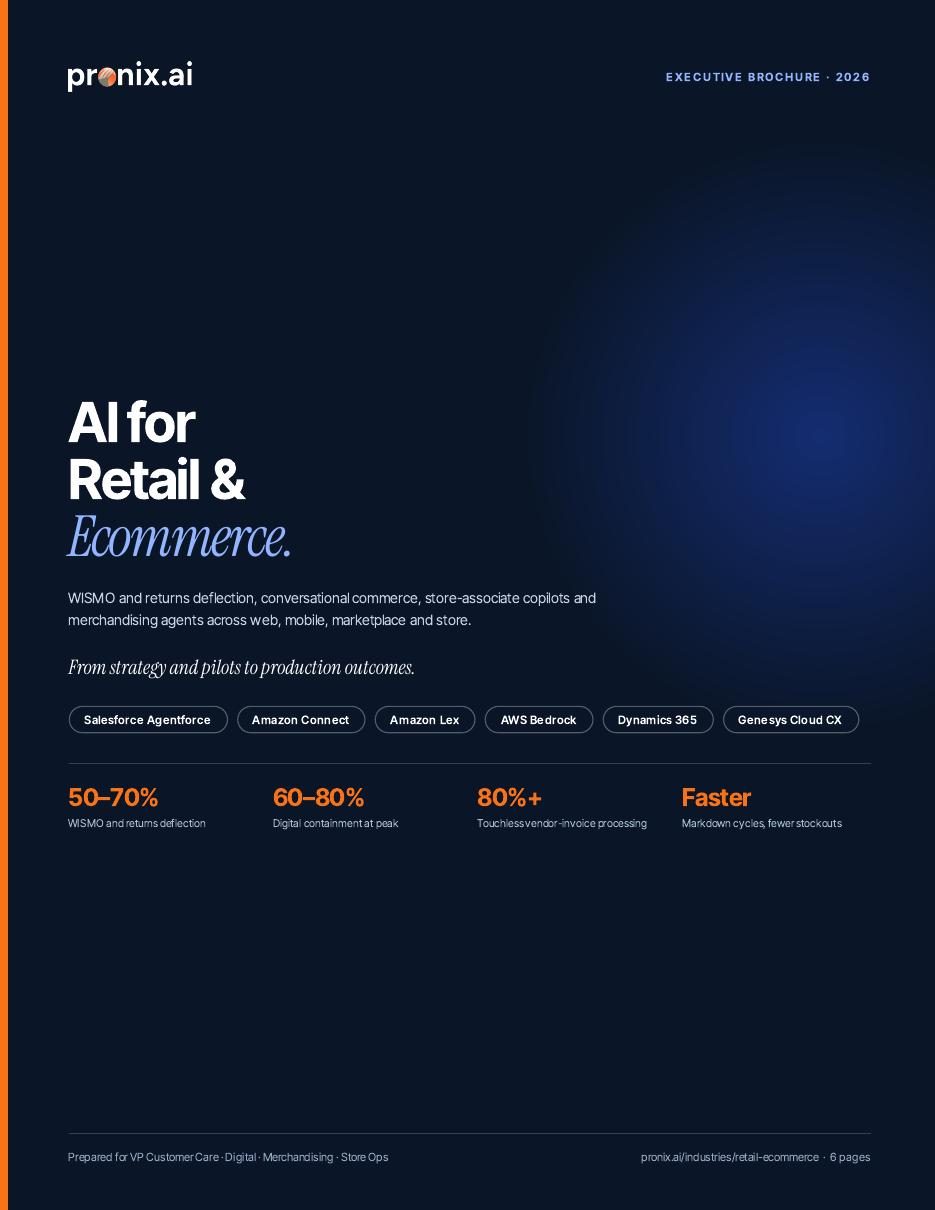
Cover of the Pronix.ai executive brochure on AI for retail and ecommerce order care and merchandising.
Definition

How do retailers use AI across customer service and operations?

Retailers use AI to resolve the order lifecycle end to end: where-is-my-order status, returns and exchanges, refunds within policy, subscription changes, and product questions grounded in the catalog. Agents act inside the order management and commerce systems so a contact ends in a completed action rather than a ticket. Peak season is the main design constraint — capacity, containment and fraud controls are sized for the busiest week, not the average.

Also known as: ecommerce customer service AI, retail contact center AI.

Highest-volume intent
Order status and delivery exceptions
Design constraint
Peak-week volume, not average daily volume
Guardrail
Refund and goodwill limits enforced by policy, not by prompt

Retail service AI vs generic chatbot

Retail service AI vs generic chatbot
DimensionRetail service AIGeneric chatbot
Order actionsCancels, returns and refunds inside OMSLinks to a self-service page
Catalog answersGrounded in live product dataTrained on static FAQ text
Peak behaviorScales with containment targetsDegrades to deflection
Fraud controlsPolicy limits and verificationNone
How we deliver

A six-step model, from assessment to managed operations.

Every engagement follows the same rhythm — so business, IT and delivery stay aligned from opportunity to outcome.

01
Assess

Journey, contact-driver and channel baseline.

02
Design

AI architecture, CCaaS blueprint, peak plan.

03
Pilot

One journey live end-to-end.

04
Implement

OMS/CRM integration, CCaaS build.

05
Scale

Journeys, channels, brands, regions.

06
Operate

Managed operations including peak-season.

Where it lands

Use cases already in production with enterprise clients.

Omnichannel order & returns bot (Agentforce + Amazon Lex)

Service agents backed by Commerce Cloud + OMS APIs; voice fallback via Amazon Connect — 50–70% WISMO/returns deflection.

Merchandising agent for markdowns & replenishment (AWS

Agents monitor sell-through, propose markdown/replenishment actions with rationale, execute after buyer approval — faster markdown cycles, fewer stockouts.

Semantic product search & merchandising RAG (AWS Bedrock)

Semantic search + LLM re-ranking + evaluation loop tuned on conversion signal — better relevance, higher conversion on long-tail queries.

Vendor invoice processing (Microsoft Dynamics 365)

IDP + 3-way match automation, exception queue and analyst copilot for coding — 80%+ touchless invoice rate.

Advisory brief

Peak-Ready CX & Merchandising Reference Architecture

How to design retail AI for two buyers at once — the VP CX (containment, returns UX, peak load) and the COO/CMO (merchandising and inventory agents). Includes load-tested containment patterns, OMS/commerce integration seams and a peak-season operating rhythm.

Runs on

Grounded on your data. Governed on day one.

Every platform we implement is only as good as the retrieval, connectors and controls behind it. These are the horizontal solutions we ship with every engagement.

Not sure where to start? Score your organization in 10 minutes.Take the AI Readiness Assessment →
Quick answer

What does AI change in retail and ecommerce customer service?

Retail and ecommerce automate the order lifecycle first: order status, returns and exchanges, delivery exceptions and promotion questions. Because these intents are transactional and integration-bound, containment moves quickly, peak-season staffing pressure drops, and agent assist keeps quality steady through seasonal hiring waves.

Last reviewed 2026-08-05

Order lifecycle intents dominate volume

WISMO, returns and delivery exceptions are the majority of contacts and map cleanly to OMS, WMS and carrier APIs.

Peak is the business case

Automation absorbs seasonal spikes that would otherwise be met with expensive temporary staffing and long training cycles.

Assist protects quality during hiring waves

Retrieval over policy and product content lets new seasonal agents answer accurately from day one.

Related questions answer engines ask

Which retail intent should be automated first?
Order status, because volume is high, the answer is deterministic and the integration is usually already available.
Does automation hurt CSAT in retail?
Not when escalation is fast and context carries across; CSAT typically holds or improves because wait times drop.
How does this handle peak season?
Automated intents scale without headcount, and assist shortens ramp for the seasonal agents who remain.

How Retail & Ecommerce AI engagements are bought, supported and staffed.

Most enterprises start with an assessment, move into a fixed-scope build, keep it running under managed support, and add retail AI engineers where their own team is short. All four can run together under one commercial agreement.

  • Assessment and roadmap

    A bounded Retail & Ecommerce AI assessment: current-state review, prioritized use cases, target architecture, business case and a sequenced delivery roadmap.

    Fixed price · 2–4 weeks typical

  • Fixed-scope build

    A defined Retail & Ecommerce AI implementation — architecture, build, integration, testing, evaluation and a documented production release against agreed acceptance criteria.

    Fixed price · 8–16 weeks typical

  • Managed run and support

    Monthly operations for Retail & Ecommerce AI in production: release management, integration monitoring, configuration changes, model and agent evaluation and incident response under one SLA.

    Monthly service tier · 24×7 coverage available

  • Staff augmentation

    Retail AI engineers, solution architects and delivery leads embedded in your team, reporting to your delivery manager.

    Monthly per person · typically live in 2–4 weeks

Where Retail & Ecommerce AI delivery happens

Programs are led from our Plainsboro, New Jersey headquarters and delivered with our Hyderabad global delivery center, plus London and Dubai for EMEA and Middle East clients.

Support coverage

Business-hours support in your time zone as standard, follow-the-sun 24×7 for production contact center and agentic workloads, with named escalation and monthly service reviews.

Submit a project brief

Scoping a Retail & Ecommerce AI and CX Solutions programme? Send us the brief.

Four fields. Tell us the outcome and timeline and a delivery lead for this area replies with indicative scope, team shape and commercial options.

industryRetail & Ecommerce AI and CX Solutions — routed to this team

Prefer to book a slot? →
Explore next
Frequently asked

Questions buyers ask us first.

Do you integrate with our OMS and commerce platform?
Yes — Shopify, Salesforce Commerce, Manhattan Active Omni, SAP Commerce, custom OMS and headless commerce stacks.
How do you handle peak-season readiness?
Load-tested AI containment, elastic CCaaS capacity, extended managed-ops coverage and daily war-room during peak — sized against your prior-year contact curve.
Do merchandising agents replace merchants?
No — agents monitor sell-through and propose markdown, replenishment or assortment actions with rationale. Buyers/planners approve and execute. Humans stay in the loop on every commercial decision.
Can this power B2B commerce too?
Yes — many of the same patterns apply to distributor and B2B service, with account-aware personalization.
How is a retail AI engagement priced, and what drives the cost?
A scoped build — order/returns bot, semantic search or a merchandising agent — is quoted as a fixed fee against defined deliverables, driven mainly by the number of journeys, OMS/commerce integrations and SKUs or languages in scope. Peak-season scaling and managed operations run as a separate monthly tier layered on top of the base build.
How long until a retail AI program is live in production?
Most first journeys — order support, returns or conversational commerce — reach production in 8 to 12 weeks, covering OMS/CRM integration, containment tuning and a pilot on one channel before rollout to the rest of web, app, marketplace and store.
How do you scale for peak season commercially?
Peak-season capacity is contracted as a separate elastic tier on top of the year-round build: added CCaaS concurrency, extended managed-ops coverage and daily war-room support for the weeks around peak, sized against your prior-year contact curve and released once volume normalizes.
What does managed support cover after go-live, and what hours?
Managed operations cover bot and agent monitoring, knowledge and catalog updates, merchandising-agent evaluation and incident response under a documented SLA, with business-hours coverage as standard and 24x7 follow-the-sun coverage during peak season.
How are retail AI delivery teams staffed and where are they located?
Delivery is led from our Plainsboro, New Jersey headquarters with our Hyderabad global delivery center providing engineering scale, plus London and Dubai for EMEA and Middle East retail clients. Specialists are billed at a monthly rate per person with a standard notice period, which lets programs flex staffing up for peak season and back down afterward.
How do you handle a mid-peak change or incident during the holiday season?
Peak-season programs run under a change freeze with a defined exception path, so only pre-agreed fixes ship during the freeze window. Support moves to 24x7 follow-the-sun coverage with a named escalation contact, and we review containment, deflection and handoff quality daily rather than monthly.

How we work

Industry programs are staffed to the model you need — advisory, implementation, managed operations or embedded pods.

Who we are

pronix.ai is the AI & CX systems integrator practice of Pronix Inc.

One accountable delivery model: US-based architecture and program leadership with global engineering pods running 24×7 build, cutover and hypercare.

Founded
2010 · Pronix Inc
Headquarters
666 Plainsboro Rd, Suite 1361, Plainsboro, NJ 08536
Delivery centers
United States · India (Hyderabad) · EMEA
Engagement model
Fixed-scope implementation, managed run, staff augmentation and T&M Agile Teams.

Certifications

  • AWS Certified (Solutions Architect, Developer)
  • Amazon Connect specialty
  • Genesys Cloud CX certified
  • NICE CXone certified
  • Salesforce certified (Service Cloud, Agentforce)
  • Microsoft Azure AI certified

Partner tiers

  • AWS Advanced Partner · Generative AI Competency Partner
  • Microsoft Gold partner
  • Kore.ai Reseller and Strategic Implementation Partner
  • Genesys Implementation partner
  • NICE CXone Implementation partner
  • Five9 Channel partner and Implementation partner
  • Salesforce Consulting partner
  • Google Cloud Select partner
  • OpenAI Select partner

Security questionnaires, controls documentation and named client references are available under NDA. More about Pronix Inc

Next step

Book a working session with our retail & ecommerce ai and cx solutions team.

30 minutes. Your architecture, your data, your KPIs. You leave with a concrete pilot outline and a business case worth defending.