

Burnout is more than fatigue: over time, it can erode an agent’s energy, empathy, and sense of accomplishment. Effective contact center agent burnout solutions start with recognizing changes early and addressing the conditions behind them, such as heavy workloads, limited recovery time, and pressure to prioritize speed over meaningful customer support.
It’s understandable to look first at attendance or performance metrics. But changes in after-call work, initiative, confidence, or team participation can also indicate that an agent is struggling. This article explains contact center burnout, how its warning signs appear, and how workplace pressures can contribute to it.
You’ll also learn how AI tools can reduce repetitive work and provide in-flow guidance, supporting agents through complex interactions. The aim is to show where technology can improve the agent experience and where operational support and coaching remain essential.
Key Takeaways
- Spot potential burnout by tracking changes in attendance, after-call work, confidence, initiative, and team participation.
- Understand how sustained emotional exhaustion, disengagement, and reduced accomplishment can develop under pressure.
- Identify how high workloads, limited recovery time, and speed-focused targets can strain agents over time.
- Explore how AI can automate routine inquiries and provide in-flow support, while coaching and human support remain important for complex complaints.
1. What AI tools are designed to improve agent experience in contact centers?
AI can improve the agent experience when it removes friction from customer service, not when it adds another dashboard. During a complex complaint, real-time agent assist can surface relevant knowledge and next steps while the conversation continues. For example, an agent handling a billing dispute can focus on listening while guided information helps clarify what to do next.
Technology needs a human support path. Supervisors can check in weekly or bi-weekly, ask about stress, and review difficult interactions without reducing coaching to handle-time scores. After a complaint involving repeated service failures, a brief debrief can help an agent identify what worked and where escalation guidance was unclear.
A supportive workplace also makes recognition specific. Managers can acknowledge an agent’s calm explanation, careful listening, or effective problem-framing, then connect that behavior to the customer outcome. Pair recognition with attainable goals and direct feedback. Agents can improve more readily when coaching explains the next step instead of only highlighting a missed metric.
In the United States, applicable federal, state, and local rules govern breaks, overtime, and scheduling. Requirements vary by jurisdiction and circumstance, so contact centers should build schedules around the rules that apply to each workforce location.
Agents may have access to an employer’s Employee Assistance Program (EAP), behavioral health benefits through a health plan, or internal well-being resources. Managers can explain how to access those resources privately and avoid presenting a support referral as a performance warning.
An effective prevention plan begins with reviewing workload, escalation patterns, and agent feedback. Then set realistic goals, clarify escalation paths, and schedule recurring check-ins. Use AI for routine support and in-flow guidance, and review whether those changes reduce unnecessary effort. Keep accountability clear: managers own follow-up, while agents can flag barriers and identify helpful support.
2. Warning signs in attendance, performance, and morale
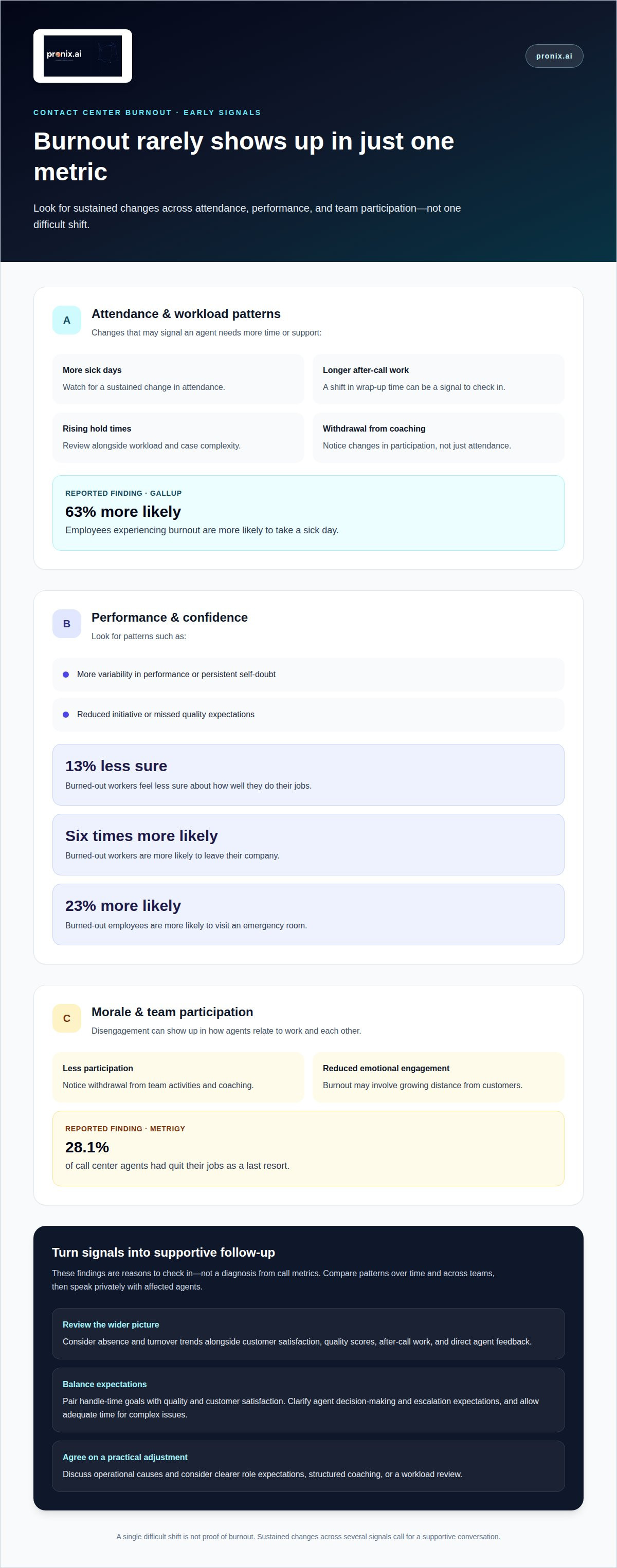
Track changes across attendance, performance, and team participation rather than treating one difficult shift as proof of burnout. Longer after-call work, rising hold times, more sick days, and withdrawal from coaching can signal that agents need more time or support. Gallup reports that employees experiencing burnout are 63% more likely to take a sick day. Look for sustained changes and ask what is affecting the work.
Performance signs can include increased variability, persistent self-doubt, reduced initiative, or missed quality expectations. Burned-out workers feel 13% less sure about how well they do their jobs, and are six times more likely to leave their company. Health can also be affected: burned-out employees are 23% more likely to visit an emergency room. These signals call for supportive follow-up, not a diagnosis from call metrics.
Measure patterns with existing workforce data and confidential check-ins. Review absence and turnover trends alongside customer satisfaction, quality scores, after-call work, and agents’ direct feedback. A Metrigy study found that 28.1% of call center agents had quit their jobs as a last resort. Compare changes over time and across teams, then discuss workload or support privately with affected agents.
Leaders should balance handle-time goals with quality and customer satisfaction. Impossible targets and rigid scripts can prevent agents from resolving unusual cases. Clarify which decisions they can make independently and when escalation is expected. Set achievable goals, provide structured coaching, and allow adequate time for complex issues. These steps preserve accountability without removing agent judgment. Effective contact center agent burnout solutions connect expectations to day-to-day work.
A practical approach to contact center agent burnout solutions starts by identifying the pattern, discussing its operational causes, and agreeing on an adjustment, such as clearer role expectations or a workload review. Managers can use AI strategy for agent support to assess where technology may reduce friction, while keeping human coaching central.
3. What Is Customer Service Agent Burnout?
Burnout can develop through sustained emotional exhaustion, growing distance from customers, and a reduced sense of accomplishment. In a contact center, it may appear when an agent disengages from callers, struggles to feel effective, or treats each interaction as another task to clear. It reflects work-related strain, not an agent’s character or commitment.
Automation can reduce repetitive work by handling routine customer inquiries, ticket logging, and basic data entry. Contact center software can also bring relevant knowledge and process guidance into an agent’s workflow. For example, an automated process might log a standard request while the agent focuses on an unusual account issue. Removing repetitive steps can ease mental effort, but poorly designed automation can add friction instead.
Software and AI can reduce routine workload by handling predictable tasks and offering in-flow guidance. Agents can then focus more on complex conversations, where listening and judgment matter. Keep a clear handoff to a person when a request falls outside the automated process.
Depersonalization can appear as reduced empathy, less emotional engagement, and lower participation in team activities. Leaders can respond by coaching specific customer-service behaviors: listening without interruption, acknowledging the customer’s concern, and explaining the next step. This makes empathy a practical part of the work rather than an abstract performance expectation.
To find preventable sources of pressure, audit the top 10 reasons for customer escalations. Group cases by cause, such as unclear policies, missing information, or limited agent authority. Then update knowledge articles, decision paths, or escalation criteria where patterns point to avoidable obstacles.
A customer-focused organization gives agents the information and decision support to resolve issues, not just move contacts along. Review whether routine automation leaves agents with enough context to help customers and whether complex cases have a clear path to human escalation. These checks connect operational design with interaction quality and agents’ ability to do meaningful work.
4. Causes and progression of contact center agent burnout
Burnout often develops through accumulated work conditions, not one difficult call. High call volumes, complex customer issues, limited recovery time, and pressure to remain composed can lead to emotional exhaustion. An agent may first struggle to recover between demanding interactions, then feel less engaged with customers and less confident in their work.
Workload design can accelerate that progression. Salesforce research found that 77% of agents reported increased and more complex workloads compared with one year earlier. High utilization can leave agents with less time to recover between interactions and may contribute to burnout. When schedules leave little space between interactions, agents have fewer opportunities to reset, review information, or prepare for the next customer.
Technology can either relieve pressure or add to it. An agent switching among the CRM, ticketing system, knowledge base, scheduling tool, and chat window must repeatedly shift attention. In the illustrative scenario, finding an answer adds another 90 seconds to handle time. Remote work can make it harder to notice strain through informal conversations, so leaders need deliberate check-ins and clear escalation support.
Burnout is not inevitable. Map workload and customer escalation patterns, then identify whether the causes include process friction, staffing pressure, unclear authority, or difficult customer interactions. Review responses by issue type to find where better guidance, adjusted workflows, or automation could remove unnecessary effort. Track whether changes improve the agent experience without weakening customer support.
Prevention program costs depend on scope, such as staffing changes, training, technology, and manager support; pricing is provided after a quote request. Return on investment can be assessed through changes in retention, absenteeism, service quality, and the effort required to resolve customer issues, rather than assumed from implementation alone.
For organizations addressing workflow and technology causes together, plan an AI implementation strategy that targets the pressure points agents face.
Pronix.ai
pronix.ai helps organizations turn contact center challenges into structured AI and customer experience initiatives. When repetitive workflows create avoidable effort, AI Business Automation and Agentic AI Implementation can help redesign how those processes are handled. For broader service changes, AI-Driven CX Modernization can align technology with the experience agents and customers need.
The right starting point depends on the operational issue. If agents struggle to find reliable information across systems, Data & AI Foundations can support the underlying data and knowledge architecture. If escalation patterns, workflow friction, or service design need closer attention, a focused strategy can clarify where AI fits and where human judgment remains essential.
Bring your contact center priorities and workflow challenges to pronix.ai to discuss a practical next step.
Turn agent support into an operational priority
Make the agent experience part of how the contact center is designed and managed, rather than a separate initiative triggered only by visible strain. Effective contact center agent burnout solutions connect workforce feedback to decisions about workflows, technology, and customer experience. Assign clear ownership, review whether changes reduce friction, and keep human support central when interactions require judgment.
When the next step involves redesigning service workflows, pronix.ai offers AI-Driven CX Modernization and AI Business Automation. Agentic AI Implementation can support organizations moving from strategy to practical deployment. These services fit when operational change and AI need to work together around agent and customer needs.
Contact pronix.ai about agent support to discuss the challenges your contact center is ready to address. A deliberate, people-centered approach can create a stronger foundation for agents and the customers they serve.
Frequently Asked Questions
What is call center burnout?
Call center burnout is work-related strain that can leave an agent emotionally depleted, detached from customers, and less confident in their contribution. It is more than a tiring shift: the concern is a persistent pattern that affects how someone feels and functions at work. For example, an agent who once volunteered to help peers may increasingly avoid team conversations and feel drained before customer interactions begin.
How Do AI Chatbots Help Prevent Agent Burnout?
AI chatbots can handle suitable, repeatable customer requests, such as explaining a standard process or collecting information before a handoff. This can reduce the number of routine interactions agents manage, leaving more attention for cases requiring judgment or empathy. Good design makes the handoff clear, gives the agent the conversation context, and avoids making customers repeat details when a person takes over.
What AI tools are designed to improve agent experience in contact centers?
Agent-assist tools can surface guidance during conversations, while automated summaries can reduce manual after-call documentation. Workflow automation can also handle routine data entry or ticket steps. For example, an agent managing a disputed charge could receive relevant process guidance while an automated summary captures the interaction. The value depends on whether the tools fit existing work and provide useful context without adding steps.
What Is Customer Service Agent Burnout?
Customer service agent burnout is sustained work-related exhaustion that can weaken engagement with customers and reduce an agent’s sense of effectiveness. It can affect how someone approaches routine interactions, responds to emotionally demanding conversations, and participates in team life. Treat it as a reason to examine workplace conditions and support, not as evidence that an individual lacks empathy or professional ability.
What are the main causes of contact center agent burnout?
Common causes include sustained high contact volumes, emotionally demanding complaints, limited recovery time, and systems that make information difficult to find. Pressure to finish quickly can intensify strain when a customer’s issue needs careful investigation. For instance, an agent may face a complex account problem while switching between disconnected tools. Addressing workload and process friction matters more than asking agents simply to work faster.
What are the signs and symptoms of burnout in call center agents?
Possible signs include persistent exhaustion, growing detachment from customers, reduced initiative, and a weakening sense of accomplishment. At work, someone might stop contributing to team discussions, struggle to engage in development, or show a sustained change in performance. These observations do not establish a diagnosis. Managers can respond privately, describe the specific change they noticed, and ask what support or work adjustment could help.