

Claims automation should move evidence faster without removing accountability. For insurers, automating insurance claims processing with AI is most useful when it reduces routine handling while keeping consequential decisions explainable and reviewable.
Manual intake, document handling, and fragmented data can delay a claim before an adjuster has the information needed to act. Legacy systems add integration challenges, and efficiency gains still need to protect customer trust and preserve effective oversight. The goal is not to automate every step. It is to identify where AI can support the workflow and where people must retain control.
This guide explains which claims tasks are suitable for automation and how to compare AI approaches based on workflow, data, and control requirements. It also lays out a governed path from selecting a use case to putting it into production, including system integration, operational measurement, and human review for higher-impact decisions.
pronix.ai brings together enterprise AI strategy, implementation, and managed services to help organizations connect workflow design and integration with secure, auditable production environments.
Key Takeaways
- Identify claims tasks where AI can reduce manual handling, from intake and document review to routing and customer communication.
- Match document AI, language models, rules, and workflow orchestration to each task’s data needs, variability, and oversight requirements.
- Use automating insurance claims processing with AI to speed up evidence-heavy work while keeping consequential decisions governed and reviewable.
- Define controls for task scope, output validation, exception routing, and ongoing performance monitoring.
- Plan the path from pilot to production by addressing data readiness, legacy-system integration, security, ownership, and change management.
Where AI Can Improve Insurance Claims Processing
AI can support specific points in the claims journey, from capturing information at first notice of loss to organizing evidence and preparing customer communications. The goal is to reduce repetitive handling and make relevant information easier to find, while keeping decisions and exceptions visible to claims professionals. A basic understanding of Artificial Intelligence helps distinguish the technology’s capabilities from the workflow controls needed to use it responsibly.
AI-assisted claims processing uses AI to classify, extract, summarize, route, or draft information within a claims workflow. It does not, by itself, mean a system autonomously adjudicates a claim. That distinction matters when automating insurance claims processing with AI. Task assistance can speed up evidence handling without transferring accountability for consequential outcomes to an automated system.
A typical journey starts with the first notice of loss, then moves through intake, evidence collection, coverage and damage review, assessment, settlement or another resolution, and closure. Steps vary by claim type, but each handoff can reveal administrative work suitable for automation and decision points that require professional judgment.
Which stages of a claim are candidates for automation?
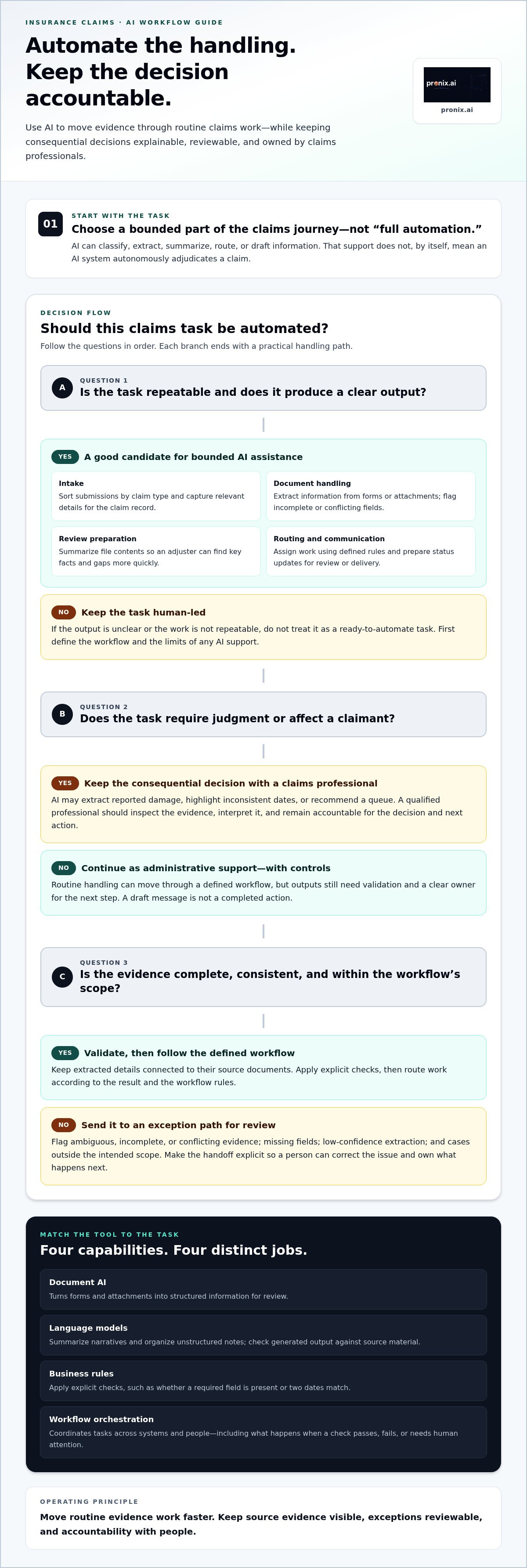
Start with repeatable tasks that produce clear outputs. At intake, AI can classify incoming messages and documents, identify key fields, and direct a file to the appropriate queue. During evidence collection, it can check whether expected documents appear to be present, flag missing information, and organize extracted details for review.
- Intake: Sort submissions by claim type and capture relevant details for the claim record.
- Document handling: Extract information from forms or attachments and flag incomplete or conflicting fields.
- Review preparation: Summarize file contents so an adjuster can locate key facts and gaps more quickly.
- Routing and communication: Assign work using defined workflow rules and prepare status updates for review or delivery.
Summaries should point back to the underlying evidence, not replace it. For example, automation can draft a message requesting additional documentation. Make clear who reviews or sends the message and who owns the next step. These controls help teams manage follow-up and prevent a draft from being mistaken for a completed action.
What should remain visible to claims professionals?
Administrative actions and recommendations are different from decisions that affect a claimant. A system might extract reported damage, highlight inconsistent dates, or recommend a queue. A qualified claims professional should be able to inspect the evidence and remain accountable for decisions about how to interpret it and what action to take.
Define a review path for ambiguous, incomplete, or conflicting evidence, and for cases outside the workflow’s intended scope. Make the handoff explicit: show what the system did, what information it used, what it flagged, and who owns the next step. This lets teams correct errors, resolve exceptions, and record human review instead of allowing an automated recommendation to become an unexplained outcome.
How AI Technologies Automate Claims Tasks
Claims automation combines technologies with distinct roles. Document AI reads submitted evidence, language models organize unstructured information, business rules apply explicit checks, and workflow orchestration moves work between systems and people. Document AI captures evidence, language models summarize it, rules validate defined conditions, and orchestration coordinates the next action. Matching each capability to a bounded task is more reliable than treating AI as one general-purpose solution.
Document AI, OCR, and information extraction
Optical character recognition (OCR) converts scanned forms and supporting documents into machine-readable text. Document AI can identify fields, entities, and relevant evidence, such as dates, amounts, or descriptions, and structure them for review. Keep a connection to the source document so claims professionals can verify how an extracted value was presented.
Consider a repair estimate uploaded to a property claim. The system ingests the file, applies OCR if it is a scan, extracts the estimate date and line items, and checks required fields and formats. If information conflicts with another record, a field is missing, or extraction confidence is low, the workflow flags the issue for correction. Uncertain output should not be treated as verified fact.
Language models, rules, and workflow orchestration
Language models can summarize a claimant’s narrative, group related details, or organize unstructured notes for review. Their output is probabilistic, so even a fluent summary needs to be checked against the source material. Use the model to help a professional navigate information, not to present generated wording as proof or a definitive interpretation.
Rules serve a different purpose. They apply explicit, repeatable logic, such as checking whether a required field is present or two dates match. Workflow orchestration coordinates the sequence across claims platforms, document services, tasks, approvals, and exception queues. It determines what happens when a check passes, fails, or needs human attention.
- Document AI: Turn forms and attachments into structured information.
- Language models: Summarize narratives and organize unstructured content for review.
- Rules: Apply defined validations consistently.
- Orchestration: Route results, approvals, and exceptions through the workflow.
Output quality depends on source data, task boundaries, and validation. Poor scans, inconsistent formats, or missing context can undermine extraction and summaries. Keep outputs traceable to source evidence and make correction paths clear. The National Association of Insurance Commissioners’ AI resources provide industry context for considering AI use in insurance operations.
For enterprise teams, the practical challenge is connecting these capabilities to existing workflows with appropriate controls. pronix.ai’s enterprise AI implementation connects strategy, workflow design, and integration for governed production environments.
How to Compare AI Approaches for Claims Automation
Choose the method based on the task, not the label. A structured completeness check differs from interpreting a variable narrative or coordinating multiple handoffs. When automating insurance claims processing with AI, compare approaches using the same criteria: the data each needs, how much variation it can handle, how explainable its output is, and what human oversight the task requires.
Which approach fits structured versus unstructured claims work?
Rules suit stable checks with explicit conditions, such as confirming that required fields are present. Machine learning can classify or predict when representative data supports the task and outputs can be tested. Language models can assist with variable text, such as organizing a claimant narrative, but their results need validation against context and source material. No method is right for every task.
- Rules-based automation: Needs defined inputs and conditions, making it a fit for low-variability checks. Its logic is explicit and straightforward to inspect. Oversight focuses on maintaining rules and handling exceptions.
- Machine learning: Needs relevant, sufficiently reliable examples for the intended classification or prediction task. It can handle patterns that are harder to express as fixed rules, but performance and explainability depend on the model and use case. Set review thresholds and monitor errors.
- Generative AI: Can work with varied text and support summarization or information organization. It needs clear task boundaries and source-grounded validation because generated wording can be inaccurate. Match the level of review to the potential impact of the output.
- Agentic workflows: Can coordinate bounded, multi-step tasks across systems and approvals. They require clear permissions, checkpoints, and exception routes. Oversight must cover both individual actions and the overall workflow.
This comparison is a starting point, not a ranking. Consider input consistency, the cost of an error, whether the output can be checked, and what happens when the system is uncertain. A predictable administrative task may need only a rule and a clear exception path. A variable evidence task may benefit from AI assistance, but a person should still verify its findings before they inform a consequential action.
When does workflow orchestration or an AI agent make sense?
Orchestration is useful when a process needs to move work through defined steps, systems, and human approvals. An AI agent may fit a task that requires controlled coordination across several steps rather than one isolated action. Because it adds operational complexity, use an agent when the workflow benefit justifies the control, monitoring, and exception-handling effort.
Before expanding autonomy, map the task sequence and identify where the process can pause for approval. Define permitted actions, the evidence that supports them, and the conditions that route work to a person. If a simpler rules-based flow achieves the same operational aim, added agentic capability may not justify the additional governance.
How to Govern and Measure AI Claims Automation
Inaccurate or inappropriate output is a serious concern when automation touches a claim. A misread document, unsupported summary, or misplaced alert can create rework or influence later actions. Governance should define what the system may do, how its outputs are checked, and who is accountable when a case needs judgment. Speed matters only when quality and customer impact remain visible.
Use a control sequence for each use case before expanding it:
- Define scope. Specify the task, permitted inputs and outputs, prohibited actions, and decisions that remain with claims professionals.
- Validate before release. Test representative claim scenarios, including incomplete, ambiguous, and conflicting evidence. Assess accuracy and whether performance differs across relevant claim types or groups.
- Review exceptions. Set thresholds for uncertainty and error, then route flagged cases to a named role with authority to resolve them.
- Monitor in operation. Retain traceable records of source information, system actions, output changes, approvals, and human interventions.
- Improve controls. Use observed errors, feedback, and workflow outcomes to revise task boundaries, validation, and escalation rules.
What safeguards support responsible claims automation?
Make access and authority explicit. Limit systems to the information and actions needed for their assigned task, and define which outputs require approval before they affect a claim workflow. Preserve links between generated or extracted information and its source so reviewers can verify it. Assign ownership for escalations; an exception queue without a responsible decision-maker is another place for work to stall.
Test real variation, not just clean examples. Include different document formats, missing fields, unusual narratives, and cases where records disagree. Track corrections and examine whether errors cluster in particular claim scenarios. Legal and regulatory obligations depend on the insurer, jurisdiction, and use case, so include appropriate legal and compliance review rather than assuming one control applies everywhere.
How should insurers evaluate operational performance?
Set a baseline before deployment. Compare equivalent workflow cohorts, accounting for differences in claim type, complexity, and intake channel. A faster average can hide more corrections or escalations, so pair efficiency measures with quality and customer outcomes. Review the measures together rather than treating them as isolated success metrics.
- Cycle time: Track elapsed time through the automated step and the wider claim workflow.
- Rework and quality: Measure corrected outputs, reopened tasks, and errors found in review.
- Routing accuracy and exceptions: Check whether cases reach the right queue and how often staff must intervene.
- Customer impact: Assess whether communication is clear and whether the process creates avoidable follow-up or delay.
Assign owners and review intervals for each measure. If routing accuracy declines or rework rises, investigate the data, task definition, and workflow controls before increasing automation. pronix.ai’s governed AI implementation connects measurement, workflow design, and ongoing management in a controlled production program.
Move from Claims AI Pilot to Governed Production
A pilot shows whether a use case can work under limited conditions. Production readiness requires reliable data, integration with core claims systems, clear ownership, security controls, and a plan for operating the workflow over time. A disciplined path helps insurers scale claims automation without treating a successful demonstration as proof that a workflow is ready for broader use.
Build a production path around one bounded claims use case
Start with a specific workflow rather than an enterprise-wide automation target. Assess its business value, process stability, data readiness, and risk. Document completeness checks, for example, may be a more manageable first use case than automating a complex decision. Define the baseline, target measures, accountable owner, escalation rules, and acceptance criteria before testing begins.
Then progress in controlled stages:
- Discover the workflow. Map inputs, handoffs, systems, exceptions, and current sources of delay or rework.
- Prepare the data and controls. Check whether source information is accessible, consistent, appropriately protected, and suitable for the task.
- Test representative cases. Include routine files and challenging cases, such as missing or conflicting information. Compare results with the agreed acceptance criteria.
- Release with safeguards. Limit the initial scope, retain human approval where required, and provide a clear route to pause or escalate work.
- Expand based on evidence. Review performance and operational feedback before widening the workflow or increasing automation.
Make progression an explicit decision. If quality, integration, or team readiness falls short, refine the use case before expanding it.
Integrate, operate, and improve the workflow
Production design must account for connections to claims platforms, document repositories, and relevant data foundations. Map how information enters and leaves each system, how exceptions return to staff, and how actions are recorded. Build security, access, and data handling into the integration rather than adding them after a pilot has shaped the process.
Assign owners for workflow performance, system access, incident response, changes, and ongoing evaluation. Claims professionals need to understand what the automation does, how to check its output, and how to handle exceptions. Operational teams also need a controlled process for updating rules, prompts, integrations, or models so changes do not undermine previously tested behavior.
For a broader view of release controls and operational readiness, apply the practices in this enterprise AI production guide. Strong data foundations also matter; an enterprise AI data strategy can connect readiness, access, and governance to the production use case.
pronix.ai connects enterprise AI strategy, implementation, and managed services to help organizations move from workflow design and integration to governed production and ongoing management. Explore pronix.ai enterprise AI implementation to plan a controlled path from claims AI pilot to production.
Set the Next Claims Workflow in Motion
Choose a production boundary your organization can own. Identify the workflow decision-maker, the teams responsible for data and operations, and the evidence they need to approve expansion. This turns claims automation into a deliberate operating capability, with a clear path for learning and change.
That path must fit the systems already supporting your claims operation. Pronix.ai brings enterprise platform experience across AWS, Microsoft, Salesforce, Kore.ai, and Genesys to implementation work shaped around organizational requirements. The focus is connecting AI capabilities to real workflows with governance and measurable business value in view.
Start with a defined use case and a production plan grounded in your workflow, data, and oversight requirements. Discuss a governed enterprise AI implementation with Pronix.ai to plan your next step.
Frequently Asked Questions
Can AI automate insurance claims processing end to end?
AI can automate selected stages, but end-to-end processing is not a single switch. For a straightforward claim, a workflow might capture submitted information, organize supporting files, and prepare the case for review. Whether it proceeds further depends on claim type, evidence, system integration, and control design. Treat AI claims automation as a set of scoped capabilities, with clear boundaries around automated actions and accountable human decisions.
How does AI process insurance claims?
An AI-enabled workflow can turn a submission into organized information that a claims team can act on. For example, it may associate an uploaded receipt with the correct claim record, identify the document type, and flag a missing date for follow-up. The insurer’s workflow determines the next step. Make sure staff can correct misfiled items and that changes are reflected in the claim record.
What types of AI are used in claims processing?
Claims workflows can combine OCR, document AI, machine learning, language models, business rules, and workflow orchestration. The right combination depends on the task. OCR can read a scanned form, while classification can identify its document type. A language model may help organize a long narrative, and explicit rules can check a required field. Keep each component’s role clear so teams know what to test and where errors may arise.
Is AI accurate enough to assess insurance claims?
Accuracy must be established for the specific task, not assumed across claims processing. A document classifier’s results do not demonstrate that a model can interpret damage evidence or support another assessment. Test representative cases and review both missed issues and incorrect flags. For example, measure whether required attachments are identified consistently, then examine cases the system marked complete that staff later found incomplete. Set review requirements based on the output’s impact.
What are the risks of automating insurance claims with AI?
Risks include incorrect or incomplete information, inconsistent outputs, exposure of sensitive data, and workflow disruption if systems do not share information reliably. Define a fallback: specify when processing pauses, which role receives the case, and how staff can correct the record. Limit system access to what the assigned task requires. Monitor not only model outputs, but also whether automation creates extra handoffs or unresolved work.
How should an insurer choose an AI approach for claims processing?
Document the task’s inputs, expected output, and consequence of error. A stable check with explicit conditions may suit rules, while varied text may call for language-model assistance with verification. Then compare approaches for data readiness, integration effort, output traceability, and exception handling. A short evaluation scorecard can help stakeholders from claims, technology, and risk teams agree on a bounded use case and its acceptance criteria.
What should insurers measure in an AI claims automation program?
Measure whether the workflow improves without shifting effort or harm elsewhere. Alongside cycle time, track staff corrections, routing errors, exceptions, and reopened work. Segment results by claim type or intake channel where those differences could affect interpretation. A quicker average, for example, may conceal poor performance on a less common document format. Compare results with a baseline and review customer-facing effects, such as repeated requests for information or avoidable status inquiries.
How long does it take to implement AI for claims processing?
Implementation time varies with the use case, data condition, integration scope, governance needs, and readiness of the teams operating the workflow. A document-triage pilot has different dependencies from a program spanning several claims systems. Plan around deliverables rather than assuming a fixed duration: workflow discovery, data preparation, integration, testing, controlled release, and operational review. Expand only when evidence shows the workflow meets its acceptance criteria and can be supported in production.