

Self-service succeeds when it resolves the customer’s issue, not merely when it contains a chatbot. Conversational AI for customer self-service can interpret requests, draw on approved knowledge, and respond in context. Static FAQs and scripted bots, by contrast, depend on fixed answers or paths. The AI is only as useful as the information, system connections, and escalation design behind it.
Customers often turn to self-service first, so answers need to reflect current products and policies, recognize uncertainty, and pass useful context to a person when needed. This article explains how conversational AI works in customer service, how it differs from FAQs and scripted bots, and what knowledge foundations support reliable responses. It also covers contact center workflows, governance, and human handoffs, helping you assess what a dependable self-service implementation requires.
Key Takeaways
- Effective self-service depends on resolving customer needs, not simply adding a chatbot to existing support channels.
- Understand where AI can respond flexibly and where FAQs or scripted bots provide a better fit.
- Assess knowledge quality and system connections as core factors in delivering relevant, dependable answers.
- Consider how escalation, conversation history, and ongoing service management can support a smoother contact center experience.
Table of Contents
How has the perception of customer self-service tools changed over the last few years?
Conversational AI interprets requests, retrieves relevant knowledge, answers routine questions, and routes unresolved cases with context. Implementation involves mapping common intents, connecting approved content, and defining escalation paths. Your team also needs to prepare current policies, product details, and customer feedback.
Automating Common Support Requests
Conversational AI uses natural-language intelligence to respond to common questions and complete repetitive support tasks. That matters when customers need quick answers about order status, account access, or return policies. A system can identify the intent, retrieve the relevant guidance, and explain the next step. Clear boundaries keep unusual or sensitive requests from being treated like routine enquiries.
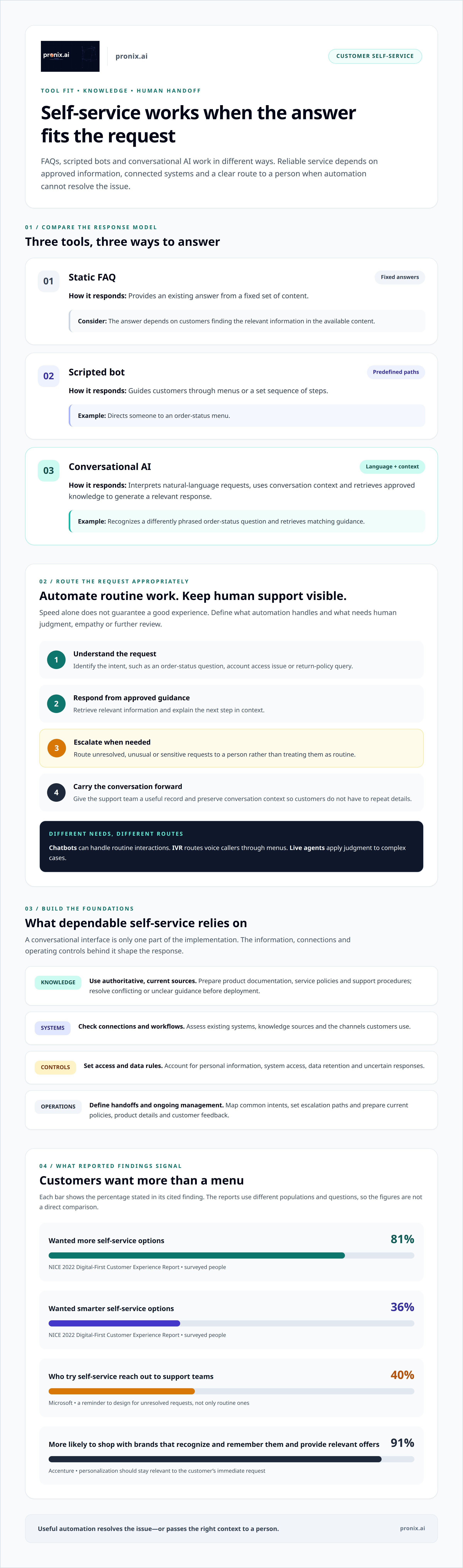
Automation should reduce effort without hiding the route to customer support. Microsoft reported that 40% of customers who try self-service reach out to support teams. That makes unresolved requests a key design case, not an exception. A well-defined handoff gives the center a useful record of the issue, so customers don’t have to repeat details when a human takes over.
Balancing Automation With Human Service
A balanced service model automates repeatable questions while reserving situations that need judgment or empathy for human support. Speed alone does not guarantee a good experience. An AI assistant might explain a standard account process, then route a disputed charge to a representative. Escalation works best when it is clear and the customer’s language and conversation context carry forward.
Expectations also show why self-service needs to feel useful, not merely available. In NICE’s 2022 Digital-First Customer Experience Report, 81% of surveyed people wanted more self-service options, while 36% wanted smarter options. These findings point to a practical distinction: customers value automation when it understands their request and delivers a relevant answer, rather than forcing them through a fixed menu.
Personalization can support service and relevant offers, but it must fit the customer’s immediate need. Accenture reports that 91% of consumers are more likely to shop with brands that recognize and remember them and provide relevant offers and recommendations. A provider can design optional recommendations around the conversation, while keeping the primary support task clear. That balance lets automation handle repetitive work without making every exchange feel like a sales pitch.
AI chatbots versus static scripted bots
Static FAQs provide fixed answers, while scripted bots guide customers through predefined menus. Conversational AI interprets natural-language queries, uses conversation context, and generates responses from approved knowledge. That makes it more adaptable, provided its information and boundaries are well managed. A scripted bot might direct someone to an order-status menu; conversational AI can recognize a differently phrased request and retrieve the matching guidance.
Conversational AI isn’t a single platform, and no option is best for every contact center. Providers evaluate fit across existing systems, messaging channels, knowledge sources, access controls, and human handoff. AWS, Microsoft, Salesforce, Kore.ai, and Genesys are examples of platforms used in enterprise customer experience environments. An implementation partner can assess how each option supports the required workflows, integrations, and operating controls before recommending an approach.
Across web chat and messaging channels, chatbots can support product discovery as well as service queries. For example, a shopping assistant might clarify a customer’s stated preferences, explain relevant product options, then answer a delivery question in the same interaction. Personalized recommendations should remain tied to the customer’s request. Accenture reports that 91% of consumers are more likely to shop with brands that recognize and remember them and provide relevant offers and recommendations.
Revenue and conversion depend on relevance, not simply inserting offers into automated responses. A useful chatbot can answer a product question, clarify an option, and present a related item when it fits the conversation. Enterprise implementation scope depends on integrations, channel coverage, knowledge preparation, security controls, and ongoing management. A generic software subscription price does not capture those professional services and operational requirements.
Chatbots handle routine interactions at scale, IVR routes voice callers through menus, and live agents apply judgment to complex cases. U.S. deployments also need controls for personal information, system access, data retention, and escalation when a response is uncertain. Providers can assess those risks alongside channel and platform requirements through enterprise AI implementation planning.
Knowledge quality and data readiness
Self-service answers are only as reliable as the knowledge behind them. To support accurate resolution, assess source quality and ownership, and how the system will retrieve approved information.
Generative AI and Knowledge Bases
Generative AI can draw on a company knowledge base to produce responses grounded in approved content, rather than relying only on fixed scripts. For example, an assistant can retrieve a policy passage and explain it in conversational language. Organizing content so that both automated systems and employees can find the same guidance helps reduce conflicting answers across service channels.
Start by identifying authoritative sources, such as current product documentation, service policies, and support procedures. Then assess whether the content is clear, current, and suitable for retrieval. If two documents describe different return conditions, the system may surface inconsistent guidance. Resolve conflicts before deployment so customers receive useful answers grounded in current, unambiguous material.
Maintaining FAQs and Knowledge Bases
Knowledge maintenance means updating source material as products, services, and customer feedback change. An answer that was accurate before a policy update could mislead customers afterward. Assign ownership for reviewing content, revising affected articles, and checking that automated responses still reflect approved wording. For example, a revised delivery policy should be reflected in both its knowledge-base entry and related FAQ answers.
FAQs and knowledge bases serve different but connected purposes. An FAQ provides concise answers to common questions, while a knowledge base can organize deeper guidance for varied issues. A question about changing an account detail might map to both a detailed article and a shorter FAQ response. This structure helps customers resolve straightforward requests and gives human agents consistent material for more complex cases.
Customer feedback and unresolved interactions can reveal missing or confusing information. Review these signals to identify recurring knowledge gaps and update the relevant source content. If customers repeatedly ask what a warranty covers, for example, the underlying article may need clearer scope and examples. This ongoing review keeps the knowledge base useful as customer needs and business information evolve.
Contact center self-service innovations
Contact center innovation is not just adding a chat window. The 2010 support toolkit included searchable FAQs, scripted chatbots, knowledge bases, and ticketing systems. Modern platforms can integrate these capabilities across voice and digital channels. Customers can then continue a task when they move from self-service to live assistance, rather than repeating the same information at each step.
Portal use and AI automation point to different parts of the opportunity. Gartner reports that 70% of customers use customer self-service portals to resolve issues. IBM estimates AI can handle more than 80% of customer service inquiries. These figures describe distinct capabilities, not a guarantee that every issue can be automated. A contact center should match each query to an appropriate self-service path or human route.
Voice automation can extend self-service beyond messaging. Automatic speech recognition can process a caller’s spoken request before routing the call to an agent. A customer might state a delivery question and receive an automated response, or move to a representative if the issue needs attention. Across channels, conversation-history visibility helps preserve context when someone starts in chat and then calls.
Unified support connects platform capabilities around the customer’s issue, not internal channel boundaries. Stanley Black & Decker’s self-service case study reported customer satisfaction rising from 85 percent to 90 percent after a unified support approach. For brands, the operational lesson is to integrate customer history, reliable knowledge, and escalation. Clear boundaries, privacy protection, monitoring, and human handoffs also support accountable service.
Ongoing operations matter after launch. Contact center teams need to monitor answer quality, review unresolved interactions, update knowledge, and adjust routing as customer needs change. An enterprise AI managed services approach can support that operational discipline across connected service workflows. If you’re planning to integrate these capabilities, discuss contact center AI implementation and align the platform, data, and support model before scaling.
Pronix.ai: Enterprise AI Managed Services
pronix.ai helps enterprises move customer self-service from design into managed operations through Enterprise AI Managed Services. Turn to this support when an AI experience is live or planned, but knowledge updates, monitoring, escalation, and platform integration need sustained ownership.
pronix.ai's AI-Driven CX Modernization aligns self-service with contact center workflows. Agentic AI Implementation and AI Business Automation can support connected workflows where autonomous actions fit the business process. The work defines which requests automation can resolve, when human agents should take over, and how governance stays in place as content and customer needs change.
If you’re planning the next step for customer self-service, contact pronix.ai to discuss your requirements.
Make the Next Move an Operational One
The next decision is not whether to add another interface. It is how conversational AI for customer self-service will fit into your service operating model as customer needs, policies, and systems change. Treat deployment as an ongoing capability: assign ownership for answer quality, define which decisions automation can make, and set a clear route for requests that need human judgment.
Connect customer experience goals with meaningful service signals. Teams can review unresolved conversations, recurring knowledge gaps, and handoff quality, then use those findings to refine workflows. This keeps the program grounded in actual customer needs instead of treating launch as the finish line. As the model matures, expand only where information, governance, and escalation are ready. That clarity helps leaders decide what to improve, who owns changes, and how feedback informs future releases.
For a practical discussion about your priorities and implementation path, contact pronix.ai to discuss your needs. A focused conversation can help shape a clear, manageable next step.