
BPO AI Automation Benchmarks — 2026
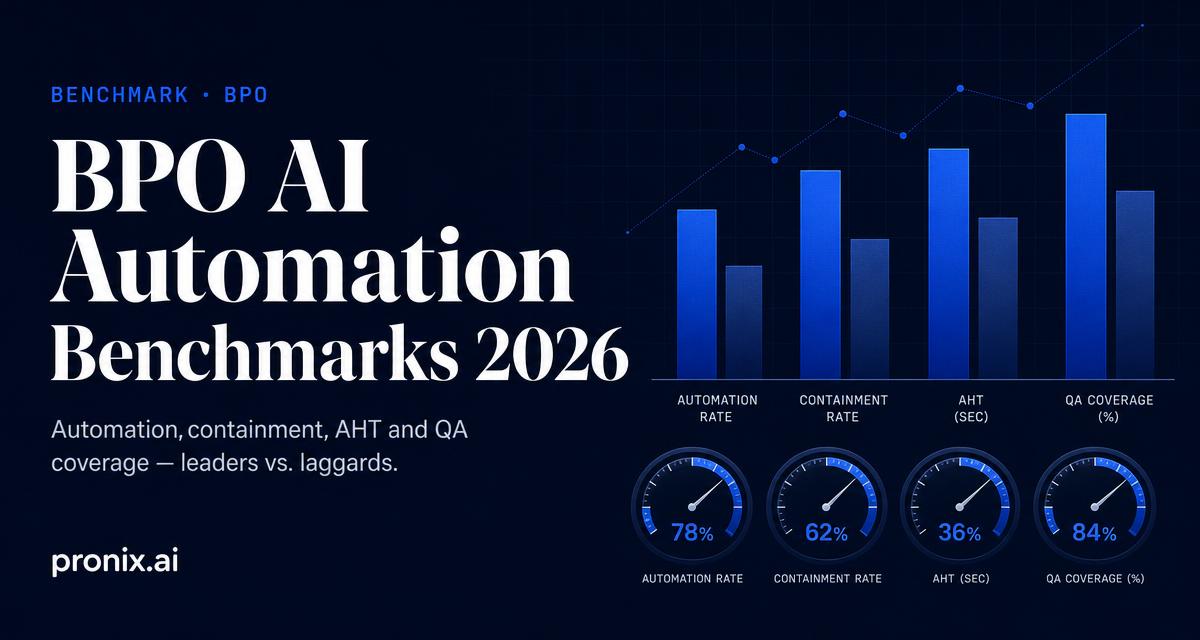
Deflection, AHT, QA coverage and margin benchmarks for AI programs across enterprise BPOs. Voice AI, agent assist, automated QA and WFM AI — with peer bands segmented by seat count, geography and LOB mix.
Jump to section(5)
What you'll learn
- Deflection and AHT deltas with voice AI and agent assist
- Automated QA — coverage bands and calibration effort
- WFM AI — forecast accuracy and schedule-adherence lift
- Seat-count reduction vs revenue-per-seat expansion — the real BPO tradeoff
- Commercial models — outcome-based, gain-share, per-transaction
The full read
BPO providers are AI's most demanding buyer. Margins are thin, contracts are ruthlessly measurable, and clients expect the savings before renewal. This benchmark covers 150+ BPO delivery centers and shows where AI automation is producing real margin, where it is producing marketing, and where the two get confused.
Automated QA is the highest-margin BPO workload
Moving from 2% to 5% sampled human QA to 100% automated scoring reliably cuts QA delivery cost by 40% to 60%. The margin flows directly to the delivery center.
The catch is calibration discipline. Programs without a weekly calibration loop see scoring drift within three to six months.
Agent assist is a client-facing sale, not a margin lever
Agent assist reduces AHT, but the savings usually flow to the client per the contract. The BPO's margin gain is in AHT-linked bonuses and renewal pricing.
Structure the contract around the outcome before you deploy the technology.
Multi-tenant patterns matter
The BPO estates moving fastest built AI as a shared platform with per-client isolation, not as a per-client stack. One control plane, tenant-tagged data, per-client rubric overlays.
The single-tenant estates are absorbing the operational cost of running dozens of parallel deployments.
Talent economics are shifting
The AI-enabled agent is now the standard. Career paths, coaching cadence and hiring profiles are being rewritten around it.
The BPOs winning talent are the ones offering explicit AI-fluency progression, not the ones offering the highest base pay.
Where clients push back
Clients increasingly want AI savings surfaced explicitly in the contract. Bundling AI gains into the base rate is becoming untenable at renewal.
Move to a transparent AI-savings-sharing model before the client asks for one.
The BPO winners of 2027 will not be the ones with the most AI. They will be the ones with the clearest AI economics — priced, contracted and reported so the client can see them.
Questions enterprise readers ask
Does the report cover outcome-based and gain-share commercial models?
Yes — a dedicated section maps AI-enabled programs to outcome-based, gain-share and per-transaction contracts with observed margin bands.
How does voice AI containment vary by intent complexity?
Simple informational intents contain at 78–86%; transactional intents 52–64%; complex empathy-heavy intents 22–35%. Full bands by industry and language are in the voice AI chapter.
What agent-assist AHT deltas are typical?
Median AHT reduction is 12% and top-quartile is 17%. Ramp-time for new hires drops 34% in top-quartile deployments through in-line coaching and retrieval.
Does automated QA replace human QA analysts?
No — the observed pattern is 100% AI coverage plus focused human calibration on ~5% of interactions, freeing QA analysts to coach agents rather than score calls.
Continue with
Enterprise Shared Services AI Benchmarks — 2026
Cost-per-transaction, straight-through-processing and exception benchmarks for AI inside enterprise shared services and GBS centers — financ…
Read benchmark report: Enterprise Shared Services AI Benchmarks — 2026 →Contact Center AI Benchmarks by Industry — 2026
Containment, AHT, CSAT-proxy and cost-per-contact benchmarks for AI-enabled contact centers, segmented by BFSI, insurance, healthcare, retai…
Read benchmark report: Contact Center AI Benchmarks by Industry — 2026 →The AI Operating Model: Org Design for Scale
How top-quartile enterprises structure AI CoEs, product teams and platform ops to move from pilots to portfolio. Roles, RACI, funding models…
Read executive brief: The AI Operating Model: Org Design for Scale →Compare the platforms behind these benchmarks.
Vendor-independent side-by-sides — pricing, AI, extensibility and best-fit customer for the platforms cited in this report.
- CCaaS head-to-head
Five9 vs Talkdesk
Enterprise-grade voice vs. Talkdesk's fast-deploy digital-first CCaaS.
Read the comparison → - CCaaS head-to-head
Amazon Connect vs Five9
AWS-native flexibility vs. Five9's packaged CCaaS depth for mid-market and enterprise.
Read the comparison → - Agent platforms
Microsoft Copilot Studio vs Kore.ai
M365-native low-code agents vs. Kore.ai's enterprise CX + IT agent platform.
Read the comparison →
Explore the rest of the library
- GuidesPillar guides by domain
- PlaybooksStep-by-step delivery plans
- Reference architecturesBlueprints for engineers
- InsightsPoint-of-view essays
- Case studiesEnterprise outcomes
- Platform comparisonsSide-by-side buyer guides
- DownloadsBrochure & capabilities deck
- BPO · AI · CX · CCaaS HubIndustry hub for BPO leaders
Want to apply this to your program?
Book a working session with a pronix.ai strategy lead — we'll walk through how the ideas in benchmark report apply to your platform, industry and roadmap.